Who Killed My Father by Édouard Louis – Young Vic, London
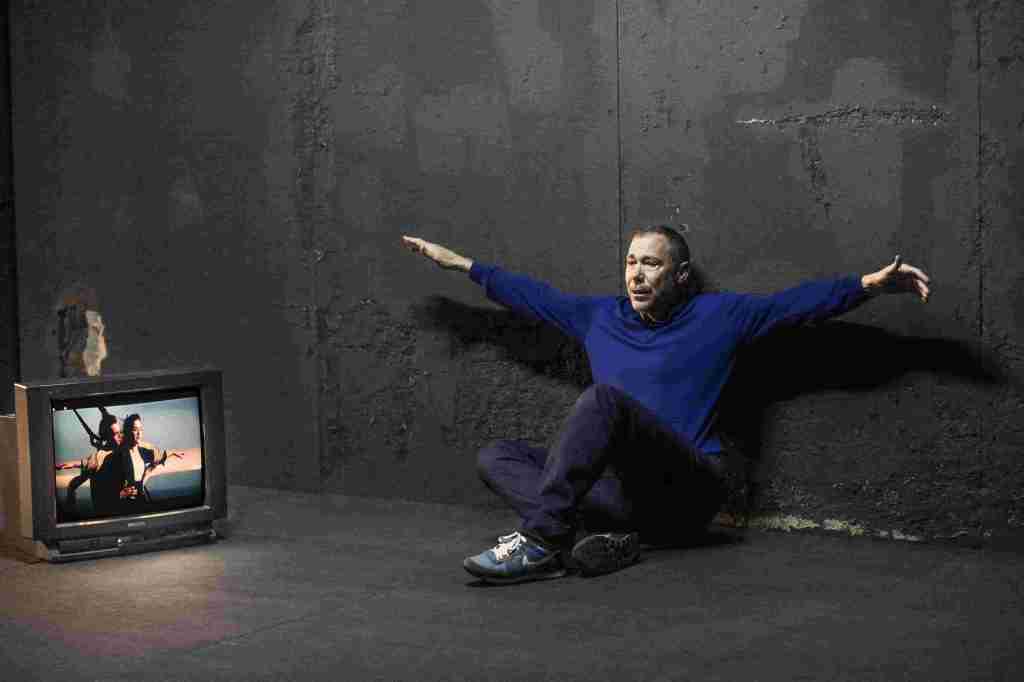
The set of Who Killed My Father looks like a prison cell – tv, bed with bare mattress, concrete walls. The only indication that it’s something else is the oxygen cylinder hanging on the wall. This grim room represents the home of Hans Kesting’s father, where he lives and suffers in poverty and poor health after a lifetime of physically destructive labour. The play, based on Édouard Louis’ novel, looks back on the harsh childhood of the narrator and sole character, unnamed, in industrial northern France. Growing up gay in a working class town with a father who believed men should be men was harsh, but Ivo van Hove’s spellbinding production digs much further than that. By confronting the truth of his father’s behaviour towards him head-on, Kesting exposes the system that condemned him to work until he was broken, the violence generated by society as much as him, and the demonisation of men like his father for political purposes. It also reveals, despite it all, love.
Kesting, performing unusually in English, is remarkable in the role. Physically he dominates the space, a large man like his father, but he is capable of transformation. One minute he is the bloated and hunched figure of his father, the next he becomes his light-footed teenaged self again. His story is told through his body as much as his words. A stand-out moments include Kesting breaking into a wild dance in a desperate attempt to impress his father The key scenes are perhaps repeated cigarette breaks when he stands in the doorway at the rear of the set, wreathed in smoke, hacking. Van Hove and Jans Versveyweld, responsible for scenography and lighting, use subtle but haunting visual ideas, including the floor level tv that floods the room with eerie light and the holes punched in the plaster by the father whose boast is that, unlike his own father, he would never hit his family. The personal story becomes political towards the end, when Kesting’s rage erupts and he directs his condemnations at French politicians of the past decade who have cut benefits and, as he sees it, abandoned the working class. This is the gilet jaune story too but, while the movement was a magnet for crackpots, Louis cuts to the heart of why people who have missed out feel abandoned. The production is a minor masterpiece.
 Tom Bolton