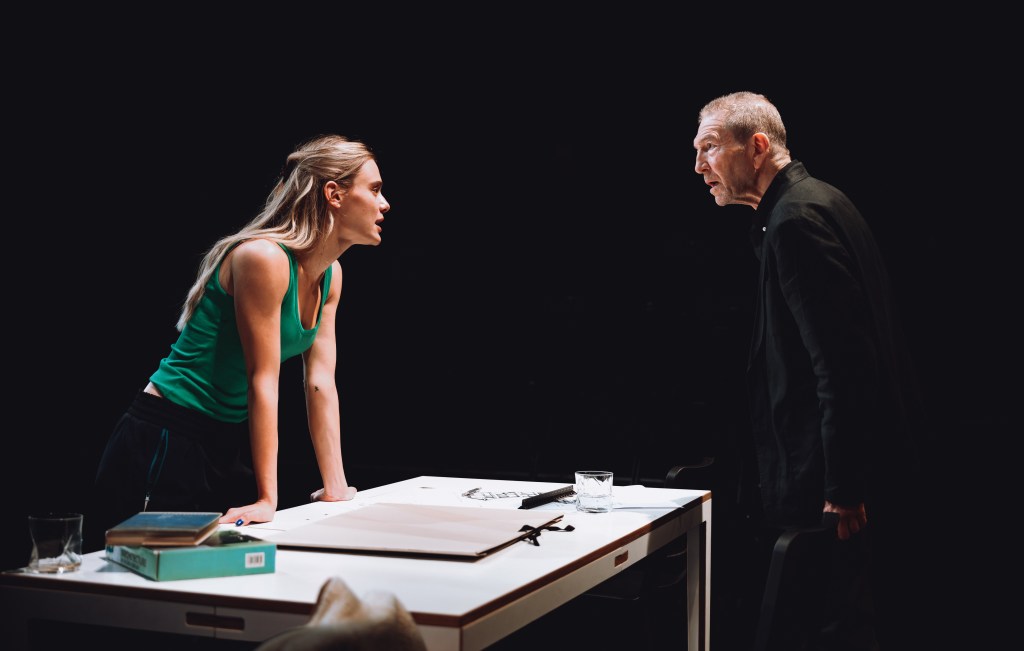
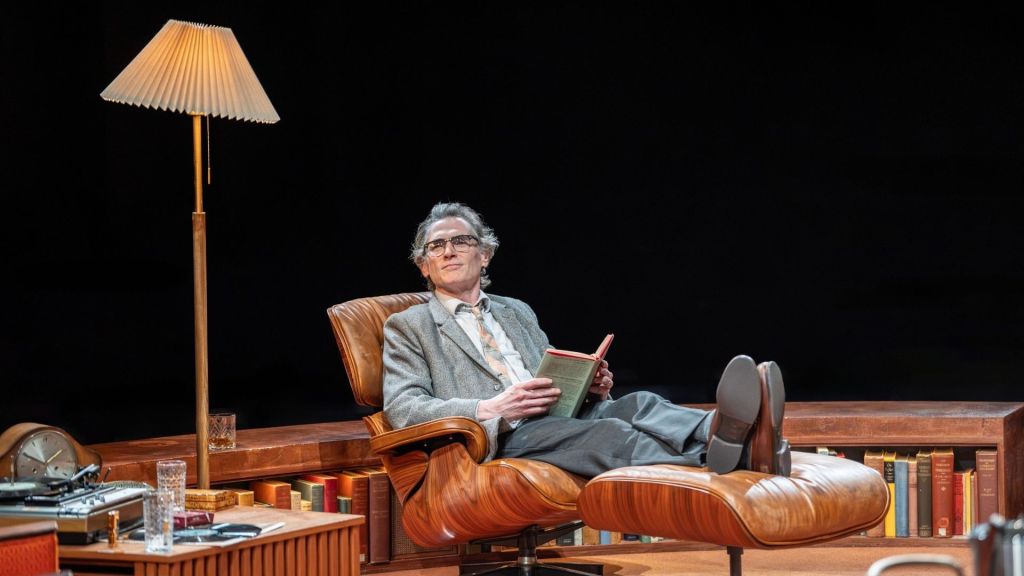
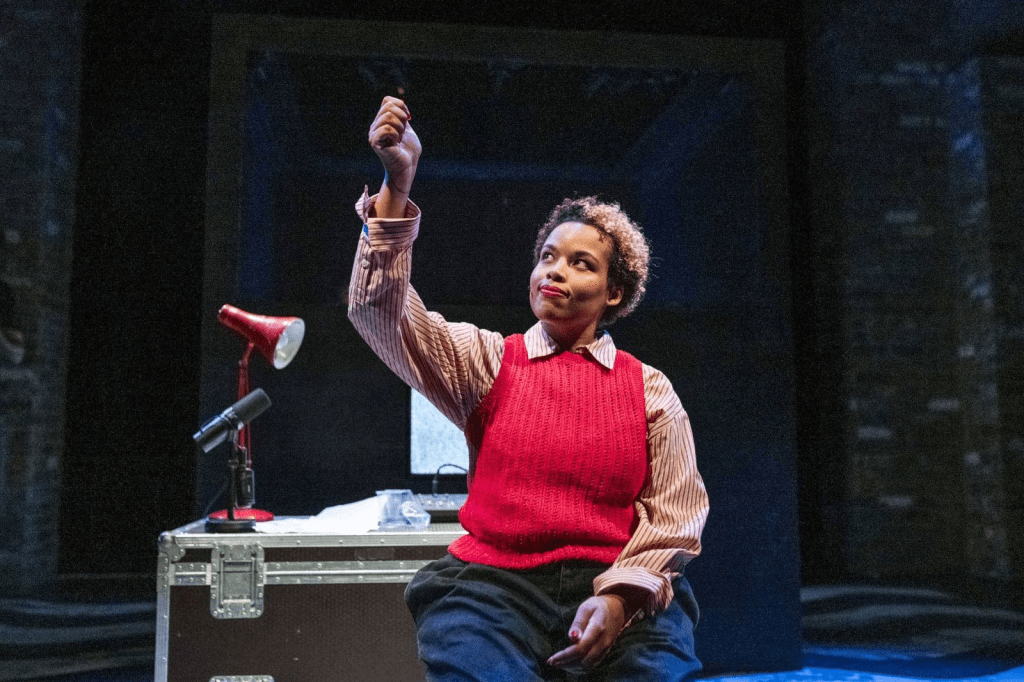
The Arcola stage is an architect’s office, complete with plywood desks and display models. Robert Innes Hopkins’ set places the production firmly in the 21st century design world of demanding clients, big egos and office politics. When Greg Hicks’ Halvard Solness walks in, the picture is complete. He is a charismatic, successful, demanding, senior architect in every way: a fully recognisable type. It is no surprise at all that, within minutes, he is exercising his power with his subordinates, and pursuing a surreptitious affair with his office manager, Kaja Fosil (Jade Williams). When his wife, Aline (Sally George), walks in she watches his excruciating attempts to behave normally with Kaja with disgust, and weary familiarity.
However, The Master Builder is a much more complex play than it first appears. One of Henrik Ibsens’ late plays, it combines realism and symbolism in a disconcerting manner, prefiguring his final work, When We Dead Awaken. Solness is soon playing a different kind of game with a different, younger woman – Hilde Wangel (Louisa Binder) – who walks into his office in her climbing gear to claim a promise she says he made her ten years ago, when she was 13. Solness kissed her and promised her a kingdom, then she watched him ascend the steeple of his new church for the only time in his life, overcoming crippling vertigo to hang a wreath on the weathervane. He doesn’t remember, but she’s very certain, and has come for her kingdom. She seems like a figure from a fairytale, calling in an awful bargain. It will clearly not end well.
The challenges of the play, and there are many, include finding a way to prevent this alarming encounter between a child and a grown man, and his enthusiasm for younger women, dominating our response to Solness. It is also tricky to balance the play’s contrasting tones. Mehmet Ergen, directing, overcomes these hurdles in an exemplary manner. Other productions lean further into the fairytale aspects of the work but, by allowing them to intrude into an entirely credible modern setting, Ergen allows an eerieness to grow which draws us along with the characters. He is helped by a series of riveting performances. Greg Hicks is a masterful actor with an highly impressive CV, and he oozes quality. He slips from egotistical dominance into a cringing fear in a moment in the presence of Hilde, showing us all of the self-doubt that has poisoned not only him, but all those around him. His exceptional performance is a privilege to watch close-up, in such a small space.
Hicks is matched by Louise Binder’s Hilde, who exudes confidence until the bitter end, effortlessly dominating those around her with her personality, and physically. Her reaction when Halvard tells her to sit, walking slowly along a bench to tower over him before lowering herself slowly down, is perfectly timed. Sally George, as Aline, presents a hard shell which hides impossible guilt about the death of her twin babies. Peter Guinness is excellent, slightly creepy as her more-than-friend, Doctor Herdal. Jade Williams makes the used and abused Kaja abject, while Ryan Wichert as her boyfriend Ragnar is on the verge of an explosion throughout. His father, Knut (Robin Hooper) is a desperate, powerless and dying, yet still winding Halvard up the wrong way.
Ergen’s classy production is made by its clarity and focus on the text, using David Edgar’s 2011 adaptation with its direct, casually earthy English. He makes sense of the overlapping histories and emotions which complicate each character’s relationships. Halvard’s ambition is matched by his belief that he does not deserve success, and must be unhappy to pay for it. Aline’s unresolved grief is terrible, while Ragnar is young but already embittered, and Kaja has sacrificed her happiness for nothing. Knut will die a broken man. Only Hilde will get what she wants, because her needs are cold and terrifying. Ergen makes the supernatural aspects of the play seem inevitable, because none of the earthbound humans can solve the tangle they are in for themselves. Halvard makes his final, fatal climb because he cannot exist in normality any longer. In a fine account of the play, it seems like the only possible choice.
Ten or more years ago, there were regular complaints that no-one was writing political plays any more. It seems like a very long time ago now. These days, post-Brexit, post-COVID, mid-climate and cost-of-living crisis and deep into the second coming of Trump, there is no ignoring politics. It looms large in everyone’s lives. It is in this context that a new play by Caryl Churchill feels like an event, and all the more so when it is a piece that runs for a mere 20 minutes, presented as a standalone production at the Almeida over a handful of performances. Triumph feels very much an occasion. The Almeida foyer is peppered with familiar faces, people whispering about who they have spotted, and front of house staff “unable to confirm or deny” whether Churchill herself is in the audience. There is real buzz of the kind not generally found on a Sunday afternoon.
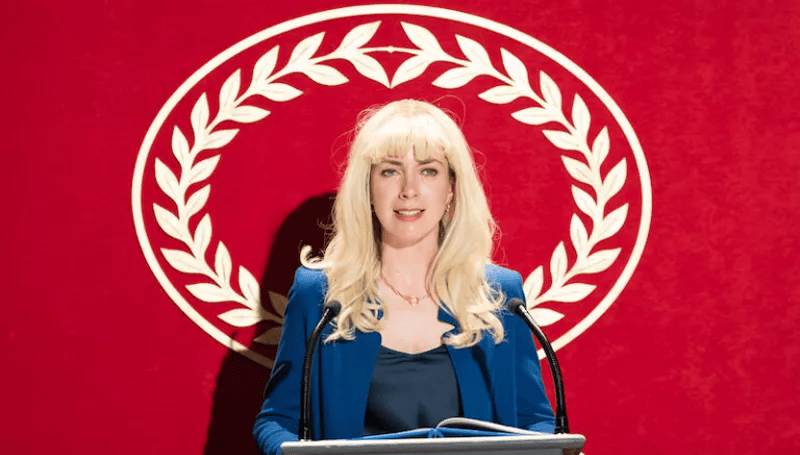
Churchill is 88, but her work still feels essential. With new Churchill plays scheduled at the Almeida in the New Year, Triumph is statement of intent from new artistic director Dominic Cooke. Not since the theatre staged Harold Pinter’s final works in the mid-1990s has been associated with a writer making urgent, late-career statements on where society has got to. Tr(i)u(m)p(h) is a piercing, conceptually powerful piece about a Karoline Leavitt-esque press spokesperson, standing behind a lecture to deliver mind-boggling statements on behalf of their boss, combining terror with hubris and farce on a gothic scale.
Directed by James Macdonald, Triumph plays out on a set by Miriam Buether lit with burning braziers, half blood-red press conference dais and half blood-red double-bed. Spokesperson Iris (Kate O’Flynn) dons a blonde wig to read prepared statements, and takes it off to sleep with the opposition – journalist Marcus (Matthew Beard). The thing is, everything she says on behalf of ‘The Emperor’ is taken directly from Suetonius’ compendium of tyranny, The Twelve Caesars. Her announcements rang from the bizarre – “The Emperor has installed a gold throne” – to the ludicrous – “The Emperor is paying for 250 young Romans to learn how to applaud.” The tone becomes darker, as the consequences of crossing the leader become clear, for Marcus and for everyone else. The press conference acquires a section introduced as “In other amputations”, and the violence inflicted on opponents by the state increasingly grotesque. Iris thinks she is exposing the truth The Emperor wants to conceal, but discovers that the more ruthless he seems the more popular he becomes, and the happier he is.
Triumph is a short but very pointed broadside about what people do to keep the Emperor happy – “a grim joke about where we are today.” The conceit of quoting Suetonius is inspired, allowing Churchill makes brutal connections between the the lies, cruelty and decadence of the last days of ancient Rome and the horror show we find ourselves in, under the megalomaniac rule of a very current leader. The running time may be short, but Triumph is the length it needs to be, no more or less. It takes just 20 minutes to draw persuasive performances from the cast, and lodge a succession of horrific images firmly in the audience’s mind. It only takes 20 minutes to make the point, forcefully, that we have enabled monsters before and we have done it again, creating a situation where leaders, and one leader in particular, can do whatever they please. This bodes ill for society, but political theatre is right at the centre of our cultural response to despairing times.
Room 13 by Immersive Octopus – Battersea Arts Centre, London
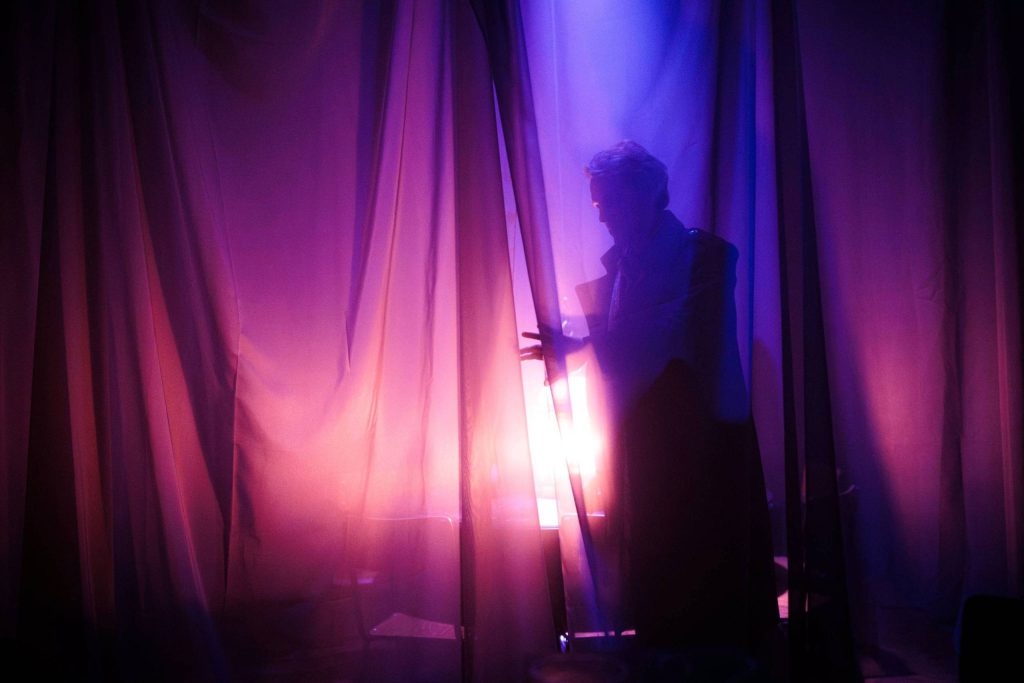
Room 13 plays with the premise that the disastrous 2015 fire which destroyed the Great Hall at Battersea Arts Centre, and from which it almost miraculously recovered, has released a demon. More than likely in a rambling complex full of hidden rooms and spaces, which was once entirely taken over by Punchdrunk’s Masque of the Red Death. This, too, is immersive theatre but on a smaller scale. There is a fair amount of pre-amble – a health and safety waiver, a waiting area with photos of the fire, and a randomised selection process, putting the audience into groups. We are brought to the door by an ushers, who warns us to keep silent to avoid raising the spirits, then guided through dark corridors and veils of curtain by a man in an antiquated costume. The show takes place around tables, where we have puzzles to solve involving occult-style symbols and statues. Then the lights go out. It very silly, but undeniably fun.
Room 13, directed by Tom Maller, was the shortest show I had ever seen, clocking in at 35 minutes. This status lasted only two days, overtaken by Caryl Churchill’s 20-minute Triumph. However, it is unusually brief, focused around some clever use of strobe lights and complete darkness, and some visceral sound effects. It is well-constructed and diverting, but it does feel like a rather limited experience, that could have been expanded extended – similar to the brand of shipping container-based work produced by Darkfield. In the context of the Edinburgh Festival, as part of the overall atmosphere and with any number of longer shows to see, it is very successful, but as an evening out it falls between two stools.
Sixty-four years after its premiere, Who’s Afraid of Virginia Woolf? is firmly a play from a different time, but its regular revivals throughout the 21st century suggest Edward Albee produced a work that continues to speak to and intrigue us. The play is many things. Most obviously, it offers a perfect pair of lead roles for warring couple Martha and George, combining humour, verbal dexterity, unashamedly bad behaviour, pathos, tragedy and a Shakespearian amount of time on stage. They are some of the biggest parts the stage has to offer. Not only that, Albee gives us Nick and Honey, the younger couple, walking into something they definitely do not understand. These are complex, demanding and brilliant supporting roles.
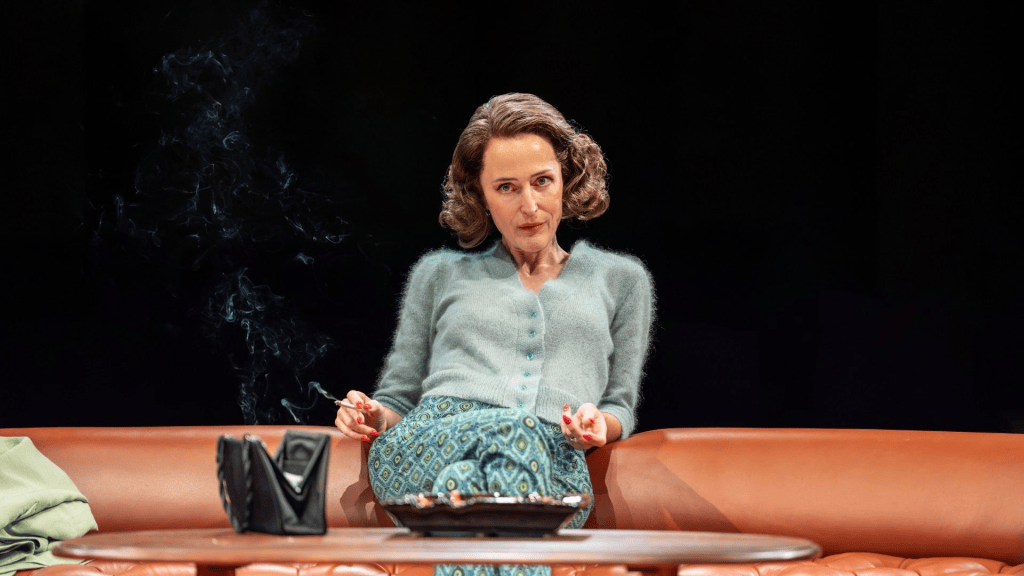
Marianne Elliott’s star-studded production at Soho Place supplies performers more than capable of relishing these parts. Gillian Anderson seizes the centre of the round stage as though she belongs there and performs – as an actor, as Martha, treating her own living room like a bull ring, and as a woman – standing right back up to anyone who dares test her, and using anyone she can. Billy Crudup, as George, is more than a match. He looks every inch the crumpled, aging academic, an underdog in most situations, and certainly when his wife’s in the room. But he is every inch as theatrical and devious as she is, and he knows – most of the time – how to use his perceived status to his advantage. Both performers are magnificent and horrifying, as they tear strips off each through the drunken early hours, and they are heart-breaking when the vulnerabilities they fight so hard to conceal finally start to wear through. The final scene, when the truth about their son is revealed, is difficult to watch.
Lined up for their pleasure are Josh Dylan’s Nick and Phoebe Horn’s Honey. Both performers have a great deal of fun – Dylan as a jock who is too easy to rub up the wrong way, and Horn as a young woman out of her depth. Then, as the barbs start to dig deeper and the older couple, George in particular, delivers carefully crafted cruelty, they fall apart in dramatic fashion. It remains highly entertaining and horrifying to watch people pulling one another apart through words alone. The play never leaves Martha and George’s sitting room, which contains a constantly shifting combination of the characters in twos, threes and fours. It’s a writing tour de force.
But the play remains more than the high-wire act. It’s harder now to understand the impact in 1962 of a female protagonist who makes no concessions to men, to expectations of female behaviour, to status, or to politeness. Martha is fearsome, and before here there had been few, if any, stage women who said and did exactly what they pleased. She is powered by her powerlessness, as the daughter of a influential man (her daddy is the college principal) with no influence or status of her own, dependent on her husband to get ahead or be recognised.
The play’s brutal irony that, although she can rail against her surroundings she cannot escape them, but her real sadness is her failure to have a child – which is both what’s expected of her, and what she wants. Honey is approaching a similar situation, her great secret being a false pregnancy, meaning that Nick is questioning her value. The play makes the situation of women in the post-war era horribly clear, but it has meaning now too for an era when politics no longer seem translated through personal relationships are they were a generation ago. Looking back to the way it was still seems important, both in terms of the underlying equality issues but also the directness with the characters speak to one another – which lands differently in the impersonal, online era. Can four people just talking ever have quite this impact again?
Elliott’s highly assured production plays on a remarkable set by Miriam Buether which revolves – but so imperceptibly slowly that it takes about 20 minutes before yo suddenly realise that all the furniture is in a different place. It’s an eerie effect, and a very clever way to match the pace of the play, where vocal excitement flares but the underlying dramatic pace is heating gradually over hours to a real boil at the very end. An ingenious, classy setting for a production which delivers a near-flawless account of a play that still hits home hard.
The autumn season at Battersea Arts Centre is a statement of intent: an eclectic programme which reaffirms the venue’s commitment to experimental theatre. BAC takes risks to ask questions that matter, but that kind of theatre is more costly than ever and harder to sustain, especially in a glorious, rambling, impossibly expensive building like the former Battersea Town Hall. BAC is irreplaceable, but the feeling is growing that sooner or later we will have to fight for places like this. The fate of Edinburgh’s Summerhall, another shoestring arts complex now forced to compete for space with hotels and student housing, shows there are no guarantees. What better way then to affirm BAC’s role as one of the UK’s most important producing venues, than with an exciting, unashamedly confrontational new play.
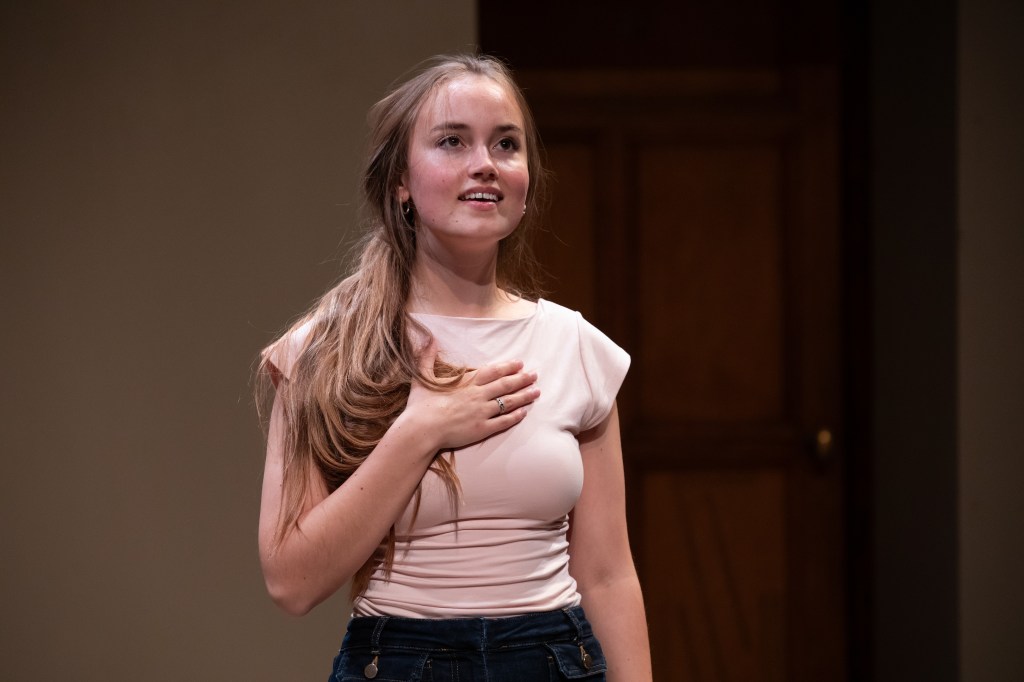
Writer and co-director Caroline Williams and fellow co-director Deborah Pearson are a team who grew up on the space for experimentation provided at BAC, where they both started out. Williams wrote Nina during COVID and, intriguingly, it makes arguments which have since dropped out of wider discourse. The MeToo era has given way to anti-woke posturing, and questions about the way women experience the power of men have become obscured. Nina is a timely return to issues never properly addressed. It is also a powerful and absorbing piece of writing which shakes up expectations. It opens with a projected quote from the writer Trigorin who, in Chekhov’s The Seagull, proposes a short story in which a young, aspiring actress is destroyed by a man out of sheer boredom, shot like a passing seagull. This scenario plays out in The Seagull itself, as the young actress Nina is used and destroyed by Trigorin himself. And it plays out in Nina, as a series of actresses audition for the part.
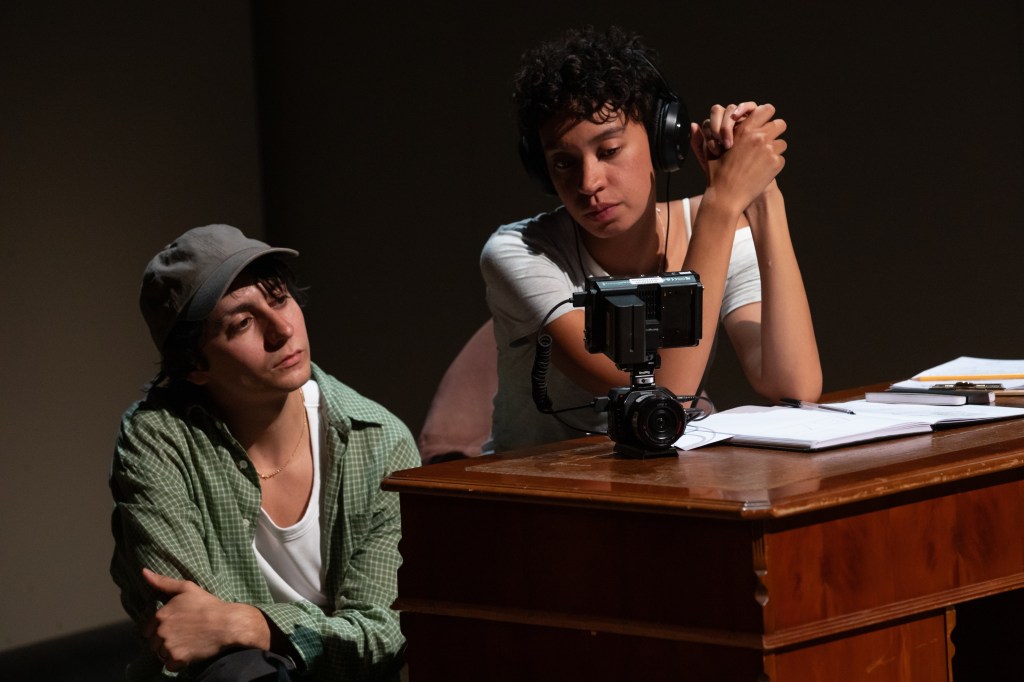
Tomás Palmer’s set is a bare rehearsal room, where four young women stand in the spotlight, while director Goran (Rowan Polonski) directs their auditions, at first as a disembodied voice through a ‘God-mike’. He is an autocratic, generically European director. All the audition candidates tell him how much they love his work, and he manipulates them as he pleases. Nina 1 (Maya Bartley O’Dea) is shot like the seagull after just a couple of lines. Nina 4 (Gemma Barnett) is told she is too old for Nina, too young for the part of Irina Arkadina. Nina 2 (Samantha Begeman) is nervous and, professionally, in no position to assert herself. Nina 3 (Nina Bowers) is too self-possessed for Goran. In an intense and horrifying scene, Goran pressures her into channelling of pregnancy and abortion to enact a childbirth scene, recreating the experience of Nina in the play. When she asks for feedback, it turns out he went to lunch halfway through.
Goran’s treatment of Nina 2 is at the centre of the play. He casts her as Nina and pushes her through an exposing masturbation scene, ignoring his pleas to let her stop. The play is a success and it makes her a star but, when the pair are interviewed on TV, the cost to her becomes clear. Nina is based around a set of stellar performances. Samantha Begeman is remarkable in her journey from awkward inexperience to an insight she never asked for. She gives a speech about the way acting makes her feel she is able to stop time, in which she pretty much does exactly that. But the cost of putting her vulnerability on display, at the behest of a controlling male ego, is shocking. In Daniel Denton’s highly effective video design, her raw performance is projected behind her as she plucks the feathers from her costume in despair.
Nina Bowers is equally impressive as a woman who thinks she is an equal artistic relationship, only to discover she is being used in every way. Rowan Polonski is unnervingly convincing as a liberal, feted, deeply misogynist director. Joseph Payne is excellent playing Goran’s sidekick, a nepo-baby aspiring writer who is an analogue for Konstantin in the Chekhov play – both socially awkward and sexually opportunisitic, touching up Nina 3 the moment she tells him she is in a relationship.
Some of the gratuitous mistreatment of the actresses would seem cartoon-like, if it weren’t for Caroline Williams’ programme note explaining that everything in the play really happened, either to her or to friends. Her writing throws the treatment of women on stage back in the face of perpetrators, but it does more than that. She also challenges the dominance of a classical canon powered by male representations of women, like Nina, suffering trauma at their hands. And she challenges the expectation that actresses will relive their own personal traumas, also experienced at the hands of men, to perform these representations. Nina shows us how much we take for granted, from actresses and the theatre, and asks whether the costs are justified. It is a must-see show, with an exciting cast, from a writer who matters.
Man is Man by Manfred Karge – Royal Court Theatre, London
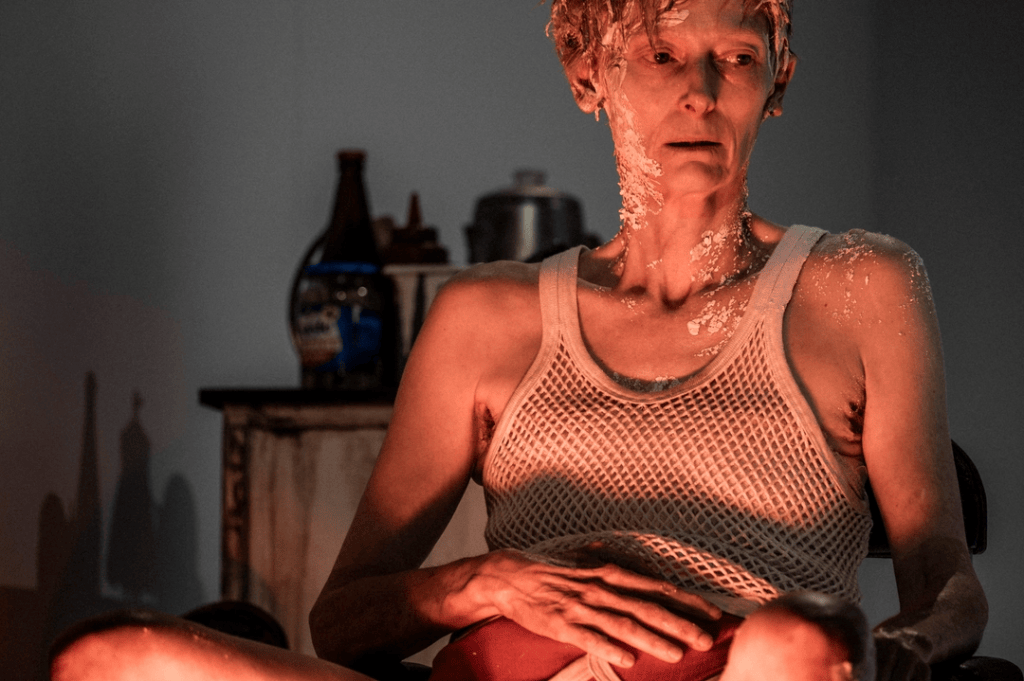
Tilda Swinton’s return to the Royal Court would be a serious theatrical event, even if she weren’t appearing in the play she performed on her last stage appearance, also at the Royal Court in 1988. Since then, she has become a film star of remarkable character and artistic credibility, building on her early fringe work and her artistic relationship with Derek Jarman to craft an entirely individual career. There is no doubting her star quality on screen, but what is it like to return to live theatre after a 38 year absence? It’s hard to think of another actor who has taken on a challenge quite like this.
Manfred Karge’s play is an adaptation of Bertolt Brecht’s Mann ist Mann, and is a one woman show – but the woman in question spend most of the night impersonating a man. Swinton plays Ella Gericke, whose husband Max is a crane operator in a 1930s German city. When he dies of cancer, a burial mistake means she can assume his identity and live as a man, experiencing the wild turmoil of the 20th century in Germany. In a string vest and Y-fronts, face crusted in white, Swinton roams her apartment telling us her story. The play has undergone several updates since its première, not least when the Berlin Wall a year later. Now, it continues to the present day (although this takes Ella out of any realistic timeline), to the point where the megaphones are out again and the menacing rise of AfD threatens to bring events full circle.
Directed by Stephen Unwin, who helmed the 1988 production too, this is a real reunion and, it has to be said, something of a throwback. It feel as though we are watching alternative theatre from a different era, which is indeed the case. It is easy to see the influence Man Is Man must have had first time around, but repeating the show does not have the same effect. The moral ambiguity of Ella, who goes with the flow and does what she needs to survive, including becoming an SA prison guard during the war, is unsettling and politically challenging both then and now. The gender fluidity and the deeply unglamorous costumes and setting (by the original designer Bunny Christie) were foundational for much subsequent fringe work. The use of an onstage microphone to deliver speeches, and flinging a pot of red paint over the back wall of the set, are examples techniques that were clearly ahead of their time – and that we have now seen many times. Although the motivation of a revival, to highlight disturbing political developments in Germany, is very laudable but the production is more of an archival exercise, fascinating to students of theatre but much less urgent than it should be.
The other issue is, unfortunately, Tilda Swinton herself. She is fully committed and invested in a lengthy solo performance, but she does have weight and stage presence to fill the auditorium. Vocally, she is underpowered and, unusually, would have benefited from being mic-ed up for the back row. Her performance also lacks variation, undermining the intense drama of the events she’s describing. She uses a South London-esque whine throughout, which is quite a transformation but does not seems to leave her room to pitch or vary her performance. As a result, it lacks pacing, and has neither peaks or troughs. The audience is always waiting for the moment that will grab them and draw them into the play, but if never quite happens. the result is an evening that fails to match up to its considerable promise.
The venues for the Ruhrtrienniale (which is, confusingly, an annual festival) are like no others. The region’s heavy industrial past has left a legacy of vast halls, chimneys, blast furnaces, gantries and bunkers which, at Landschaftspark Duisburg-Nord in particular, are imaginatively repurposed to stunning effect. Thus, Marina Abramović’s Balkan Erotic Epic is staged in the 170m-long brick Kraftzentrale building, a former power plant for the surrounding iron works. The work fills the vast space with ease. Directed by Abramović, with a cast of 70 performers and a large production team, it completely ignores supposed boundaries between performance art, installation, film, music, dance and theatre, creating a full immersive parallel reality over the space of four hours.
This is the German première for a production co-commissioned by the Ruhrtrienniale festival with a number of other institutions, including Factory International, Manchester and Park Avenue Armory, New York, and has been playing around the world since 2025. The audience gathers in front of a 30m-high black curtain as a woman enters leading a funeral procession, followed by a Balkan band. She is Abramović’s mother Danica, played by Maria Stamenković Herranz, and this is the funeral procession for Yugoslav dictator Josep Broz Tito, whose death in 1980 signalled the beginning of the end for his country. The procession leads us into a space with thirteen separate stages, on which performances take place simultaneously. The audience can move between stages and experience the evening in any way they choose, including leaving temporarily for a drink. The performances combine endurance and skill with impressive, moving, funny and confrontational elements often combining in one setting.
The central funeral thread moves between two of the stages, including a carefully recreated 1970s Yugoslav café, where women dressed identically in black sit virtually motionless for a good two hours, occasionally lifting a hand to smoke, before finally rising to stand in turn on Tito’s coffin while the national anthem plays. The final woman stamps furiously on the lid. All this is overseen by Danica Abramović, whose stony face gradually softens as the evening progresses. Marina’s mother, a senior party official, was notoriously dictatorial and this show is undoubtedly her daughter’s attempt to come to terms with her upbringing. She brings the rituals of her home region to bear, focusing on the power of women as expressed through Balkan traditions to influence the weather and the land, and to bring fruitfulness to crops and couples.
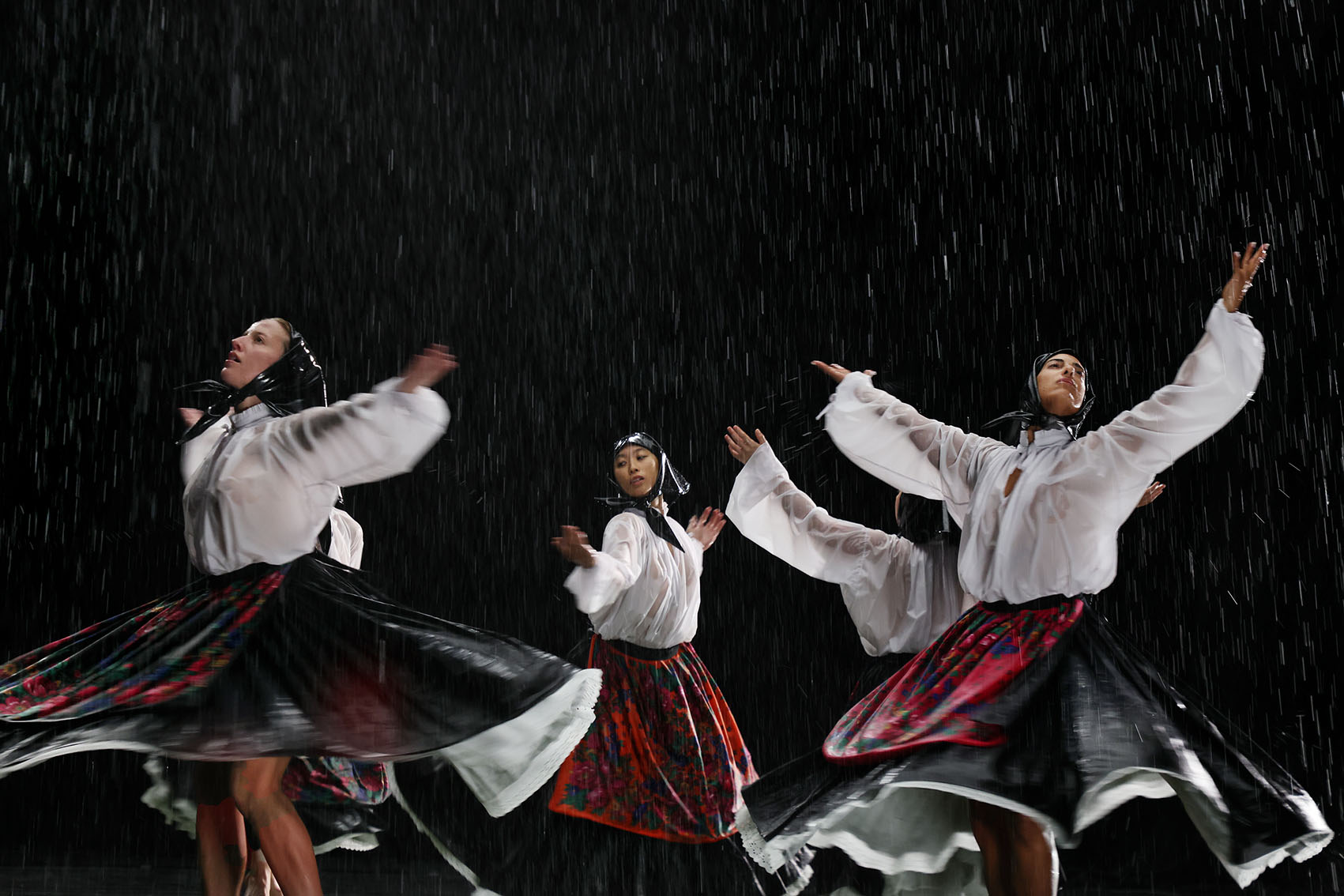
On stages scattered around the huge space, these rituals are performed. The many scenarios include a graveyard in which naked men and women copulate with skeletons, moving in extreme slow motion, to awaken the earth; a violent knife dance, in which women assume the male role in a household lacking men; a dance in which five women in traditional costume bare their vulvas to the sky to banish the rain; three naked men humping the earth to bring fertility; and a lecture from a ‘scientist’ played by Elke Lutyen, who informed us about various Balkan sexual rituals, surrounded by giant phalluses.
The most moving and arresting peformance is, perhaps, the black wedding – a ceremony in which a young man is joined with a woman after death. His ‘widow’ dresses his naked corpse, the weight and difficulty of moving a body evident in every tender gesture. Meanwhile, a troupe dressed in black perform intense, mutually supportive dances. A man carries two women, one on each shoulder, clasped around him. The quality of the choreography, by Blenard Azizaj, is outstanding.
The show also has a Durational Performance Director, Billy Zhao, whose work is crucial to the evening. There is an element of endurance for the audience, as they watch repeated, ritualistic actions, but the entertainment value makes the show pass remarkably quickly. However, the commitment of the performers, who are too numerous to name, is astonishing. A woman, for instance, dressed in red and looking like Marina herself, poses on a high platform beside a coffin, moving roughly every 40 minutes, in a performance of pure discipline. The vulva-baring women dance non-stop throughout the full four hours, a feat of remarkable endurance. Marina Abramović describes Balkan Erotic Epic as her most ambitious work, and it is certainly her most complex and collaborative. It is hard to imagine anyone attempting anything comparable, and the result is an experience which those lucky enough to attend will not forget. Her originality and vision are indisputable, and so is her ability as an artist, and now as a director, to bring performances and audiences with her, teaching us to speak her language.
The huge Maschinehalle, once the engine house for the Zweckel coalmine in the heart of Ruhr, looks as much like a mansion as a place of work, with balconies, staircase and a space inside like a ballroom. Standing alone, surrounded by forest, it makes a bewitching venue for Lisaboa Houbrechts’ production of Siddhartha, adapted from the novel by Herman Hesse about the journey towards enlightenment made by a young prince in the time of the Buddha.
Siddhartha by Herman Hesse, Lisaboa Houbrechts, Caroline Shaw, Latvian Radio Choir – Maschinenhalle Zweckel, Gladbeck
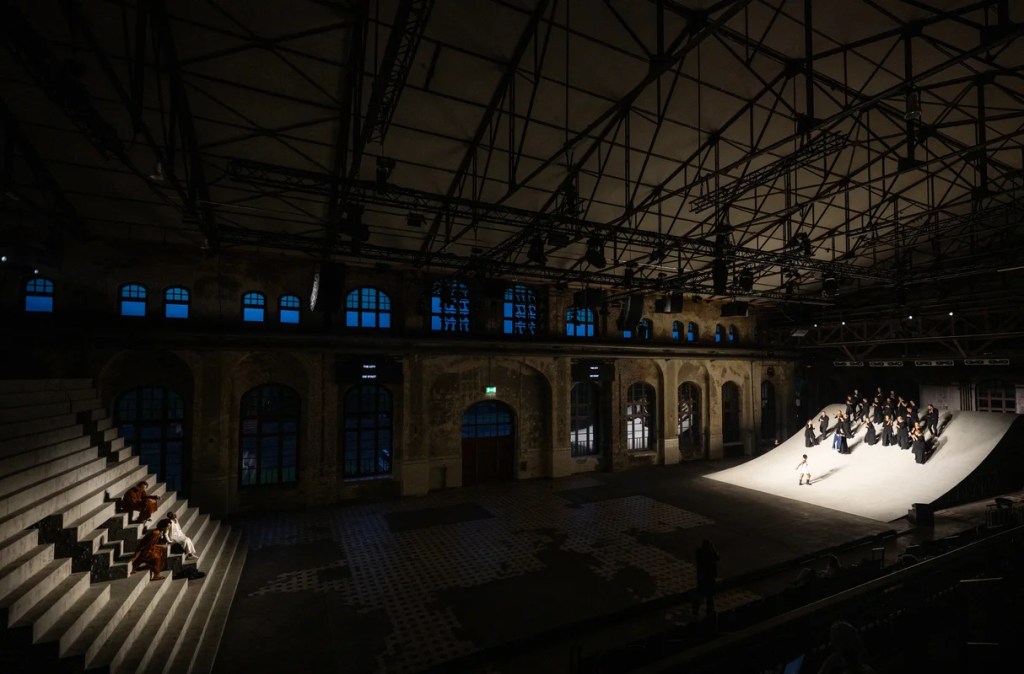
The scale of the production matches the space, which is especially wide, and ideally suited to the grand, symbolic gestures which structure the production. Houbrechts not only directs, but has also written what is described as ‘the libretto’. The production has a cast of 27, most of whom are members of the Latvian Radio Choir, providing a chorus which is varied, and at times stunningly, performed. They move through the production as a group of fully committed extras, directed and managed in great detail, contributing throughout. They combine singing with movement, resulting in a series of very memorable moments. The cast process, slowly and deliberately, in copper robes, carrying flaming brands, and performing a piece using only intonations of breath. It is as though an ancient ritual has sprung to life in front of us. Dressed in black and white they form a village, and later a town, while performing a varied, impressive soundtrack which includes the entirety of Caroline Shaw’s ‘Partita for Eight Voices’. At one point the choir also sings the first lines of ABBA’s ‘Lay All Your Love On Me’. That they not only pull this off, but make it a moment of extreme poignancy, is testament to the production’s confidence. The show has a musical leader, Christian Balvig, and Casper Clausen working on soundscapes, while Kaspars Putnins conducts the choir on stage as part of the ensemble. The scale and impact of a choir, filling the space both physically and musically, is a result of many people’s work.
Credit must go to Oumar Dicko, whose costumes are a key part of the setting, and to set designer Sammy Van den Heuvel. He bookends the remarkably wide stage with a set of white steps on one side and a long white slope on the other, each a good 20 feet high. The steps represent the hard way, and the slope the easy way, but the latter of course is not as easy as it seems. Houbrechts has adapted Hesse’s novel by changing the gender of the Siddhartha, who becomes non-binary, played by a woman – Belgian singer-songwriter Meskerem Mees. Her lead role is demanding, as she has to not only sing but at times express her struggle through pure physical movement, and she does occasionally feel a little lost in the space. The show works best when it fills the room with people, but is anchored by some key performances, including from Sufi singer Zila Khan as a harrumphing, chuckling Buddha, and Claron McFadden as Siddghartha’s mother.
The production achieves some remarkable moments. One is the boat – in the form of a floating wheel – which drifts across the stage as it becomes a river, apparently of its own accord, in a piece of bold stagecraft. Another is the use of the Machinehall’s big windows, open to the trees beyond, as the backdrop to the entire show. The sun sets as the evening progresses, and the natural light fades, bringing us closer together in the room. When the central doors are flung open to the outside, once at the start as Siddhartha begins her journey, and again near the end as the Buddha appears, the effect is simple but startling.
Siddhartha has been five years in the making, and is a fine example of a clarity of vision, purpose and ambition which characterises the best theatre in Germany and the Low Countries. It plays at Antwerp’s Tonelhuis over the winter, before touring, and is very much worth a trip across the Channel.
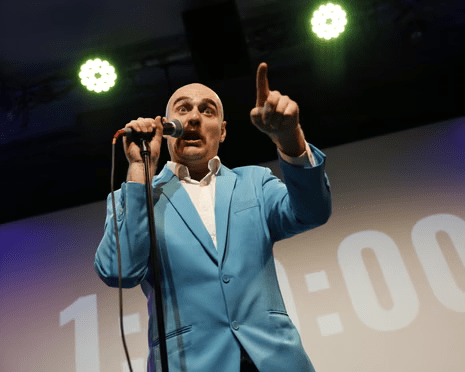
He does, and it’s a very clever idea, conceptually simple but completely fascinating. Australian comedian Conk (Connor Dariol) hits on something special which is hard to described without identifying the song, which would spoil the surprise when the audience first recognises the introduction. It would be safe to say that everyone’s reaction is ‘whaaat?’ Not only has Conk chosen to repeat himself for an hour, he’s chosen a song that many people would avoid listening to just once. But the choice is part of the show’s purpose. As he repeatedly performs the song (15 times) his style changes from a fully energised crowd-pumping hand gesturing performance to something more doubtful. As we hear the dated, sexist and somewhat disturbing lyrics again and again, we are forced to think about what they mean, and what kind of a culture, a generation ago, was producing this material. It’s funny but completely compelling as a show because it isn’t really comedy. An hour with Conk is closer to conceptual art – specifically Ragnar Kartjansson’s A Lot of Sorrow, a film in which The National perform their song ‘Sorrow’ live again and again – than to any stand-up show you might see at the Fringe.
Foriegner by Koan Brothers (Sohrab Haghverdi, Benjamin and Mason Rosenthal) – Summerhall
Foriegner (sic) is an exceptional performance from Sohrab Haghverdi which uses all the power of live performance to get confrontation with his captive audience. He does not feel the need to win us over, as is evident from the first scene of the show, which is simply him coughing over and over for what feels like 10 minutes. He then goes on to crawl around wearing a rug, to talk endlessly about ejaculation and urine, and to excoriate a long list of religions and ethnicities including his two Jewish directors. He intersperse film clips of Summerhall Arts CEO Sam Gough, talking in arts world platitudes. And, yes, he does produce and then drink his own urine on stage. The rationale for such an unpredictable and off-putting performance is political. Sohrab is Iranian, trying to escape from the Iranian regime, which he hates, and settle permanently in the US, which he’s not particularly keen on either. He has no wish to tell the refuguees story we expect, and has decided that doing ‘crazy’ things on stage is the only way he can get a visa, through the exceptions offered to ‘genius’ artists’. A scene in which he plays a sperm quoting the philosopher Rumi, who tells us to kill our false selves to live honestly, is brilliantly weird, and a neat summary of Sohrab’s intentions. Foriegner is a startling and original piece of theatre, much more sophisiticated than it would have us believe.
Jude Green’s show is based on her own experiences of navigating the Universal Credit system to keep her head above water while trying to maintain a career as an actor. It is rather too close to the nose, I imagine, for many Fringe performers, depicting as it does in excruciating but almost comic detail the Kafkaesque bureaucratic nightmare that comes as a mandatory accompaniment to a benefits claim. Green, who claims not to know what Kafkaesque means, plays a helpless character, alone on stage responding to the disembodied voice of the Universal Credit helpline, which also becomes the voice of her equally high-handed agent – played from the gallery by Jack Whateley, also the show’s tech operator. The cycle of jobs that pay nothing or cost her money to take, and general hostility to a sustainable career in theatre becomes increasingly absurd, eventually absorbing the very show we are watching, but the message is loud, clear and important. Who can afford to work in theatre any more?
Celtic Collective by Dance and National Youth Arts Wales – Dancebase
Two pieces performed by the National Youth Dance Companies of Wales and Scotland. The Welsh dancers perform Momentum, moving around large mirrors to music by composers from James Blake to Tchaikovsky, which keeps the action somewhat static until they break free late in the piece and the energy starts to flow. The Scottish dancers, performing Afterglow are a larger company and perform in 1920s party costumes in orange, gold and black, with more than hint of David Bowie’s Ashes to Ashes video. They move freely and energetically, impressing with the quality and confidence of their dancing as they appear in changing combinations, crossing and recrossing the stage. An impressive and enjoyable hour of emerging work.
New Zealand company Binge Culture’s Werewolf is a shaggy dog show, which is silly but entertaining. The audience is confined to the auditorium for five days and nights as part of a national effort to contain an outbreak of lycanthropy. Things start cheery, with breathing exercises and health checks, but the three safe house supervisors become suspicious of one another, and increasing scary things start happening a night, with the house lights off. Members of the audience are given roles which they are not allowed to reveal, so things gets very unexpected and it’s fair to say it doesn’t end very well. It’s an exercise in how much you can wind up an audience in the space of an hour, but it turns out more funny rather than frightening.
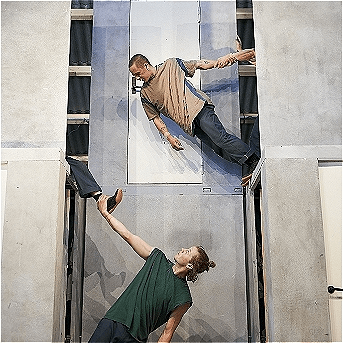
Circumstances are four Belgian circus and dance performers, in a show choreographed by Piet Van Dycke. Their set begins as a set of doors, and they move through them in increasingly complicated patterns, emerging in different costumes and from unexpected directions. The backdrop is white, which makes them look like a human cartoon – specifically like a Morph animation by Tony Hart, with their slightly exaggerated movement giving the impression of characters who are not entirely human. So far, so enjoyable, but the show steadily increases the pace and the stakes, when the central section of the set, 15 feet high, starts to revolve around a central axis, reversing the position of the door then, eventually, spinning wildly. All the while the performers move up, through, around and over it, risking decapitation several times a minute. Their movements are daring bordering on the ill-advised, but coordinated to an incredible degree of precision. It is entirely mesmerising, and the piece gains an irresistible momentum, bringing the audience with it until we reach the end, barely believing what we have seen. It is a tour de force.
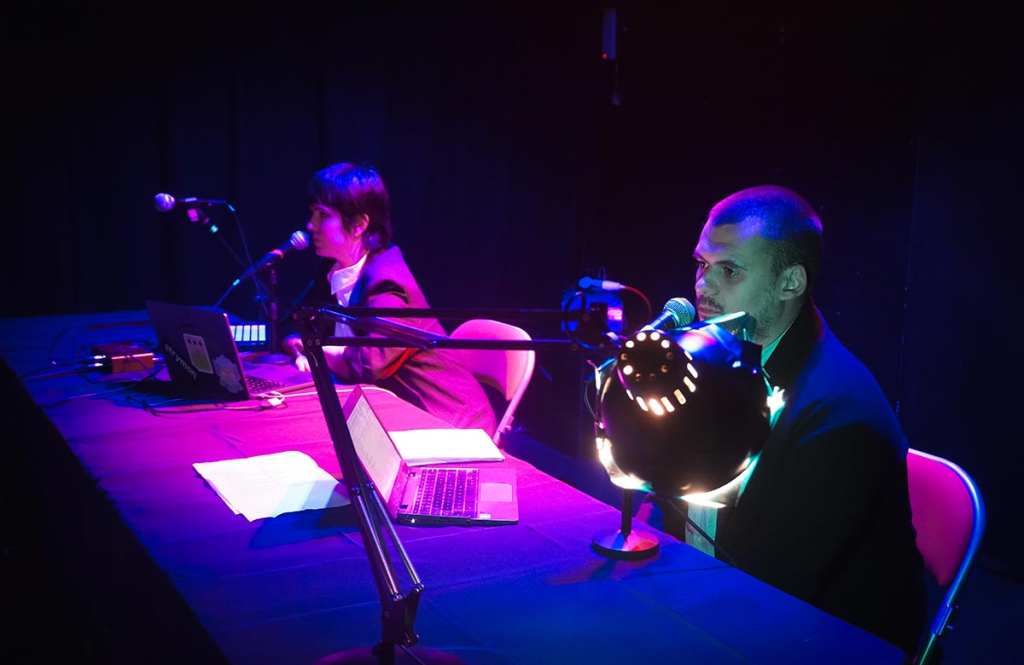
Badgers is written and performed by Malaike Kegode, with backing from a two-person band who perform in a booth behind her – Beth Roberts and Joe Williams. The story she tells is about a folk musician who disappeared ten years ago while recording an album, and may have stumbled on a song with supernatural powers. Unfortunately, this is not a convincing premise. The story seems wilfully whimsical, a characteristic of the worst folk music, and lacking in wider resonance. The characters are highly dislikeable, especially Kegode’s, a podcaster called Meles Costas who combines naïvety with a complete lack of moral principle. She seems to represent a sature of the content-producing era, but we also seem to be expected to engage with and follow her. Kegode’s performance is underpowered – she is miked up in the Traverse’s small studio space which actually makes her harder to hear – and the writing is not of the quality for which the Traverse is justly known.
Soft Spot by Olo Company and Cluster Arts – Zoo Southside
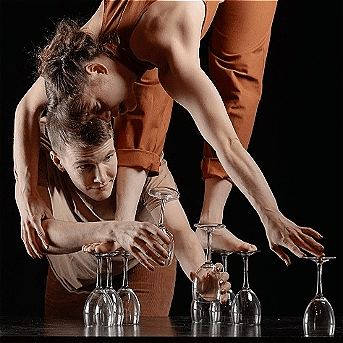
A Swedish piece, Soft Spot is performed by Stina Otterström and Arttu Lahtinen. She is a handstand artist, and he is a juggler. They show their skills through the use of a lot of wine glasses in ways that make the audience hold their breath, partly in terror and partly in disbelief. Lahtinen does not juggle in the traditional sense – he moves, manipulates, spins and stacks wine glasses in ways that are highly precarious. He also arranges them so Otterström can perform handstands on them, upturned, in groups at first and then in smaller and smaller numbers. Eventually they bring on a box ostensibly filled with their breakages and tip a mountain of broken glass over the stage. The barefoot Otterström sweeps a path through the shards, which are all too visible in the stage lighting, and stands on her hands on glasses in the centre of the chaos. The underlying them of the show is trust and interdependence: the two work closely together and everything, including their safety, depends on the other getting it right. It’s ridiculously impressive – hard to classify, but certainly unlike anything else on offer at the world’s largest festival, which is an achievement in itself.
Carmen Collective are performer Sam Rees, musician AJ Turner and producer Ella Dale. Gameplay is a show in which very little happens, but a great deal is described. Rees stands behind a lectern and tells the audience what they are seeing, which is him and AJ Turner, behind a laptop. It is as though he is describing the scene for audience members without sight, before the actual show begins – and this is partially true. The show is designed as an accessible performance, but the descriptive style becomes the show itself, as Turner builds a slow burning electronic soundtrack in the background. Rees tells us about Vasili Arkhipov, an executive officer on the Soviet B-59 submarine, which was off the coast of Cuba in 1962. He is credited with refusing, under enormous pressure, to fire a nuclear torpedo at the USS Randolph, an aircraft carrier it believed was depth-charging them. In doing so, he almost certainly prevented nuclear apocalypse. This story is one of the most consequential in human history (although Arkhipov is, terrifyingly, not the only Soviet individual to have single-handedly prevented nuclear war), and Rees’ matter-of-fact narration builds an unforgettable picture. His detached explanation of the sequence of events that would have ended humanity is reminiscent of Ontrorend Goed’s masterful World Without Us, in which it gradually dawns on the audience that the narrator is describing a world without humanity – a comparison that reflects the clarity and ambition of Carmen Collective’s work. The Arkhipov story is intertwined with a strange, melancholy story from the point of view of notoriously reactionary Daily Mail theatre critic Quentin Letts, attending the theatre and finding himself disconnected and disappointed by everything. In some ways, it seems the show was devised to meet the brief of dropping a nuclear bomb on Quentin Letts, which makes it funny as well as formally daring.
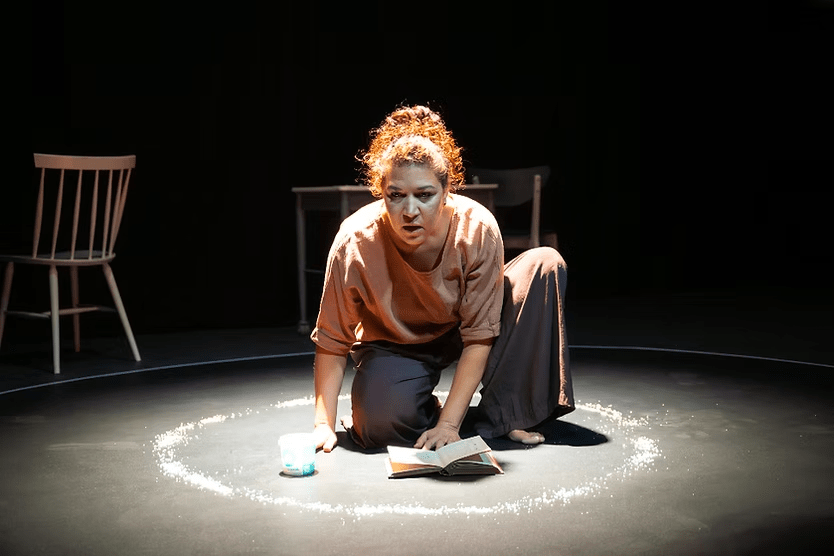
Zinnie Harris’ new play, which she also directs, is about the experiences of a woman who thinks she has been cursed. Sally (Nicole Cooper) falls down a hole in the pavement while going about her everyday business, and afterwards finds herself beset by a Greek chorus who insist, sometimes physically, that she behaves in a way that fits their perceptions of how a Greek drama should be structured. Meanwhile, she gains a Cassandra-like ability to foresee future disasters, and naturally no-one will listen to her. Richard Conlon, as her husband, does his best to be sympathetic, even agreeing to tell the neighbour who hates them that Sally has foreseen she has cancer, but he draws the line at scouring the city for an unidentified young refugee woman who may be about to lose her baby. Performed on a bare set with only a white chalk circle (designer Alisa Kalyanova), the cast are excellent at bringing Harris’ funny but strangely believable writing to life. Cooper is thoroughly likeable, and makes others feel bad for doubting her. But is it all in her head? The truth of what is happening is not really the point – it is ultimately a play about the strains on a marriage, filtered through the extremities of the classics. It is also a play about our times, with the far right and the refugee crisis floating around the margins of the narrative, expertly handled and never overstated. Supposing is an intensely imagined drama which shows us our own concerns through a lens that makes them seem wilder, stranger and more urgent.
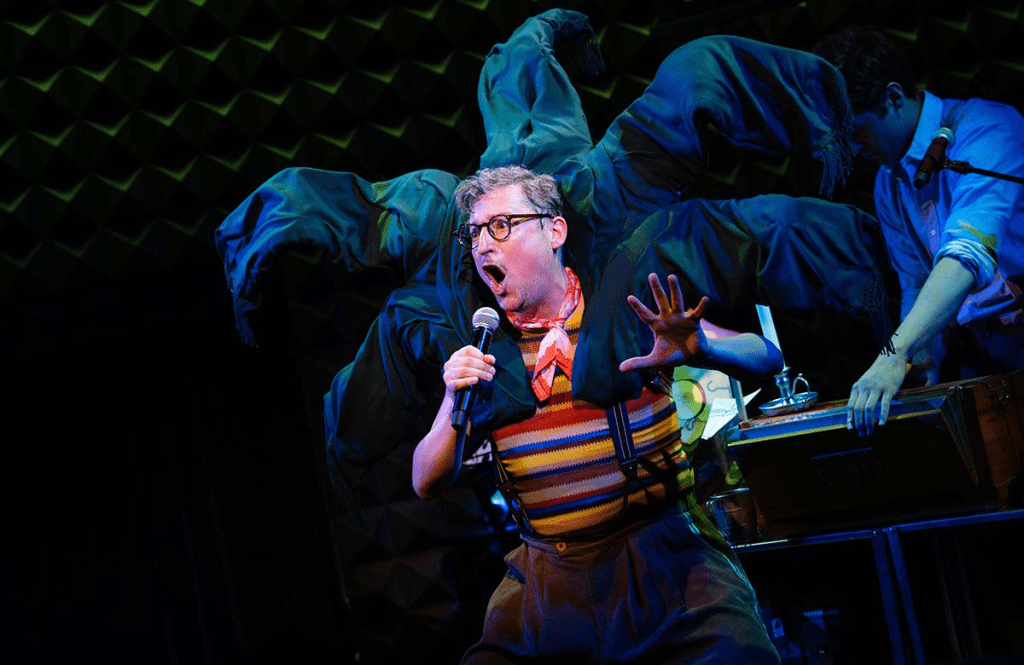
Salty Brine’s 2024 Edinburgh run in ‘These Are the Contents of My Head (The Annie Lennox Show)‘ was a triumph, and has allowed him to scale up (at least in terms of the experimental theatre hiearchy) to a booking in the flagship Disseection Room at Summerhall for his new show. It’s no more than he deserves. Salty combines a book and an album to create cabaret-esque performances that are uniquely his. After Annie Lennox and Kate Chopin in 2024, ‘How Strange It Is’ brings together Neutral Milk Hotel’s 1998 album In the Aeroplane Over the Sea and Anne Frank’s diary. The concept sounds bizarre: the reality is absolutely top notch theatre-making. Neutral Milk Hotel’s guiding spirit is Jeff Mangum, a somewhat enigmatic character who incorporated his fascination with Anne Frank’s writing into a record which has gained a cult follow. Salty somewhat overstates Mangum’s reclusiveness and reluctance to talk about the album – I well remember him curating and headlining a 2012 edition of All Tomorrow’s Parties in 2012 – but the album is gorgeous and it’s succession of irresistible tunes conceals multiple levels of meaning. Against this, Salty winds together his reading of Anne Frank’s coming of age with Peter van Pels, a story that shines out far beyond its tragic context, and his own awakening as a gay man. No-one but Salty could pull this off, delivering a full, astonishly dynamic performance of the album with a backing band while weaving a wider story out of the music. He’s done it before, but it keeps getting better. There is absolutely nothing to dislike about this show, which leaves everyone lucky enough to see it elated.
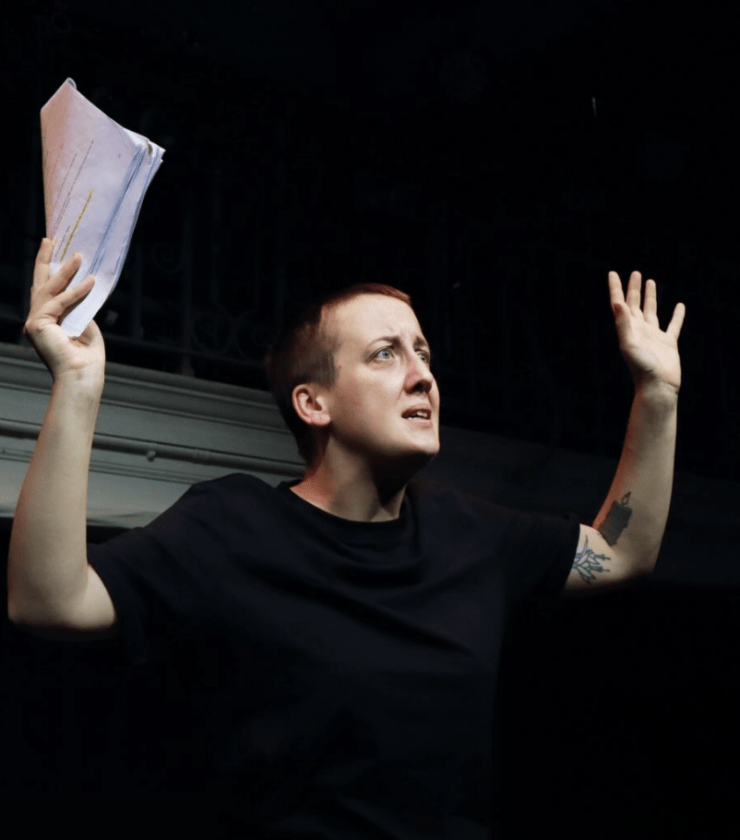
Gregory Nussen’s one-man show has its roots in Jorge Luis Borges. Named after the narrator in Borges’ Cosmicomics, the performance starts with Nussen’s plan to write a show based his book If On A Winter’s Night A Traveller, which is famously a novel about the novel itself and the experience of reading it, rather than any conventional subject. Although he frames the show with lots of self-reflexive material, including interventions from audience members secretly given scripts who claim to be assigned by ‘The Institute’ to inspect his storytelling, it gradually reveals itself to be personal. A story emerges, which becomes increasingly alarming, about his Jewish US upbringing, the messages he was fed, and what happens if you challenge the conventional narrative about the legitimacy of Israel and its actions. What Nussen himself describes as a failed exercise in experimental performance morphs into a powerful exploration of one of the most prominent political issues of our time. Nussen’s charm and self-deprecation work very well to set up a show that tells a story no-one wants to hear – a definition of theatre that matters.
Sāo Paolo dance company TF Ciade Dança perform a work choreographed by Igor Gasparini, which dials up the energy from zero to something way past eleven over the course of an hour. The eight dancers, a mix of genders, ethnic backgrounds and body types, begin with barely perceptible movements as though they are trying to escape shackles. Then they explode into life, to a soundtrack of pulsing beats, moving as group, writhing into stylised, fluid poses while lit like a Caravaggio picture. They are mesmerising as they put their all into a technically very precise sequence in which they constantly move around one another, before finally breaking out into individual sequences, dancing as though they are at club. It’s an exhilarating experience.
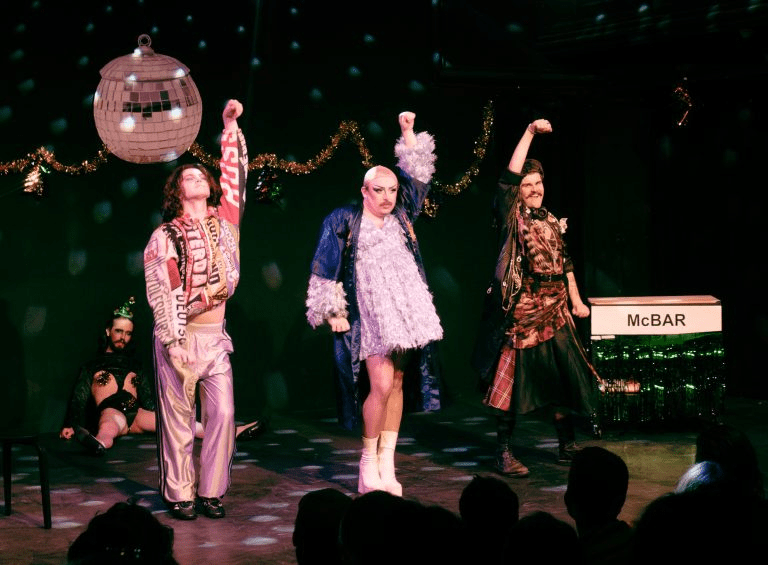
I doubt that anyone except the performers and the group of their delighted friends in the audience understood what was going on during Mother, Maiden and Crone, but that doesn’t mean we didn’t have a good time. The Bedlam Theatre is a last bastion of the old Fringe, before it became significantly more corporatised. The walls of the bar are plastered with Fringe posters going back half a century, and the atmosphere is one of unbridled, unfunded experimentation. It feels essential to the spirit of the festival, and stills draws good audiences and wins awards. Mother, Maiden and Crone is effectively a queer pantomine, about three queens running a club dealing with the horror of hosting a hen night. Parallels with Macbeth are extremely loosed, although it does give a great excuse to kill characters. The performers don’t need the Festival for their show: you get the impression they’d be here anyway, with most of their audiences, trading in extensive in-jokes and scene motifs, essentially playing themselves and not worrying too much about the lines. There’s more corpsing than I’ve seen on stage for years, and it feels like two fingers up to the worst inclinations of the Fringe, which come closer to a hen party than is generally admitted. A show that sits outside star ratings and conventional expectations is, in many ways, something special.
Joy Nesbitt’s play, set in an audition for a production of Julius Caesar, is a satire on the cult of the director, and on people who play lip-service to diversity. It is also set in Dublin during far-right riots resembling those that took place in 2023. As the threat builds outside, the three performers feel threatened in different ways, especially Black actor played by Loré Adewusi. Meanwhile, the preening and tyrannical director (Ultan Pringle) is an obnoxious bully, constantly clamning that the actors must trust his ‘process’. The scenario is promising, but under delivers, principally because the characters are too extreme to feel real, and too annoying to make us care, while there is not enough comedy to drive the play as a satire. The director character is a larger-than-life monster, while interactions between Adwewusi and the gaffe-prone Daniel Mahon seem contrived. Pattie Maguire, as the only woman in the room, plays a character who never seems to settle. The connection to the riots is never fully explored or developed either, beyond the somewhat vague suggestion of parallels with the play. A bloody ending that comes out of almost nowhere, while amusing, feels like something of a cop-out.
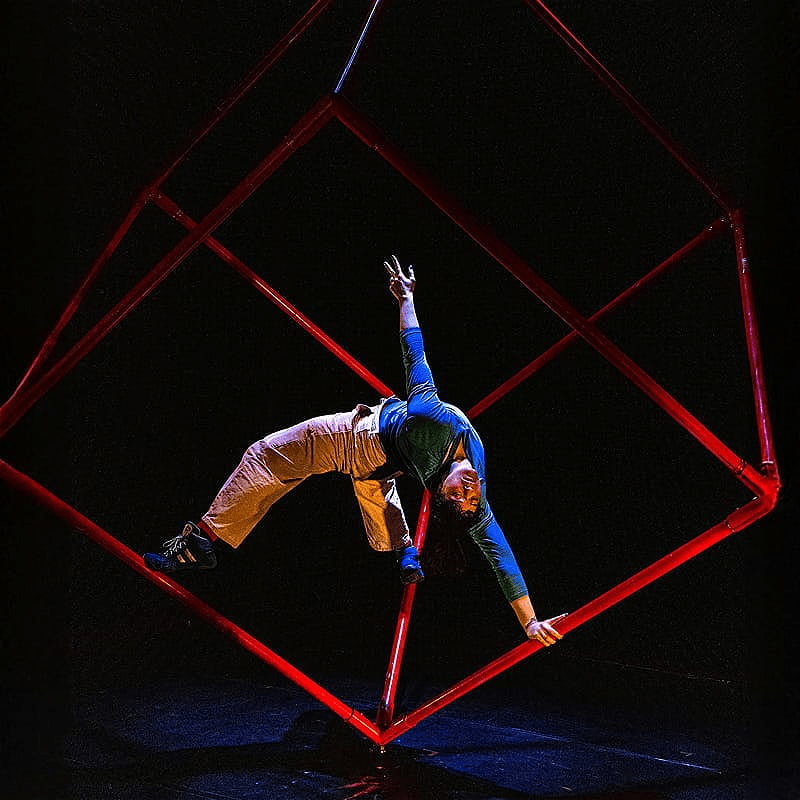
The Edinburgh-based Sadiq Ali Company are circus performers, and Tell Me is an inventive and powerful piece of work. It deals with two diagnoses of HIV, for a man in the 1980s and a woman in 2026, and traces the very different options and trajectories, showing how far we have come in being to prevent a disease which killed so many a generation ago. The purpose of the show it to highlight the threats to this progress from far right politics and funding cuts. The narrative is delivered through a selective voice over, but the medium of expression is the three performers’ remarkable skills. They perform on a metal frame, two metal cubes suspended within it. Their feats of flexibility and strength escalate, to the audience’s astonishment, as they pull off moves that are more and more risky and unlikely. It’s not just a display of skills though – the choreography is coherent and highly expressive, and the show is moving and complete.
Collaborator by Ockham’s Razor – Pleasance at Edinburgh International Conference Centre
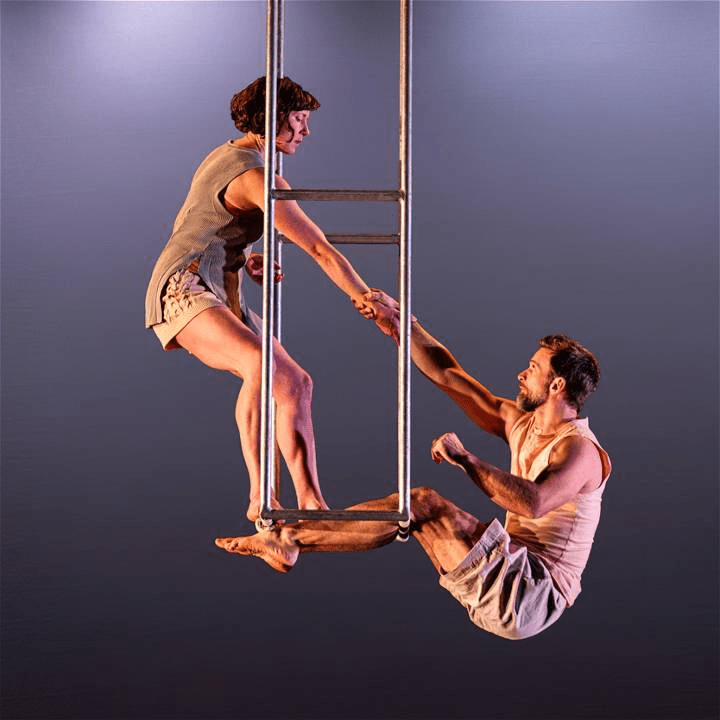
Ockham’s Razor are led by circus performers Charlotte Mooney and Alex Harvey, who met at circus school twenty years ago, married and started performing together against their best instincts. They went on to build a company and fascinating CVs, but it’s been a while since they performed as a couple. Now 47, they do it one final time, devising a show which is just the two of them, and expresses the trust and tensions of marriage and interdependence. Collaborator is genuine and moving, and a huge physical achievement. Much of the show is performed inside an open, metal box suspended 20 feet above the stage. Even hanging from this height would be too much for most of us, but it’s their resting position as they prepare for fluid sequences of intertwined moves, as they raise, support, lean and lie on one another, all in mid-air. It’s mesmerising to watch, and the couple’s charm is unmistakable, down to Charlotte’s need to find her glasses every time she talks to the audience. The show has several segments, including sequences using pendulums and digressions on wave theory, some of which work better than others. However, at its best – when they are showcasing their circus skills – Charlotte and Alex own the stage one final time.
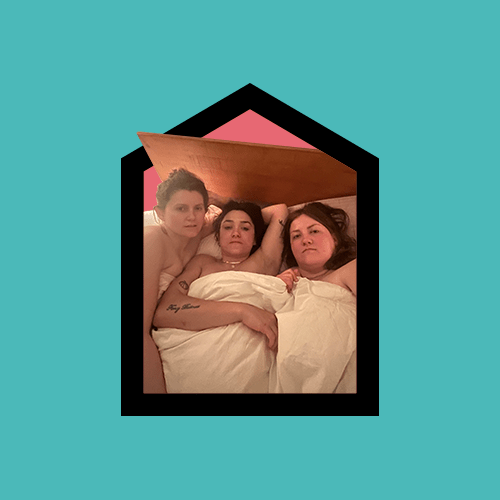
In Bed With My Brother broke through with their exceptional, unpredictable show Philosophy of the World at the 2025 Fringe. For one night only they reprised highlights of their previous career, which goes back to 2016 when they got together in Exeter. Nora Alexander, Dora Lynn and Kat Cory claim to have performed this succession of very silly and highly entertaining sketches before, but it is quite possible they were making all this up. They also open the show by describing them as ‘shit’ and, having lowered expectations, are to do precisely as they please for the rest of the evening – a very freeing strategy. This includes a whole series of throwaway non-sketches including Soup and a Towel, which is like Vic and Bob with more nudity, and a game of Guess Who? in which they ‘flip’ members of the audiences. Kat takes all her clothes off and pretends to heat up a vindaloo in a microwave. They show a dance they claim never to have got right and eventually, invite a trio of pre-briefed young men up on stage, who do it perfectly. Then they have to finish because the stage manager says they’re 10 minutes over. Everyone in the room enjoys every minute of a show that illustrates what is possible with the confidence to be as silly as you can possibly be on stage.