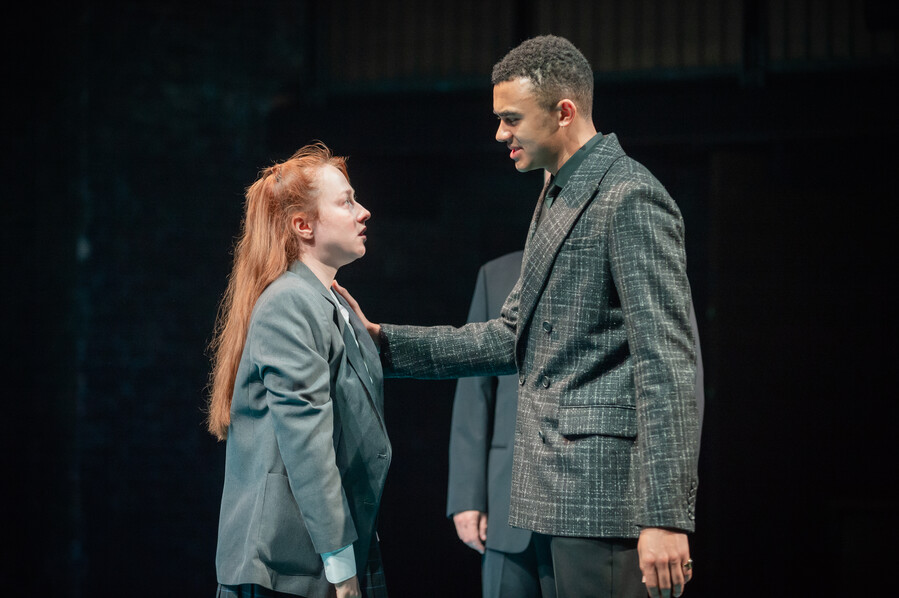
All’s Well That Ends Well by William Shakespeare – Royal Shakespeare Theatre, Stratford-upon-Avon
All’s Well is the definition of a tricky play, with its combination of the fantastical and the emotionally brutal, its historically specific yet confusingly vague setting and its hard-nosed, difficult-to-love main characters. Embracing the oddness is probably the only way to make it work on stage but, despite some promising ideas and strong individual performances, Blanche McIntyre’s production does not feel coherent.
The programme focuses on the vulnerability of teens on the internet, which the production seems keen to use as a way to understand the young anti-lovers, Helena and Bertram. The staging uses back projections of social media posts and reels. As the play begins, this which works well with the online announcement of the of the Count of Roussillon’s off-stage demise. However, the idea never amounts to more than a series of interludes between scenes, and adds little to our understanding of the play.
Nor is the set by Robert Innes Hopkins a success. A large wooden domed frame is raised and lowered over the stage to distinguish between setting, but feels clumsy and functional, especially when hung with a cloth for back-projected phone footage which, for much of the time, remains blank.
The set also contributes to a lack of distinction between the play’s settings especially Roussillon and the French court, which is also reflected in the staging. Helena leaves her home, and the care of the Countess, to cure the French king of a fistula, offering her life as a sacrifice if she fails, a bid to secure Bertram as her husband in exchange. However, the court is full of louche, idling young men who play computer games, and any sense of threat is left to Bruce Alexander as the King. Fortunately, he gives the stand-out performance as a grizzled charmer whose demeanour turns when crossed into rumbling menace.
If the King wears his heart on his sleeve, and makes no secret of his authority, Helena becomes more guarded as she understands her lack of power. Rosie Sheehy is young and naive enough to imagine fairytales can come true (although dressing her a schoolgirl labours the point). She also possess fairytale powers of healing so when she cures the King, off-stage and without explanation, it is perhaps understandable that she expects he will make her happy ever after in return.
Her mortification when she realises that Bertram has no wish to play the part she has assigned him is total. From then on, she works differently to achieve her aim. Faking her death, disguising herself as a backpacker (an updated version of the original pilgrim) and concocting a plot that deceives Bertram into getting her pregnant, she plays very dirty indeed. In a modern context she would be sent to prison for what she gets up to. However, we are left in no doubt that Bertram is a wrong-un, and Benjamin Westerby very successfully conveys a disdain for Helena that goes beyond the horror of an excitable young man, careless of others, discovering his freedom has been taken away without his consent.
The success of the play requires some particularly disparate characters to convincingly create a world the audience can believe in. Some parts are notoriously challenging, especially the braggart Parolles who is less amusing than Shakespeare, in granting him a great deal of stage time, seemed to imagine. Jamie Wilkes works very hard indeed and entertains the audience with his physical daring and a spectacular meltdown when tricked by his fellow soldiers, Falstaff-style, into revealing himself as an abject coward. However, his wider role in the play as a foil and warning to Helena is not clearly communicated.
Simon Coates, as the courtier Lafew, makes his scenes baiting Parolles very enjoyable. However, Funlola Olufunwa’s manic Widow seems unrelated to the play around her, while the character of the clown Lavache, despite Will Edgerton’s best efforts, is peripheral. The Countess, usually seen as a star role, fades into the background. Claire Benedict seems to lack opportunities after the opening scenes to make her presence felt, and is not helped by the production which shunts her to the back of the stage in most of her scenes.
Blanche McIntyre can do difficult Shakespeare well, as she demonstrated with her Measure for Measure at the Globe last winter. However, with All’s Well she does not locate the conceptual unity needed to bring the story together and help us believe in its sharp changes in tone and the moral opacity of its world. Rosie Sheehy’s performance is involving and legitimately low-key, but seems at times to be undermined by the production which tries too hard to create noise; but not hard enough to help us understand the motivations of characters who refuse to behave the way we would expect.
 Tom Bolton