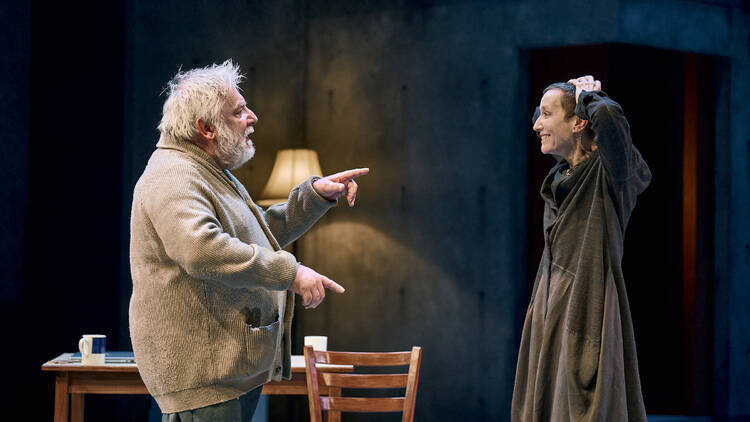
Simon Russell Beale and Le Williams – photo by Manuel Harlan
John Gabriel Borkman by Henrik Ibsen – Bridge Theatre, London
Ibsen’s penultimate play, John Gabriel Borkman is rarely performed but, unlike his final play When We Dead Awaken, it is hard to understand why. It is a highly dramatic study of what happens to a family when it is disgraced, a subject of perennial fascination, full of great roles. The patriarch, known in his heyday as ‘JG”, is played by Simon Russell Beale, who has become a connoisseur of the best leads for the older actor. His wife, Gunhild, is played by Claire Higgins and sister-in-law Ella by Lia Williams. This heavyweight cast, deployed to great effect by director Nicholas Hytner, are the successors to the great trio of Paul Schofield, Vanesa Redgrave and Eileen Atkins who played the roles in its last major London revival, more than 25 years ago at the National Theatre.
The play’s title character, known as ‘JG’ in his heyday, lost his position as a mover, shaker, and head of a bank when he was jailed for fraud. The money was, of course, just resting in his account. In eight the years since his release he has lived in the same house as Gunhild, but separately. In the opening scenes, while she broods downstairs he can be heard relentlessly pacing the room above. Their son, Erhart, is Gunhild’s obsesssion, and she schemes to push him towards greatness to show that the family can redeem itself. Erhart (Gabriel de Souza) is desperate to escape the poisonous home atmosphere and make his own life, somewhere a long way off. Then Ella turns up, Erhart’s surrogate mother during his childhood, carrying the matches that will ignite the tinderbox.
Staged on a cleverly Nordic set by Anna Fleischle, the play is apparently biographical, in that Ibsen and his wife fought each other all the time, and competed through their son. Although the play is ostensibly about JG, it focuses just as much on the dynamic between the two sisters who, it emerges are fighting each other for both father and son. Claire Higgins plays Gunhild as comfortable in her role as the embittered, betrayed wife, but also terrifyingly needy and vulnerable when Erhart comes into the picture. Lia Williams, one of the most under-rated actors of her generation, is thin and jumpy, but far more robust beneath the surface, a force to be reckoned with because she is capable of adapting and, unlike Gunhild or JG, seeing beyond herself.
As the latter, Simon Russell Beale gives one of his best performances. He is full of bluster about getting his business and influence back, especially in front of one-despised lackey Vilhelm (an excellent Michael Simkins), now his only friend, but there is a brittleness to everything he says that reveals his inner despair. Paul Schofield played the character as a man who had lost his mind, with awful consequences. Russell Beale is more human, more calculating and, ultimately more affecting when he decides to take his own path after all. This path leads, as so often in Ibsen, to the top of something tall from which there is no coming back, alive at least. The symbolism in the drama plays against its social realism, with the Norwegian mountains representing both damnation (JG is obsessed with mining the iron they contain) and salvation (climbing to the very summit is the only release from the misery of the world below). The production is a very fine piece of work, and includes several of the finest performances you will see on a stage. Not to be missed.
 Tom Bolton