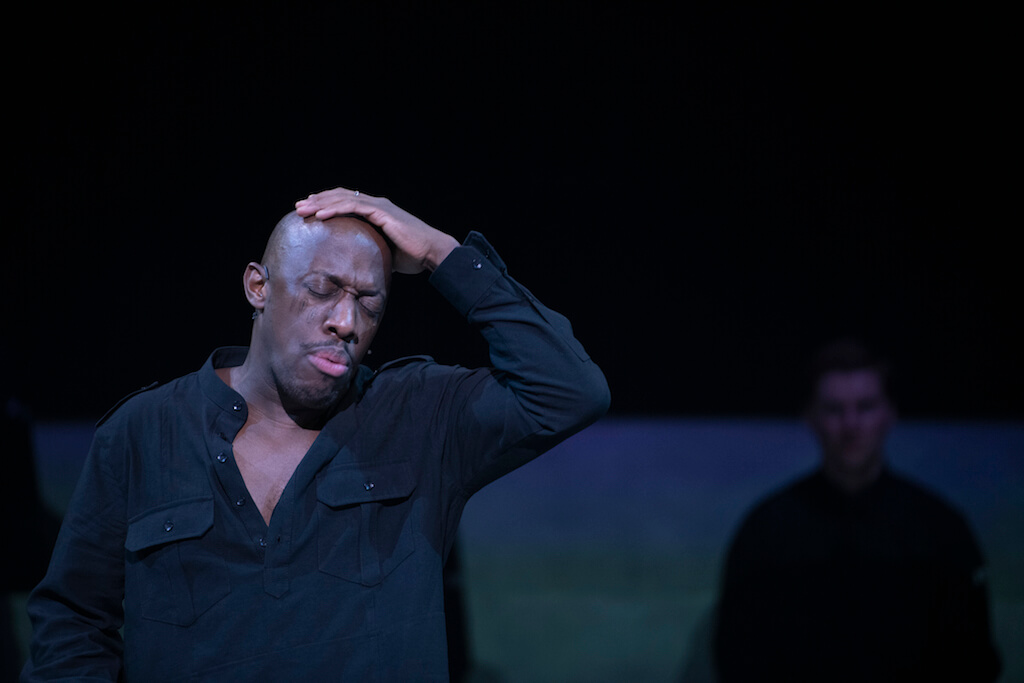
Giles Terera as Othello. Image by Myah Jeffers.
Othello by William Shakespeare – National Theatre: Lyttleton, London
The scene is set before the plays begins by projections of theatre posters which cover Chloe Lamford’s amphitheatre set – the production history of Othello since the 19th century. None of these versions had a black director, and Clint Dyer’s new National Theatre production is the first time this has happened in Britain. Dyer, the NT’s Deputy Director, redefines the play for our times, not by imposing interpretation from above but by revealing meaning within Shakespeare’s words. Like all the best Shakespearean accounts, he makes his interpretation seem obvious. How could we not have seen it like this before?
Giles Terera’s refined Othello seems aloof at first, separating himself from the oppressive Venetian world around him. It soon becomes clear this is his protection from a society that accepts his military skills and, in return, gives him contempt and worse. The Duke of Venice’s entourage, in fact almost everyone in the play, is in black-shirt uniforms and go about wielding burning torches, like an incipient lynch mob. Paul Hilton’s twisted, sadistic Iago is a military man through and through, a sergeant major who embodies the attitudes of the system he serves. In his military moustached, he bears a striking resemblance to Enoch Powell, played upon in the first scene when he puts on a West Midlands accent as he leads a baying mob to the Duke’s door. He is also an arrogant wife-beater (Tanya Franks’ Emilia appears with a bruise across one cheek) and con-man, his mouth constantly curdling into a sneer. But, in targeting Othello he is simply putting the culture of Venice into action.
The sense of a world closing in upon Othello is very effectively enhanced by Dyer’s use of the case a black-clad chorus, who sit in tiered rows around the stage, physically amplifying and reflecting the mood – twitching their heads in unison as Othello wrestles with what Iago has told him, or marching around the rim of the set in a torch-bearing procession. Their presence focuses the sense that Othello is allowed to exist only so he can, when it becomes necessary, be destroyed. Dyer also makes it clearer than any production I have seen before that Othello, although he imagines otherwise, can have no free will in a society that despises him for the colour of his skin. Until Iago unleashes his grim plot, he is the only character who soliloquises to the audience. As soon as he feeds Othello his story, the latter begins to speak directly to us as well, as though performing under Iago’s control.
Hilton is excellent, and so is Terera as a powerful but sympathetic Othello, fighting against himself and his inability to see things for what they really are. The other stand-out performance is Rosy McEwen’s Desdemona. She is self-possessed, witty and in no respect a victim, which makes what happens to her all the more heart-rending. Her angry cry of “These men! These men!” is the play’s emotional climax. Othello is never a cheerful play but this is production is exceptionally dark, both in look and mood, and that seems the only way to understand it. Shakespeare, somehow, gave us a brutal account of the way societal racism destroys everyone in its path, a message that has lost none of its relevance. Dyer’s version is harsh and revelatory.
 Tom Bolton