Photo by Johan Persson
Phaedra by Simon Stone from Euripides, Seneca and Racine – National Theatre (Lyttleton), London
Simon Stone’s rewriting of Phaedra is the latest of many reworkings. Each finds something that speaks to their time in the myth of Cretan princess who falls in love with her stepson and, when he rejects her, causes his death and her own. Stone, who has written and directed the National Theatre’s new version, makes an utterly convincing case that this is a play about things that concern us now. His production has all the confidence and clarity that comes from working with the Toneelgroep in Amsterdam, and is a thrilling experience.
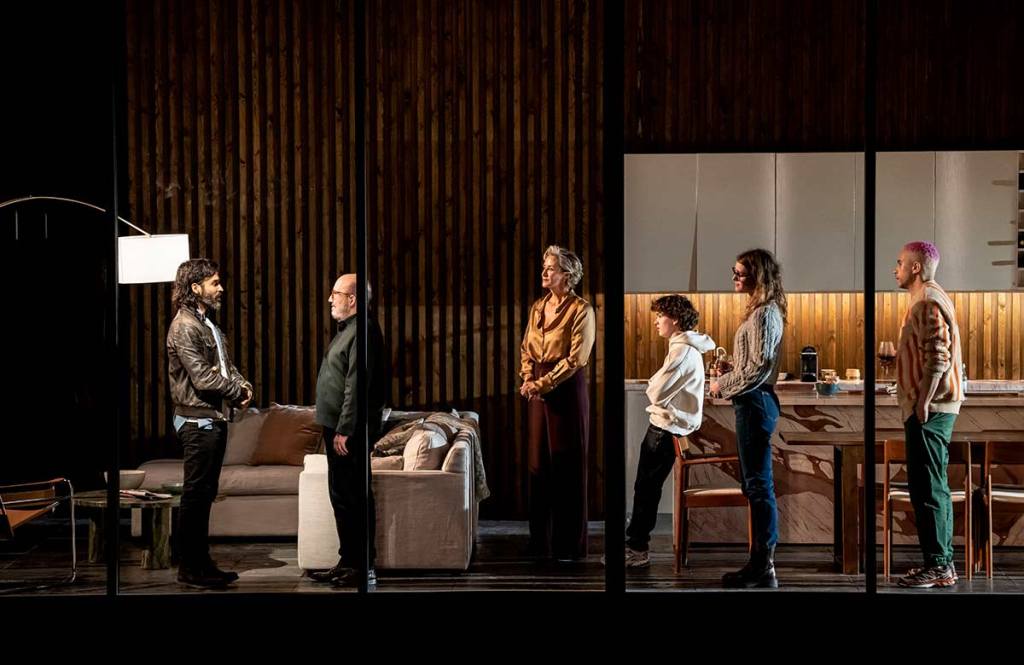
The action takes place inside a glass box designed by Chloe Lamford, which at first seems to distance the audience from the action. However, it soon becomes apparent that this visual metaphor is the key to Stone’s interpretation. He shows us our society through the floor-to-ceiling windows that look down on our cities from new apartment blocks, as well as through our phones, putting everything is on display. His Phaedra is Helen (Janet McTeer), a shadow cabinet minister in an unspecified party, married to Hugo, an ambassador, with an older married daughter Isolde (Mackenzie Davis – making a remarkable stage debut) and a teenage son Declan (Archie Barnes). Their life is busy, high powered and wealthy. The opening scene shows us their family life, inside the box, as they gather for what we discover will be a meeting that upends all their lives. The energy and quality of Stone’s writing shines from the opening moments, as the family greet, tease, annoy and swirl around one another. Actors speak over one another in a way almost never seen on stage – perhaps only in work by Annie Baker – and we are completely convinced that what we are watching is absolutely real. Phaedra starts at top pace and never relents, whisking us through the arrival of the son of Helen’s former Moroccan lover, Sofiane (Assaad Bouab). He has come to see the woman who broke up his family decades before. In response, Helen’s family tear themselves apart.
The evening is a succession of memorable scenes, powered by Stone’s direct, note perfect script and by a full house of fine performances. McTeer is every inch the queen bee politician, whose career always has to come before her family, who either serve her or struggle to escape. It is subtle, clever commentary on the psychological toll politics demands from women. Chahidi gives the performance of a lifetime as the cosmopolitan, loyal and funny companion squeezed out by the history within his family, and his messed up post-colonial identity. Bouab is sincere and devastating as Sofiane, who breaks apart the society his fins simply by his presence, letting the guilt flood out. Davis is very subtle as the daughter who can never please her mother, but can certainly hurt her. John MacMillan, as her husband Eric, is funny and touching as everything goes utterly wrong for him. Barnes is also great, as a teenager old enough to be cocky, young enough to be totally vulnerable.
The glass box situates the audience as voyeurs, gazing on as the increasingly brutal events play out. The more shocking the events become, the more public they are. An astonishing scene erupts at Helen’s birthday meal in a restaurant, next to tables of shell-shocked diners, as both Helen and Isolde reveal they are leaving their husbands for Sofiane, in front of both husbands, Sofiane himself, Declan and a friend (Omolara, played by an acerbic Akiya Henry). But what seems personal is every bit political, as the colonial power relations between France and Morocco, Britain, Nigeria and Iran all become directly relevant to how people relate to one another now. The play, unusually for a British production, is multi-lingual with sub-titled French, Arabic and Farsi spoken at various points. As well as being a thrilling evening of theatre, it is also a highly intelligent dissection of the nation we have become, arrogant enough to imagine we can separate ourselves from the rest of the world and engage with it only on our terms. It is also a very un-English production in the best way, and we should hope that the European influences of creators like Simon Stone continue to feed back onto our own stages, making them less insular and far more connected.
 Tom Bolton