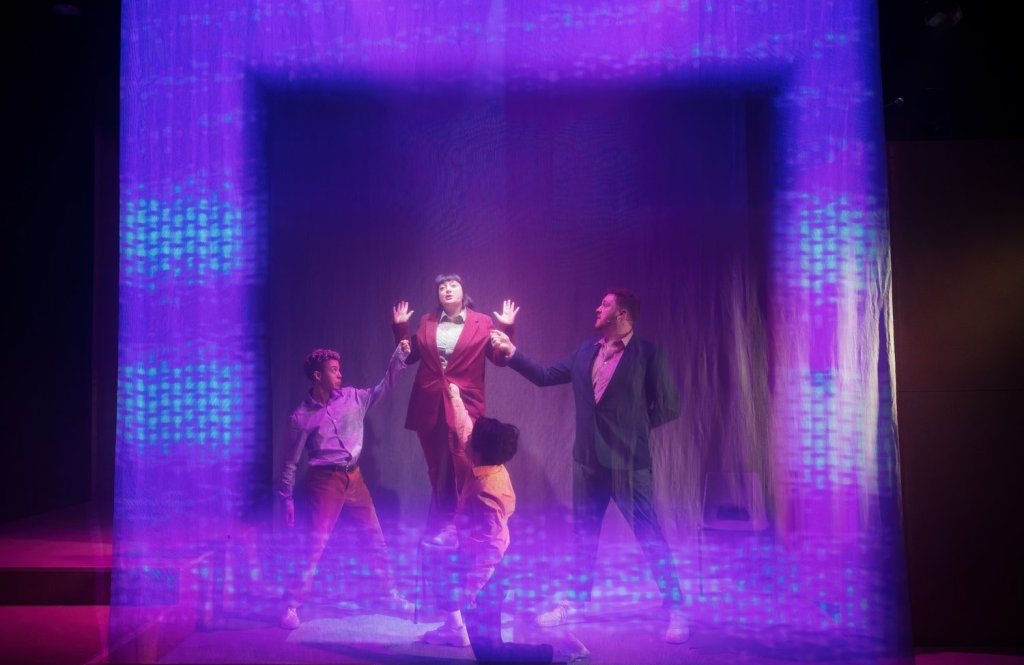
After the Act: A Section 28 Musical by Breach Theatre – New Diorama Theatre, London
The New Diorama’s Intervention 01, a season with no shows during the second half of 2022 is over. Its aim was to take stock post-Covid, regain excitement, and focus resources on building ambitious work that would not otherwise get staged. On paper, it was a bold and forward thinking, but the test lies in the quality of the work that comes out of the process. Breach Theatre’s After The Act strongly suggests this was an artistically inspired move. Their musical about Section 28 – legislation passed 35 years ago by Margaret Thatcher’s government banning “the promotion of homosexuality” in schools – is a wild, moving, engaged and essential piece of theatre. It tells audiences to look much harder at their assumptions about the supposedly progressive society they live in, and does so from the throes of a brilliantly unhinged party.
Co-writers Ellice Stevens and Billy Barrett have devised a verbatim / musical / agitprop / physical theatre with strong echoes of Tammy Faye and the film Blue Jean, but with an identity all of its own. Directed by Billy Barrett the four performers, including Ellice Stevens as well as Tike Mu’tamir, EM Williams and Zachary Willis put on a high energy show. Their movement and physical occupation of the stage is beautifully choreographed, as they create the show’s all-action atmosphere by impersonating an entire dance troupe. The music, played live by composer and musical director Frew and by Ellie Showering, is synth-driven, catchy and entirely appropriate to a show about the 1980s, without entering the realms of pastiche.
While the music is highly entertaining, the show’s power comes from the sophistication of its writing, which draws on deep analysis of the circumstances around the Section 28 controversy. It’s safe to say this the first time anyone has put former Manchester City Council leader Graham Stringer’s protest rally address to music, still less the grimly bigoted Parliamentary speeches made by Conservative MPs Elaine Kellett-Bowman and Jill Knight in support of the bill. The clause stated that a local authority should not “promote the teaching in any maintained school of the acceptability of homosexuality as a pretended family relationship.” It is a shocking piece of hate that had serious consequences for some and gave rise to iconic cultural moments. The ‘invasion’ of BBC News studios by protestors is very entertainingly staged, Nicholas Witchell and Sue Lawley still gaining plaudits today for the way they dealt with those awful lesbians. The accounts of the two women who abseiled into the House of Lords debate on the bill are funny and moving. Breach Theatre also cleverly stage scenes from the pages of Danish children’s book ‘Jenny Lives with Eric and Martin’, which became a lightning rod for the fear and hatred that exploded from the bill’s supporters.
The show boldly switches mood several times. Verbatim-style scenes, including accounts of the experiences of a teenager bullied for being gay and a teacher forced to hide her real self, are powerful and make the arguments against Section 28 by themselves. The clause was only repealed in 2003, showing our society had not progressed nearly as far as people imagined by the early 21st century. Importantly, Breach also makes the link with current debates around Trans rights explicit, pointing out that it remains fundamentally wrong to tell someone they must change who they are. Unfortunately, this message remains as urgent today as it did in 1988. The show is full of invention, variety and sophistication. It is a tribute to the New Diorama’s leadership that they have found a way to support and enable work this good. After the Act is Breach’s best work to date, and an exciting leap forward for a company who have always promised much.
 Tom Bolton