The House of Bernarda Alba by Federica García Lorca – National Theatre: Lyttleton, London
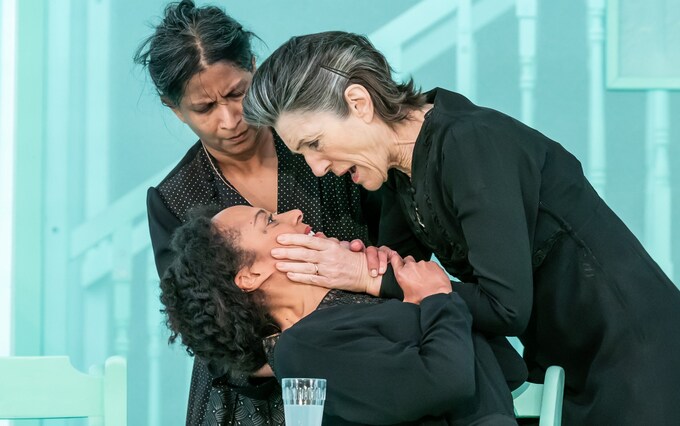
The titular House of Bernarda Alba, as directed by Rebecca Frecknall for the National Theatre, is laid out before us like a doll’s house with the front removed. Merle Hensel’s set exposes two floors of rooms – bedrooms where the tortured, insanely oppressed women of the house sit alone and brood, and the downstairs living room, kitchen and yard where they talk to and gradually destroy one another. The house, where Harriet Walter’s matriarch Bernarda plans to shut up her five adult daughters for a supposedly traditional eight-year mourning period, is shut off from the outside world. The only, fateful, interaction comes through illicit encouters over the high gate. Frecknall stages sone scenes as taking place simultaneously, dialogue overlapping in different parts of the house, a clever device that enhances the claustrophobia and the realism of events.
Harriet Walter’s performance is central to Lorca’s dark but fascinating play, an brutal allegory of fascism, religion and sexual oppression. Traditionally, she is a dragon but Walter plays her as a surprisingly sympathetic character. While she dominates her daughters and is violent towards them, we have the strong impression that her social conditioning has led to act this way. It is impossible to take your eyes off her as she wrestles with her family’s seething frustrations. Performances across the board are excellent. Lizzie Annis is perfect as a Martirio, boiling up just below the surface. As Magdalena, Pearl Chanda’s spirit is turning to bitterness, directed at those around her. Rosalind Eleazar as Angustia is the oldest daughter, and the most terrified that she will never marry and leave the house. As Emilia, Eliot Salt is younger, with a kindness that does not serve her well. And the doomed youngest daughter, Adela, is played by Isis Hainsworth as a very convincing teenager, thoughtless and heedless in a way everyone is at her age.
The family also includes Thusita Jayasundera as all-knowing housekeeper Poncia and Bryony Hannah as the maid, providing a commentary as household tensions built. Frecknall brings the world outside into the house in the form of stylised movement sequences involving the wordless Pepe El Romano, the external male disruptor who will tear the house apart. She also stages a shocking scene in which the reported pursuit of a local woman who has killed her baby bursts into Bernarda’s living room, as a mob seizes their quarry, like a tableau of a mythical hunt. This is a key moment in a play that is about society rather than events in a private house, and how the two are inextricably linked. Frecknall’s excellent production reveals the play’s continued power, 87 years after its author was murdered by a state he could clearly see coming for him.
 Tom Bolton