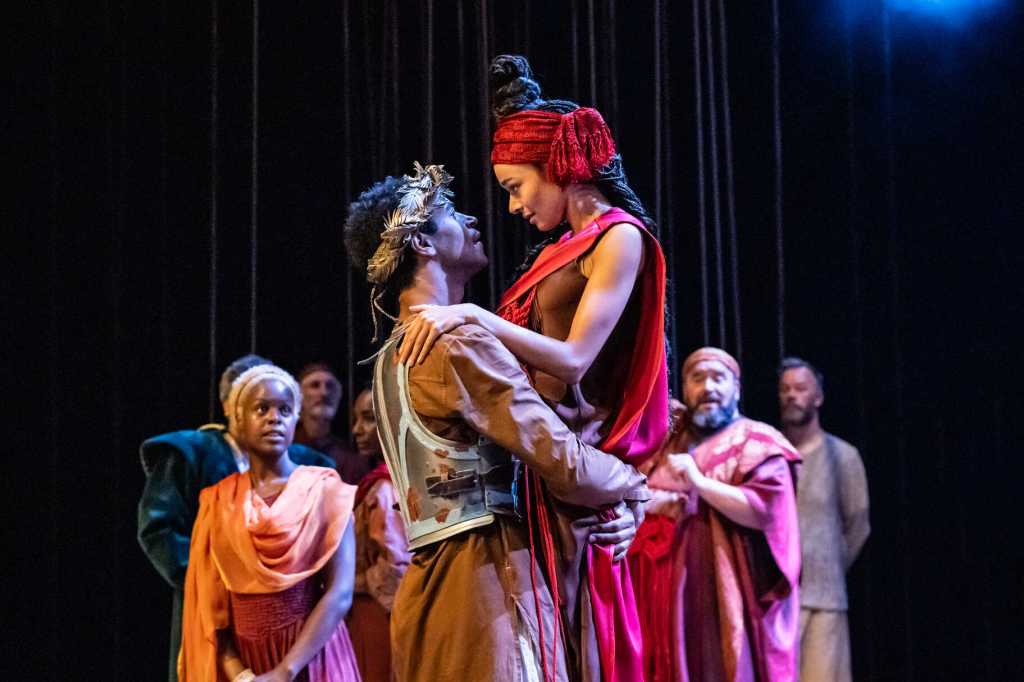
Pericles by William Shakespeare – Swan Theatre, Stratford-upon-Avon
Published at Plays International
Pericles is perhaps the least well-regarded of William Shakespeare’s play: episodic, fantastical, thematically confusing, and written with an unknown collaborator (possibly, but not definitely, brothel-keeper George Wilkins). Even the Royal Shakespeare Company only undertakes it occasionally, the last time 18 years ago. So it is a bold choice for new RSC co-artistic director Tamara Harvey’s first Stratford Shakespeare and, it turns out, an inspired one. With a company of actors mostly making their RSC debuts, this production is a chance for Harvey to make a statement about how she and fellow boss Daniel Evans see the future for the country’s premier classical company. It is a major achievement that she leaves the audience wondering why they know so little about such a spellbinding play.
The plot of Pericles is absurd if judged as realism, but as a story with its origins in Greek myth the play makes a lot more sense. The titular character roams the Eastern Mediterranean beset by assassins, shipwrecks, and the apparent loss of his country, his wife and his daughter. It is a picaresque adventure, powered by terrible personal loss and impossible redemption. It is also a review of government, as Pericles encounters leaders who are in turn depraved, honest, deceitful and, finally, converted from sin to an honest life. Events derived from the realms of myth provide a lens for examining the way mortal men and women respond to power.
Jonathan Fensom’s simple set, draped with ropes and hung with astrolabes, turns the Swan Theatre into a ship. Or rather, it reveals that the much-loved auditorium has always been a ship – its wooden balconies decks and its thrust stage a prow. Striking, beautiful costumes by Kinnetia Isidore are Greek but also Levantine, Indian, Japanese – tunics and robes slashed with colour, setting the play in a distant, semi-fictional past. And Claire van Kampen’s music, full of swirling woodwind, with a modern song neatly inserted, places us firmly in a land of imagination. What brings these elements together is the use of movement, choreographed by Annie-Lunnette Deakin-Foster, with the full cast constantly on stage striking tableau or writhing en masse to create vivid settings out of nothing. We know which city we are in – and there are several – simply by the way they move. As a binding visual motif it is a brilliant concept, bringing unity to the disparate plot strands and timelines.
For this to work, the company has to work exceptionally well together, and Harvey’s cast is a tight and compelling group. They are led by Pericles, played by Alfred Enoch who, a somewhat naïve perennial optimist, is relentlessly ground down by the horrors he experiences until he is left mute, perched on the edge of the stage while the action continues without him. His reunion scenes with Marina, and with his lost wife Thaisa, are genuinely moving but, in a very well-judged performance, he leaves the distinct impression that his mind may be lost beyond redemption. He is permanently changed by grief, even though the people he thought lost have returned.
Harvey makes the clever decision to give the part of the play’s chorus, Gower, to Marina, Pericles’ daughter. This places Marina, who would otherwise not appear until Act IV, on stage throughout the play, albeit as a baby in a couple of scenes. It also makes the potentially distancing narration conspiratorial, and sympathetic, drawing us in. Rachelle Diedericks’ excellent performance is honest, open, and credible. We believe that she really can convert punters from their sinful ways, in the notorious brothel scenes. The play’s themes of hope, acceptance, and love are as relevant now as ever.
The cast is uniformly strong. Felix Hayes is darkly louche as the incestuous King Antiochus, and very funny as a gaping Pander and a somewhat touched Fisherman. Christian Patterson has the audience in the palm of his hand as the jovial King Simonides. Chukwuma Omabala is ravaged by disaster as King Cleon, in a Macbeths-style double-act with his scheming wife Dionyza (Miriam O’Brien, cooly understudying the indisposed Gabby Wong). Leah Haile’s Thaisa is totally assured, and Philip Bird’s staunch retainer Helicanus holds much of the play together. There are distinctive memorable performances in multiple roles across the cast, including from Jacqueline Boatswain, Sam Parks, Miles Barrow and Chyna-Rose Frederick. It is easy to imagine many of these actors becoming Stratford favourites in the years to come, part of a lineage neatly summed up by a departing audience member who remarked that he had seen Alfred Enoch’s father (Russell Enoch) in the first RSC season he watched, in 1970.
The production’s coherent vision makes light of the play’s supposed difficulties, and reveals it as an enchanting mixture of allegory, story-telling, romance and wish-fulfilment. Tamara Harvey’s revival of this unloved piece is something of a revelation. She makes a powerful case for a company that can bring fresh perspective to texts we think we already know, and give us the theatre we did not realise we needed. This is of course why the RSC exists and, on the evidence so far, the future looks very promising.
 Tom Bolton