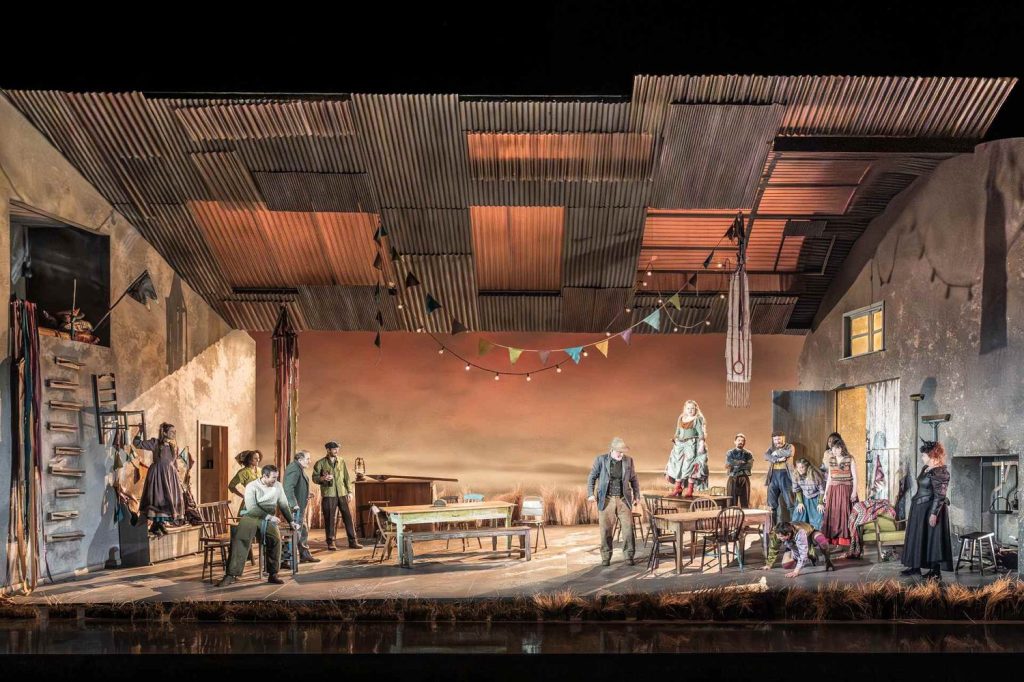
Playboy of the Western World by J.M. Synge – National Theatre: Lyttleton
Caitríona McLoughlin’s production J.M. Synge’s masterpiece seems to be the first at the National Theatre since 1976, which is extraordinary. The play, once a staple of amateur dramatics, has perhaps become a little forgotten in the UK, although not in Ireland. McLoughlin is the artistic director of the Abbey Theatre, Dublin, and brings an all-Irish cast to London to familiarise new audiences with a play that once caused riots.
Synge’s writing is remarkable – both deeply lyrical, with a powerful ear for speech patterns in the west of Ireland, and blackly comic. Both must have been revelatory for 1907, when the play premiered in Dublin. The play is populated entirely with people of no social consequence living in a poor, even despised part of the country, but Synge makes their language a thing of beauty. It’s set in a pub, where characters talk in a way they might not elsewhere. At the same time, he punctuates the play with the kind of comic violence – Old Mahon, who just won’t die – which seems remarkably modern. Playboy could be seen as the origin play for the subsequent century of Irish drama, from Friel and to McPherson to McDonagh.
McLoughlin, on a widescreen set by Katie Davenport, gives the production life and movement, if not always consistency. The cast is fascinating, but offers a range of peformance styles that do not always gel. At one end of the scale is Siobhán McSweeney’s urbane Widow Quin, giving it her all when trying her luck with Christy Mahon, but experienced enough to let it go and change tack too. At the other end is Lorcan Cranitch’s Michael Flaherty. Cranitch gives a performance that threatens to steal the entire play. In a very thick Mayo accent, he builds up to a dramatically drunken entrance on his return from a wake where “You’d never see the match of it for flows of drink.” He plays an entire scene while in a highly unbalanced state, constantly threatening to topple over, and the audience cannot look away. It is a complete tour de force. However, the contrasting performances do illustrate the production’s inconsistent tone.
Elsewhere, Éanna Hardwicke is extremely unnerving as Christy, gurning and almost slithering around the set. He leaves the audience unsure whether he’s a fool or a cunning chancer, or whether he’s sincere. Nicola Coughlan is fierce and charming as Pegeen Mike, but perhaps lacks the presence the part demands, to dominate a barroom full of people. However, her final scene, howling on her knees as Christy departs, is chilling. Marty Rea’s Shawn Keogh exudes weakness from his apologetic frame, while Declan Conlon is excellent as a domineering, physically threatening Old Mahon. The supporting cast are strong, especially the gaggle of local girls led by Marty Breen as Sara Tansey and Fionnuala Gygax as Honor Blake.
Despite some reservations, however, the play is fascinating and entertaining and very much reconfirming its classic status. The themes around easy celebrity and fickle popular opinion seem extremely current, while Pegeen Mike’s sexual independence, and the unashamed interest of women in sex, which triggered the 1907 riots, is refreshing and seems well ahead of its time. And Synge’s language remains a thing of wonder. Its dense wordplay makes no compromise whatsoever for the watching, listening public and, as a result, draws them deep into a parallel world. Playboy remains thrilling after all these years.
 Tom Bolton