Medea

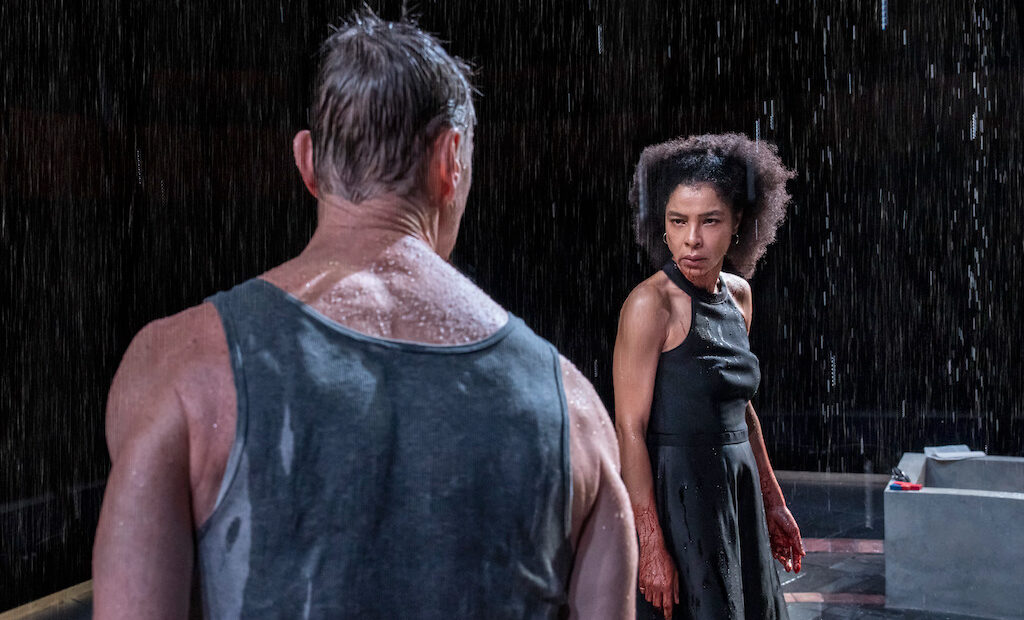
Ben Daniels and Sophie Okonedo. Photo: Johan Persson.

Medea by Euripides – Soho Place Theatre, London

Soho Place remains a strange theatre – an in-the-round jewel box concealed inside a weirdly bling office block in the new Elizabeth Line era Tottenham Court Road. Vast LED screens, gold-effect facades, low ceilings and high bar prices create an eerie setting, a non-place that belongs no more to London than to any other global city. All the more fortunate, then, that the theatre itself is the best small space in the West End, albeit with few competitors. As the setting for Dominic Cooke’s production of Medea, it could not be bettered. Viki Mortimer’s design consists of a tiled Mediterranean oval and a set of stairs that lead down to an unseen place below. Within the oval, the action takes place. Around it, consequences gather. Below, the worst deeds of all occur. Ben Daniels, playing all the male roles including Jason, Creon, Aegeus and the tutor to Medea’s sons, circles around the oval, approaching in slow motion as Medea speaks, while she is always trapped at the centre of the stage. Cooke also takes the ingenious decision to place the three actors playing the Women of Corinth, who form the Chorus, in the audience. Penny Layden, Jo McInnes and Amy Trigg interject from their seats, stand up and shout advice and eventually come up on stage, where they are reluctantly drawn into the unfolding horror.

As Medea, Sophie Okonedo is entirely herself, but also a woman whose revenge is to become what other people want her to be. The logic she applies to the decision to kill Jason’s offstage lover Glauce and then her two sons makes sense not just to her, but to us as well. She has been stripped of all power – used by Jason to climb the ladder, discarded for another woman and thrown out of Corinth with nothing. She could seek the protection of another man, Aegeus, but if everyone including her husband thinks she’s a witch and an evil influence, proving them right is the obvious course of action. Okonedo is mesmerising, fully inhabiting a role that develops agonising step by agonising step, as Medea strips away all her options until only one remains. Marion Bailey, in the Chorus-like role of the Nurse, expresses the horror at Medea’s actions which she herself is unable to feel.

Ben Daniels’ performance is just as good as that of his co-star, if entirely different. He switches roles with impressive ease, even drawing laughs for his camp Aegeus, while delivering a convincing brutal Creon and a Jason so self-centred he genuinely cannot understand what the problem is. Medea is simply there to do as he says, and trust him even as he destroys her. The test is by Robinson Jeffers, a classic translation first used by Judith Anderson and John Gielgud in 1947 which remains clear, direct and entirely modern. Cooke’s production is superb. The cauldron of ancient hatred he has set swirling behind the theatre’s glass walls brings some essential wildness to an urban landscape of surfaces. It is important that Soho Place continues to programme theatre that would not otherwise be seen outside the subsidised sector – such as Medea and As You Like It – which gives the West End some much-needed depth.

Macbeth

Macbeth by William Shakespeare – Southwark Playhouse (Borough)

Published at Plays International

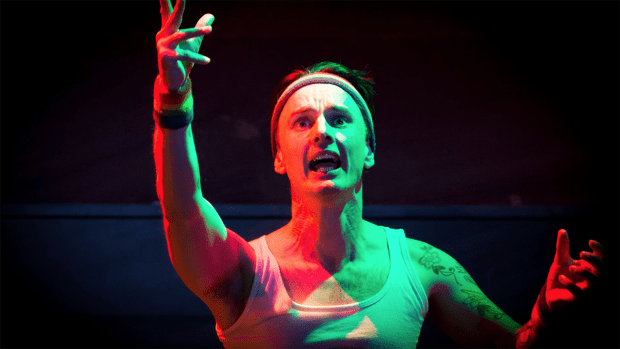
It is an unusual Macbeth that comes to life with the Porter’s scene, the play’s disconcerting post-murder comic interlude – even more so when it is performed without words. Dale Wylde’s mimed scene is a weird and captivating interlude. It encapsulates the strengths and weaknesses of Flabbergast Theatre’s version, which is a powerful physical spectacle, but frequently seems encumbered by the play’s text, which gets in the way of the performers’ urge to express themselves. The company is on stage throughout, dressed in braces and sackcloth kilts and daubed with mud. As the audience arrives, they are already moving as a group, twisting and grasping at things in the air around them. This haunted atmosphere defines the show. The performers generate a powerful physical presence, driven by their commitment to a form of theatrical expression rarely seen from a British company.

Flabbergast Theatre was set up by Henry Maynard, who directs and designs Macbeth, and plays the title role. At the first opportunity after lockdown, in 2020, the new collective lit out for the Grotowski Institute in Poland to work with performer Matej Matejka, who then joined them as movement director on Macbeth. The togetherness and collective purpose that came from this process is obvious. It is exciting to see such a bold, expressive, and startling interpretation, entirely unlike the standard English Shakespearian production. It is visceral, animalistic and strange. However, the approach has some significant downsides, and the main victims are the text and the nuances of the play.

The performers tend to play their parts with exaggerated vocal mannerisms, accompanied by bold physical expression. This creates types rather than individuals with, for example, Daniel Chrisostomou’s Duncan a Pere Ubu-style grotesque. Yet Macbeth does not lend itself to this approach. Despite its all-action surface, the play is full of intuition, off-stage disasters, unspoken thoughts and social awkwardness. These subtleties are absent from Flabbergast’s version, and it is often difficult to hear what is being said. Emotions are signalled in to reinforce what the text says, including Briony O’Callaghan’s Lady Macbeth dragging her husband by the hair to help screw his courage to the sticking post, and Maynard having an epileptic seizure when confronted with the Witches’ prophecy. The company’s approach delivers impressive energy but not clarity and, without prior knowledge of the play, it is difficult to follow what is happening on stage.

Adam Clifford’s music is a key driver of the play’s atmosphere. Four drums at the rear of the stage, beaten simultaneously, create propulsive ritual rhythms. The cast prowl the stage brandishing staves, which they pound on the stage, especially effective during battle scenes, and hand chimes which sound eerie notes. The ritual element is strong, and much of the play feels like a whirlpool of fate, from which none of the characters will emerge. Interestingly, this includes Malcolm whose crowning by the witches at the play’s end is an ominous moment, a reminder that we already know his children will not succeed to the throne. 

Flabbergast’s strengths are movement and spectacle, and there are memorable scenes throughout. The Macbeths lie on a vertical bed, held up by witches and spirits whose gurning faces frame the couple. The cast moves as a single snorting, menacing cluster to send Banquo on his fatal horse ride, and lurches across the stage in unison, staves akimbo, like a cohort of samurai, as the armies advance on one another. However, the decision to include the tricky scene in which Malcolm tests Macduff by declaring himself unfit to be king, shows us what is missing. Sometimes cut from the play, it is tough to make the dialogue credible, but Maynard and Daniel Chrisostomou play it straight and, counter-intuitively, it is a moment of clarity and relief. Suddenly, the audience is absorbed in the dialogue but, when another character enters, the performance style reverts and the atmosphere dissipates.

It is tempting to think that Maynard could have achieved what he wanted by ditched much more of the script. Flabbergast’s style is exciting and, in many ways, what our text-constrained theatre needs. The company’s ambition is admirable, but Macbeth, at least in this form, is not an ideal vehicle for their skills. Perhaps it is a staging-post, en route to the fully free physical expression that these performers are clearly well-equipped to deliver.

Lemons Lemons Lemons Lemons Lemons

Jenna Coleman and Aidan Turner. Photo: Johan Persson

Lemons Lemons Lemons Lemons Lemons by Sam Steiner – Harold Pinter Theatre, London

Sam Steiner’s play has followed a well-documented path from student drama to West End, thanks partly to the simplicity of its central concept (a society much like ours restricts everyone to a maximum of 140 words, written or spoken, per day), but also its structure as a two-hander with a pair of attractive parts for an attractive male and an attractive female lead. From the balcony of the Harold Pinter Theatre, it seems like a play better suited to the Paines Plough mobile Roundabout auditorium where it became known. The play’s strongest suites are charm and intimacy, but it’s hard for even the most skilled performers to hit the back of the stalls with their loveability. Aidan Turner (who seems to have grown a beard during the run) and Jenna Coleman give it a good try though, and their interaction is convincing and enjoyable.

Set on a Roundabout-sized carpet circle walled in with domestic detritus, the action focuses on the two actors, who meet, get together and cycle through the phases of a normal relationship while politic turns dark in the background. Too much of the play, around two thirds, is spent on the build-up which, although nicely written, does not tell us enough that is new about the way men and women relate to one another. The political concept, distopian and fascinating, has great potential that is not entirely fulfilled. Steiner seems unsure whether the word limit is to be taken entirely literally, or whether it is primarily a metaphor. If the former, the writing needs to be more precise, with word limits actually enforced in each conversation rather than only sometimes. The absurdities of a situation where a couple cannot communicate because they have used up all their language elsewhere has potential that seems underexplored. As a metaphor, the idea is powerful and it is hard to believe that Lemons… predates the pandemic. The sense of claustrophobia, and the need to make the best of an inconceivable loss of freedom feels darkly familiar. The play also contrasts unjustified male certainty with restricted female expression in a way that feels agenda-setting for 2015, when it was written.

In the end, Lemons… falls between stools, providing neither a dystopian alternative near future nor a full exploration of character. Neither of the two characters, Oliver and Bernadette, feels entirely real. Nevertheless, it is a play that asks questions and at its best makes the audience shiver in recognition as well as laugh in sympathy.

Truth’s a Dog Must to Kennel

Tim Crouch – photo by Stuart Armitt

Truth’s a Dog Must to Kennel by Tim Crouch – Battersea Arts Centre, London

For Tim Crouch, challenge is inherent to performance. Walking onto a stage to address an audience immediately raises questions about who we imagine we are, both audience and actor. ‘Truth’s a Dog Must to Kennel’ is as stripped back as performance can be with no set and only Crouch, wearing a suit and a virtual reality headset, talking to us on a bare stage. He warns us that this is all we will get, and that there is nothing inside the headset either. Then, having set the bar for audience engagement very high indeed, he tangles us in a net of his own devising, leaving us amused, baffled, embarrassed and horrified during an intellectually fascinating, theatrically irresistible hour and ten minutes.

The show could be entitled ‘I, Fool’, and it clearly relates to Crouch’s series of monologues imagining Shakespeare from the perspective of marginalised characters: ‘I, Banquo’, ‘I, Cinna’, ‘I, Malvolio’ and ‘I, Peaseblossom’. For some of the time he is The Fool from ‘King Lear’, and the show plays around the character’s disappearance in Act III of the play, his fate unexplained, never to return. Crouch, with his headset on, describes a theatre to us. ‘King Lear’ is playing on stage but he, The Fool, cannot take the horrors happening around him anymore. He walks out, or tries to, away from the aristocrats torturing and destroying one another. But he also turns us gaze on the audience in a West End-style venue, from bored corporate Deloitte executives to those on pre-theatre dinner deals, in the £95 seats, or who have snuck down from standing. He describes the nature of a theatre dominated by money, where the motivations of those attending are shaped by spending power and privilege. 

The chaos on stage is just a spectacle to the West End audience, a story with no direct relevance. But Crouch also tells us about ourselves, the Battersea Arts Centre audience, in virtual reality, suggesting we are a Guardian-reading, self-satisfied tribe. He questions whether there is any point in performance or theatre.  All “this” is dying, he says, everyone watches television now. Only people like us are interested, and we do not matter. It is a stark assessment of the arts in Britain, and contains more truth than performers generally like to acknowledge. Yet he also simultaneously counters his argument with his powerful, seemingly effortless presentation of a blank slate, where a stage can be used to do and say anything.

Crouch, however, is not just interested in the small world of the stage, but in culture much more widely. The show contains a scene of jaw-dropping depravity, in which the repeated use of the phrase “you know” does nothing whatsoever to disguise the scenes of gruesome, ‘Naked Lunch’-style sex acts he describes, in detail. It is a disconcerting sequence as Crouch, whose charm makes the audience complicit with him from the start, becomes a suddenly menacing figure asking us whether we are entertained and why we think we should trust him. It is a brutal parody of reality culture, strongly suggesting that we are culturally in a dark place. 

The show’s title is a quotation from The Fool and reads, in full, “Truth’s a dog must to kennel / He must be whipped out”. The Fool is a character who says ‘no’ and stands up to the horror. He shows us that truth is something that society claims to value but rarely wishes to acknowledge. The truths about us are unpalatable. We are deluding ourselves when we think that we do not exploit others, that theatre is a medium of equality, or that we can really see what is going on. But at least we are willing to listen while Crouch shows us ourselves, in a virtual reality mirror. At its best his work is extraordinary, taking big questions and turning them into theatre that possesses a remarkable clarity. ‘Truth’s a Dog to Kennel’ is Tim Crouch on top form.            

The Walworth Farce

Emmet Byrne, Killian Coyle and Dan Skinner in The Walworth Farce. Photo by Tristram Kenner.

The Walworth Farce by Enda Walsh – Southwark Playhouse, London

It is more than 15 years since Enda Walsh’s play The Walworth Farce arrived in London and, like many big hits, the scale of its popularity then has been matched by the speed with which it has been forgotten. It is well due a revival, and the Southwark Playhouse’s revival, directed by Nicky Allpress is exciting. It is also the second play at the theatre’s freshly opened venue in the base of an Elephant and Castle tower block, the start of a much-delayed new era for the Playhouse. If the space provides capacity to examine the case for potential modern classics, it would be of great benefit to the London theatre scene.

The Walworth Farce is set in flat on the eponymous road, which begins outside the theatre’s front door. An Irish father, Dinny (Dan Skinner) and his two sons Blake (Killian Coyle) and Sean (Emmet Byrne) live together in circumstances which it soon becomes apparent are very weird indeed. Only Blake is allowed out, on strictly controlled supermarket trips, while Dinny forces the pair to join him in acting out an endless, absurdly involved ‘play’ which tells the story of their childhoods and their relationship to their revered mother, who is apparently at home in Cork. The play includes many characters, and requires constant role swapping and costume changes, but only Diddy ever wins the ‘acting cup’. They all play multiple characters at the same time, staging conversations with a different wig on each hand. It is ludicrous, funny, then sinister and, when supermarket cashier Hayley (Rachelle Diedericks) arrives to disrupt the routine, threatening to expose the absurdity of their behaviour.

The cast are excellent, and very hard working. The mechanics of the play, which are absurdly complex, are beautifully managed by the performers who have to constantly work together. Dan Skinner combines strutting menace with ludicrous self-delusion, and is exceptionally watchable. Byrne and Coyle are very convincing as brothers who are both connected and separated by their situation. On a neat, squalid set by Anisha Fields characters enter and exit via two large wardrobes during the play within the play, but when the actual front door opens the tone changes. Diedericks is enjoyable and funny as someone who has stumbled into a scenario way beyond her control.

The Walworth Farce is a very interesting play revisited from the perspective of the 2020s. The 2000s obsession with characters trapped in deeply unhealthy fantasy worlds, found in works by Jez Butterworth and Philip Ridley among others as well as Walsh, now seems a defining characteristic of the time. It seems to reflect the scale of change as the digital era arrived, not entirely acknowledged while it was happening. On the surface everything appeared to be the same, but underneath a collective mental breakdown was building. The characters in the Walworth Farce are paddling desperately to maintain their version of reality in the face of fear that, in the outside world, they may as well not exist. Walsh takes the tropes of the Irish play – storytelling, close families, obsession with appearances – and spins them into a wild parody which smashes the stereotypes for good, hacks apart the traditional dramatic structure and paves the way for the new forms of performance that were to come. It is not to be missed.

Phaedra

Photo by Johan Persson

Phaedra by Simon Stone from Euripides, Seneca and Racine – National Theatre (Lyttleton), London

Simon Stone’s rewriting of Phaedra is the latest of many reworkings. Each finds something that speaks to their time in the myth of Cretan princess who falls in love with her stepson and, when he rejects her, causes his death and her own. Stone, who has written and directed the National Theatre’s new version, makes an utterly convincing case that this is a play about things that concern us now. His production has all the confidence and clarity that comes from working with the Toneelgroep in Amsterdam, and is a thrilling experience.

The action takes place inside a glass box designed by Chloe Lamford, which at first seems to distance the audience from the action. However, it soon becomes apparent that this visual metaphor is the key to Stone’s interpretation. He shows us our society through the floor-to-ceiling windows that look down on our cities from new apartment blocks, as well as through our phones, putting everything is on display. His Phaedra is Helen (Janet McTeer), a shadow cabinet minister in an unspecified party, married to Hugo, an ambassador, with an older married daughter Isolde (Mackenzie Davis – making a remarkable stage debut) and a teenage son Declan (Archie Barnes). Their life is busy, high powered and wealthy. The opening scene shows us their family life, inside the box, as they gather for what we discover will be a meeting that upends all their lives. The energy and quality of Stone’s writing shines from the opening moments, as the family greet, tease, annoy and swirl around one another. Actors speak over one another in a way almost never seen on stage – perhaps only in work by Annie Baker – and we are completely convinced that what we are watching is absolutely real. Phaedra starts at top pace and never relents, whisking us through the arrival of the son of Helen’s former Moroccan lover, Sofiane (Assaad Bouab). He has come to see the woman who broke up his family decades before. In response, Helen’s family tear themselves apart.

The evening is a succession of memorable scenes, powered by Stone’s direct, note perfect script and by a full house of fine performances. McTeer is every inch the queen bee politician, whose career always has to come before her family, who either serve her or struggle to escape. It is subtle, clever commentary on the psychological toll politics demands from women. Chahidi gives the performance of a lifetime as the cosmopolitan, loyal and funny companion squeezed out by the history within his family, and his messed up post-colonial identity. Bouab is sincere and devastating as Sofiane, who breaks apart the society his fins simply by his presence, letting the guilt flood out. Davis is very subtle as the daughter who can never please her mother, but can certainly hurt her. John MacMillan, as her husband Eric, is funny and touching as everything goes utterly wrong for him. Barnes is also great, as a teenager old enough to be cocky, young enough to be totally vulnerable.

The glass box situates the audience as voyeurs, gazing on as the increasingly brutal events play out. The more shocking the events become, the more public they are. An astonishing scene erupts at Helen’s birthday meal in a restaurant, next to tables of shell-shocked diners, as both Helen and Isolde reveal they are leaving their husbands for Sofiane, in front of both husbands, Sofiane himself, Declan and a friend (Omolara, played by an acerbic Akiya Henry). But what seems personal is every bit political, as the colonial power relations between France and Morocco, Britain, Nigeria and Iran all become directly relevant to how people relate to one another now. The play, unusually for a British production, is multi-lingual with sub-titled French, Arabic and Farsi spoken at various points. As well as being a thrilling evening of theatre, it is also a highly intelligent dissection of the nation we have become, arrogant enough to imagine we can separate ourselves from the rest of the world and engage with it only on our terms. It is also a very un-English production in the best way, and we should hope that the European influences of creators like Simon Stone continue to feed back onto our own stages, making them less insular and far more connected.

Titus Andronicus

Katy Stephens as Titus and Kibong Tanji as Aaron – photo by Camilla Greenwell

Titus Andronicus by William Shakespeare – Sam Wanamaker Playhouse, London

Published at Plays International.

Jude Christian’s new production of Shakespeare’s least reputable play, Titus Andronicus, has an all-female cast telling us immediately that perceptions of power will be tested to destruction. The presence of a guillotine on stage strongly suggests they will also be chopped up into little pieces. The last time the Globe Theatre produced Titus, Lucy Bailey delivered a famously blood-soaked production, with audience members stretchered insensible from the pit. Fifteen years on, there is sense that we need to think more about why we are still producing and watching this Gothic gore fest. Can Titus, dismissed for much of its history as a primitive potboiler unworthy of Shakespeare’s genius, really speak to our times, or should we just enjoy it for what it is. Christian’s production may not entirely answer these questions, but she gives the audience a very good time in the attempt.

Each half of the show starts and ends with songs, written for the show by cabaret duo Bourgeois & Maurice, which attempt to contextualise the play. Performed by an energetic cast with a thoroughly enjoyable chemistry, they are very funny. The opening number tells us to relax, “enjoy the bloodbath” and forget our own miserable lives. This seems a little apologetic, but the production tests how far this is really possible. Titus Andronicus is more folk tale – the nasty kind – than history, punctuated with rape, mutilation, murders aplenty and spectacular, gruesome revenge: as Bourgeois & Maurice put it, “Men killing men killing men killing women killing men killing men killing flies.” It cannot be taken entirely seriously, yet it certainly has something to say about men and power. The gender swapped cast opens up fresh interpretations, while giving a series of excellent performances.

Katy Stephens, who feels like an underrated actor despite her central roles in the RSC’s 2000s history cycle, is excellent. She plays Titus as a fantastically deluded and dangerous character. A stooge for unscrupulous rulers, he has lost 22 of his own sons in the cause of Rome and ‘honour’, and soon murders another on stage for disrespecting the emperor. Asked to choose between Bassianus and Saturninus for the top job, he picks the latter – a comically ill-advised choice. Lucy McCormick’s Saturninus is a twitching, gurning psychopath and, in an extremely entertaining piece of acting, the most obvious baddie you could imagine. Titus slips into madness after his daughter, Lavinia, in the play’s most notorious scene, is raped and has her tongue and hands cut off. However, the madness does not bring the clarity one might expect, spurring him only to focus his killing skills on revenge, rather than his own family. Like Rome he a staggering corpse-in-waiting, with death the only logical end point for an autocratic, fascist society.

The staging hints strongly at a mental hospital. Co-designed by Rosie Elnile and Grace Venning, the set has palatial arches but a suspiciously clinical floor with easy-to-mop corners, while the cast wear what look like pyjamas, in teal, tangerine, aubergine and duck-egg blue. Watching the inmates puts us in an uncomfortably complicit position. Staging the absurd levels of violence is the biggest challenge in producing Titus, and Christian using a clever solution, specific to the candle-lit Sam Wanamaker Theatre. Each character holds a candle, and when their life ends it is snuffed out – sometimes just like that, at other times under the guillotine or a steak hammer, or very slowly with a blowtorch or power tools. Saturninus dismembers one candle with his bare hands. This approach lacks the gore value of more direct physical violence, but is psychologically effective.

The production also asks us to rethink our assumptions about Aaron, ‘The Moor’. Kibong Tanji plays him as living up to the role assigned by a shamelessly racist Rome, as the play’s ultimate villain. He and his lover Tamora, the captured Goth queen played by Kirsten Foster, are as close as this play comes to characters we can understand as they take on the Romans at their own game, slaughtering with hesitation. However, the play’s ending is changed so that Aaron, who Shakespeare leaves to be buried alive, escapes with his baby, whom the Romans would have killed. However, its is Titus’ final acts that stick in the mind: the ritualised destruction of women in the play and their roles. He kills his own daughter Lavinia (a stunned Georgia Mae-Mayers), deeming her life worthless after the shame of her rape. And he feeds Tamora her own sons baked into a pile of pasties before killing her, symbolically destroying her motherhood.

Jude Christian shows us ways to think differently about the play, but her achievement is really the atmosphere she has generated in working with the cast. Performances are delightful to watch as the cast pull very obviously together. Playing Tamora’s sons Chiron and Demetrius, Mei Mei MacLeod and Mia Selway interact beautifully as a pair of twisted, constantly fighting teens. A special mention should be saved for Beau Holland, who plays eight different roles. Cut off early as Bassanius, she returns as a series of increasingly short-lived characters, announcing herself as a midwife, a clown and eventually a fly, all done away with shortly afterwards. She even plays both of Titus’s young sons at once, introduced without explanation, thrown into a pit and then framed for the Emperor’s murder. Her comedy makes a strength of the play’s absurdities, part of a cast who send us away as entertained as we are disturbed by the bloodfest, and by an energetic, clever and questioning production.  

The Great He-Goat

Photo by Majasc Mikha Wajnrych

The Great He-Goat by Mossoux Bonté – The Place, London

Mossoux-Bonté’s two nights at The Place as part of the London International Mime Festival 2023 are sold out, which suggests connoisseurs of boundary-hopping Belgian physical theatre know what they are doing, because this company is astonishing. The show is set in the Black Goya gallery in the Prado Museum, Madrid. The cast as dressed as gallery attendants, and move together a group while becoming gradually infected by the demonic presence of Goya’s terrifying pictures. The show is a cavalcade of imagery bound together by fluid movement, dance and puppetry that combine to create an experience almost unlike anything else. The tableaux follow fast upon one another – the gallery staff beating a collective rhythm with the short sticks they carry, a young girl wielding flags and religious objects, the staff becoming more dishevelled, removing their uniform shirts to slap the floor in unison. They morph into Goya pictures – The Seductress who, disturbingly, is a man in a black veil, The Pilgrimage and, finally, the Witches Sabbath. The show climaxes with an attendant donning a pair of cardboard Satanic horns.

The other thing is the puppetry, which adds a remarkable level of weirdness to the experience. Attendants move around the stage in groups of three, and it takes a long moment to realise that only two of them are human. The realism of the life-size puppets they manipulate with exceptional skill is enhanced lower face masks that also partly immobilise the faces of cast members. Using ingenious concealment with dark clothing, puppet limbs and other body parts are used to create the illusion of levitation and apparently impossible movement.

The Great He-Goat is inspiring and totally absorbing, reminding us if we needed it that Northern Europe, and Belgium is particular, has a vibrant performance culture that inhabits a parallel world to British text-based theatre (with honourable exceptions, not least Lost Dog). We really could do with more of what their best companies have to offer. Two nights is not enough.

And Then The Rodeo Burned Down

And Then The Rodeo Burned Down by Chloe Rice and Natasha Roland – King’s Head Theatre, London

Published in Plays International

Natasha Roland and Chloe Rice are New York-based performers, a two-person company who have made their way to Islington via a short but fêted run at the 2022 Edinburgh Fringe which won them a coveted Fringe First award. Their unclassifiable show, And Then the Rodeo Burned Down, now has a well-deserved long booking at the King’s Head Theatre. They bring a strong sense of Edinburgh summer excitement to dark January London, with a boundary-dissolving show that combines physical theatre, writing and music to enchant and confound the audience. 

The tiny King’s Head stage is configured in the round with a lone star painted on the floor, the entirety of the set. Roland and Rice, in cowboy gear, are apparently part of a rodeo show, where Rice works as the Rodeo Comedian. Roland is her shadow, then the lead cowboy, then a horse. The rodeo is “the best place in the world” Rice keeps telling us, but the cowboy is an arrogant prick, the horse is trying to escape rodeo animal abuse, and she is put firmly in her place. Rice says she does not need a shadow, but Roland follows her around anyway, matching her gestures while taking a persistent interest in whether cowboys are allowed to kiss one another. The scenario is weird, like an acid-fuelled American nightmare with all the right pieces, but in the wrong order. A lighter keeps appearing, the lighting is blood red and the music is all about fire. Then the lights go out. The performers step out of their roles, and admit they have not thought the plot through and are short of the funds they need to finish. The construct collapses and we are left with the reality of fringe performers, struggling to make ends meet, personally, creatively and financially.

Roland and Rice are fine physical performers and, while the first half of the show leaves the audience hanging to some extent, their interaction is a joy to watch. They twirl, tumble and twist in perfect synchronicity, moving as one. Roland dogs Rice, matching her actions with eerie prescience, and great charm. Then, as the cowboy, she turns on the masculine arrogance which crackles through her cigarette, which embodies her rodeo status. Their skits have the feel of Laurel and Hardy silent comedy routines set loose in a western dreamscape. The show is punctuated with songs: Johnny Cash, Miley Cyrus and Dolly Parton, whose ‘9 to 5’ bookends the evening. This is the key to some of what is going on. The rodeo is a microcosm of the unequal dynamics of the workplace, and the fringe stage in particular, where gender roles dictate what people can be, and how much power they are allowed. 

Gender is at the heart of the show, which features two queer female performers playing a series of men in stereotypical male roles, before unravelling their roles. With pretence finally stripped away Roland and Rice eventually play themselves, and their personal dynamic is real and delightful. As a stage couple, their interaction is the show’s greatest strength and the way they physically respond to one another is a pleasure to watch.  As themselves, they can build something that does not need permission from anyone. As Dolly puts it, “You’re just a step on the boss man’s ladder / but you got dreams he’ll never take away.” Roland and Rice never work out how to end the show, or whether the rodeo burned down at all, but they know where they left the lighter.