Hamlet

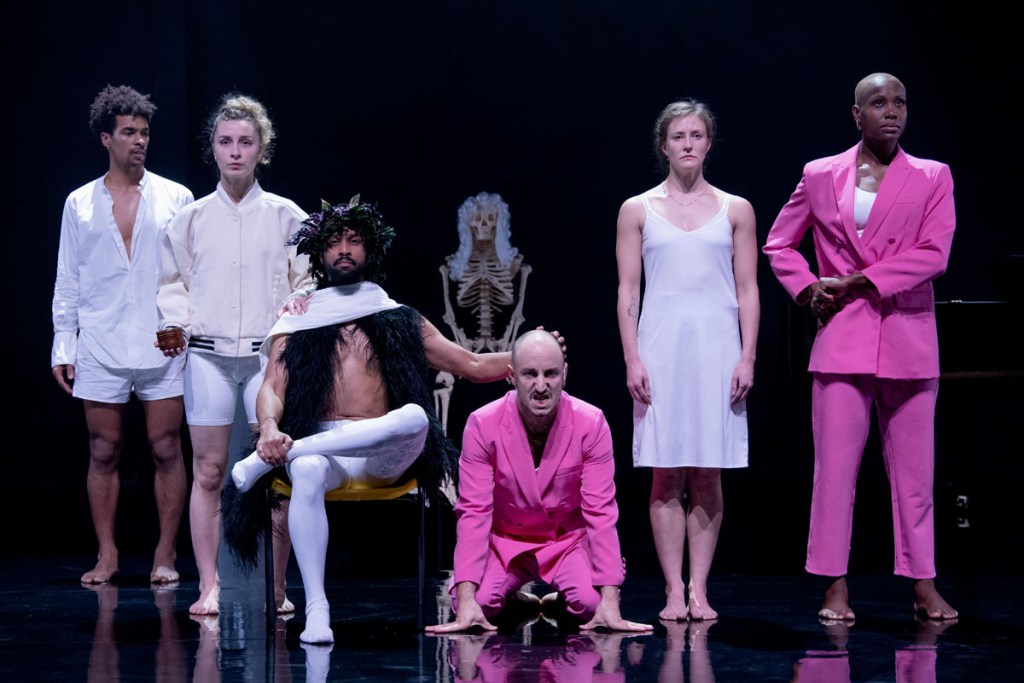
Michael Hawkey as Hamlet. Photo by Charles Flint.

Hamlet by Lazarus Theatre Company – Southwark Playhouse (Borough)

Published at Plays International

Lazarus Theatre, and their artistic director Ricky Dukes, specialise in introducing classic plays to new audiences with younger performers. Over 16 years they have presented a remarkable range of shows, from Greek tragedy and Jacobean revenge to  Marlowe, Wilde, Brecht and, of course Shakespeare – but never Hamlet. Dukes admits to shying away from a play with such a weighty history until he found a way to think about it differently. Lazarus’ production at the Southwark Playhouse (Borough Road branch) strips the older generation from the play, leaving us with only the younger characters. Battered, used and confused, the play reveals how focusing on their experience can show us a familiar text in a new and disturbing light. Hamlet is, among many other things, a tale of an older generation destroying their successors to serve themselves.   

The cast has varying levels of experience, but all are at the start of their careers and some are making their professional debuts. Not least among these is Michael Hawkey, doing so in the role of Hamlet: rather like learning to drive by just closing your eyes and flooring it. Fortunately, director Dukes knows what he is doing. Hawkey is more than up to the challenge and, although the play is cut down to 95 minutes, he is in charge of the stage and his presence is persuasive and changeable. As the play begins he is a student from a wealthy background down from university (Wittenburg as Durham, perhaps), with a moneyed assurance that hardens into a dismissiveness towards others, especially Ophelia which, whether feigned or not, comes easily to him. At the same time there is comedy, with the players for example thoroughly unimpressed at being told how to do their jobs by a posh bloke, with Hawkey even hinting in the direction of the Duke of Sussex. His performance is moving because, as a young man with limited experience of life, he is so easily used by others while imagining he is in control.

Dukes’ experiment in restructuring Hamlet leaves us with a core selection of scenes that prove to be the keys to the play, in which younger characters deal with the consequences of the way their parents and rulers behave. It is an original and fascinating take on the play. The action opens with a therapy group, wearing matching blue jumpers and sitting in a circle of chairs, taking turns to explain their troubles. Without the oldies, the cast consists of Hamlet, Ophelia,  Laertes, Horatio, Marcellus, Barnarda [sic], Rozencrantz [sic], Gildenstern [sic] and the three players. Hamlet starts to tell his story, informed by a God-like voice off which occasionally speaks lines belonging to the older characters, that this is a ‘safe space’. It immediately becomes apparent that Elsinore is in fact an intimidating and brutal space. However, none of the characters that remain in the play are to blame for the bloody events that will see almost all of them dead before the play is over. It is their parents’ fault. 

The show, with a minimal setting by Sorcha Corcoran consisting mostly of plastic chairs, is full of inventive staging and moments that make great use of limited resources. The ghost of Hamlet’s father stalking through torch beams, face obscured by a full helmet, is genuinely alarming. Yorick’s skull is illuminated in a drinks fridge, possibly borrowed from the bar. The players deliver ‘The Murder of Gonzago’ with glee, wearing paper crowns and ruffs. The players scene takes on a new significance as, surprisingly, the First Player’s account of the death of Priam becomes the centrepoint of the play. Everything stops as she delivers her speech which, shorn of interjections from Polonius, becomes mesmerising in a way that I have never seen in a production of Hamlet. Partly a result of Dukes’ ingenious rebalancing of the play, it is also a tribute to Kalifa Taylor, whose performance as the First Player threatens to steal the play, and marks her out as someone to keep a close eye on. Lexine Lee as Ophelia, Sam Morris as Laertes and Kiera Murray as Barnarda and the Player Queen also stand out. 

There a couple of jarring moments where the text has been unhelpfully hacked. Hamlet is “not as mad as you think” rather than able to “tell a hawk from a handsaw”. When he hesitates over killing Claudius, saying “Now might I do it”, but not “pat”. There are also moments when a previous knowledge of the play is probably needed to fully appreciate what is going on, not least in the final scene where the duel sequence, minus Claudius and Gertrude, is a little hard to follow. However, these are minor criticisms of what is a fresh, clever and exciting production from a company who specialise in seeing things differently, and showing us how to look again at plays we think we already know.

As You Like It

Rose Ayling-Ellis and Leah Harvey. Photo by Johan Persson.

As You Like It by William Shakespeare – Soho Place, London

As its best, As You Like It is a trip into a parallel world where everything seems easy yet every character confronts their own reality. This is very difficult to pull off, depending on group dynamics and audience faith in this group of people, despite their fantastical temporary existence in the Forest of Arden. Plenty of productions search fruitlessly for the magic, but Josie Rourke’s version at the new @sohoplace theatre makes it seems effortless. This is greatly helped by the delightful new space, designed by architects Haworth Tompkins as that rare thing – a theatre in the round. The entire audience sits within spitting distance of a stage with four entrance ramps, and a parquet floor in the middle of which sits a piano where Michael Bruce plays his own compositions throughout, frequently becoming an adjunct to the action that whirls around him. Robert Jones floor is partially dismantled as the play moves from court to forest, and the wildness of Arden spills over it.

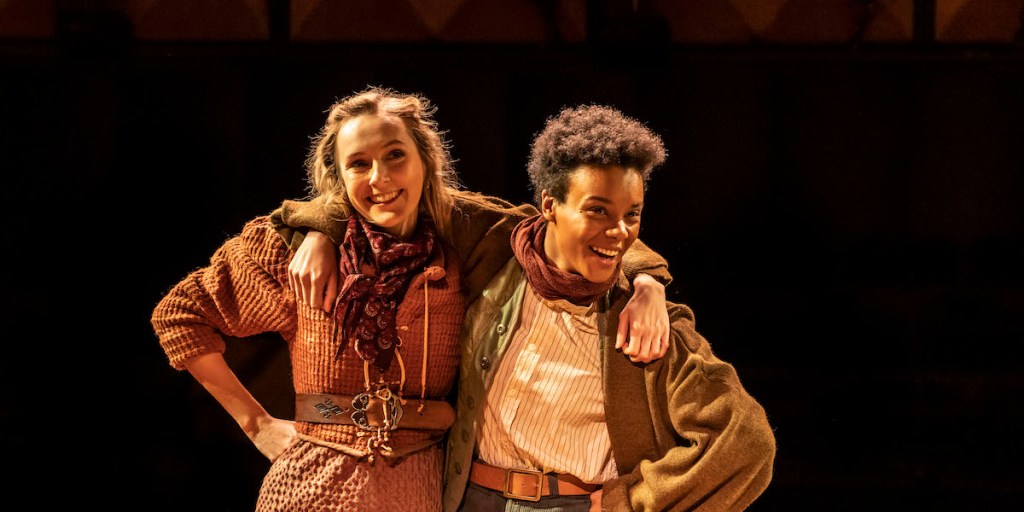
The star of the show is, unusually, Celia, played by deaf actor Rose Ayling-Ellis. Supported by subtitles at circle level, she signs her part and delivers a performance of great charm. Her presence, far from seeming an add-on, is integral to Rourke’s interpretation. Not only does she sign with Rosalind (Leah Harvey), but so do other members to one another as everyone tries to communicate across the voids created by love – unrequited, confused, or unacknowledged. Celia is the sensible one, signing her bafflement at Rosalind’s increasingly bizarre plans to court Orlando (Alfred Enoch), while Harvey’s Rosalind is unmoored by love, fully committed to the fantasy forest existence. Harvey’s gender identity – her biography specifies the pronouns ‘they/them’ – adds a further layer of ambiguity to the gender swapped drama, which seems relevant to our times in way that were not apparent until recently.

Jacques is cast in a conventional gender swap, with Martha Plimpton playing her with a beautifully weighted combination of charm, cynicism and sadness. Tom Mison’s Touchstone is also a triumph, a clumsy, loveable jester in real fool’s garments. Alfred Enoch as Orlando takes on a world he does not understand with amusing sang-froid. But it is the entire ensemble who generate the energy required to suspend our disbelief, working together in a way that makes us want to be part of their gang. Rourke’s production makes it clearer than any I have seen that Arden is a place of experimentation, where young people can try out the limits of their sexuality and discover what they truly want, without the consequences that come from being trapped in a hierarchical court system. Everyone is set free and, punctuated by most of Shakespeare’s best songs, the audience leaves feeling that they have travelled without moving an inch, and ended up somewhere entirely different.

Ruination

Photo by Camilla Greenwell

Ruination by Lost Dog – Linbury Theatre, Covent Garden

In the basement Linbury Theatre we have chosen, as Hades himself points out, to visit the underworld rather than The Nutcracker, taking place upstairs on the main Royal Opera House stage. What kind of people, he enquiries, watch a show called Ruination rather than a Christmas classic? Fortunately, there is no doubt about the best place to be – Ruination is a multi-layered, multi-talented triumph, a challenging, funny and spectacular piece of dance-music-theatre that defies classification in the best way. Lost Dog specialise in story-telling that turns our assumptions on their head in a number of ways. They take stories we think we know – as in Juliet and Romeo and A Tale of Two Cities, and show them to be something else entirely. And they use dance as the basis for story-telling, combining movement with narrative theatre and much else beside in a way that remains exceptional and unchallenged on the British stage.

Ruination is the story of Medea, set up as a trial in the underworld. Medea, her ex-husband Jason, their two sons, and Jason’s second wife Glauce are all dead, and in the realm of Hades, played by Jean-Daniel Broussé as flamboyant impresario, with his wife Persephone (Anna-Kay Gayle). The show finds time to question the myth of Persephone’s imprisonment in the underworld which, as she herself points out, involved her kidnapping (she claims she was snatched by Hades in a white van). However, their main role is to host the newly arrived dead, who find themselves in a bureaucracy where forms need to be filled, Lethe drunk from a water cooler, and the journey to heaven or hell embarked upon. Jason, Greek hero who seems to have died in a drunken accident, asks for Medea to be place on trial for the murder of her children and of Glauce, opening up a dissection of the Medea story. Was she, could she, have committed the worst crime of all – and what part did Jason’s behaviour play in what happened? Who does the version that we know really belong to?

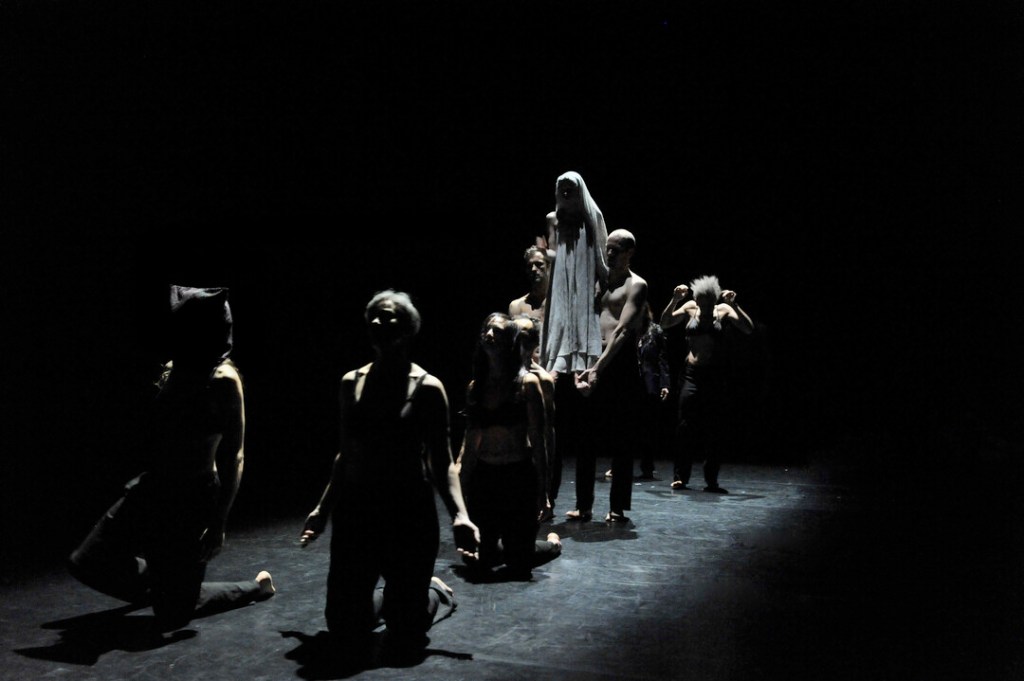
Ruination makes us think hard about why we believe what we are told by the mythmakers who control the cultural narrative. If that sounds worthy, it is anything but. Director Ben Duke, co-founder of Lost Dog, treats us to an astonishingly rich staging, his resources augmented by collaboration with the Royal Ballet. The dance is remarkable, each piece a stand out, from Jason (a charismatic Liam Francis) awaking from the dead and learning, spasmodically, to walk again; to the skeleton dance from Ray Harryhausen’s animation; to Medea (a disarmingly open Hannah Shepherd) rubbing ointment over (almost) all of Jason’s naked body; to Aeetes (Miguel Altunaga) Medea’s deeply sinister father, dancing with his daughter; to a final scene in which Medea is born aloft, like a crucifixion, as she struggles in vain to swim the waters of the Charon to reach her dead sons, in limbo.

Duke seamlessly blends movement with story-telling, but he also uses music to create atmosphere in ways that are truly memorable. Steve Reich’s Clapping Music accompanies Jason’s fateful transgression with Glauce (Maya Carroll). Yshani Perinpanayagam sings Radiohead’s Pyramid Song in his eerie counter-tenor, like something from a Peter Greenway film. Louis Armstrong’s version of Mack the Knife plays alongside a staccato conga of the dead. And the show ends with the heart-stopping voice of Sheree Dubois, singing George’ Harrison’s song Isn’t It a Pity. Every scene is a showstopper.

Ruination is inventive and sophisticated, and it is funny and moving. It is probably Lost Dog’s best show yet, but their resumé is increasingly full of work that carves a new path for performance. Ben Duke treats his audiences with respect, delivering shows that respond to the hyper-aware 21st century by avoiding easy routes. Instead, he plays gleefully with our expectations, and gives us stories that reflect our times and can make us laugh and gasp in the same breath.

Othello

Giles Terera as Othello. Image by Myah Jeffers.

Othello by William Shakespeare – National Theatre: Lyttleton, London

The scene is set before the plays begins by projections of theatre posters which cover Chloe Lamford’s amphitheatre set – the production history of Othello since the 19th century. None of these versions had a black director, and Clint Dyer’s new National Theatre production is the first time this has happened in Britain. Dyer, the NT’s Deputy Director, redefines the play for our times, not by imposing interpretation from above but by revealing meaning within Shakespeare’s words. Like all the best Shakespearean accounts, he makes his interpretation seem obvious. How could we not have seen it like this before?

Giles Terera’s refined Othello seems aloof at first, separating himself from the oppressive Venetian world around him. It soon becomes clear this is his protection from a society that accepts his military skills and, in return, gives him contempt and worse. The Duke of Venice’s entourage, in fact almost everyone in the play, is in black-shirt uniforms and go about wielding burning torches, like an incipient lynch mob. Paul Hilton’s twisted, sadistic Iago is a military man through and through, a sergeant major who embodies the attitudes of the system he serves. In his military moustached, he bears a striking resemblance to Enoch Powell, played upon in the first scene when he puts on a West Midlands accent as he leads a baying mob to the Duke’s door. He is also an arrogant wife-beater (Tanya Franks’ Emilia appears with a bruise across one cheek) and con-man, his mouth constantly curdling into a sneer. But, in targeting Othello he is simply putting the culture of Venice into action.

The sense of a world closing in upon Othello is very effectively enhanced by Dyer’s use of the case a black-clad chorus, who sit in tiered rows around the stage, physically amplifying and reflecting the mood – twitching their heads in unison as Othello wrestles with what Iago has told him, or marching around the rim of the set in a torch-bearing procession. Their presence focuses the sense that Othello is allowed to exist only so he can, when it becomes necessary, be destroyed. Dyer also makes it clearer than any production I have seen before that Othello, although he imagines otherwise, can have no free will in a society that despises him for the colour of his skin. Until Iago unleashes his grim plot, he is the only character who soliloquises to the audience. As soon as he feeds Othello his story, the latter begins to speak directly to us as well, as though performing under Iago’s control.

Hilton is excellent, and so is Terera as a powerful but sympathetic Othello, fighting against himself and his inability to see things for what they really are. The other stand-out performance is Rosy McEwen’s Desdemona. She is self-possessed, witty and in no respect a victim, which makes what happens to her all the more heart-rending. Her angry cry of “These men! These men!” is the play’s emotional climax. Othello is never a cheerful play but this is production is exceptionally dark, both in look and mood, and that seems the only way to understand it. Shakespeare, somehow, gave us a brutal account of the way societal racism destroys everyone in its path, a message that has lost none of its relevance. Dyer’s version is harsh and revelatory.

Pass It On

Pass It On by writers from the Yellow Coat Theatre Company Collective – Theatre 503, London

COMPANY B

Lane Swimming is written by Lucy Dobree, performed by Alessandra Perotto and directed by Ella Murdoch.

Untitled is written by Khawla Ibraheem, performed by Hazal Han and directed by Bettina Paris.

Period Pills is written and performed by Emma Lamond and directed by Caron Kehoe.

Dirt, Moss and Pigeon Shit is written by Sherry Newton, performed by Nicola Rockhill and directed by Sherry Newton and Belle Bao.

PA’ing is written by Emma Dawson, performed by Leila McQuaid and directed by beth drury.

That’s Not My Name is written by Siân Rowland, performed by Corinne Strickett and directed by Tania Black.

Grown Ups is written by Claire Marie Perry, performed by Lucy Renton and directed by Belle Bao.

The Argos Delivery is written by Annette Brook, performed by Roli Okorodudu and directed by Ella Murdoch.

Seaside is written by Martha Reed, performed by Marina Johnson and directed by AK Golding.

Let’s Talk About Tea is written and performed by Caron Kehoe and directed by Fiona White.

The full line-up of monologues that makes up Yellow Coat Theatre’s Company B performance is delivered in 60 minutes by ten different actors, each of whom stands up from the side of the stage and steps in the limelight when their moment arrives. The consistent quality of both writing and performance is a real achievement – and there are Companies A and C too! All ten plays are involving, unpredictable and carefully honed pieces. They are by women and about women, but that’s where any similarity ends. Subjects and styles range from a woman asserting herself in the middle lane of the local pool, to a PA fighting her instincts to tell the new starter how she’s really treated to a girl practising fleeing the bombs in Gaza, and finding herself doing it for real. All ten authors do not miss a beat, and the actors deliver their work with uniformly involved performances

The piece that perhaps stood out from a high quality bunch was The Argos Delivery by Annette Brook, about a woman with a surprisingly strong attachment to her toaster. It was offered a perfect side-angle on mental illness and isolation while also being genuinely funny and strange. Roli Okorodudu performed it with a disarming openness, and hints of a lot more hiding behind the mask.

Yellow Coat Theatre Company have something very impressive going on here, and Pass It On is a guide to the theatre of the future.

Tammy Faye

Andrew Rannells and Katie Brayben. Photo by Marc Brenner.

Tammy Faye – book by James Graham, music by Elton John, lyrics by Jake Shears – Almeida Theatre, London

The Almeida, and director Rupert Goold, have pulled off quite the coup with Tammy Faye. Of all the people a director might lure to wrote a new musical, Elton John must be top of the list, probably backed up by Jake Shears writing the lyrics. The dream team might not include James Graham, but his involvement is a very clever move. The result is a musical that is just as camp, ludicrous and over-the-top as everyone would expect, but also politically incisive and historically pertinent. Graham serves us up a warning from history that looks amazing and sounds even better.


The recent focus on Tammy Faye Bakker is a little strange. Half of an American tele-evangelist duo with her husband James, who pioneered satellite Christian broadcast as part of a new wave of Reagan conservatism, she also became an unlikely gay icon. As recounted in Michael Showalter’s 20201 film ‘The Eyes of Tammy Faye’, which won Jessica Chastain the 2021 Best Actress Oscar, she incurred the wrath of evangelical peers by inviting HIV positive pastor Steve Pieters onto her show in 1985, when AIDS was being used as a propaganda tool by the religious right and homophobia was standard. Her reputation is built on this remarkable act, which has prevented her from being consigned to history with Jim, who was convicted of fraud and given a 45 year jail term after the couple’s Heritage USA theme park went under, taking the contributions of many viewers with it. She died of cancer in 2007 and the show begins, in a scene neatly balanced between comedy and tragedy, with Tammy Faye (Katie Brayben) on all fours being examined by her proctologist. Her story is fascinating for various reasons: as a story of resistance to expectations, of a woman fighting to be recognised and as an account of a historical era which extends its influence over US and world politics forty years later.


Graham has woven a persuasive account of conservative intolerance around the rise of the Bakkers. He includes a rogue’s gallery of contemporary preachers – Pat Robertson, Jimmy Swaggart, Jerry Falwell, Marvin Gorman, Oral Roberts and their forbear, Billy Graham – and shows the growth of the tele-evangelists alongside the reintroduction of religion, previously frowned upon, into US politics by Ronald Reagan. Before long evangelical Christians were voting as a block, brought together partly by the unprecedented reach of tv preachers, and declaring war on the liberal issues of feminism, gay rights and abortion. Plus ça change. The evangelists were deeply unpleasant people (and still are – Jim Bakker and Pat Robertson are both still alive and full of hate), but they were big characters and, as well as providing the kind of history lesson only Graham can deliver, ‘Tammy Faye’ is wildly enjoyable ride. Zubin Varla’s Jerry Falwell is all five o’clock shadow and ’70s suits, and unveils a powerful tenor voice to boot. Ashley Campbell gives us an absurd Elvis-esque Jimmy Graham, not to mention a scene as Larry Flynt. Nicholas Rowe is Pat Robertson, Ted Turner, the CNN owner who unleashed Christian tv on the world, and Pope John Paul II. Steve John Shepherd pulls off the equally remarkable trio of Jimmy Swaggart (seedy), Robert Runcie (dishevelled) and Ronald Reagan (very convincing). Kelly Agbowu and Richard Dempsey make an amusing duo as the Praise The Lord Club’s incompetent, increasingly rebellious management team.


This is all very enjoyable, but the stars of the show are Katie Brayben as Tammy Faye and Andrew Rannells, as Jim. Cycling through costumes from their ’60s Christian puppet show beginnings to their ’70s rise, ’80s heyday and fall from grace, they both deliver wide-eyed, driven performances, taking themselves as seriously as only Americans can, even when they are singing Jakes Shears’ innuendo-laden lyrics. A sample number (about Jesus) has the chorus “He’s inside Tammy and he’s inside Jim”. On stage virtually throughout, Brayben is a powerhouse with a top notch voice, probably a great deal more likeable than the real Tammy Faye (who was mysteriously untouched by the fraud prosecutions that brought the couple down). Rannells plays Jim as significantly less sharp than Tammy and flawed in ways that only he cannot see. The pair pile into Elton and Jake’s songs, which range from catchy tunes (‘Bring Me the Eyes of Tammy Faye’) to Bonnie Tyler-esque power ballads (‘Prime Time’ with the hair to match, Tammy being at her ’80s peak). Goold has packed more entertainment into the evening than anyone has the right to expect, filling the stage with capering chorus lines involving Colonel Sanders, an extremely camp Pontius Pilate, flogging a Jesus who seems to be enjoying it and debates between the Pope, the Archbishop of Canterbury and Mormon President, Thomas Momson. Rannells interviews Reagan during a lifestyle cookery segment, pausing to declare to camera “You cannot have too much cinnamon.” Bunny Christie’s set is simple but effective, using a Celebrity Squares wall of television screens. Katrina Lindsay costumes deserved a curtain call of their own.

‘Tammy Faye’ is a real achievement – entertainment, satire and historical reflection in an equal partnership. With any luck it will transfer to the West End, where it can offer lots more people a very good time and give the Almeida some important financial certainty.

Sarah

Jonathan Slinger. Picture © Tristram Kenton

Sarah – adapted by Oliver Reese, novel by Scott McClanahan – Coronet Theatre, London

Published in Plays International

A middle-aged man steps up to a spot-lit microphone on a dark stage. He starts a routine, but his humour is dark to the point of obliteration. “I was the best drunk driver in the world!”, he declares, and spins an anecdote about driving as fast as he can while drinking gin from a water bottle, and not just getting away with it, but loving it. His two young children sit terrified and forgotten in the back seat as he speeds through traffic, inches from death. It is an authentic alcoholic’s tale, sentimental and entirely self-centred, but transformed in the telling if, just for a moment, we can buy into the drinker’s mindset. His name is Scott, and the fact he is telling us this at all hints at some sort of redemption. He may be alive, but this is not a redemptive story.

Scott McClanahan’s novel ‘The Sarah Book’ has been adapted and directed by Oliver Reese, Artistic Director of the Berliner Ensemble, last seen at the Coronet Theatre in 2020 with his adaptation of Günter Grass’ ‘The Tin Drum’. The Coronet’s own Artistic Director, Anda Winters, has built an intriguing partnership with Reese and persuaded him to adapt the novel for the stage. McClanahan, from West Virginia, is hot indie property and his work lauded for its raw but funny prose about the realities of American life. Reese has turned the book into a 90-minute one-man show. Performed by Jonathan Slinger, it has its own unmistakable flavour – a queasy, disconcerting experience, in which every laugh is tempered with horror while the darkness threatens to swallow Scott at any moment. 

The setting is the American South, a couple of hours from Charleston. This is the only geographical information we acquire in the course of the evening, as everything takes place in an endless succession of parking lots, Walmarts and drive-in burger joints – a void where a society should be. Scott’s marriage, to high school sweetheart Sarah, is falling apart because of his provocative drinking. He recounts his behaviour in excruciating detail, smashing the family computer in front of Sarah after she finds his porn search history; sleeping in his car surrounded by drug deals; spitting on Sarah’s new boyfriend’s flash car. His life is a series of rock bottoms and there is very little to laugh at, but this does not stop Scott. He layers his account with gross-out humour – stories that focus on piss, shit, vomit, the habits of a repulsive dog. He seems to see what he considers the ugliness of life that we ignore. “I’m a horrible person.” he tells us “And so are all of you, sometimes.”

Oliver Reese’s direction, like his adaptation, is confident. He uses the accumulating junk of the set, which fills with crushed cans and detritus as Scott descends through mounting layers of chaos. The scenery consists of simple props – a carpet rolled out to become an apartment. Scott pulls costumes from a fridge freezer, changing on stage between scenes, pulling costume after costume from its shelves and discarding each one. The subtle use of music, from bluegrass banjo to moody slide guitar, builds atmosphere without ever overwhelming it. 

Jonathan Slinger relishes a challenging part, playing the role in a Virginian accent and occupying the stage throughout. He treads a fine line between charm and neediness, elation and sentiment, and utter selfishness. He seems dowdy and unremarkable but his face cracks into an impossibly wide grin, like the ghost of his RSC Richard III. Then the smile vanishes, leaving nothing. His performance is layered and slippery, and he keeps the audience guessing. We never feel we have a handle on who he really is, or why we are listening to a man who destroys everyone around him.

Slinger is highly compelling, but the uncertainty at the heart of the script limits the show’s success. Scott’s character is very hard to like, despite his relentless attempts to make us complicit in his story. He relates his despair to the parade of loss that is non-negotiable for all of us but his charm convinces no-one, and he is clearly in the business of self delusion, so the audience is left questioning the value of his story. There is charm in flashbacks to the early days of his relationship with Sarah, before the drinking, but we only have Scott’s word for it. The script is also episodic, moving from set piece to set piece in a way that sometimes seems contrived. We may not believe Scott, but we have to believe in him to be fully invested in his story – especially when he claims to be telling us something about ourselves. 

The Coronet is doing us all a big favour by bringing exciting practitioners and ambitious artistically programming to one of London’s best, most characterful spaces. Sarah is a sophisticated attempt to create drama that speaks to us, telling us things we do not want to hear. Scott’s greatest fear is boredom, but there is nothing boring about this flawed but fascinating show. 

John Gabriel Borkman

Simon Russell Beale and Le Williams – photo by Manuel Harlan

John Gabriel Borkman by Henrik Ibsen – Bridge Theatre, London

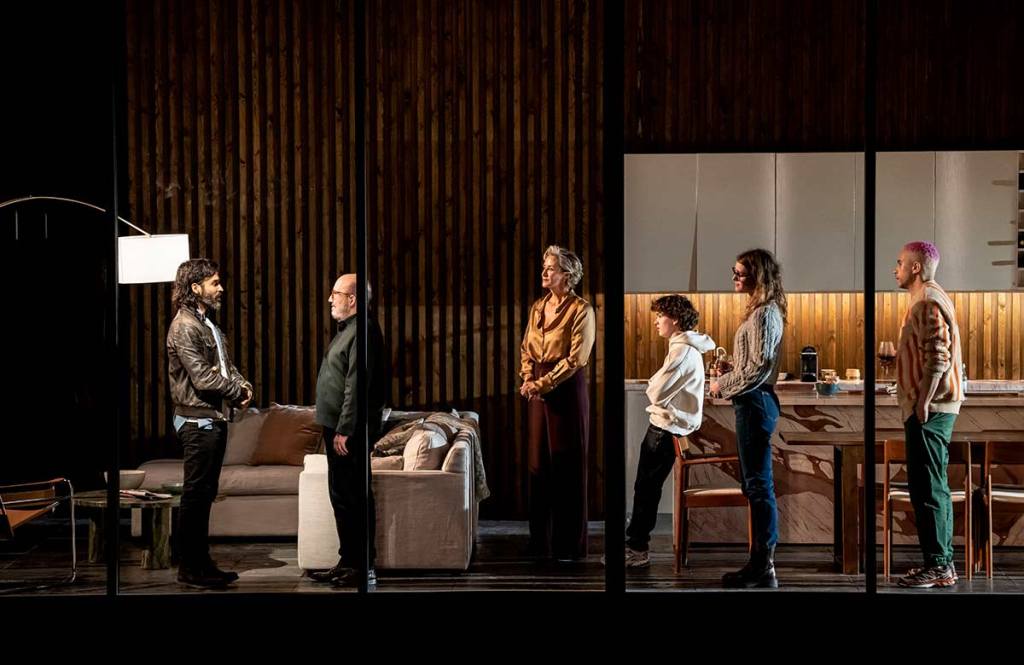
Ibsen’s penultimate play, John Gabriel Borkman is rarely performed but, unlike his final play When We Dead Awaken, it is hard to understand why. It is a highly dramatic study of what happens to a family when it is disgraced, a subject of perennial fascination, full of great roles. The patriarch, known in his heyday as ‘JG”, is played by Simon Russell Beale, who has become a connoisseur of the best leads for the older actor. His wife, Gunhild, is played by Claire Higgins and sister-in-law Ella by Lia Williams. This heavyweight cast, deployed to great effect by director Nicholas Hytner, are the successors to the great trio of Paul Schofield, Vanesa Redgrave and Eileen Atkins who played the roles in its last major London revival, more than 25 years ago at the National Theatre.

The play’s title character, known as ‘JG’ in his heyday, lost his position as a mover, shaker, and head of a bank when he was jailed for fraud. The money was, of course, just resting in his account. In eight the years since his release he has lived in the same house as Gunhild, but separately. In the opening scenes, while she broods downstairs he can be heard relentlessly pacing the room above. Their son, Erhart, is Gunhild’s obsesssion, and she schemes to push him towards greatness to show that the family can redeem itself. Erhart (Gabriel de Souza) is desperate to escape the poisonous home atmosphere and make his own life, somewhere a long way off. Then Ella turns up, Erhart’s surrogate mother during his childhood, carrying the matches that will ignite the tinderbox.

Staged on a cleverly Nordic set by Anna Fleischle, the play is apparently biographical, in that Ibsen and his wife fought each other all the time, and competed through their son. Although the play is ostensibly about JG, it focuses just as much on the dynamic between the two sisters who, it emerges are fighting each other for both father and son. Claire Higgins plays Gunhild as comfortable in her role as the embittered, betrayed wife, but also terrifyingly needy and vulnerable when Erhart comes into the picture. Lia Williams, one of the most under-rated actors of her generation, is thin and jumpy, but far more robust beneath the surface, a force to be reckoned with because she is capable of adapting and, unlike Gunhild or JG, seeing beyond herself.

As the latter, Simon Russell Beale gives one of his best performances. He is full of bluster about getting his business and influence back, especially in front of one-despised lackey Vilhelm (an excellent Michael Simkins), now his only friend, but there is a brittleness to everything he says that reveals his inner despair. Paul Schofield played the character as a man who had lost his mind, with awful consequences. Russell Beale is more human, more calculating and, ultimately more affecting when he decides to take his own path after all. This path leads, as so often in Ibsen, to the top of something tall from which there is no coming back, alive at least. The symbolism in the drama plays against its social realism, with the Norwegian mountains representing both damnation (JG is obsessed with mining the iron they contain) and salvation (climbing to the very summit is the only release from the misery of the world below). The production is a very fine piece of work, and includes several of the finest performances you will see on a stage. Not to be missed.

Not Now

Matthew Blaney and Stephen Kennedy. Photo by Lidia Crisafulli

Not Now by David Ireland – Finborough Theatre, London

Published in Plays International.

‘Not Now’ is the third new David Ireland play staged at the Finborough Theatre since 2017, in what is becoming a partnership of significance. First seen in a Glasgow pub earlier this year, the two-hander comes to London in a new production directed by Max Elton, who was also responsible for last year’s Ireland/Finborough venture, ‘Yes So I Said Yes’. Both plays are set in contemporary Belfast and deal with the search for masculine identity in a post-conflict Northern Ireland. They could not be more different. 

Ireland is known for his hilariously dark comedy, seen to general acclaim in ‘Cyprus Avenue’ and ‘Ulster American’. His work bears some similarity to Martin McDonagh’s plays of the 1990s, in which horrified laughter is the only possible response to the absurdity of sectarian conflict. Ireland’s provocations reached a peak with the epically offensive ‘Yes So I Said Yes’, which contained some of the darkest material seen on a UK stage in recent years. ‘Not Now’ is the calm after the storm: a deceptively simple play that conceals multiple levels of meaning. Ireland has, perhaps, written a perfect play about Northern Ireland post-conflict, post-peace, post-Brexit and post-truth.

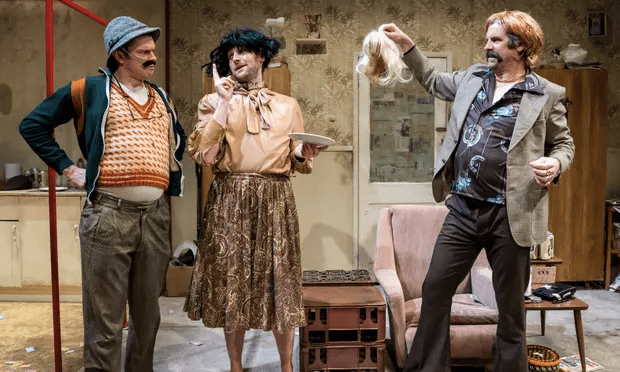
The play opens with the young Matthew (Matthew Blaney) practising the opening soliloquy from ‘Richard III’ and making a meal of it, dragging one leg around the kitchen table like a comic Olivier. Ray (Stephen Kennedy) catches him at it, and an awkward conversation begins across the divide. Ray is Matthew’s uncle, and his unnamed brother, Matthew’s father, has just died. Matthew has an audition at RADA that morning and is about to fly to London and, potentially, an entirely new future. Ray is a painter and decorator, a recovering alcoholic, with no apparent future. Their discussion is equal parts hilarious and troubling. Ray’s inability to remember names leads to some very entertaining exchanges about the actors “Ciaran Farrelly” (Colin Farrell) and “big Liam thingy”. Ray also has problems with the conceptual difference between Richard III and Hamlet. If Hamlet kills just as many people, why is Richard the baddie? Is it because he didn’t mean to? There is much more to these conversations than we first realise. Family secrets start to emerge and no-one, dead or alive is what they seem. They are all pretending, even Matthew who plans to audition in an English accent rather than his natural Belfast, but has problems with the first word in his speech, “now”.

Both Matthew Blaney and Stephen Kennedy give excellent performances, neither putting a foot wrong. Blaney is direct yet confused, at the exact moment in his life when identity is shaped one way or another. Kennedy is equal parts funny and sad. Stocky and older, but not as old as he seems, he is worn away by hiding and by his secret which, we discover, is more shameful than anyone could imagine. Max Elton swirls the action deftly around the central table that occupies the Finborough’s tiny stage, framed by designer Ceci Calf’s lovely 1970s estate buttresses.  

In a taught 50 minutes, nothing happens without a very good reason. The Hamlet/Richard III discussion, for instance, becomes directly relevant to the secret the two men must face. Every word revolves, implicitly or explicitly, around what it means to be Northern Irish and Protestant, what to do about the past, and how to create an identity that is neither charming Irishman, nor Loyalist throwback, but real. It is all here: colonialism, violence, masculinity, shame, sexuality, history, culture, honesty, truth. ‘Not Now’ is a small but exquisite work, and in some ways the logical extension of David Ireland’s more flamboyant writing. He and the Finborough which, under its Artistic Director Neil McPherson, won London Pub Theatre of the Year only a couple of weeks ago, continue to deliver must-see new writing.