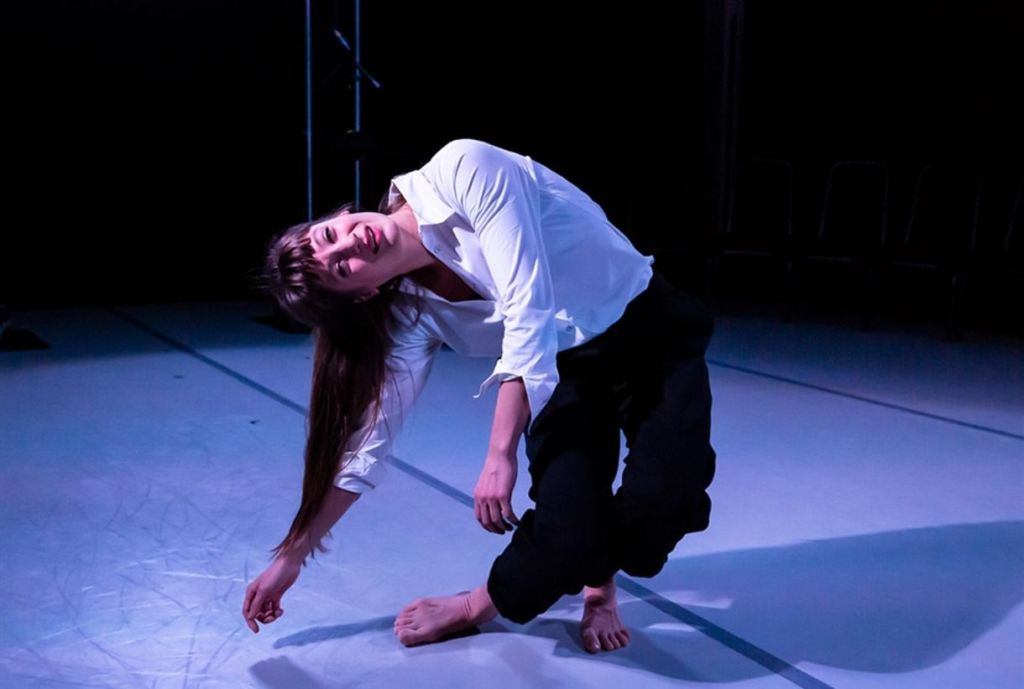
Tempus Fugit: Troy and Us

Tempus Fugit: Troy and Us by NMT Automatics – Army @ The Fringe, Edinburgh

Army at the Fringe, a programme staged at the 52nd Lowland Army Reserve Centre, is an unlikely but always welcome addition to the festival. Here the Army has hosted a wide range of companies presenting pieces that deal with the relationship between society and the military, often exploring difficult questions, none more so than Tempus Fugit which draws lines between a modern soldier, Alec and his wife, Bea, and the doomed Trojan Hector and Andromache. Directed by Andres Velasquez and devised by NMT Automatics creative team, the production tells a story with an inevitable, dark ending in straightforward but very effective style. Noah Young as Alec and Genevieve Dunne as Bea are both very sympathetic characters, meeting as students and being drawn, via Alec’s determination to join the Army, into a life of separation and constant anxiety that controls their lives. The two performers constantly rearrange crates on stage to create the various settings, while also giving the impression of a battle to organise their lives to make them liveable. Between scenes they don masks to enter the events of Greek myth, via a production broadcast on the radio. Tempus Fugit pulls no punches, neither in depicting the psychological impact of Afghan tours on a soldier, nor the equally brutal effects on a soldier’s partner. It’s an honest, difficult and impressive piece of theatre that makes its characters very real and provides insight that feels completely convincing.

Runners

Runners by Cirk La Putyka – Zoo Southside, Edinburgh

Cirk La Putyka are a Czech circus company, and a thrilling sight in full flow. Runners is based around surely the biggest piece of kit at the Fringe – a giant running machine, which fills the stage and can take four people side by side. It can also, as we discover, go very fast indeed. The four performers are physically very impressive, and they make full use of the constant flow of the machine, slipping on and off the giant conveyor belt and creating mesmerising rhythms. The result is a piece of dance theatre with extra props and daring. Giant spheres spin in perpetual motion, performers leap on and off and constantly defy gravity and speed at together. Particularly memorable sequence include people momentarily clasping one another as they pass on the belt, before it carries them away again – its motion becoming time itself. Directed by Rostislav Novák Jr. and Vít Neznal, with live music on keyboards and cello from Jan Čtvrtník and Veronika Linhartová, the piece is advertised as being about the incessant speed of modern life. In fact, it is a lot more subtle than that – tracking and contemplating stillness as well as movement. Runners has created a new genre of unclassifiable, exceptionally enjoyable physical theatre.

Rocky!

Rocky! by Fig and Foxy – Zoo Southside, Edinburgh

Written and directed by Tue Biering, Rocky! begins as a commentary on the film, and ends as something much more extreme. Genial performer Morten Burian tells us about his sympathy for Rocky, a ‘loser’ who fights his way out of the role society has assigned to him. As a self-declared educated liberal, he recognises the contrast with Sylvester Stallone’s character but finds himself drawn to him. Then his remarks begin to take on an odd, racially charged tone and it becomes apparent that we’re watching a play about far right politics. The Rocky story goes awry as Burian tells us about his radicalisation against immigrants and rise to power as a populist, Trump-esque politician. Burian takes this very badly and starta to fall apart as his performance becomes increasingly physical and uncomfortable. There is no doubting his commitment, as the play incorporates a real pig carcass, a meat hook from which Burian suspends himself, naked, and a series of very uncomfortable self-flagellating acts. Rocky! makes powerful points about the sinister power of far right politics. It does, however, take itself very seriously which sometimes makes is difficult for the audience to do the same.

Every Word Was Once An Animal

Every Word Was Once An Animal by Ontroerend Goed – Zoo Southside, Edinburgh

The new show from accomplished experimental company Ontroerend Goed is about now having a show. The play, of it ever existed had it’s premiere cancelled “on 5th April” and all that remains is characters stepping up to a microphone to air theories about who they are, or what they might have done. Fragments of ideas remain, including a rather beautiful sequence in which the theatre’s red velvet curtains dance of their own accord. We also see film taken from the windows of flats in Ghent, where the cast live, showing mostly empty streets.

The significance of the date becomes apparent as we realise we are watching a Covid show, although the pandemic is never mentioned. It is a situation perfectly suited to Ontroerend Goed, who have the confidence to make theatre from anything. The cast use their presence as performers to convince us we are seeing something complete and to hold our attention throughout. From a space where a show might have been, they conjure a meditation on identity, theatre making and the line between fiction and reality that demonstrates their ability to challenge expectations of what we could see when we buy a ticket.

The Last Return

Naima Swaleh, Fionn Ó Loingsigh, Anna Healy, Fiona Bell and Bosco Hogan.
Photo: Lottie Amor

The Last Return by Sonya Kelly – Traverse Theatre, Edinburgh

Sonya Kelly’s play is set in a ticket queue imhabited by two cartoonish characters – a reticent professor and a passive aggressive middle aged Umbrella Woman who works in “an open plan office”. In the background, the formidable ‘ticket person’ controls who gets the returns they are desperate for. The show has a highly stylised tone, inhabiting a world of comic types that soon also includes an unlikely US marine and a silent Somalian woman. The purpose of the play emerges gradually, as colonial power relations are reflected in the self-regard and desperate manoeuvrings of the queuers. Most of the stage time is occupied by a strangely heightened atmosphere created by the stereotyped characters. If this sounds like a criticism it isn’t, on the whole. Some genuine comedy emerges, much of it focused on Anna Healy’s formidable ticket person who, as we discover is not only stern but heavily armed. Fiona Bell’s Umbrella Woman teeters on the edge of hysteria with her manic politeness, while Bosco Hogan’s Professor starts patient but is clearly heading for a meltdown in slow motion. Sara Joyce’s production for Druid Theatre is carefully choreographed and absorbing. Kelly has re-imagined Ionesco for the post-colonial era, and leaves us feeling we’ve seen something we won’t forget in a hurry, even if its exact meaning is elusive.

Patriots

Tom Hollander as Boris Berezovksy

Patriots by Peter Morgan – Almeida Theatre, London

Peter Morgan’s new play is a history lesson, filling in the gaps in our understanding of how we ended up where we are now. Specifically, it connects events in Russia after the fall of Communism with the high profile deaths in the UK of Russians who had fallen out with Vladimir Putin and, more implicitly, with the invasion of Ukraine and the state of Russia today. There is no doubt that the story of Boris Berezovsky is fascinating, providing important insight into how Russia ended up led by a brutal autocrat. It is, however, a story without sympathetic characters. Tom Hollander, in a fairly remarkable physical transformation, plays Berezovsky as a balding Richard III – a charming bully used to having things his own way, whose inevitable downfall is as much part of his character as his success. He is very watchable, but there is no hiding the fact the Berezovsky was a greedy, ruthless criminal and a complete bastard, just not as ruthless as Putin.

Morgan flashes back to Berezovsky’s childhood as a maths prodigy, with Ronald Guttman as the professor who took him under his wing, and highlights his decision to turn away from a self-contained life of equations on blackboards (mathematics on stage must always involve chalk) to engage with the world as it opened up under Boris Yeltsin. However, he doesn’t manage to get to the heart of why the world he chose to join was the post-Communist gangster capitalism of the 1990s, where he made a fortune from importing and illegally reselling cars. His role, however, in putting Putin where he is now is well told. Will Keen plays Putin as so reserved as to be almost tongue-tied when Berezovsky plucks him from an obscure role as Deputy Mayor of St. Petersburg and has the Yeltsin family appoint him head of the FSB then, when Yeltsin resigns on millennium eve, makes him Prime Minister. Keen’s subtle, increasingly terrifying portrayal shows him growing in confidence while remaining in the shadows until he can seize his moment, and reject the man who expected to control him. Berezovsky’s downfall begins here and ends with his 2013 suicide in luxury exile in the UK.

Elements of the story connect in ways that surprise: for example, the notorious murder of Alexander Litvinenko (Jamael Westman) in London in 2006 is an inherent part of the story. As Berezovsky’s head bodyguard his killing was a message for the exiled oligarch. Director Rupert Goold draws a great deal of entertainment from a dark story of increasingly desperate political and criminal gambles. Miriam Buether’s set has a pair of catwalks set at right angles, with characters on these but also on high stools beside them at ground level, partially hidden from circle seats and a complicated arrangement that doesn’t obviously serve the production. Patriots struggles, as plays that try to document history over long periods often do, with the balance between teaching the audience about events and allowing the characters to live. In this case, the result is too much telling and not enough showing.

A Doll’s House, Part 2

Noma Dumezweni and Brian F. O’Byrne

A Doll’s House, Part 2 by Lucas Hnath – Donmar Warehouse, London

Lucas Hnath’s play is part of a long tradition of sequels to Henrik Ibsen’s A Doll’s House. By walking out on her husband and, more particularly, her children Ibsen’s Nora ignited a furious debate that is, remarkably, still smouldering. From George Bernard Shaw to Stef Smith, writers have been tantalised by the question of what happened to Nora after she closed that door behind her. Hnath’s play is set 15 years after her departure, and to some extent is a gloss on events during the play. It is difficult to find fault with James Macdonald’s production for the Donmar, but the reason this play needed to be written never becomes clear. It doesn’t give us much that we couldn’t already have imagined as possible futures for Nora, and it indulges a tendency to lecture the audience. As a result, Nora becomes a strangely unsympathetic character, and the drama focuses becomes about her insensitivity towards people, and her inability to relate to others. This seems a restrictive gloss on Ibsen, which closes down the character rather than opening her out.

Nevertheless, the staging is very effective. With the Donmar auditorium in a rare in-the-round configuration, designer Rae Smith fills the stage with a house that is dramatically lifted away to reveal the interior of Torvald’s living room, which Nora (Numa Dumezweni) re-enters as the play begins, for the first time since her fateful departure. Dumezweni is commanding and magnetic in the role, although it is difficult to like the Nora Hnath has written for her. Brian F. O’Byrne is exceptional as the aged, embittered Torvald – every inch a man defeated, disappointed and scarred by his wife’s departure. June Watson is glorious as Anne-Marie, Nora’s former nanny who brought up the children Nora left behind. Her accusation that Nora has only returned because she wants something from her rings true, as does her sadness at her inability to make things right in the family she has served all her life. And Patricia Allison as Emmy, Nora’s now adult daughter, is self-possessed and sharp, choosing marriage with her eyes open, to Nora’s horror.

While the production is of a particularly high quality, the experience of watching A Doll’s House, Part 2 is too much like having the original play explained at length. Nothing is left unsaid, and everything is told rather than shown, in contrast to Ibsen’s writing. Nora’s unpacks her feelings and motivations to everyone in turn, like a walking Cliff’s Notes, and in the process renders the character shallower, more selfish and more emotionally obtuse than Ibsen intended. Torvald doesn’t come out the play particularly well either, but if Hnath is fascinated with the possibilities that Nora presents it seems reductive and redundant to create a new version that shows her to be a lesser person than we would hope.

The Dance of Death

Hilton McRae and Lindsay Duncan

The Dance of Death by August Strindberg – Arcola Theatre, London

Strindberg’s The Dance of Death has a reputation, encouraged by its title and the troubled life of the author, as a full-blown exercise in turn-of-the-century Scandinavian nihilism. This is unfair. The National Theatre’s ’60s production with Laurence Olivier and Geraldine McEwan revealed its blackly comic potential, pursued even further up by Ian McKellen and Frances De La Tour in Sean Mathias’ 2003 London production. Now Lindsay Duncan and Hilton McRae reveal the full depths of its ambiguity in a production that is funny and strangely touching. Directed by the Arcola’s own Mehmet Ergen, the couple – married in real life – interact with a naturalness that takes the edge off their barbed attacks on one another, even as they push one another further and further and, almost, over the edge.

McRae, as aging, disaffected Army captain Edgar, is fragile and thin-skinned but, crucially, also self-aware. He slides incredibly easily into the role of the grumpy old man, just as Lindsay Duncan’s Alice deploys her frustrated performing talents (her stage career, she claims, was ended by Edgar) in playing dark games with Edgar, and then her cousin Katrin, with a glee discernible through her unnatural composure. Rebecca Lenkiewicz’s adaptation gender-swaps the role of Kurt, the outsider who unwittingly acts as the grist in the marital mill. It’s an interesting move, and fits the dynamics for the most part very well. Emily Bruni plays her as virtually a nun, dressed in black and engaged in charitable work, both practical in managing domestic crises and hopelessly hidebound. Her sexual move on Alice is all the most wild and shocking as a result. Lenkiewicz also updates the language, including plenty of swearing, which gives the conflict a new credibility.

The treat in this production, though, is watching Duncan and McRae up close, applying their skills to the portrayal of a relationship. Beginning and ending with a game of cards, it is clear that these two know how to survive and how to live together. The way they interact with outsiders could easily, however, give quite the opposite impression. They bait one another with practised ease, and make dramatic claims about cruelty as soon as the other leaves the room. But it is others they are cruel to because, while they might not mean what they say, their self-centred way of living poisons others. No-one, however isolated they might imagine themselves, can separate themselves from their effect on others. This is the play’s true darkness, but the way in which Edgar and Alice very nearly go too far to retreat – particularly Edgar, claiming he has filed for a divorce – is unavoidably hilarious.

This is a high quality staging, featuring two seriously fine performers who absolutely inhabit their roles. A touring production in partnership with theatres in Bath, Cambridge, Northampton and Oxford, Ergen has reworked a classic to reveal it as fresh and current, and given it a dream cast. It is definitely the kind of theatre we need: not easy answers, no escape, just life in all its darkness, frustration, extremity and glory.

The Lesson

Hazel Caulfield and Jerome Ngonadi. Photo by Ikin Yum

Published in Plays International

The Lesson by Eugène Ionesco – Southwark Playhouse, London

It says something about national cultures that the French equivalent of The Mousetrap is Eugène Ionesco’s short play, The Lesson. It has been running at Théâtre de la Huchette in Paris since 1951, and is as far from the contained, comforting threat of Agatha Christie as drama has to offer. The Lesson, Ionesco’s second play and an early example of post-war ‘theatre of the absurd’, remains a thoroughly disconcerting experience. Icarus Theatre Collective’s production, now at Southwark Playhouse, revels in undermining expectations. The audience struggles to comprehend what they are seeing, and the laughter becomes increasingly hollow as it becomes apparent what they are seeing is not entertainment.

From the opening moments, as The Pupil (Hazel Caulfield) rings at an invisible front door, the atmosphere is manic. Caulfield, blonde hair in plaits, is dressed as a model student in an apron and dirndl-esque dress. She is wildly over-excited at the prospect of her lesson, but The Maid (Julie Stark) is a forbidding gatekeeper and, when he eventually emerges, The Professor (Jerome Ngonadi) is a shambling, begowned caricature of a schoolmaster. Each seems to be playing an absurd stereotype, and the lesson is also a sham. The Professor lavishes praise on The Pupil as she struggles to name the four seasons. Soon, however, her faults become more specific – she can add, but does not understand the concept of subtraction. Meanwhile, The Maid issues mysterious warnings to The Professor about what might happen if he gets overexcited. It is no surprise when things take a darker turn. The Professor starts to insist, didactically, that all languages are the same. The pupil-teacher relationship becomes tense, painful, with constant complaints of toothache, and then violent.

Max Lewendel’s production is tightly choreographed and highly absorbing. Hazel Caulfield plays The Pupil with a distinctive physical presence, bounding and tripping around the set like an automaton. Jerome Ngonadi is a creepy combination of bumptious and childlike as The Professor, but with the charisma to fix a front row audience member in a long, uncomfortable stare before pronouncing the word ‘pepperpot’ with undisguised lascivious intent. Julie Stark is a tweed-skirted tyrant, the ego to The Professor’s id. Together they form a destructive force, but the production has a fourth character – the blackboards that line the set. These, designed by Christopher Hone, are cunningly interactive and do far more than provide surtitles for the performers. They function both as conventional blackboards, with the cast writing on them in chalk, and as an autonomous entities, illustrating and embellishing the text in playful and then more menacing ways. It is an innovative, and rather brilliant device.

It is difficult to discuss the true significance of The Lesson in a review. Much of the play seems unlikely, unrealistic, and irrelevant to real life. Its purpose only becomes apparent in the final moment of the play, in one of theatre’s ultimate shocks. Only then we can understand how and why twisting knowledge and manipulating truth can have deadly consequences. The Lesson is not nearly as well known here as it is on the Continent and in a time when truth in public life is particularly opaque, Icarus’ revival is very timely. Their production is a clever, shocking, top quality theatre, and it shows Ionesco still has the power to scramble our minds.