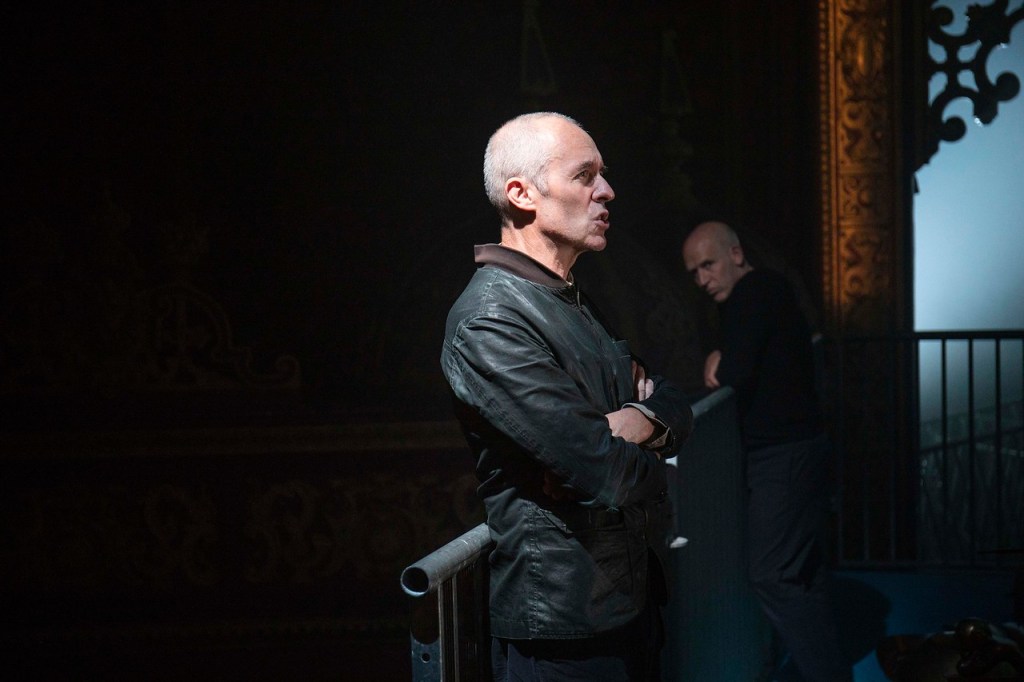
How It Is (Part 2)

Photo: Clare Keogh

How It Is (Part 2) by Samuel Beckett – Coronet Theatre, London

Published in Plays International

Irish company Gare St Lazare were booked to perform at the Coronet Theatre when the pandemic struck in 2020, depriving London audiences of the greatly anticipated second instalment in their stage adaptation of Samuel Beckett’s 1961 prose work, ‘How It Is’. The book is divided into three parts, and the first was seen at the Coronet Theatre in 2018 while Part 2 premiered in Cork in 2019. In a much-delayed transfer, it finally arrives in Notting Hill where it proves well worth the long, long wait. 

First published as ‘Comment c’est’ in the same year as ‘Happy Days’, Beckett’s final full length prose work was not written for the stage and could easily be viewed as unstageable. Gare St Lazare have no such qualms and tackle its rhythmic, at times almost abstract, monologues with a complete conviction that results in a piece of theatre that is in equal parts entirely absorbing, extraordinarily demanding, and unlike almost anything else seen on a stage. Continuing where the first production left off, two actors – Stephen Dillane and Conor Lovett – describe their experiences lying side-by-side, face down in the mud, unable to speak aloud, hardly able to move, and sustained by sacks of tinned food. Part 2 is introduced by the unnamed narrator (Dillane) who lies beside Pim (Lovett) and tells us what happens: “My time. My life. In the dark. In the mud. With Pim.” Then we hear from Pim, who takes up the narrative from his own perspective. The actors alternate long streams of consciousness, expressing themselves in truncated sentences that Pim describes as “Short blurts. Midget grammar.” Beckett’s highly stylised writing is like a form of verbal minimalism, repeating phrases, circling and returning, the same yet different. It is a mesmerising experience.

The performance also includes a gamelan orchestra – specifically the Irish Gamelan Orchestra. Their instruments completely fill the stage with banks of gongs, bonang drums that look like cooking utensils, and xylophones. There is a singer, woodwind and strings, including an eerie, scraping rebab that sounds as though it is broadcasting from another time. Multiple musicians materialise and vanish, playing pieces of strange, deeply atmospheric music that fills the theatre. The conjunction of gamelan and Beckett is, on the face of it, very odd but in practice seems to make complete sense. The rhythms of text and music respond to one another, mutually reinforcing their power of communication. The orchestra is led by Mel Mercier, a long-term collaborator with Gare St Lazare, who acted in Part 1. He kneels at a drum shouting out mysterious number sequences that somehow control the polyrhythms flying around him. It is like a classical orchestra on acid.


The production is directed and designed by Judith Hegarty Lovett, joint company director with Conor Lovett. Her vision is unmistakable, a staging that locates the two performers around the edges of the Coronet’s magnificently decayed auditorium. Dillane first appears draped at an uncomfortable angle over the aisle handrails, spotlit against flaking paintwork. He and Lovett perch awkwardly behind the orchestra, lie on the floor behind the gong racks, and appear in the audience. They are never centre-stage, as they struggle to communicate their bizarre predicament from the sidelines. Yet they cannot stop talking. The words flow from both without ceasing, beyond their control, and they spend around half the evening attempting to conclude what they have to say.

Both performances are astonishing. The evening runs, remarkably, for more than 150 minutes with an interval and involves feats of memory that put almost any other stage roles in the shade, including Beckett’s own, notorious challenging monologue ‘Not I’. Conor Lovett’s Irish accent is soft, lyrical and in tune with the poetry of Beckett’s phrases. Stephen Dillane, contrasting English in his delivery, attacks the lines, as though speaking despite himself. Lovett at times bounds across the stage with a weird delicacy, while Dillane strikes strange formal poses that appear unrelated to what he has to say. At one point Dillance grabs a lectern and delivers an imaginary commentary on what they are doing, at double speed, written by a “witness” who he then concludes cannot exist. They take a tea break halfway through, in real time, boiling a kettle and making and drinking cups of tea while muttering to one another, as the audience looks on. Both actors are both disconcerting and completely captivating, giving the performances of their lives.

The scenario of ‘How It Is’ is like a more extreme version of Winnie’s predicament in ‘Happy Days’, half buried in a way that is both symbolic but also entirely real. The narrator and Pim describe the contortions involved in reaching objects and each other, in moving and communicating while face down in the mud. Disturbingly, their relations quickly turn to violence. Pim subjugates the nameless narrator, conditioning him to respond to unspoken commands delivered with nails to the armpit, a tin opener to the buttocks, a smack on the skull and finger up the arse. Beckett’s world is figuratively as well as literally dark, a place where only two men are required to ensure inequality, exploitation and oppression. This is what passes for communication, until Pim discovers that he can trace words on his companion’s back which he can eventually decipher. The two characters seem to become one another as they demand narratives of “life above”, which emerge in dark, alarming fragments – a half-remembered life in the building trade, married to a woman who jumped from a window. Beckett’s language is coarse as well as mesmerising, never allowing the audience’s expectations to settle. The question “Do you love me, c***?”, scraped into a bare back, is as close as he comes to anything life affirming. Yet the basic truth is that, despite everything, both characters are still alive, and as long as they are alive they can speak.

At the end of an astonishing evening, time having long since lost its meaning, we emerge wondering what we have seen and what it could signify. Beckett offers no easy answers, and probably no answers at all, but he exposes the nature of being in a way that few other writers have attempted. Fifty years after this work was written, it still provides the most difficult and disconcerting experience theatre has to offer. How It Is (Part 2) is not for the faint hearted. It is, however, made for anyone who wants to see artists who are completely committed to an entirely original vision, a show that demands everything from its audience as well as its performers, a company that is working on the cutting edge of world theatre, and work of the highest quality. Serious credit must also go to the uncompromising Coronet Theatre, and its artistic director Anda Winters, for staging work that few theatres would contemplate. Gare St Lazare deliver an experience few will be able to forget.

The Corn is Green

Photo by Johan Persson

The Corn is Green by Emlyn Williams – National Theatre (Lyttleton)

Emlyn Williams’ play, once famous, has been little revived in recent years. Set in the early years of the 20th century in a North Wales mining village, it tells the story of a determined single woman who defies social and gender expectations to set up a school, teaching miners. In Glansarno, boys become men at the age of 10 when they are sent to the mine, and the idea that they should learn how to make any more of themselves is seen as at best strange, and at worst dangerous. Miss Moffat (Nicola Walker) blows into town and changes the outlook of everyone she meets, using her inheritance to set up a village school against the opposition of the local, English squire (Rufus Wright) who is happy to profit from the mines he owns, and not at all happy to be told what to do by a female. Miss Moffat recruits frustrated spinster Miss Ronberry (Alice Orr-Ewing) and pleased with himself Baptist Mr Goronwy Jones (Richard Lynch) to teach, giving them new expectations of themselves. She also identifies the potential of Morgan Evans (Iwan Davies), coaching him to an Oxford scholarship, unheard of for someone of his background.

Many aspects of Williams’ play are dated, not least the character of 16-year old Bessie Watty, a stereotyped floozy who leads Davis astray with her feminine wiles. Many of the characters are stock types, whose role is mostly to provide comic relief, including the idiotic Squire and the flustered Miss Ronberry. However, Dominic Cooke’s production makes a good case for reviving it. He stages the play, very cleverly, within a narrative structure that emphasises the highly autobiographical nature of the story. Gareth David-Lloyd plays Emlyn Williams who leaves a sophisticated London party, staged with a striking shadow play of dancers behind a screen, and imagines the play into existence. His typewriter begins to clatter on its own, and he describes the setting and stage directions as characters appear on an empty slate platform. A chorus of miners wraps itself around the action, punctuating the action with beautiful male voice songs in Welsh. As the play progresses, props and then a set start to appear as the story gathers pace, and Williams becomes drawn in.

The staging is excellent, but the real reason to see the play is for Nicola Walker. Her performance as Miss Moffat, full of self confidence which is challenging throughout, is subtle and human. The part, which attracted Betty Davis and Katherine Hepburn on film, is a fully fledged starring role and she delivers in full. It is hard to keep your eyes off her, and she reaches deep within herself to overcome barriers that are as much in her own head, as in the social structures around her. She finds a way to work with people, rather than ordering them around, that allows her to achieve everything she wants – but at an unexpected price. Walker gets better with every role, and looks set to be an indispensable member of the National’s ensemble for years to come. Dominic Cooke follows Follies and The Normal Heart with another triumph that showcases his range, and confirms him as a director operating at the highest level.

Psychodrama

Psychodrama by Sleepwalk Collective & Christopher Brett Bailey – Battersea Arts Centre, London

Not many theatre pieces begin with the brutal assassination of the Roadrunner (from a speeding car, with a baseball bat), nor do they include a home invasion resulting in the deaths and dismemberment of Mickey and Minnie Mouse (with a chainsaw). But not many performers have the hallucinatory genius of Christopher Brett Bailey and Sleepwalk Collective, and still fewer have the nerve to stage such an intense, terrifying and often hilarious performance. Playing only a few nights at Battersea Arts Centre as part of a tour, Psychodrama stands out in a big way and those lucky enough to catch it will wonder, in years to come, whether it can really have happened.

The audience wears headphones throughout the show, and the two performers – Bailey and iara Solana Arana – speak into microphones, addressing us as though we are a watching tv audience. Their world is television – a pre-internet version with cathode ray tubes and cartoons, where the separation between violence and entertainment becomes terminally blurred. In a series of linked sketches they delve deep into very dark and strange places, like excerpts from the world of David Lynch that have broken loose. Bailey has Eraserhead hair, while Solano is a dive bar Marie Antoinette. Announcing their intention to take up residence inside our heads, they evoke a series of increasingly disturbing scenarios, performed with cool levels turned to maximum. As well as cartoon assassinations (“Sometimes we kill for money, sometimes we kill for pleasure, sometimes we kill to eat”), the evening encompasses a particularly alarming episode with a psychotic Popeye, a staggeringly over-the-top diner sex scene, and a jukebox ballad that is Lynch through and through. Meanwhile a woman interrogates them, apparently in subtitled Russian, about their states of mind.

These scenes, often jaw dropping, risk being as cartoonish as the scenarios they explore, but they are a great deal more. The use of headphones allows a remarkable soundscape to infiltrate the minds of the audience, immersing them deeply in a world of disquiet. Bailey and Sammy Metcalfe, who designed the sound together, achieve something remarkable by conjuring a late-night, nightmare world that is both alluring and alarming, like a therapy session gone wrong. The queasy, late night atmosphere is strongly reminiscent of Chris Morris’ radio series, Blue Jam, the highest of accolades for weirdness.

Above all, the writing from Bailey, Solano and Metcalfe is remarkable, a storm of twisted cultural confusion, Americana gone very wrong. The audience watches in open mouthed glee as he tramples all over sensibilities and trigger warnings to present the things we really do not want to see, all at once. The density of the script could be too much, but the performers use neat theatrical devices – tiny effects boxes, a miniature loudhailer, unexpected inflatables – to punctuate their narratives, like cartoon exclamations. Psychodrama is an outlier: with its analogue pop culture obsessions it references a previous generation, but is all the more welcome for being made right now. Bailey and Solano effortlessly deliver the unhinged, road trip strangeness that shows such as Is God Is have recently been desperate to achieve. They seriously question the role of violence, particularly against women, in our culture without any hint of preaching. And they remind us of how stunning, unexpected the best theatre can be – rising fully formed from the minds of some seriously twisted geniuses.

Straight Line Crazy

Photo by Manuel Harlan

Straight Line Crazy by David Hare – Bridge Theatre, London

David Hare’s new play is a history lesson. New York city planner Robert Moses shaped the modern city by supplying it with expressways and parkways, new roads that accelerated the era of the car and drove their way through the properties of the elite and the poor alike. Straight Line Crazy is set at two key points in Moses career as the man no politician dared say no to. In 1926 he established his reputation by building two parkways to Long Island, opening the backyards of New York’s millionaire families to ordinary people, or at least those with a car. In 1955 he met his match, defeated by a coalition of the organised middle class over plans to build an expressway through Washington Square Park. We see the arrogance and unshakeable self-belief that both made him and finished him. He claimed to serve the people, but on the basis that he knew what was best. In the 1920s, the car seemed to be the future. By the 1950s it had become clear that traffic was destroying the places it was supposed to serve.

The strengths of Nicholas Hytner’s production lie in its excellent case. Ralph Fiennes, as Moses, approaches the part like Olivier – finding the right stance. He throws his shoulders back and his chest out to thicken his profile, and prowls the stage as coiled and tense as the braces that hold up his enormous 1920s trousers. Fiennes is in his element as man whose tragic flaw, his inability to understand or respect anyone else, will clearly be his downfall. Hare’s script has him smouldering most of the time, but when he explodes Fiennes is in his element. His favourite politician, man of the people New York Governor Al Smith, is excellently played by Danny Webb as a twinkly, mischievous character whom you cross at your peril. Samuel Barnett and Siobhán Cullen play Moses’ lieutenants, who grow old and disillusioned as the times catch up with Moses and pass him by.

Helen Schlesinger gives perfect impersonation of Greenwich Village campaigner Jane Jacobs, but it is here that the play’s problems become evident. Firstly, Hare only seems interested in Moses. While the play is about him, the writing fails to activate the characters around him, with the exception of Al Smith. Jacobs signs off at the end of the evening by explaining that she later moved to Toronto, but there is no mention of the rather more important fact that she became the greatest and most influential urban thinker of her day, whose work still shapes the way planners think about cities. This is more than an oversight – it diminishes one of the 20th century’s most important figures, making her serve the story of Moses, which is particularly ironic given his apparent disregard for the opinions of ‘housewives’. Other characters struggle for significance. Attempts to provide Barnett and Cullen with storylines feel like token efforts, and they spend much of their time standing around on Bob Crowley’s cavernous architect’s office set, listening as Fiennes tells us what he thinks.

If the point of the play is Moses, Hare also fails to make it clear why. There is no sense of the current relevance of this story, or why he has chosen to stage it now. The events of Moses’ life are relatively well known, and the play resembles a history lesson that ends in 1955, repeating a story as it happened, without analysis of how it changed our 21st century world. There is a hint at the end of the play of a different, more interesting story as Jacobs is given lines claiming Greenwich Village was destroyed by gentrification instead of the expressway – a theme that suddenly brings the evening into brief focus. Ultimately, despite the undeniable quality of the performers, this is a safe and even somewhat dull evening, which does not challenge or threaten the audience, and leaves them smugly confirmed in the beliefs that held when they took their seats.

Playing Latinx

Playing Latinx by Guido Garcia Lueches – Camden People’s Theatre, London

Guido Garcia Lueches is not Mexican. Nor is he Peruvian. Nor Puerto Rican. Nor the emotional Latinx (pronounced Latinks) type people expect. This does not stop him playing all those parts as an actor, in the guise of either fighter, lover or comic relief. Guido’s one-man show tackles the experience of the Latinx performer in the UK, where these stereotypes cover people from “one and a half continents”. Fellow actors and casting directors can be anything from clumsy to rude, and rarely see Latinx actors as people but as a distinct, controllable type. “I was white before I came here”, says Guido, in typically understated but piercing aside.

Although the show deals with some sobering themes about our not-so-post-colonial attitudes, it does so with enormous humour and grace. Guido is a superbly engaging performer, who has the audience at his mercy from the start. Humour is his medium, and he loves to work with the audience. Ostensibly delivering a seminar in how to be a stereotypical Latinx in a ludicrous accent, he is constantly interrupted by calls from his agent to attend auditions, for sexy pool cleaners, gang members, revolutionaries, and samba dancers. Each time, the agent is played by an audience member who has to occupy the casting chair on stage before the show can continue. By the end, half the audience has been on stage, while the other half has become involved in other ways – and everyone seems to be enjoying it hugely.

Playing Latinx makes neat use of light touch stage techniques such as these, but it is Guido who makes it all work. He is the kind of performer you are happy to trust because his motives are clear. He has written a piece of smart, funny and reflective entertainment that will send you home delighted with what you’ve discovered. Whether he ever gets to play “Ricardo Tres”, as he puts it, is another matter but Guido deserves big audiences for a standout piece of fringe theatre.

After The End

Photo © The Other Richard

Written for Plays International

After The End by Dennis Kelly – Theatre Royal Stratford East, London

Dennis Kelly’s 2005 play, After The End, is set inside a nuclear fallout shelter, so it is not surprising that it deals with situations beyond the boundaries of what passes for normality. It has a cast of just two: Mark and Louise, who are colleagues and friends… sort of. Mark has apparently rescued Louise from a nuclear blast.  “Terrorists. Probably.” he says, “Suitcase nuke”. There is no information on what might have happened to everyone else, although Mark says he saw charred bodies, and there is no signal on the radio. Fortunately, he bought a flat with fallout shelter under the garden, built in the 1980s – not because of the shelter, although everyone at work laughed at him for it, but… well… lucky he did, isn’t it?

Kelly builds, with some glee, an atmosphere of intense awkwardness between the two, who find themselves living together in a confined space for the two weeks that, according to Mark, it will take for the radioactive dust outside to settle. It is all too easy to believe that if the apocalypse happened, it would be distressingly ordinary in its mechanics. People would behave in exactly the way we would expect, only more so. Fear and boredom would go in tandem, and a complete lack of any agency would drive everyone insane. Inevitably, we would not get to choose who we faced the future with.

After The End is about the idea of a catastrophe that renders everything else irrelevant, and leaves us with little more than ourselves to fall back on. However, it is also about more than this. For a reviewer the plot is mostly off-limits, as it hinges around a big twist that changes our perceptions of what we are watching. It is safe to say, though, that Kelly is writing about other types of conflict than just nuclear war. We wait in fear for a war that is already taking place, without our noticing. The power that men exercise over women is the territory of daily violence and oppression, and this is what plays out in Mark’s bunker.

Lyndsey Turner’s production is expertly crafted. As tensions rise, Mark and Louise use the confined space differently, spreading to press one another against the concrete walls, and warily covering one another’s sightlines. Designer Peter McKintosh has letter-boxed a shelter space into the Theatre Royal’s proscenium arch, like a section through a subterranean world. It is a thoroughly claustrophobic setting. The two performers – Amaka Okafor as Louise and Nick Blood as Mark – are excellent. Blood is entirely convincing in his neediness, very much the creepily socially awkward colleague, resentful of the apparently easy friendships and connections enjoyed by others. Okafor is the opposite – a confident, competent woman under pressure from people who want things from her. The friendship between the two is unhealthy. Mark is obsessed with her, too immature to express himself or relate as an equal. He seems amiable but, as we soon see, is capable of exploiting his power over Louise, and maybe of much more.

Although they are played very well, After The End falls short through these two characters. Mark is too much of a cliché to be entirely believable: a man whose genuine obsession is having Louise to himself, so they can play Dungeons and Dragons. Louise is defined by her reactions to the situation she finds herself in, and it is not until the play’s final scene that we see a fuller version of her, and understand a little more about who she is and what she wants.

Okafor’s performance is compelling, and her explosion when finally able to do as she chooses is visceral. However, the final note of rapprochement between the two feels odd in light of what has gone before. It is very difficult to have any sympathy for Mark, who emerges as an unpleasant character on every level, from the petty to the fundamental. His behaviour is, from any perspective, unforgivable. After The End is an intriguing, but not entirely successful play. Turner’s revival is high quality and Stratford East should be commended for programming challenging work, giving us a chance to look again at the new writing of our recent past.

The Merchant of Venice

Photo © Tristram Kenton

The Merchant of Venice by William Shakespeare – Sam Wanamaker Playhouse, London

Written for Plays International

‘The Merchant of Venice’ is seen as a problematic play but, increasingly, it seems that the problems are with us, as much as they are with Shakespeare. We only have to look back a couple of decades to see Shylock portrayed as an ‘other’, a character who, if not quite the author of his own problems, certainly makes life difficult for himself. In her first production for the Globe, director Abigail Graham makes these interpretations seem like something from the dark ages. She reclaims the play, triumphantly, with a production that reveals a powerful expose of racism that has been there all along, but that as a society we did not see.

Against a silvered backdrop, an indoor Venice is revealed, filling the jewel box Sam Wanamaker Playhouse and its disconcertingly dark corners. Graham cuts the comic scenes involving the Gobbos, but Lancelot survives – wheedling his way into the employment of Bassanio at a testosterone-fuelled party of young, white, traders in masks – and the older Antonio. The lads force him to drink a shot every time he says the word ‘Jew’, leaving us in no doubt about the nature of the society they represent. The cast give unnervingly credible performances as a privileged cabal who protect their own interests by viciously demeaning those who do not belong. Michael Gough’s excellent Antonio is perhaps an outsider, working hard to stay on the inside. His relationship with Bassanio, played by Michael Manus as a self-centred, calculating chancer, is physically close and makes him vulnerable. His reaction is to outdo everyone in his anti-semitism, and is shocking to see an older man deploying his experience to be the cynical and vicious of all.

The contrast with Adrian Schiller’s superb Shylock is heart-breaking. This money lender is a low-key businessman in an old-fashioned suit, windcheater and yarmulke. He is softly spoken, as though long experience has taught him it does not pay to stand out. When Antonio asks him for a loan, while repeatedly expressing his scorn and threatening to spit on him, Shylock adds the numbers up in a pocket book with a trembling hand. He clearly wants to be left alone, a luxury not afforded to a Jew in Venice. The hatred on display is a powerful illustration of how racism works in practice, ringing through the centuries like an alarm bell.

Shylock’s subsequent actions are entirely defined by his position in society, and his treatment by people who are open in their contempt for him, and his right to be treated like a fellow human. Schiller provides many stand-out moments. His tears when told that his daughter Jessica’s has not only eloped with his goods, but has pawned a ring given to him by Leah, who we assume to be his dead wife, are truly moving. He arrives in court for his pound of Antonio’s flesh, carrying a folding table and chair and a tupperware box, like a pensioner out for a picnic. He is very much on his own, but determined to take a rare chance to stand up to a society that victimises and bullies him. His hand shakes so violently as he holds the knife to Antonio’s chest that it is clear he cannot go through with it. 

The toughest parts to play and direct in ‘The Merchant of Venice’ are Portia and Jessica. Sophie Melville plays the former as a sparkling, brittle performer, toughened to snapping point by her social position. Her father’s cruel bequest, of a husband to be chosen by lottery, leaves her powerless. The suitor scenes are staged as a gameshow, with Portia wheeled out to be displayed as the prize, in a nod to Rupert Goold’s 2011 Las Vegas-set RSC production. Open racism is part of the equation at Belmont too, seen in Portia’s horrified reaction to the Prince of Morocco. Yet, when she finds herself in a position of influence in court, she seizes her chance to join the boys club, turning on Shylock with relish, to the delight of Antonio, Bassanio and their cronies, a victim turned abuser. She receives her come-uppance when, at the conclusion of the scene, the men slam the door in her face, her usefulness at an end.

Jessica is, if anything, an even more difficult part. There is little to like about Shylock’s daughter, who betrays him completely. She disappears within the play, apparently content to live with Lorenzo on the share of her father’s wealth extracted through the corrupt Venice courts. Graham, taking a cue from Jessica’s single, desolate line “I am never merry when I hear sweet music” tops and tails the production with her singing – “Today’s gonna be a good day” at the start, a Hebrew lament at the end – which imply she too has been used and deceived. Eleanor Wyld’s performance is compelling and charismatic, greatly helping to position her as a rounded character.

Other cast members to make an impression are Raymond Anum as a champagne-swigging Gratiano, Daniel Bowerbank as an opportunistic Lorenzo and Morocco, and Tripti Tripuraneni’s ambiguous Nerissa. The ensemble performs as a unit, connected by Abigail Graham’s fearless vision of the play. The final image of Shylock, walking away to an uncertain future clutching his briefcase, makes a natural connection to images from many eras of persecuted people, fleeing with what they can carry. Graham’s ‘Merchant of Venice’ sets a newstandard for future productions, and showcases the talents of the under-rated Adrian Schiller in a definitive performance. It is the highlight of the Globe Theatre’s winter season.

When We Dead Awaken

Photo: Coronet Theatre

When We Dead Awaken by Henrik Ibsen – The Coronet Theatre, London

Written for Plays International

Jonathan Kent opened his tenure as Artistic Director of the Almeida Theatre with a production of Henrik Ibsen’s final play, ‘When We Dead Awaken’. When, years later, he was asked for his advice to young directors he supposedly said “Don’t start with ‘When We Dead Awaken’”. Kent’s production was well-received and his time at the Almeida a triumph, but the play is famously difficult. If anyone can get to grips with its strange combination of symbolism and despair, it is surely The Norwegian Ibsen Company. Previously seen at the Coronet Theatre with strong versions of ‘Little Eyolf’ and ‘The Lady from the Sea’, they return with a production directed by Kjetil Bang-Hansen. If the play remains difficult to love, it is hard to imagine a more powerful, well-produced account of its strengths and weaknesses.

The set, designed by Mayou Trikerioti, extends the abandoned 19th century music hall atmosphere of the Coronet onto the stage itself. Peeling paintwork on the balconies give way to a derelict stage, floorboards torn up, dominated by a pile of junk heaped into front of a painted proscenium arch. These are the remnants of an abandoned theatre, where the audience has departed for the last time. It neatly sums up the ruined atmosphere of Ibsen’s final work, which seems to be a complete renunciation of his artistic achievements. It is an astonishing play in many ways, but not all of them are good. Ibsen was apparently dissatisfied with what we now regard as his great works – plays such as ‘Little Eyolf’ and ‘The Master Builder’ that he felt said nothing new. The central character of ‘When We Dead Awaken’ is the aging sculptor Arnold Rubek, his greatest work behind him, also condemned to what he regards as ‘hack work’. His young wife Maia can no longer connect with him and, when he encounters his former model Irene, who posed for his greatest work, he follows her where she leads. His final journey with her to the top of the mountain is heavy with symbolism – Lohengrin, boats that run ashore, the ‘murder’ of children, resurrection, light, darkness, seagulls, swans, and a stream that erupts, startlingly, from the set.  

The cast, who perform mostly in Norwegian with subtitles, with some scenes in English, inhabit the unreal world of the play completely. Øystein Røger, as Rubek, has natural authority which conceals a complete collapse in his confidence or sense of self. He has returned to his Norwegian home town, against his better judgement, to look for meaning in his life. Maia, played by Andrea Bræin Hovig with frustrated energy, has given up hope that her husband will take her, as he promised, to the top of the mountain to see the glories of the whole world. The supposed settings – a country hotel and a mountain retreat – seem like painful fantasies and, when other figures appear, they appear to have been conjured from the troubled minds of Rubek and Maia. First Ulfheim (James Browne), a bear hunter, captivates Maia and takes her away to show her something exciting (apparently his dogs, feeding). He later offers to tie her up with their leashes. Then Rubek recognises Irene von Satow, his muse and saviour/nemesis, played by Ragnhild Margrethe Gudbrandsen. She glides into the picture, accompanied by a nun, both real and spectral, and leads Rubek to the top of the mountain, up a path that Maia and Ulfheim find much too dangerous. What happens next is not entirely clear, and Ibsen was apparently unsure how to end the play, but both Rubek and Maia are set free in contrasting ways.

There are a number of problems with ‘When We Dead Awaken’. In abandoning the realism that proved so effective in plays such as ‘Little Eyolf’ when combined with elements of the supernatural, it seems self-indulgent. The dreamlike setting makes it hard to take events seriously but, while it could perhaps be said that Ibsen is mocking his status as a great artist, the play contains little in the way of humour. Rubek, unlike the characters for whom Ibsen is famous, seems a cliché – a tortured, self-absorbed artist who treats others, both Maia and Irene, abominably. Our sympathies for Rubek are rapidly lost as he retreats inside his own self-pity, and it is hard for us to care much about his redemption. Meanwhile, it is disturbing to see how Ibsen, at last writing about what he really felt, had nothing left to say. The darkness that overwhelms him is like an onstage breakdown, distressing to watch and a harsh coda to a life that, more than a century later, seems a triumph.

However, despite the play’s inherent strangeness, the Norwegian Ibsen Company offers a rare and valuable opportunity to see ‘When We Dead Awaken’. The confidence of the performers and the memorable staging, not to mention the alluring sound of Norwegian spoken on stage, make this an evening of high quality theatre for more than just Ibsen completists. The Coronet continues to play an important role in the London theatre scene, hosting European companies who would not otherwise be seen in the UK, and widening our cultural horizons in ways that we should not take for granted. 

Mugabe, My Dad and Me

Photo by Jane Hobson

Mugabe, My Dad and Me by Tonderai Munyevi – Brixton House, London

Tonderai Munyevi is a charming performer. His one man show, which opens the new Brixton House Theatre – home of the relocated Oval House Theatre, and the first in Brixton for a very long time – is a spirited combination of personal and global histories. The two are hard to separate when, as Munyevi was, you are brought up in Zimbabwe and relocate to London to make your life. His experiences include different types of marginalisation, growing up as a gay man and a Zimbabwean immigrant in London. His family story is messy, but the show moving unearths the trauma that led to his father alcoholism, the root of his problems. This is inextricably linked with the fight for independence that led to the end of the apartheid Iain Smith regime in 1981, and the rise of Robert Mugabe as the new leader bringing hope to an oppressed nation. Of course, the Mugabe era did not turn out as anyone hoped, and part of Munyevi’s stated aim is to explain how, far from being a standalone despot, Mugabe was the product of a desperate colonial past.

He succeeds in this only to some extent. As a history lesson, ‘Mugabe, My Father and I’ is sometimes frustratingly lacking. The land disputes that blew up in the 1990s, leading to Mugabe’s transformation into a pariah, are the theme that underlies the show, but are never fully explained. Those without background knowledge may be a little baffled. It is also strange that no reference is made to Mugabe’s infamous homophobia, despite Munyevi’s sexuality being a theme throughout. However, the show is engagingly performed and very well staged. John R. Wilkinson’s direction fills the relatively large Brixton House stage with the help of Nicolai Hart-Hansen’s set of outfits, from military uniforms to Spice Girl dresses, suspended over the performers. Although it is a one-man show, there is also a woman – Mille Chapanda, who plays the Mbira, a haunting Zimbabwean instrument, as well as occasional characters in the show. The Mbira is the name for both the instrument and the story it tells in in music, a different tale for each one of us. This is Tonderai’s tale, and a strong way to open an exciting new theatre space.