There are very few companies who do what Lost Dog does so well – seamlessly combining theatre and contemporary dance, as though this was an obvious way to tell a story. In fact, their work is exceptionally skilled and original, and very easy to get wrong. With ‘A Tale of Two Cities’, they have taken on a complicated and occasionally baffling Dickens tome, which could be a Nicholas Nickleby-style epic in different hands. Naturally, they do not put a foot wrong. Ben Duke directs a larger cast than previous Lost Dog productions, with five dancers juggling multiple roles. His approach owes something to the company’s brilliant Juliet & Romeo – looking back at a well-known story and questioning the assumptions of its main characters. Dickens’ ‘Tale of Two Cities’ is examined by Lucie Manette, who was seven when her mother (of the same name) whisked her and her father Charles Darnay out of revolutionary Paris, escaping the guillotine. She is making a documentary about what happened, interviewing her reluctant parents and brother on camera.
The camera provides our view of past events in many scenes, filmed out of our sight behind the ruined walls of a Parisian hovel, and projected onto screens. Her parents’ secrets – the sacrifice of their friend Sydney Carton who sends himself to execution in place of Charles, and his love for Lucie, and Charles’ evil aristocratic family – are drawn out through Lucie probing. So is the kidnapping and rape of Mme. Defarge’s sister by said aristocrats. Lucie (an engaging and amusing Nina-Morgane Madelaine) guides the audience through these complex events, but Lost Dog does such a good job of expressing the key moments that we are never in any doubt about what’s happening.
The production thrills in the scenes where the cast go beyond words and burst into movement. The combined forces of Temitope Ajose-Cutting, Valentina Formenti, John Kendall and Hannes Langolf alongside Madelaine, are something to be reckoned with. A slow motion riot scene, cast wrestling grimly with one another, and a ship-board scene on a cross-Channel ship, Formenti and Langolf hanging onto the imagined rigging as they talk, are familiar techniques but rarely performed with such precision. Other scenes – Ajose-Cutting losing her core, physically, as she discovers what really happened to her sister, and Kendall dancing a jig on the end of a hangman’s rope, while a timer counts down the excruciatingly slow 3 minutes it takes him to die – are actively astonishing. The show is both an intellectually rigorous re-examination of a tale taken for granted, and a piece of pure entertainment. Ben Duke continues to be one of the theatre-makers of our time, demonstrating exactly why dance matters.
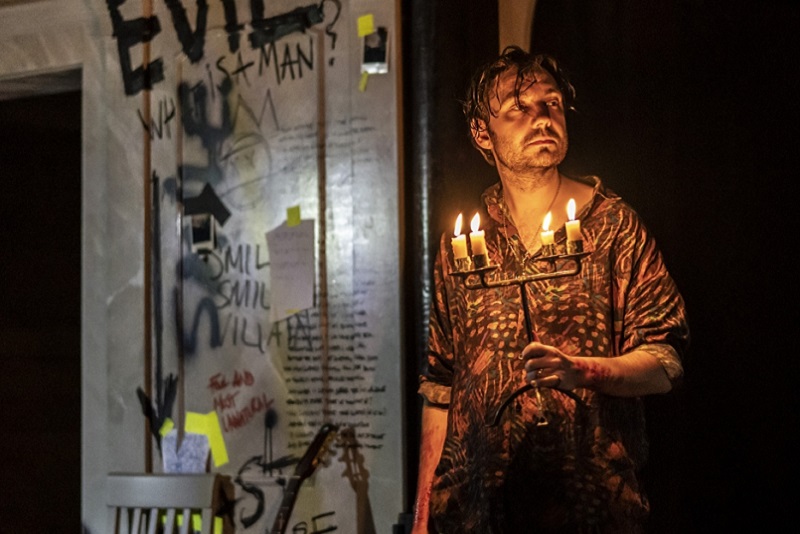
Sean Holmes’ production of Hamlet in the Globe’s indoor space opens with a snatch of “Oh mother I can feel the soil falling over my head”, from The Smiths’ song ‘I Know It’s Over’. Then the candles are doused, the theatre plunges into complete darkness, and we are on the walls of Elsinore. This is about as conventional as the production gets. The next scene, rather than introducing Hamlet through his meeting with The Ghost, skips forward in the play and it is several scenes before we return to the castle walls. Every production of Hamlet is an exercise in editing and rearranging competing versions of the play into a version that is not only coherent, but also short enough for the audience to get home afterwards. Usually, the audience barely notices how the effect has been achieved. If they do, the rationale should be clear. Radical re-edits of Shakespeare can work brilliantly. Joe Hill-Gibbins’ 2018 production of Richard II for the Almeida is a recent example of how taking a cleaver to the structure of a play can change all expectations of how it should be performed. However, the intention behind Holmes’ rearrangements is never clear, and the confusion feeds into many aspects of his production.
The set, by Grace Smart, uses the neat device of an ornamental pool in the centre of the stage. This is used in inventive ways: for Hamlet to teeter on its brink, to douse chandeliers by lowering them into the water and, eventually, to contain the dead. One of the evening’s most effective moments comes when the lights suddenly go up to reveal Ciarán O’Brien’s semi-clad, furious Ghost standing in the water. It is hard to imagine a more threatening Ghost, full of rage at his treatment. However, this interpretation unbalances the play a little, especially when he later returns to waterboard his indecisive son. It is hard to escape the feeling that the elder Hamlet may not have been a pleasant man or a good king, and sympathies begin to tip unexpectedly towards his murderer.
The feeling is amplified by the portrayal of the prince himself. Hamlet is played by George Fouracres, an actor who made his name as part of the comedy trio, Daphne. He is a Black Country prince, delivering the famous lines in a broad Wolverhampton accent. Despite the efforts of companies such as Northern Broadsides to normalise regional accents in Shakespeare, this is still something that is rarely seen. His distinctive tones resonate with the language, giving it a different musicality and revealing new inflections on well-known speeches. Shakespeare and his contemporaries are thought to have spoken in an accent much closer to modern West Country than to received pronunciation, so this arguably a more authentic approach. However, Fouracres is a very downbeat Hamlet, and a remarkably unsympathetic one. Holmes’ decision to dress him as Morrissey, in a far-from-subtle continuation of The Smiths theme, seems to match his misanthropic spirit. In a paisley shirt, skin-tight black jeans and sixteen-hole Doc Martens, Fouracres resembles someone working behind the counter of the Oxford Street Virgin Megastore around 1995. There has rarely been a more morose Dane, but the characterisation feels unsubtle, and foregrounds the least attractive aspects of the character’s behaviour. Hamlet seems most alive when viciously attacking both Ophelia and Gertrude, as though this was his real revenge. Misogyny may be a true reflection of the entitled ‘90s male, but it makes Hamlet very hard to like.
The production’s confused approach manifests itself in a very uneven set of performances from the cast, who fail to present a unified approach to the play. Polly Frame, as Gertrude, is an honourable exception and her scenes have a coherence and weight that is unfortunately lacking elsewhere. Irfan Shamji plays Claudius as a klutz, without any sense of menace or the ruthlessness needed to seize the throne. John Lightbody’s Polonius is broad and comic, a fool through and through who plays to the crowd, but eliminates any sympathy for the character with his ludicrous behaviour. Rachel Hannah Clarke’s portrayal of Ophelia seems to change from scene to scene, and she appears most at home when involving the audience in the call-and-response popular with drunken cricket fans: ‘Everywhere we go / the people want to know / who we are / where we come from’. This, it can safely be said, undercuts the effectiveness of her mad scene, substituting emotional impact for brief, irrelevant audience engagement.
Holmes contrives to make Hamlet much more confusing than needs to be. Cuts mean that Hamlet is suddenly considered mad, without any apparent lead up, while his relationship with Ophelia progresses in jump cuts. The director takes the surprising decision to include the two courtiers, Cornelius and Voltemand, whose tiny parts are usually absent, but transfers Claudius’ confusion over which is which from Rosencrantz and Guildenstern to them. Later, the same actors morph into Rosencrantz and Guildenstern anyway, without explanation. Individually, decisions such as these are quibbles but there are too many of them to avoid.
Holmes approach strongly implies a lack of confidence in the play to engage the audience, or in the audience to last the course. The Gravedigger is played by composer and on-stage guitarist Ed Gaughan, who breaks the fourth wall to explain how difficult it is to make his scene funny, and how by this point in the play everyone is usually getting tired. As if to illustrate, he then delays the final scenes by another few minutes with a series of lame jokes about tv quiz The Chase , as if the audience need to be cajoled into paying attention with some second-rate stand-up. This sums up the problems with a production that seems most comfortable when it can find a way to avoid taking the play seriously.
The Glow by Alistair McDowall – Royal Court Theatre, London
The Glow is an absurdly ambitious play. Its first act is set in 1863, in the household of a Victorian medium, Mrs Lyall, who exploits a patient, extracted from an asylum. Her powers, unlike those of her mistress, are not fraudulent but terrifyingly real. So far, the dramatic structure is conventional, although the subject matter – reality buckling under the harsh gaze of the supernatural – is not. Then Alistair McDowall drops his characters into Roman Britain, 343 AD. Then 1348. Then 1993. Then 1979. Then 1348 again. At one point we pay a brief visit to 500,000 BC, described in the script as the Lower Palaeolithic Age, where an act of brutal violence takes place. The linking character is ‘The Woman’, brilliantly played by Ria Zmitrowicz, a figure who has apparently existed throughout time, an everywoman who reappears in each eras, glimpsed in the backgrounds of paintings. The script even includes an amusing fake academic essay on the myth of The Woman as an appendix. The concept is like a Doctor Who plot opened up beyond the confines of a genre, to encompass limitless possibilities. It is both enthralling and disturbing.
Zmitrowicz continues to bolster her ever-growing reputation with an otherwordly performance, in which she contrives to seem both vulnerable and very dangerous in equal measure. Although she has the power to destroy people, and is seen doing some extremely nasty things to people, she suffers more than everyone else put together – rejected, reviled and used across centuries. In a remarkable final speech, she explains what it is like to watch and participate as humanity comes miraculously to life, then destroys itself, and then to carry on existing. She becomes part of the universe, cradling the life spark that could begin the process over again – The Glow. She is a fantasy – saviour, conspiracy theory, universal outsider, and consciousness of humanity in one frail character, who should never be underestimated.
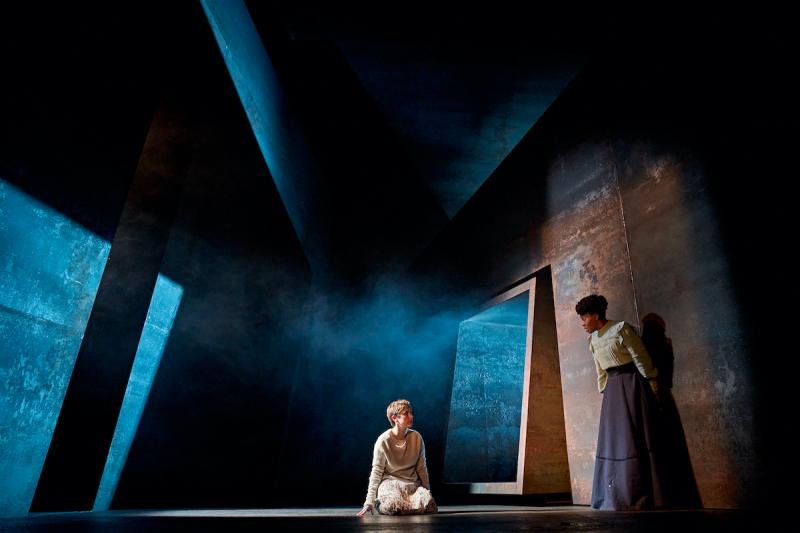
Alongside Zmitrowicz, a cleverly chosen cast deliver equally fine performances. Rakie Ayola plays the cruel Mrs Lyall and the kind Ellen, 130 years on, with equal command. Fisayo Akinade plays four characters with an anxious intensity that stands out. Tadgh Murphy is a medieval warrior (and briefly a caveman), who seems to have stepped out of a Walter Scott fantasy and is starting to wonder who he really is. Vicky Featherstone directs a very challenging script by sticking to a simple approach, which gives McDowall’s characters and their words space to breathe, and to convince us that we are seeing real people, whether from pre-history or otherwise. Space is provided literally by Marie Hensel’s cavernous corten steel slab set, like a chamber located outside time.
The sort of world-swapping, era-jumping epic structure of The Glow has been the aim of many playwrights, but notably few have come close to pulling it off. That McDowall does is perhaps the highest tribute to his skill. The Glow is the kind of work that, in ten years’ time, people will still be wondering at. It is reminiscent of Caryl Churchill, specifically her most recent work for the Royal Court, and of Annie Baker, one of the finest playwrights working today. Both they and McDowall freely combine the everyday with the inexplicable in a way that splits open our literal, conservative, over-documented times. It provides no answers, no plot-driven conclusions, and no compromises. Instead, McDowall spins ideas that won’t leave your head, plays with our fantasies of how we might be saved – half laughing at us and half sympathising with the human plight – and demonstrates that theatre can take us absolutely anywhere if it has the nerve to try. This is one of the most exciting plays to emerge so far, in this stalled decade.
On a spare, skewed platform a man (Nathaniel Christian) in RAF uniform and and a woman in a 1940s dress (Becky, played by Rachel-Leah Hosker) are enacting a goodbye in stilted, Brief Encounter tones. He’s off to war, naturally, but she doesn’t seem to want to play the role he expects. And she is wearing a leather jacket that is surely too modern for the era. Then, mid-sentence, we are in the present day and Becky is trying to avoid committing to buying a house with her boyfriend (played by Hamish McDougall), apparently distracted by her phone. She speaks news alerts and social media messages out loud as they interrupt her thoughts and conversation.
The Winston Machine is a typically inventive piece devised by Kandinsky theatre company, directed by James Yeatman with dramaturgy from Lauren Mooney. Their collaboration is key to the show’s energy, which is often captivating, sliding boldly between eras mid-sentence and flattening timelines into a single feed, in a way that feels genuinely innovative. This approach is a logical way to approach an exploration of the mythologies of the past – in the form of the wartime experiences of Becky’s grandparents – and its place in the present, where it haunts Becky’s imagination and that of the organisers of a 1940s themed festival where she is booked to sing. Hosker’s voice is at the centre of the evening, as she sings songs of the time confidently, and beautifully. The performers are very adept at bringing a complex show to life, and Nathaniel Christian’s is impressive in what is apparently his professional debut.
Christian morphs from Becky’s grandfather, a complicated character rather than the hero some would like to imagine him, into an old school friend, Lewis, now a successful musician. Becky and Lewis are drawn to one another, and may have a future that looks different to her grandparent’s existence and that of her uptight father, scarred by proxy. However, the focus starts to dissipate towards the end of the play, as it becomes apparent there’s no real ending. The themes of the evening are potent – the dangers of Second World War fantasy nostalgia (given a new lease of life through Brexit), the blurring of past and present online, the things that connect us (music, shared understanding) and what to do with your knowledge of the past. It doesn’t entirely work, but The Winston Machine opens up fascinating questions even if it cannot resolve them. Kandinsky have a fearless performance energy that means their work should be taken seriously, and may well realign your perceptions before you realise what is going on.
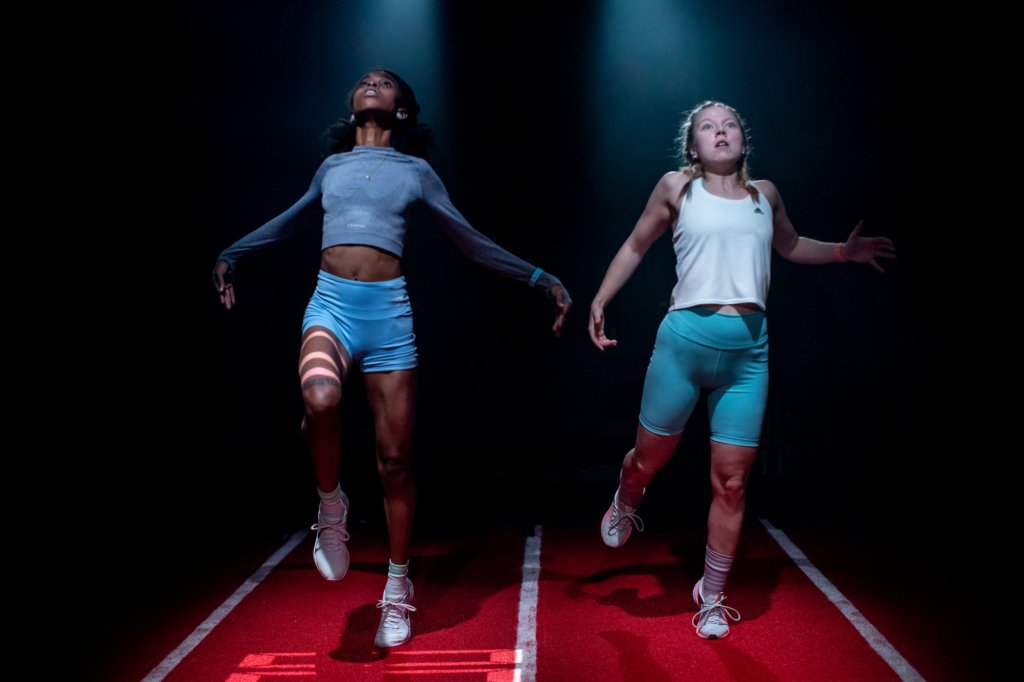
Ella Road’s new two-hander is set in the world of track athletics but the two characters, Ann (NicK King) and Sophie (Charlotte Beaumont) are not just any runners. They are young, promising, female 800m runners. They train under the instruction of an off-stage coach to fulfil their potential. If they do the reps, eat the right food and, above all, commit they can follow a pathway that goes from national to European to world championships and, eventually, the Olympics. At first Road’s play seems to be concerned with the friendship between two young women, sharing the particular pressures of pursuing a career in athletics alongside school and the pressures of growing up. Her writing is very engaging. We quickly feel we are witnessing the ups and downs and the shared experience of Ann and Sophie. The play’s structure is short and sharp, divided into the reps that govern their training. As the progress to championship level, they become closer, Sophie’s cockiness complementing Ann’s worried elegance. The play’s headline theme – gender definitions in athletics – is kept until daringly late, and therefore comes as a shock. Ann’s disqualification and the effective end of her career after her testosterone levels register too high for her to qualify as a female competitor, open up a gulf between the two. Road pulls off the difficult trick of dramatising an argument that is familiar from news headlines without allowing the debate on stage to seem contrived.
Director Monique Touko’s staging is dynamic, energetic and paced like an 800m race. She builds the tension on Naomi Dawson’s running track set gradually until, without realising, we are flying at full throttle. Both performers bring a convincing physicality to the play, with stretching, limbering up and running as the rhythm of their lives. Their practice sequences cross the line between athletics and dance. Beaumont and King carry the audience with ease, strong performers who work well together. The issues ‘Fair Play’ raises are wide ranging, and troubling. The use of an arbitrary hormone cut-off point, decided by white men, to decide who is and is not a woman appears indefensible. Although Road works hard to build a counter-argument in the form of Sophie’s relief at having an explanation for why her friend’s times are faster than hers, and her resentment at this advantage, she clearly has limited enthusiasm for doing so. But this is a play about more than the issues of gender testing, important although that is. It raises questions about the demands placed on young athletes, especially young women, and the nature of competitive sport itself which demands that everyone sacrifices all to be the best, while knowing that very few ever can. Winning seems a delusion that chews up lives for our entertainment, but athletes still choose to do what they think it takes. ‘Fair Play’ provides a genuinely thought provoking evening, and new writing of a very high calibre.
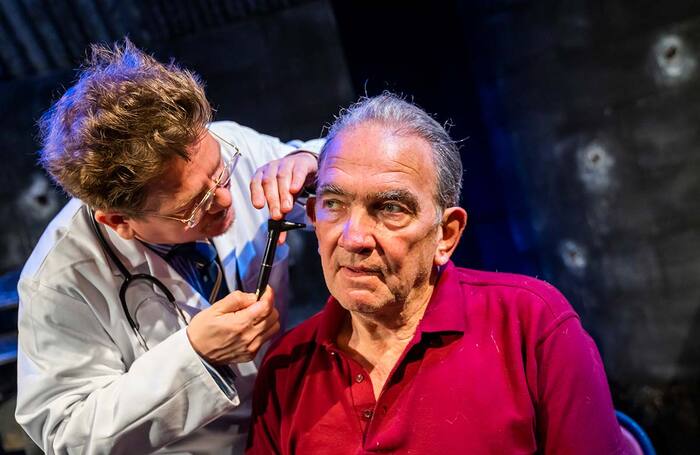
The mental disintegration begins early in David Ireland’s play about a former loyalist gunman. Alan ‘Snuffy’ Black (Daragh O’Malley) is complaining to a doctor about his headaches, his problems sleeping, and the barking dog that keeps him awake. It is this, rather than the many people he admits to killing, that troubles him. The doctor (Kevin Trainor) seems inappropriately flip as he establishes that Alan has nothing in his life. He also seems inappropriately sexual. From this point, the play unmoors itself completely from any expectations of conventional drama, and launches into a gleeful, horrifying cascade of surreal events and forced sex. The dog in question (also played by Kevin Trainor) starts talking to him, and they get surprisingly intimate. Two masked Loyalist comrades with ludicrous names (played by Declan Rodgers and Kevin Murphy) show up to shoot him, repeatedly. A psychiatrist (Laura Dos Santos) gets involved, and stands in judgment. His neighbour ( Owen O’Neill) demands reparation. Ireland’s writing is packed with digs at sectarian mentalities, failure to change with the end of conflict, and the absurdities of people who take themselves so seriously. The cast launches into a script that, on the page, appears almost unperformable, with total commitment. They bring the audience with them all the way, mostly to places they would rather not go.
Written in 2011, before Ireland’s huge successes with Cyprus Avenue and Ulster American, Yes So I Said Yes is epically offensive but very finely honed. Ireland is not a writer who upsets his audience for the sake of it, but this earlier work cuts closer to the bone that either of his better know works. This production, directed by Max Elton, is advertised as the first in Great Britain. It’s perhaps not a surprise that a larger theatre has yet to take a punt on it, so the Finborough is to be congratulated for staging such a ludicrously provocative, yet unforgettable play. The final rape scene, which is both awful and comic, matches anything produced by writers such as Edward Bond during the 1960s assault on censorship. Writing of this nature demonstrates the purpose of theatre. Something this extreme yet also surreal could hardly be produced on film, but the stage allows for both realism and metaphor to combine, to maximum effect. This is an excellent production, and exactly what one would hope to see in a pub theatre in the back streets of Brompton.
Measure for Measure by William Shakespeare – Sam Wanamaker Playhouse, London
For her last production in the Globe’s candlelit Sam Wanamaker Playhouse, Ben Jonson’s Bartholomew Fair, Blanche McIntyre expertly conjured the life of a city onto a tiny stage. Her Measure for Measure is another city play, but of a very different kind. It is an enclosed affair, in which the action takes place in the private chambers of Vienna – hidden manors, courtrooms, confession booths, jail cells – and in the tortured heads of its leaders. The Playhouse is built for dark interiors, but not usually for the 1970s settings that feature in James Cotterill’s design. McIntyre has taken the cheeky decision to set the play in 1975, which allows the use of some very enjoyable costumes. She also uses the neat trick of a power cut at the start to justify the use of candles throughout the play. It is debatable whether the choice of time period adds to the play’s interpretation, but the cast looks great in a succession of chic pantsuits and wide boy outfits.
The Duke is played by Hattie Ladbury in an ankle-length white coat which sets her apart from her subjects. In disguise, wearing a friar’s black habit, she becomes her own hidden reverse, a provocateur prowling the jails and brothels, throwing lives into chaos. The Duke’s motivations are the abiding mystery of Measure for Measure. Ladbury is a tall, socially awkward presence. There is a hint early on that she has been unable to communicate her true feelings towards Angelo (Ashley Zhanghaza), and her decision to flee her responsibilities is a way to regain some level of control. Her activities seem increasingly strange and cruel, as she uses her subterfuge to toy with the lives of her subjects, pretending to Isabella that her brother Claudius has been executed long after any justification for this story has evaporated. However, her behaviour seems to stem less from malicious intent than from a clumsy desire to play the fairy godmother.
Georgia Landers as Isabella has the wide-eyed certainty of the young about her, convinced about the rightness of everything she does. Her moral certainty makes her much more dangerous than the supposed villains of Vienna, the pimps and bawds. Yet, when Angelo corners her in a sudden fit of rage and demands her body, she cries out “To whom can I complain?” in a way that seems entirely modern. So too, perhaps, is her polarised position which allows for no flexibility of thinking. From a 2020s perspective, it is becoming easier again to understand the right-or-wrong mindsets with which she, and other moralists in the play, back themselves into corners.
The cast is strong and versatile, ensuring McIntyre’s production is always compelling to watch. Ishia Bennison plays four roles, including a concerned Escalus, a brassy Mistress Overdone and a triumphant cameo as the prisoner Barnardine, drunkenly insistent from a hole in the ground. Eloise Secker puts her mark on the production as both a flatly insolent, androgynous Pompey, and a Greta Garbo Mariana in headscarf and sunglasses.
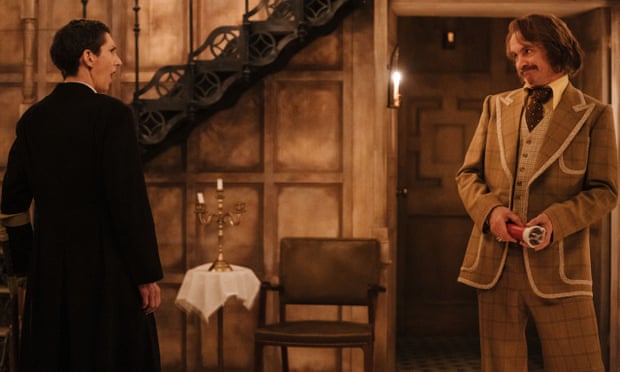
Gyuri Sarossy’s Lucio, with dirty blond hair, moustache and brown suit, is first seen collecting his belongings from the street, where Pompey has slung them from a bawdy house window. His line in comedy and sleaze fits the 1970s setting very well. Sarossy also delivers a twitchy, white-coated version of the executioner, Abhorson, dragging a giant axe behind him. Daniel Millar plays both the Provost and Elbow, opposite ends of the law enforcement spectrum. His Elbow is a chaotic fantasist wielding a malfunctioning bull horn which punctuates his tall tales.
These many entertaining parts do not always coalesce, and a coherent account of this elusive play is never quite delivered. There is plenty of food for thought however, not least in the gender-swapping of the Duke’s role. This allows the character’s motivations to be separated from the exercise of male power that has always dominated interpretations. Both Zhanghanza’s Angelo and Ladbury’s Duke are ill at ease with themselves. For Angelo, this leads to downfall and public disgrace, which does not appear to be eased in the slightest by the Duke’s closing instruction that he should marry Mariana. For the Duke, her appearance belies the woman beneath. In the final scenes, with her cropped hair and dressed head-to-toe in white, she strongly resembles the sexily evil Servalan, from 1970s sci-fi sensation Blake’s 7.
For her last production in the Globe’s candlelit Sam Wanamaker Playhouse, Ben Jonson’s Bartholomew Fair, Blanche McIntyre expertly conjured the life of a city – London – onto a tiny stage. Her Measure for Measure is another city play, but of a very different kind. It is an enclosed affair, in which the action takes place in the private chambers of Vienna – hidden manors, courtrooms, confession booths, jail cells – and in the tortured heads of its leaders. The Playhouse is built for dark interiors, but not usually for the 1970s settings that feature in James Cotterill’s design. McIntyre has taken the cheeky decision to set the play in 1975, which allows the use of some very enjoyable costumes. She also uses the neat trick of a power cut – echoing those dark years in the UK when electricity use was restricted by strikes and government action – at the start to justify the use of candles throughout the play. It is debatable whether the choice of time period adds to the play’s interpretation, but the cast looks great in a succession of chic pantsuits and wide-boy outfits.
The Duke is played by Hattie Ladbury in an ankle-length white coat which sets her apart from her subjects. In disguise, wearing a friar’s black habit, she becomes her own hidden reverse, a provocateur prowling the jails and brothels, throwing lives into chaos. The Duke’s motivations are the abiding mystery of Measure for Measure. Ladbury is a tall, socially awkward presence. There is a hint early on that she has been unable to communicate her true feelings towards Angelo (Ashley Zhangazha), and her decision to flee her responsibilities is a way to regain some level of control. Her activities seem increasingly strange and cruel, as she uses her subterfuge to toy with the lives of her subjects, pretending to Isabella that her brother Claudius has been executed long after any justification has evaporated. However, her behaviour seems to stem less from malicious intent than from a clumsy desire to play the fairy godmother.
Georgia Landers as Isabella has the wide-eyed certainty of the young about her, convinced about the rightness of everything she does. Her moral certainty makes her much more dangerous than the supposed villains of Vienna, the pimps and bawds. Yet, when Angelo corners her in a sudden fit of rage and demands her body, she cries out “To whom can I complain?” in a way that seems entirely modern. So too, perhaps, is her polarized position which allows for no flexibility of thinking. From a 2020s perspective, it is becoming easier again to understand the right-or-wrong mindsets with which she, and other moralists in the play, back themselves into corners.
The cast is strong and versatile, ensuring McIntyre’s production is always compelling to watch. Ishia Bennison plays four roles, including a concerned Escalus, a brassy Mistress Overdone, and a triumphant cameo as the prisoner Barnardine, drunkenly insistent from a hole in the ground. Eloise Secker puts her mark on the production as a flatly insolent, androgynous Pompey and as a Greta Garbo-like Mariana in headscarf and sunglasses.
Gyuri Sarossy’s Lucio, with dirty blond hair, moustache, and brown suit, is first seen collecting his belongings from the street, where Pompey has slung them from a bawdy house window. His line in comedy and sleaze fits the 1970s setting very well. Sarossy also delivers a twitchy, white-coated version of the executioner, Abhorson, dragging a giant axe behind him. Daniel Millar plays both the Provost and Elbow, opposite ends of the law-enforcement spectrum. His Elbow is a chaotic fantasist wielding a malfunctioning bull horn which punctuates his tall tales.
These many entertaining parts do not always coalesce, and a coherent account of this elusive play is never quite delivered. There is plenty of food for thought however, not least in the gender-swapping of the Duke’s role. This allows the character’s motivations to be separated from the exercise of male power that has always dominated interpretations. Both Zhangazha’s Angelo and Ladbury’s Duke are ill at ease with themselves. For Angelo, this leads to downfall and public disgrace, which does not appear to be eased in the slightest by the Duke’s closing instruction that he should marry Mariana. For the Duke, her appearance belies the woman beneath. In the final scenes, with her cropped hair and dressed head-to-toe in white, she strongly resembles the evil, sexually charged character Servalan, from 1970s sci-fi sensation Blake’s 7. However, she lacks the sexual confidence her appearance implies, leading to an intriguing final moment. Her offer of marriage to Isabella, which comes out of the blue and is now usually played as a disastrous misstep, is embarrassed and tentative. She and Isabella linger, facing one another, neither knowing what their next move should be. It is a surprisingly romantic ending for a play that has some of the fairy-tale elements of Shakespeare’s later comedies. Will they or won’t they? We will never know and neither, probably, will they.
Force Majeure by Tim Price – Donmar Warehouse, London
Adapted from Ruben Östlund’s film, Force Majeure is an exercise in family breakdown set among a group of well-off Swedes on a skiing holiday. Threatened with a avalanche, heading straight for his wife and two children, Tomas (Rory Kinnear) grabs his phone and runs. His wife Ebba (Lyndsey Marshall) grabs the children and dives under the table. The play deals with the consequences of his instincts, and his refusal to admit what happened. Ebba and Tomas’s marriage is clearly strained before this incident. He spends all his time on work, leaving her to manage the children, who he doesn’t really know. The combination of an unfamilar setting and a sudden crisis brings it all tumbling down. Kinnear is the master of tight lipped denial, and his casting is very good. He is excellent at being superior while entirely in the wrong. Marshall is equally good, combining steeliness and vulnerability. Their children, Vera and Harry played on this occasion by Bo Bragason and Harry Hunt, are all too recognisable as a sarcastic teen and a wired pre-teen.
Michael Longhurst’s production makes creditable efforts to bring ski slopes to Covent Garden. The stage is covered in white matting, and cast members ski across its rake with admirable control. The otherworldy neon of ski gear, and the somewhat hellish Euro-dance bar atmosphere is evocative and convincing. It’s not clear, though, that this particular film needed a stage adaptation. The script is not entirely convincing, resorting to unlikely stereotype characters as foils for Tomas and Ebba – a blokeish mate separated from his wife (Sule Rimi) and a liberated swinger (Natalie Armin). Kinnear delivers his eventual meltdown as both funny and pitiable, but the ending seems contrived and the message murky. However, the evening is an enjoyable spectacle, and includes neat touches such as the ever-present hotel staff who interrupt every significant scene trying to get their work done, their minimum wages lives contrasting grimly with the privileged families they look after.
The Tempest by William Shakespeare – Jermyn Street Theatre
The Jermyn Street Theatre is a tiny place to stage a play that is more usually seen filling all the space on offer at the RSC or the National Theatre , but the scale gives Tom Littler’s production of The Tempest particular meaning. The set, designed by Anett Black, is Prospero’s rather cosy cell, lined with desirable, wavy bookshelves. The fantastical happenings on the island seem conjured from his head to a greater degree than most productions and even, perhaps, take place only in his imagination. The part is played by Michael Pennington, whose performance is intriguing in several ways. He wrote, in his book ‘Sweet William’ about his reluctance to play the part, which he attributed to failing to fully understand Prospero. However, in the programme for this production he also discusses his concern that this is the final part a Shakespearean actor plays, after which there is no more. Pennington’s Prospero is stooped and elderly, trying to put his affairs in order and provide neat endings for all the loose ends in his life before it is too late. Pennington’s voice is remarkable, carrying all the power and cadence of a man used to bestriding the big stages. It is a treat to watch him so close up. His performances is all the more remarkable because he reads the part from a book, a very rare situation on stage. Presumably this is what he needs to do to be able to play the part and, to some extent, it fits the conceit that Prospero is directing events. It also adds to the vulnerability of his performance, and to the sense that Prospero is running out of time.
The rest of the cast are strong, with some enjoyable performances. Rachel Pickup’s Miranda and Tam William’s Ferdinand are both older than actors often cast in these roles, adding to the sense that Prospero’s grasp on time has eroded. Richard Derrington and Peter Bramble double, to great effect, as Antonio and Stephano, Sebastian and Trinculo, playing both ends of the social spectrum with relish. Derringtons’ Welsh Stephano is a particular pleasure. However, the driving force is Whitney Kehinde’s Ariel, who works very hard indeed for her master. Her movement style makes her seem alien, and her energy compensates for Prospero’s lack of it. She even performs the entire masque sequence herself, as three different characters in quick succession. The production is expertly managed and the tiny stage expands to fill the dimensions of an island, with only a painted sheet to change the scene. It provides an opportunity that should be missed to see a fine actor giving the performance he never thought he would.



 Tom Bolton