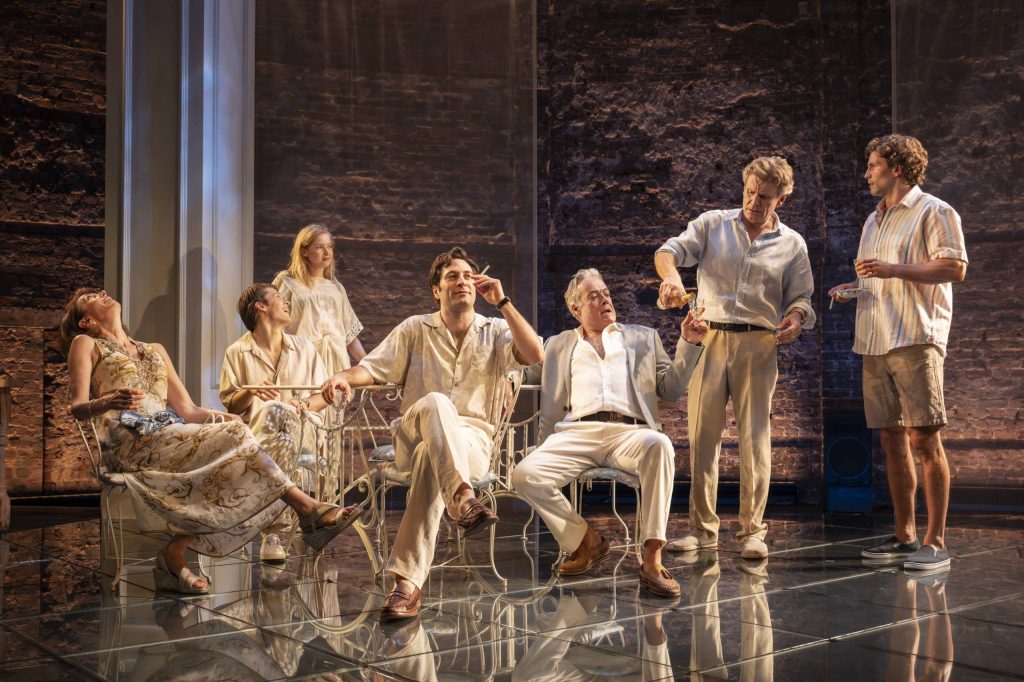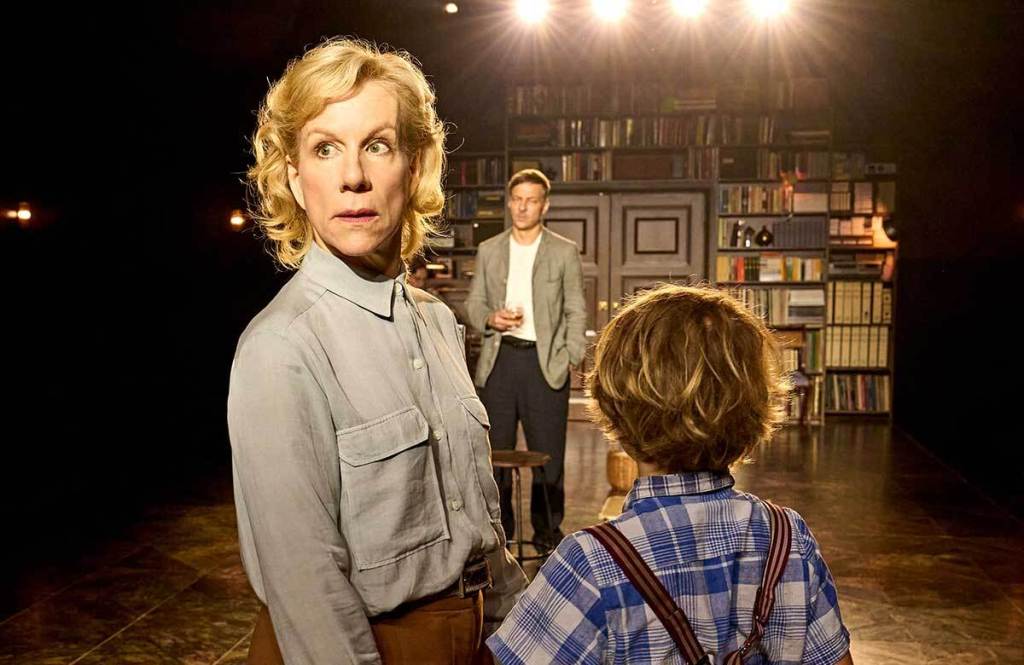
Stephen Daldry’s production of David Lan’s new play, about the moral dilemmas in the aftermath of World War II and their lifelong consequences, piles the pressure on relentlessly. Juliet Stevenson plays Ruth, now in her 70s, living in London. Someone she hasn’t seen for 50 years arrives – Thomas (Tom Wlaschiha) – and we watch the story of what happened to him unfold over the next two and a half hours. Ruth was a young woman working for the UN in Bavaria, the American sector, after the German surrender. She and her small team of women look for children stolen by the Nazis from Eastern Europe and checked for Aryan characteristics. Those who passed the tests were given to German families with new names. Those who did not were murdered. Once the children are identified, the hard part begins. Thomas is with parents who hide his real identity, but are distraught when he is removed. Ruth becomes attached to him, saving him from the fate of many children – removed en masse by the Russians or by the Americans to be rehomed. But she doesn’t send him back to Poland either, where he might have rediscovered his original family. He has flown to London from New York to reveal the consequences.
Daldry crosses the play’s two time periods over one another – literally, with Ruth and Thomas occupying either end of a long traverse stage holding Miriam Buether’s London apartment set .while the events of 1945 play out across the middle. The pacing is effective, with the flashback action erupting into the civilised lives they have both built. Stevenson is remarkable, her calm demeanour drawing the audience’s attention to the emotions shifting tectonically below the surface. Wlaschiha is blank faced, traumatised, and expressing himself through music – although it’s a shame he stands aside from the action for much of the play, providing a catalyst rather than participating. The character Thomas is a pianist, and Wlaschiha has remarkable skills too, performing live on the apartment piano as a number of other characters also do, including Stevenson. It is an ensemble performance, with strong performances from Kate Duchêne as Ruth’s mother, Marek Oravec and Cosima Shaw as Thomas’s adopted parents and Caroline Lonq as Elise in a cast that includes several European stage actors appearing at the National Theatre for the first time.
Lan has uncovered a little documented set of events from a time that is much pored over, and has constructed a rigorous, emotionally hard-hitting story. It is an excellent vehicle for the talents of its very high end cast and production team.
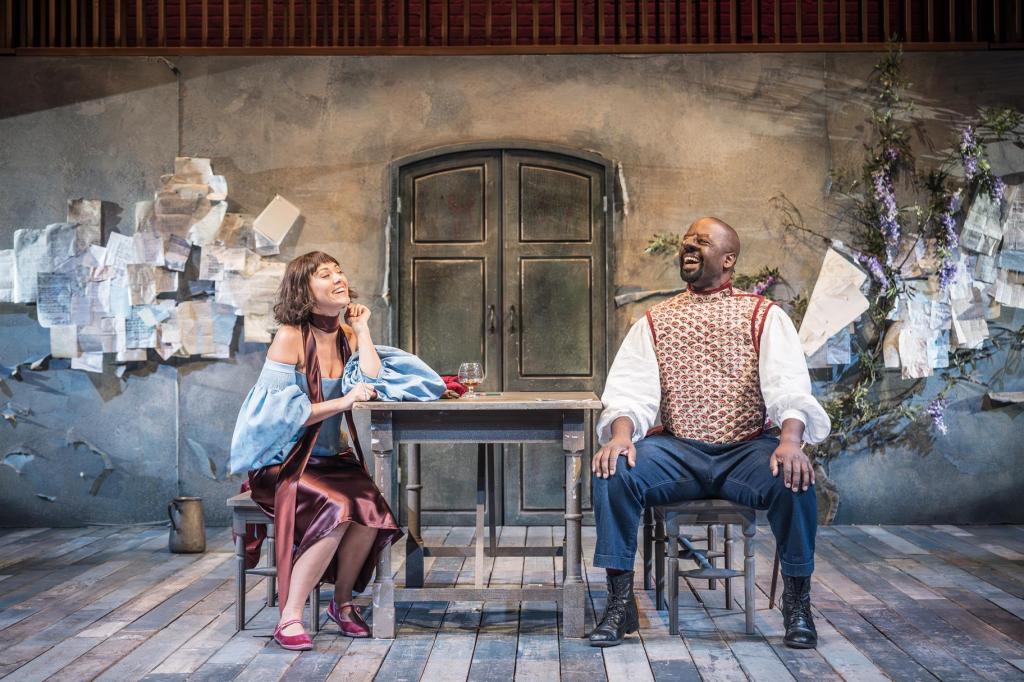
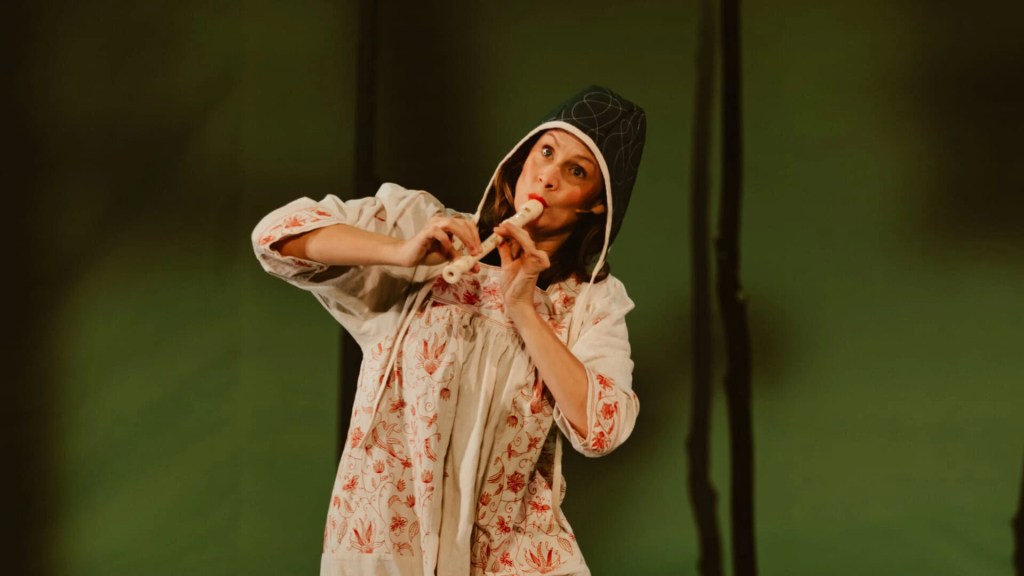
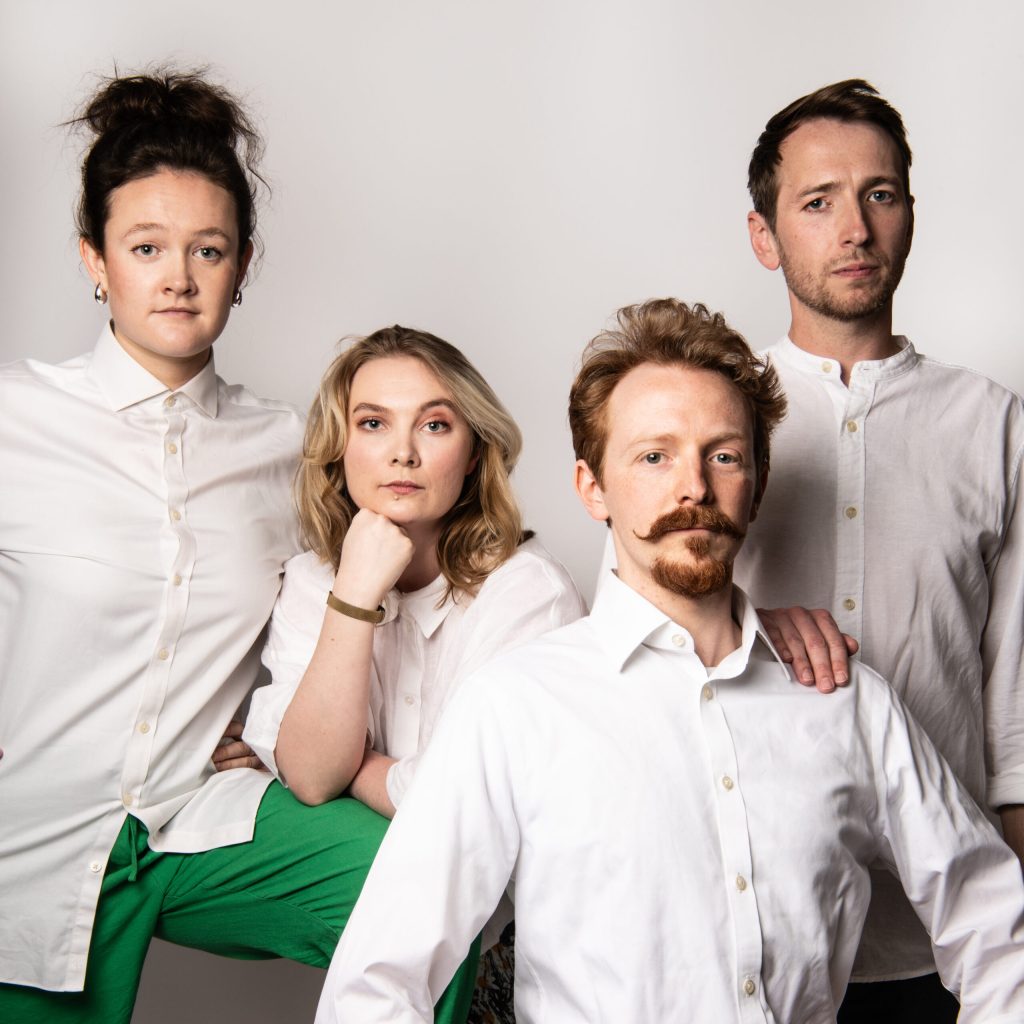
This outdoor production of Much Ado, by genuinely itinerant cycling performers Handlebards, is a glimpse into the travelling player ethos that was most people’s experience of theatre in the pre-modern era. In rain – stair rods for about 15 minutes – the four performers worked tirelessly to maintain the energy, and keep the audience from walking away. They achieved this by turning Much Ado into a sort of clown show – like pantomime Shakespeare – with lots of physical comedy, general silliness, audience participation (the same two audience members were brought on stage repeatedly to fill in the character gaps, and to become a self-generating running gag), and musical interludes. On the surface Handlebards attitude is to take nothing seriously, and the darker moments of the play are certainly not to the forefront. However, their casual approach disguises serious skills. Their timing is impeccable when it matters, and provides a deep comedy well when it doesn’t. Their music-making – lute and ukele tunes and four-part harmony – is of a standard not many people could deliver in a rainstorm.
And Much Ado isn’t dumbed down. It’s simplified, but nothing important has gone missing. And it is communicated clearly, so no-one is in doubt about what is going on, rain and planes notwithstanding. There’s a lot to like here, particularly the four tireless performers who are constantly switching roles, playing voices while someone else does the hands, and generally rushing around. It’s a very enjoyable couple of hours.
Cascando by Samuel Beckett – Jermyn Street Theatre, London
Irish company Pan Pan’s production of Beckett’s radio play, Cascando, is a promenade piece. The audience gathers at the theatre to put on hooded black cloaks and an mp3 player with headphones. With the tech hidden under their hoods, they walk at a measured pace through the streets of, in this case, St. James’s for half an hour while the piece plays in their ears. It is both an intense experience, immersive in the true sense, and a public performance.
Audience members are directed to walk in single file, heads down, focusing on the feet of the person in front ‘as if you were slightly depressed’. The result is a quietly disruptive experience, as a procession of, apparently, monks files slowly through the central London rush hour, amusing and bemusing passers-by, stopping both them and the traffic. The experience of becoming the performance is both very simple, and exhilarating. It is a fundamental twist in the audience contract which turns everything on its head. And that’s without the play itself. Cascando was written for radio and first broadcast in 1963. There are two male voices – Opener (Daniel Reardon) and Voice (Andrew Bennett) – whose rich tones fill our heads. They tell a disjointed story in language stripped to the essentials. Opener sets the scene for Voice, who is apparently trying to finish a story about a man called Woburn, on a journey, ‘same old coat’. The journey seems to be a pilgrimage of sorts, and the Opener a God-like presence. There are also intervals of music by Jimmy Eadie.
The overall production, which premiered in 2016 and has since been performed in venues around the world, is directed by Gavin Quinn. It is quietly astonishing, bringing Beckett disconcertingly alive in a new, modern ritual. As Woburn drifts out to sea clinging to a boat, we know that there is only one way the story will end for all of us, but we measure our steps anyway, one foot in front of another, along the pavements.
The Winter’s Tale by William Shakespeare – Royal Shakespeare Theatre, Stratford-on-Avon
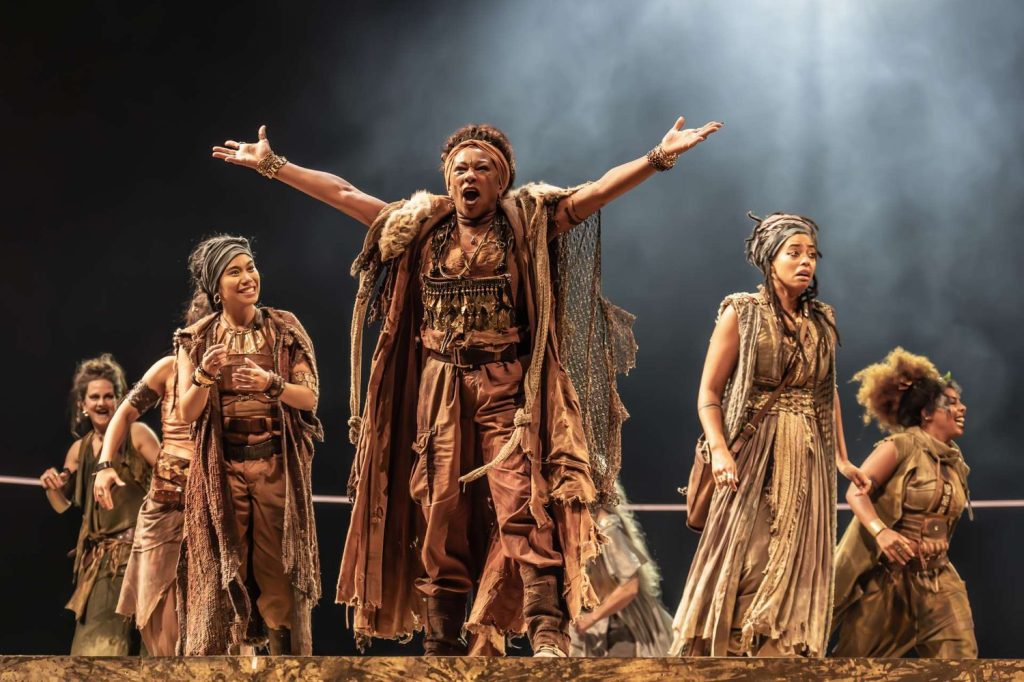
Yaël Farber’s production of The Winter’s Tale is played against the backdrop of a giant, three-dimensional moon. It glows pale white or blood red to signify the contrasting locations in the play: Sicily and Bohemia. Soutra Gilmour’s designs, both set and costumes support an interpretation which has pace and coherence, which can easily vanish with the complete shift in setting and characters that occurs between Act III and Act IV. The early scenes of jealousy, as Leontes pulls apart the lives of those around him, are staged in an almost noir context, with a barefoot king and queen in loose grey clothing. The intensity is completely gripping, in some of Shakespeare’s most driven and desparate scenes. Bertie Carvel’s Leontes is rangy and wired, his paranoia entirely convincing. John Light’s Polixenes, the object of his irrational hatred, is outwardly jovial but wary just below the surface. Madeleine Appiah’s Hermione is full of goodwill, which makes her destruction all the more unbearable. Her trial scene, where she defends herself with patches on her dress from lactation, having just given birth, is very upsetting.
Farber combines the characters of Time and Autolycus to create an rogue / thief / everyman character, played with Geordie accent by Trevor Fox, who ranges around the action, sitting on the edge of the stage smoking a cigarette and linking the two settings. His ballad singing is augmented by Farber with additions from Brecht, which do not neccessarily clarify the play’s themes. Nevertheless, the Bohemia scenes combine pagan and rave themes, and are exciting and tense, which is rarely the case. Lewis Bowes as Florizel and Leah Haile as Perdita are both young, energetic and naïve. Polixenes’ violent fury in this scene, as he exposes their planned marriage, has clear parallels with Leontes’ destructive rage. It is clear that male coercion and violence is the driving theme of the play, and Farber emphasises this by using the same actors to play a band of women around Hermione and around Perdita.
At the centre of the female resistance is Paulina, played by the excellent Aïcha Kossoko who brings power and fearlessness as she stands between Leontes and his victims, then implements 16 years of penance as he submits himself to her authority. The final statue scene, an exercise in standing still for the actor playing Hermione, is played beautifully and plucks the heart strings of everyone in the audience. Farber reveals the play as a complex fable with simple ideas of human love and kindness at its heart, the reason it still makes us weep.
A simple show, but completely absorbing. Three performers dance to rave music, with a set consisting of coloured strip lights. Yes enough to create the atmosphere of a warehouse party. The dancing is free like a rave, but choreographed, with all three moving in unison. The performers become more sweaty and exhausted as the show goes on, grabbing gulps from a table of plastic water cups. It becomes an endurance test for them. Watching people moving in a situation where you would only ever take part gives surprising perspective on an activity that is expressive, involving and strangely fascinating.
The combination of dance and Holocaust memory is unusual but effective. Roger White has recorded interviews with his grandmother, whose father was Jewish. The family left Germany in 1939, and Marianna’s memories provide a vivid account of the day-to-day persecution and the terror that one day her father wouldn’t come home. He was saved by a tearful policeman, and her recollections include more humanity than might be expected. The darkness is underlined by the dancers whose angular movement is sinister but also tender.
Valentina Tóth is a very accomplished classical pianist and singer, a child prodigy who hated performing. She reclaims performance on her own terms, with a brilliant show that ties together stories of ‘hysterical’ women. She draws on Dutch misogyny and sex abuse scandals with a set of songs that also cover her domineering Russian piano teacher (her mother in disguise), menstruation, revenge (in the persona of a Southern belle) and a song about a rape. It’s tuneful, remarkably well performed and unrelentingly dark and confrontational. She even gives us the Queen of the Night aria. She is very convincing, totally in control and remarkably good.
Ontoerend Goed are a cut above most alternative theatre companies. They strip back the assumptions an audience brings to a production, leaving a blank slate which they then fill in ways that are entirely original. Thanks For Being Here is a remarkable example of their work. The audience is shown itself – footage of everyone entering and finding their seats, and live film of everyone in the auditorium, watching themselves. There is no narrative, and no need to persuade us we are interested. The performance is the event, it’s happening live and it is us. The concept is so simple it sounds like nothing, but it is really something. Everyone is fully engaged, present and hanging on what will happen next. It’s strangely moving and profound, a real masterclass in stripping theatre back to its essence: people together in a room.
Khalid Abdalla’s one man show is about a lot of things: his family history of political activism in Egypt; his life as an actor, including playing the lead hijacker in United 93; British colonialism in the Middle East; Abdalla’s arrest on a Gaza protest in London; the death from cancer of his friend. He is a charming, charismatic presence and he holds our attention throughout, using a range of theatrical techniques in a production by Fuel. It’s often like an illustrated lecture, with clever camera and projector work. But the show really comes to life when Abdalla uses movement. As a poised, posh performer it comes as a visceral surprise when he expresses his feelings physically. Although enjoyable throughout, Nowhere tries to cover too much territory, leading to history lessons of limited value. It’s at its most engaging when Abdalla communicates his helplessness in a world he cannot change.
Two male dancers are rehearsing a piece, overseen by a rude, cherry tomato-eating director. The comic framing is silly but fun. The dancing is exceptional, with the pair combining contemporary and street dance techniques in a tight knit performance which is exciting. And they do it twice, with a second run-through: very demanding, and compelling to watch.
This show creates a fantastical scenario in which an aging actress with dementia is supported in a care home by a small team perpetuating her belief that she is rehearsing King Lear. Her son, whose relationship with her is messy, is asked to communicate with her in character, sometimes and Goneril or Regan, sometimes Cordelia. This Lear, however, has a happy ending in which Cordelia forgives her father. The actor is played for much of the show as her younger self, by an excellent Venetia Bowe. Later she’s a brilliantly handled puppet, then an older woman. The staging, directes by Colley, is very high quality but the scenario does not provide the insight needed to take this to the next level.
The Shaggs, rediscovered in the 1990s, were forced to rehearse and perform by their coercive father despite having no apparent musical talent. They became proto-punk heroes, but it didn’t do them much good, although Tom Cruise owns the biopic rights l. The three performers who are In Bed With My Brother approach their story in the style of the band – as though they’ve never seen theatre before. None of the conventions of performance are acknowledged, and the show is anarchic, bizarre and brilliant. Their roadie, who doubles as the Shaggs appalling father, is murdered by the trip multiple times and keeps coming back to life. He’s outside selling t-shirts at the end, covered in blood. He represents the patriarchy, which is the real focus of the show’s anger. The story of the Shaggs is told in captions, accompanied by pummelling music and gunfire, but Nora Alexander, Dora Lynn and Kat Cory focus their energy on the society around them, from the male music industry to the arms industry. They are chaotic, confrontational and, despite the impression they work hard to create, rigorously political.
Breaking Bach by Kim Brandstrup / Orchestra of the Age of Enlightenment – Usher Hall
The unlikely combination of The Orchestra of the Age of Enlightenment and street dance, choreographed by Kim Brandstrupz is strangely brilliant. A slimmed down version of the Orchestra plays rhythmically tight Bach, which creates a grid of sound for the troupe combining professionals and young break dancers. They perform on a reflective silver dancefloor, with the OAE perched on a platform above them. The dances are performed in different combinations to Concerto for Two Violins, Brandenburg Concerto No 3 and shorter solo cello pieces. It’s clever and thrilling.
Red Like Fruit is stripped down to two voices – a man and a woman. The woman (Michelle Monteith) is a journalist investigating a domestic violence story with political repercussions. It triggers memories of sexual abuse in her teens, both from a tour guide and her older cousin. She is taking part in group therapy in a gloomy Toronto hospital room We only know this because she has asked a man (David Patrick Flemming) to speak on her behalf. She says little, but her distress is very apparent. The man reads from a script, but at various points she asks him direct questions about what he thinks. The crux of the play is the insidious use of power that leaves women thinking, decades later, that what happened to them may have been their fault. Hannah Moscovitch’s writing is excellent – honed, insightful, lacking cliche. Combined with a simple, devastating production, it makes for some of the best theatre you’re likely to see.
Swiping Right by Sophie Anna Veelenturf – Zoo Southside
Sophie Anna is in her mid-20s. She has been dating on Bumble and, while the majority of her partners are left wingers like her, she’s had short relationships with three politically right wing men. An engaging and sophisticated performer, she tells a story very well, using verbatim performance from interviews she has conducted with ex-boyfriends and people who date across the political divide. The subject isn’t quite up to it though. Her set-up seems too artificial to carry wider meaning. She is someone to watch, and with stronger material she could be exceptional, but it’s hard to shake the feeling that the men in question don’t have well-thought-through political convictions, but are just not great partners.
Kelly’s play is firmly in the territory of the Irish kitchen table family drama, in a lineage from Martin McDonagh and Marina Carr. Four generations of women gather for a celebration but it becomes very clear that something is wrong. The play has high quality elements and is often very funny, but is also uneven. The great granddaughter, Muireann, is a bundle of clichés about over-sensitive Gen-Zers. The great grandmother Eileen (Julia Dearden) is a foul-mouthed force to be reckoned with, and Dearden’s performance is the highlight of the show. The remaining women are neither Gothic caricature, nor believable individuals, leaving the play stylistically stranded. It’s funny and dark, but it is never really clear why it needs to be written now rather than a generation ago.
THIS IS NOT ABOUT ME. by Hannah Caplan and Douglas Clarke-Wood for WoodForge – Summerhall
Hannah Caplan’s play is about an on/off relationship between Grace and Eli. It’s told in reverse, partly, in a sequence of timestamped scenes going back several years. Performances, from Amaia Naima Aguinaga and Francis Nunnery are both charming and involving, working the audience expertly in a tiny Summerhall room. They are actors to watch. The writing lacks focus, with too many themes swirling but unresolved – addiction, S&M, depression – all within the structure of a meta drama about writing and truth. It’s promising, but there’s too much for it to hang together.
Mimi Martin’s play, which she performs, is personal. She writes about the Hong Kong democracy protests from the perspective of an expat teen, looking for fun while her parents are away, but caught up in violence. Her writing and energetic performance are very effective at conjuring the terrifying atmosphere of HK as the Chinese police machine brutally crushes demonstrating schoolchildren, including her friend. With the democracy movement shunted off the UK front pages, this feels like a politically important show, but it is also atmospheric, impressive theatre by a talented young performer.
The Ego by Anemone Valcke & Verona Verbakel – Zoo Playground
Anemone and Verona are two Belgian actors with limited public recognition and, they claim, more famous friends. Their show is stripped of convention as Verona, then Anemone, present their stories. At first it seems they are telling us about the difficulty of making a living in the industry, but it becomes apparent they are really discussing sexual abuse. Both experienced exploitation as young actors, and some upsetting video footage takes us back to how they felt. It’s not often a performer shows us themselves, outside a role and completely vulnerable. Verona’s video diaries are genuinely shocking. The pair also use music to stunning effect: a version of The Winner Takes It All, playing on its dark lyrics; a wild, exposing, sex simulating dance to Marilyn Manson which is a savage satire of sexually exploitative male directors; and a highly loaded performance to Sinead O’Connor’s Phoenix From the Flames. There’s humour too, as supposedly more famous colleagues from Ontoerend Goed appear in filmed segments. The show is exceptional: uncompromising either in subject or performance style. Flemish theatremakers show us how it should be done.
Dancers Merav Israel and Claire Pençak spend much of the performance moving stones around the stage. It sounds a little beyond parody, but actually the experience is mesmerising. The two women take turns to arrange and rearrange rocks in shades of iron and chalk in spirals, circles and heaps. Then they move around them together in a mutually supportive dance. They position stones on one another’s bodies, and move around the space, at one point opening the balcony door. It’s as though they are marking the space in a long, slow ritual. There’s no explanation, and no apology – and by the time it ends, we feel as though we’ve been initiated into something special.
Emma Frankland is a trans woman strongly influenced by Kurt Cobain, and specifically Nirvana’s MTV Unplugged performance. She plays with the internet conspiracy theory that Cobain was trans. While he certainly wore dresses, the significance is more in the cultural weight he could have lent to beleaguered trans identity if it has been true. Emma plays a raw version of All Apologies, drips black candle wax over her bare torso, smashes her guitar, sets fire to the case and performs an Icarus sequence. Despite powerful ideas she spends a lot of time moving props around. It’s impossible to take issue with the heartfelt plea for trans rights, but the show lacks coherence.
The last major production of Far Away, directed by Lyndsey Turner at the Donmar Warehouse, was brought to a premature conclusion by the COVID pandemic – exactly the type of global environmental disaster that lurks in the background of Caryl Churchill terrifying masterpiece. Since its premiere, 25 years ago, the reputation of Far Away has grown slowly but surely, and playwrights like Alistair McDowell cite it as a key text. Prescient, deeply disturbing, and naggingly unforgettable, it is probably time to acknowledge it as a 21st century classic.
Rebecca McCutcheon’s production, for her company Lost Text/Found Space, is staged in the astonishing, cavernous depths of Ambika P3. The venue, a supersized concrete basement below the University of Westminster’s Marylebone Road building, is generally used as a visual arts venue. Far Away is thought to be the first theatre staged here, and McCutcheon is the ideal person to do it. Lost Text/Found Space specialise in site-specific productions of forgotten plays, principally by women. Caryl Churchill isn’t forgotten category but it could be argued that, for the country’s greatest living playwright, she is significantly underperformed. The profiles of her male contemporaries – Stoppard, Hare, Ayckbourn – are substantially higher, but she outstrips them in originality, consistency, variety and sheer, unnerving insight. The prophet, of course, cannot expect honour in her own land.
Far Away is therefore an astute choice, both in terms of its importance to the world of the 21st century, and its suitability for the venue. McCutcheon’s production is ambitious. Ambika P3 consists of a vast, windowless space, like a slightly smaller Turbine Hall, which at first glance presents huge challenges as a performance space. However, the production makes brilliant use of the venue’s qualities. The audience is guided through a roller shutter onto a balcony overlooking a dark void marked out with telegraph poles and cut through with shafts of light (part of Jack Hathaway’s excellent lighting design). The world of the play – like a starker version of our own – is set up with a short prologue section then, at a peremptory whistle from a cast member, the audience is summoned below. It turns out Ambika has a small warren of side rooms and curiously-shaped spaces, and the play is performed across several of these. The designs, by Nicola Hewitt-George, treat these spaces like a series of installations. We glimpse a miniature landscape of earth and telegraph poles, or perhaps grave markers, and watch the opening farmhouse scene through net curtains hanging in a huge space, which later fills up with mutilated furniture. The soundscape, by Lucy Ann Harrison, sampled from ambient noises in the venue, is central to the show’s atmosphere.
The settings, skilfully conjured, are unsettling and oppressive. The audience perches on chairs, or leans on pillars to watch, trying to come to terms with the absence of comfort, which also pervades the play. Far Away transpires in three scenes across different setting and times, written with a taught focus that does not waste a single word. The first scene, with a young girl, Joan (Lorna Dale) and an older woman, Harper (Lizzie Hopley) talking in the kitchen, is an astonishing exercise in stripping away the trappings of civilisation. Joan has seen something very disturbing, and Harper’s explanations change as she realises how much the girl knows, smoothly expanding normality to encompass the most brutal acts. Hopley plays Harper with a rural accent – Shropshire, perhaps – which creates a false, motherly reassurance. Dale is totally convincing as a 14-year old, doubling the role with the older Joan who appears in the later scenes.
The play then moves to hat factory, where Joane works with Todd (Samuel Gosrani) making hats for surreal competition which is gradually revealed as something spectacularly dark. At its 2000 première, this scene seemed to comment on the Balkan Wars, but its violent public spectacle has since become entrenched in culture through shows such as Hunger Games and Squid Game. Churchill’s laser-focused satire is balanced against short exchanges between Todd and Joan as they become interested in one another. Their sweet, spiky relationship is played subtly and persuasively by Dale and Gosrani. From the balcony, we return to the side room and a post apocalyptic future in which nature is siding with nations in a series of ludicrous but genuine conflicts: the elephants work with the Koreans, the cats are on the side of the French, and it is no longer acceptable to hate deer. It is filled with frenetic, climate crisis paranoia, and has one of the boldest, most confidently abrupt endings in theatre.
Far Away conjures the dystopian future its seems we are now living with a eerie foresight. McCutcheon’s production is truly immersive, plunging us into a environment where everything familiar suddenly seems strange and different, and we are confronted with ourselves. She makes the venue serve the play in a highly effective way, and her use of the huge central space, where scenes are prefigured rather than enacted, is ingenious. The show is a very high quality piece of work: important, valuable drama presented in a way that means the audience will find it very hard to forget. Churchill’s work continues to prove its worth by showing us the things we can no longer see because we have forgotten that, once, they were not normal.
At first he seems a little fussy but in control of his life, an impression that disintegrates over the course of an hour as his obsession with cleanliness grows, his isolation increases, and rejection mounts as it becomes clear that real connection is beyond him. Even the cactus has the capacity to hurt him.
The show, imaginatively directed by Lucy Bailey, makes great use of the Arcola’s studio theatre. Mike Britton’s wall of cupboards brings bursts of colour into the space as doors are opened, and Chris Davey’s lighting transforms the flat into “Mexico”, “Iceland”, or whatever Thomas asks Alexa.
Keating – who worked so successfully with Bailey at the Arcola in 2016 when he starred in Mike Poulton’s play Kenny Morgan, telling the story of Terence Rattigan’s real-life inspiration for The Deep Blue Sea – is excellent. He holds the audience’s attention effortlessly and draws them into his increasingly dysfunctional world. He moves from gleeful dancing, polishing the floor with mops attached to his feet, to a full-blown crisis over the course of a well-balanced performance. His victimization as a gay man drives the psychological difficulties that begin to engulf him, retreating from a world that does not seem to want him.
However, the script by Wynne – who won an Olivier Award for Best New Comedy for his 2009 play The Priory – falls somewhat short. The tone is uneven, with the titular cactus bringing a more whacky than gothic tone to the story, which seems at odds with the abusive and self-destructive behaviour surrounding Thomas. There is also too much telling, as Thomas explains what he is doing and why, narrating his own actions while telling us little we do not already know. Thomas also seems naïve about people in a way that does not fully convince us he is a fully realized character.
The play was inspired by Philip Ridley’s Covid-era dramatic monologue The Poltergeist, but Clive lacks the weirdness and unremitting menace that make Ridley’s work so compelling. Clive is a well-performed and produced show, but the writing is too predictable for it to be more than the sum of its parts.
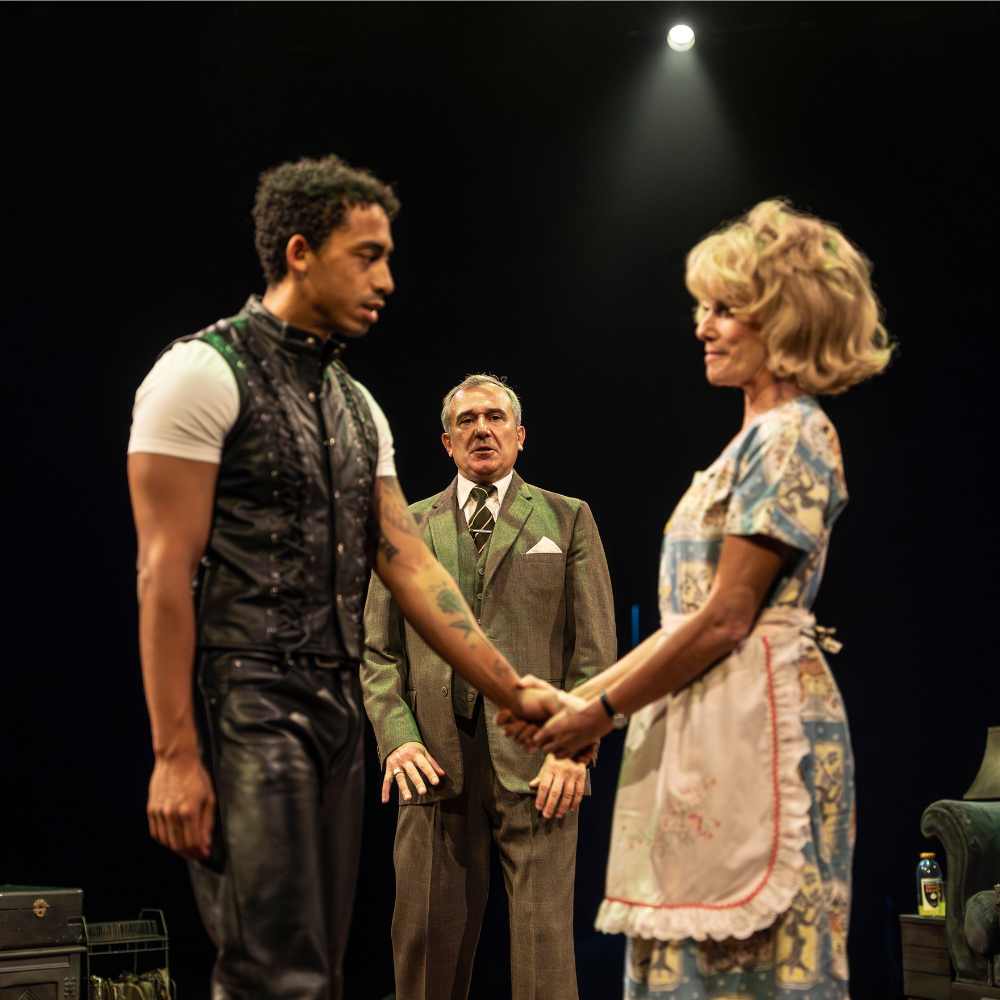
Shann Sahota’s new play is a family drama, tying Southall to Westminster. Adeel Akhtar’s Angad Singh is a government minister, seizing the unexpected opportunity to stand for the party leadership. It quickly gets personal, and his relationship with his two sisters, Gyan (Thusitha Jayasundera) and Malicka (Shelley Conn), and with his late father, become political collateral. Sahota’s writing is very sharp, and she explores themes somewhat outside general discourse – the equivocal position of south Asians within the British establishment, misogyny in Sikh families, and what families have to hide when society expects them to justify their existence by being better than everyone else.
The performances are excellent too. Adeel Akhtar brings his vulnerability and the underlying menace he can produced, which is all the more disturbing for being so expected. He is thoroughly compelling, although it is a little hard to believe that someone quite as self-abasing has made it up the political ladder. His sisters are equally well-played. Thusitha Jayasundera superb, as always, as the motherly older sister ground down by Angad’s refusal to share his inheritance equally with his sisters, against their domineering father’s wishes. Shelley Conn is impressively combustible as the furious, younger sibling. The spiky atmosphere of a minister’s office is amusingly embodied by advisers Petra (Helena Wilson) and Isaac (Fode Simbo). The power of establishment is represented by the towering, besuited figure of Ralph (Humphrey Ker).
Daniel Raggett’s production is thoroughly enjoyable. He stages the play as a drawing room drama on a set that could double for a Noël Coward, complete with sliding wooden panels by Chloe Lamford. The Dorfman is set out, unusually, in a proscenium configuration, playing on the expectations of traditional theatre by using a familiar form to tell stories about ‘brown’ people, as Angad puts it. The Estate is a straight show – a family drama that plays out in a linear fashion, which brings limitations too, but within her own parameters Sahota has done an excellent job.
Inter Aliaby Suzie Miller – National Theatre: Lyttleton, London
Judge Jessica Parks (Rosamund Pike) juggles a high profile career as one of a small number of female justices with the usual pressures of family life – trying keep an eye on her son Harry (Jasper Talbot) while assuaging the ego of her barrister husband Michael (Jamie Glover), and living an upper middle class dinner party lifestyle with their friends. She is both a pioneering, feminist judge who stands up to the patriarchy and tries to do things differently, particularly in her treatment of rape victims, and a mother whose role is to shoulder the family’s emotional burdens. Suzie Miller’s new play is a follow up to her hit Prime Facie with Jodie Comer, and is set in the same high pressure legal world in which she once worked – but Inter Alia also has the plot line of a Greek drama. It asks how far a mother would go to protect her son.
Justin Martin’s production builds the tension through a physicality, to which Rosamund Pike is beautifully suited. She deploys the pin-point timing of a farce as she pulls coats, wigs and ironing boards from cupboards in her kitchen, powering through her life without a moment to spare, entertainingly depicted through Lucy Hind’s movement direction. She also struts her stuff on the bench, addressing the prosecution with a microphone stand and backing band consisting of her husband and son. The set, by Miriam Buether, hides the domestic behind the courtroom and, behind that a dark wood filled with towering trees into which her son disappears, both as a child and as an 18-year old – not a subtle metaphor, but a satisfying scenic effect.
The writing is direct, and sometimes too obvious. The nature of the dilemma Jessica faces cannot be revealed without spoilers, but it is clear what will happen from early on. Her principles are tested in way that is cruel and believable. However, it draws the audience into the terrible moral conundrum while effectively addressing issues of online toxicity, the manosphere and the unequal justice system. There are moments of particular power, not least when Michael, perfectly pitched by Glover, collapses in tears at his inability to communicate with his son.
The show’s focus on the terrible power of blood ties is cleverly enhanced by the physical absence of almost any actors beyond the family trio. Jessica’s best friend and her dinner party guests are present on stage, but only in our imaginations. It’s an ingenious technique and, when new actors do appear they are children who drive the disturbing plot developments. Inter Alia is a high quality production of an effective if limited play. It will undoubtedly be a big success because of Pike’s triumphant performance, owning holding our attention, and the show together from start to finish.