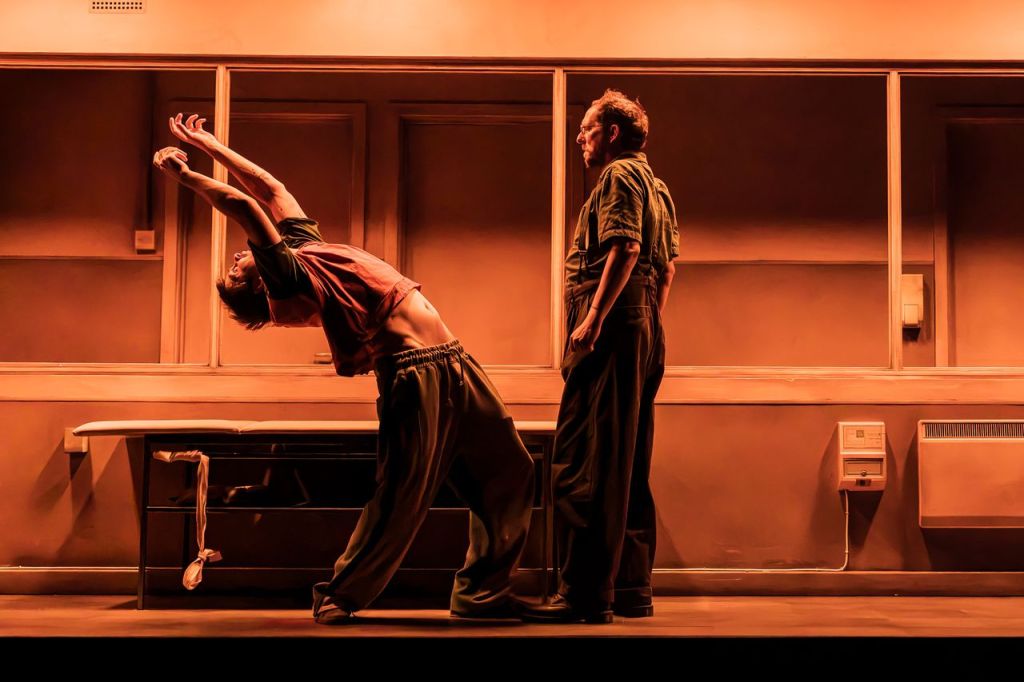
The Plough and the Stars

Photo by Roz Kavanagh

The Plough and the Stars by Sean O’Casey – Abbey Theatre, Dublin

Published at Plays International

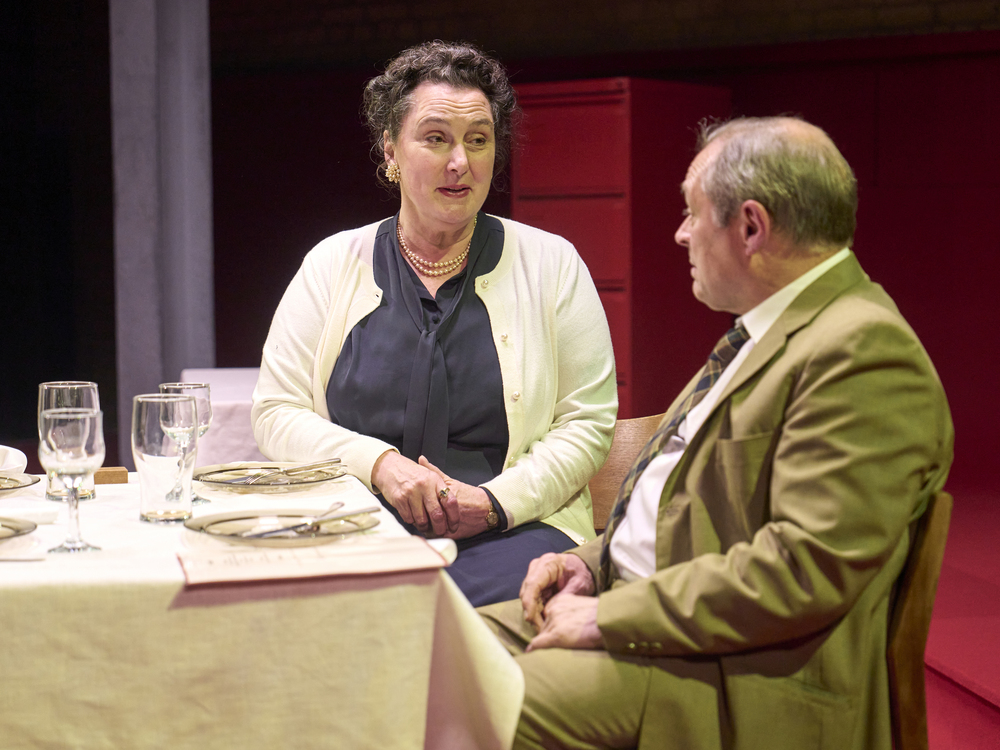
Sean O’Casey’s 1926 play is a super-local drama, describing events that took place on the Abbey Theatre’s doorstep during the 1916 Easter Rising in Dublin. Set in a nearby tenement block around the corner from the General Post Office, as it is besieged by the British Army, it is a masterpiece with Shakespearian character and scale but, as a modern work, a more immediate impact. Tom Creed’s centenary production for the Abbey revisits a play which, at its première, upset sections of the audience so much they rioted. Theatrical riots can seem strange and archaic: it is hard to understand why the Abbey’s patrons got so hot under the collar at the Abbey première of A Playboy of the Western World twenty years earlier. However, it is entirely different with The Plough and the Stars. Creed’s riveting production reveals it to be provocative and iconoclastic one hundred years on, and relevant to an extent that should alarm us as a society.

In Dublin, where streets and stations are named after Easter Uprising leaders and 1916 is commemorated all over town, questioning the credentials of the Irish Citizen Army and the Irish Volunteers is close to heresy. Sean O’Casey tears the rebels to pieces, along with the British. He pulls idealisers to the ground, and elevates ordinary, fundamentally flawed people who do not live the lives politicians imagine for them. Snatches of Patrick Pearse’s speeches ahead of the uprising drift through the pub window during the play, his calls for a blood sacrifice to cleanse the soil sounding fascistic and unhinged. As we fail to learn the endlessly repeated lesson that violence brutalises and destroys, the play still has the capacity to upset the accepted view of history. 

O’Casey’s towering achievement is to craft a play built around such a large, complex, yet wholly convincing cast of characters. His tenement inhabitants reveal a society with an ease comparable to the Henry IV plays. There are many fine roles, but it is particularly notable how well he wrote the female characters, who are all complex, unidealised and alive – an achievement beyond most male playwrights of the time. The Abbey’s cast are fully immersed in the play’s world, and seem to emerge from the setting rather than imposing their performances on it. Kate Glimore’s tragic Nora Clitheroe puts everything she has into saving Eimhin Fitzgerald Doherty’s doomed Jack, knows exactly what she has to lose, and fails. Her descent into madness is horrifying. Mary Murray’s Bessie Burgess is confrontational and aggressive, but also unexpectedly kind, with a tale as confounding as anyone. Kate Stanley Brennan is very funny as Mrs. Grogan, her lyricism and larking a terrible counterpoint to her hollow-eyed, dying daughter Mollser (Evie May O’Brien). O’Casey’s incorporation of humour into the dark events is a masterclass in dramatic writing. Caitríona Ennis’s Rosie is desperate, but achieves a moment of remarkable dignity when she, accused of being a prostitute, her silence speaks volumes. 

The men in the play do not understand what is coming, and what the consequences of war will be. Michael Glenn Murphy’s Peter Flynn is a comic braggart, perhaps the most ludicrous character in the play, from a Shakespearian lineage of old men who fancy themselves as soldiers. Thommas Kane Byrne’s Marxist Young Covey is smackably smug and very entertaining, but also the only man who lets his front fall apart at the end. Fluther is one of the great comic everyman roles, a man who survives despite his own best efforts, and Dan Monaghan delivers both entertainment and depth. Ash Rizi, Fintan Kinsella and Conor Wolfe O’Hara as the British soldiers who arrive on the scene to make things, inevitably, much worse are frightened and dangerous. 

Jamie Vartan’s sets are somewhat confrontational, consisting of unpainted, plywood flats and minimal decor, but they prove very effective. At times the characters feel like ghosts, inhabiting a place that is fading out around them, casting long shadows on the bare walls. The revolve is elegantly used to switch scenes, and seems to echo the transience of time and the lives it contains. The production is superbly powerful – in the commitment of the performers, the vivacity of the characters who live on, a century down the line, and the uncompromising message of the play – that war is madness. Creed’s production reaffirms O’Casey’s status as a great writer who still has much to teach, and whose work remains gripping from start to finish.

The Resistible Rise of Arturo Ui

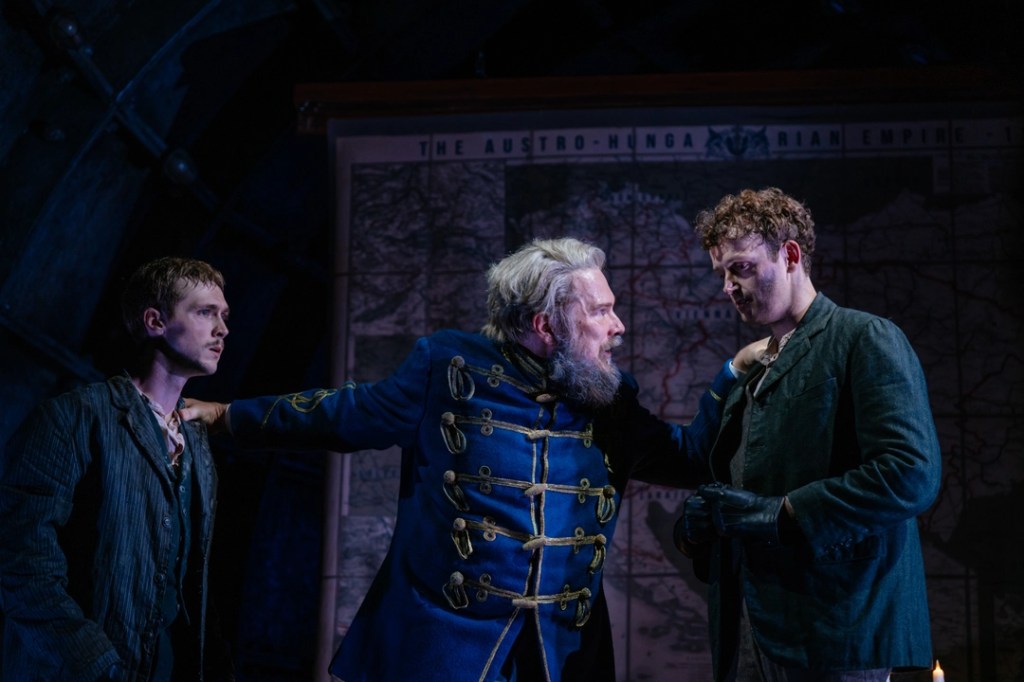
LJ Parkinson, Mark Gatiss and Mawaan Rizwan. Photo by Marc Brenner.

The Resistible Rise of Arturo Ui by Bertolt Brecht – Swan Theatre, Stratford-upon-Avon

Sean Linnén’s revival of Brecht’s Arturo Ui could not be better timed. The play has seemed more apt to the times with every passing day since it was announced. With Mark Gatiss as Arturo, the RSC has pulled over a casting as well as a programming coup. There is a sense of excitement around this production, and it delivers in an evening of visual excitement and political chills.

Brecht mocks the Nazis by transporting their rise to a comic Chicago underworld, with shades of Bugsy Malone. There, shadow Hitler Arturo Ui rises to dominate the city’s cauliflower trade through threats and thuggery, before setting his ambitions on the entire USA. The American setting echoes differently with us now, as we live through the rise of a new 21st century American version of fascism. Linnén plays into the comedy, arming his gangsters with vegetables rather than weapons and creating an atmosphere of imminent farce throughout the evening. The play has a new soundtrack by Placebo, performed live by a house band perched on a podium (a reminder of the importance of live music, under threat at Stratford). Their music drives the show forward, building momentum and becoming more ragged as events accelerate and Arturo gains power.

Mark Gatiss is very watchable as Ui, capable of being both pathetic and deeply sinister. Dressed unashamedly as Hitler, he wheedles his way into the orbit of tortured politician Dogsborough, the cypher for German President Paul von Hindenburg (a moving performance from Christopher Godwin), before using his associates to force him into doing what he wants. As he gains influence, he seems to gain physical presence, until he looms over the stage addressing the city from a platform. Gatiss is repulsive and chilling, but recognisably very human.

The most difficult aspect of the play is giving individuality to characters who are essentially allegorical types, while also giving full reign to their outrageous, appalling behaviour. The cast does a fine job. Kadiff Kirwan as Roma, chief gangster and Erich Röhm analogue, bring a sense of tragic betrayal to a character who is unredeemably nasty. The decision to cast Maawan Rizwan as both lead gangster Gigi and the compere works well, as his Cabaret-style rabble-rousing blends into psychopathic prancing around the stage, wearing hats taken from his murder victims. LJ Parkinson is his gleeful accomplice, Girola. Janie Dee is understated, as the defence lawyer among other parts, in a way that shows how decency, lawful behaviour is overwhelmed by aggressive, stage-stealing populists.

The show is a visual treat, with sets and costumes by Georgia Lowe, who dresses the cast in cartoonish 1930s Chicago outfits. The band’s podium slides on an off stage, as they play on top, retreating to reveal new sets. These include Arturo in his bubble bath, a white coffin around which Gatiss and Dee play a Richard III-esque seduction scene over the body of her husband, and a courtroom with a bloodied defendant unconscious in the dock. The Night of the Long Knives is staged as a St. Valentine’s Day massacre, in which Roma and his men are machine-gunned, writhing in slow motion and casting rose petals from their pockets for what seems like an impossibly long time. The evening is full of memorable tableaux.

Linnén shows the play to be as relevant as we might have feared. He resists temptations to make any direct comparisons with the Presidency of Donald Trump, rightly seeing that these comparisons make themselves. Brecht wrote Arturo Ui in 1941, but it was not staged until 1958, by which time it had acquired an epilogue reflecting the post-Nazi perspective. It has always, therefore, been a play about fighting future fascism, and the Resistible in the title is rallying call. As such, Mark Gatiss final lines: “The bitch that bore him is in heat again” is a direct warning about times that we are now living through. Staged in a county now run by a Reform council, this production gives the RSC a much-needed voice in the battle with regressive values that threatens to consume the world.

John Proctor is the Villain

Photo by Camilla Greenwell

John Proctor is the Villain by Kimberly Belflower

Kimberly Belflower’s play premièred in the US in 2022, and has been successfully revived twice already, most recently on Broadway last year directed by Danya Taymor. It’s UK première at the Royal Court is a recast version of her production,. Set in 2018, during the increasingly distant #metoo era, it re-examines the gender politics and in-built prejudice of Arthur Miller’s The Crucible, as studied by a high school class of five girls, one of whom is absent for reasons that become apparent. The girls, questioning standard assessments of John Proctor as a hero of American drama, propose the formation of a school feminist club. Their teacher, Mr. Smith, who they admire and, in some cases, fancy deems it too controversial, but suggests bringing in two boys, after which it apparently flies under the local social radar. The relationships between the pupils and their teacher become complex in ways that, although not for revealing in a review, are hardly surprising.

This is the problem with the production. Nothing presented on stage feels unexpected or new, and there is a sense that the audience is having its world view confirmed. The most shocking aspect of the play, to a UK audience, is the idea that feminism is so controversial an idea that a school would stop pupils discussing it for fear of ‘what people might say’ – a truly terrifying bulletin from US conservatism. But the production itself displays a level of conservatism that makes it seem old-fashioned in comparison to the work the Royal Court is staging from British writers at the moment. The characters of the girls seem surprisingly formulaic, like types rather than individuals. There are some highlights among the performers. Sadie Soverall is excellent as the awkward but Shelby, who arrives like a ticking time bomb. Reece Braddock as the sweetly daft Mason is very funny – the two boys are both convincingly written as teenage idiots, but he has the better role. Dónal Finn is strong as the charming, untrustworthy teacher who is the analogue for John Proctor.

However, the heavily realistic classroom set by AMP featuring Teresa L. Williams, and Taymor’s direction, tie the action down, while the writing makes it difficult to believe that many of the characters are real people. The play is well-intentioned, and its John Proctor-cancelling is an intriguing, even exciting ideological position. Despite this, the production and performance-style seem leaden-footed. The climactic moment, with the girls taking over the classroom and dancing to Lorde’s ‘Green Light’, feels manufactured and fails to deliver the catharsis it insistently sells to the audience.

Henry V

Alfred Enoch – photo by Johan Persson

Henry V by William Shakespeare – Royal Shakespeare Theatre, Stratford-upon-Avon

Following their highly successful 2024 collaboration on Pericles, Joint Artistic Director Tamara Harvey and Alfred Enoch reunite for a Henry V that uses the same language of movement, from Annie-Lunnette Deakin-Foster and fight director Kate Waters. Lucy Osbourne’s costumes are medieval in inspiration, with a couture edge. Michael Elcock’s Dauphin wears silver trainers, but the foot soldiers on both sides are in dull colours, and one side is indistinguishable from the other. The mass of men suffer and die, regardless of allegiance. The glorification of war is constantly exposed in front of a wooden scaffolding set, also by Osbourne, against which attackers and defenders alike are slaughtered.

The war, which is the singular plot of what is an unusually simple play for Shakespeare, in terms of structure, cannot be escaped. Harvey brings in Henry IV’s deathbed speech to Hal, from Henry IV Part 2, at the start of the play in which the father advises the son “Be it thy course to busy giddy minds with foreign quarrels, that action, hence borne out, may waste the memory of the former days.” Alfred Enoch’s Henry V takes him at his word, and displays a messianic focus in pursuing what is revealed to be a tenuous claim to the French throne in the play’s opening exchange. There’s something of Tony Blair in Enoch’s smooth, polite and slightly innocent manner. He gives the impression that he is an entirely reasonable man, and his war is reasonable too, but the glint in his eye grows and, by the time he delivers the St. Crispin’s Day speech, he has morphed into a cult leader. Enoch is excellent, both likeable and unnerving in one of Shakespeare’s strangest roles.

The triumphalism traditionally read into the play seems very hollow in Harvey’s interpretation. Little of what Henry says that can be taken at face value and, when he alone, he gives a bitter, self-pitying pre-battle soliloquy in which he castigates his subjects for their lack of gratitude, bemoaning his position as “subject to the breath of every fool whose sense no more can feel but his own wringing.” At the end, the Chorus reveals the futility of achieved Henry did, explaining how his son will go on to lose it all.

Harvey’s production uses a coherent, well-cast ensemble, continuing a welcome trend under the new RSC leadership of powerful group dynamics on stage. There a no weak links, and the performers clearly fully understand the production’s direction, and are committed to it. Jamie Ballard plays the Archbishop of Canterbury, King of France and the soldier Williams in a tour de force of flexibility. Catrin Aaron is excellent and completely different as Mistress Quickly and the Queen of France. Micah Balfour’s Exeter is a lynchpin. Gender switched parts worked seamlessly, includoing Sophie McIntosh as the Duchess of Gloucester and Sarah Slimani as Mountjoy. Natalie Kimmerling’s Katherine is a strong presence, fully understanding the politics that sweep her into marriage. Emmanuel Olusanya as Bardolph, Ewan Wardrop as Nym and Tanvi Virmani as ‘The Girl’ (the Boy in the original) make a genuinely funny and seedy grouping with Paul Hunter’s Pistol. The latter is a joy to watch, setting an extremely high baseline for physical comedy, drawing other performers in his wake.

This Henry V is less obviously a response to current events than is sometimes the case in times of international crisis, but it provides a powerful, coherent warning against leaders who never doubt themselves, a lesson with wide application. Harvey continues to direct very high quality Shakespeare, and to build a broad company and a clear, fluid, modern performance style (with excellent verse speaking) which we can look forward to enjoying, all being well, for many years to come.

The Shitheads

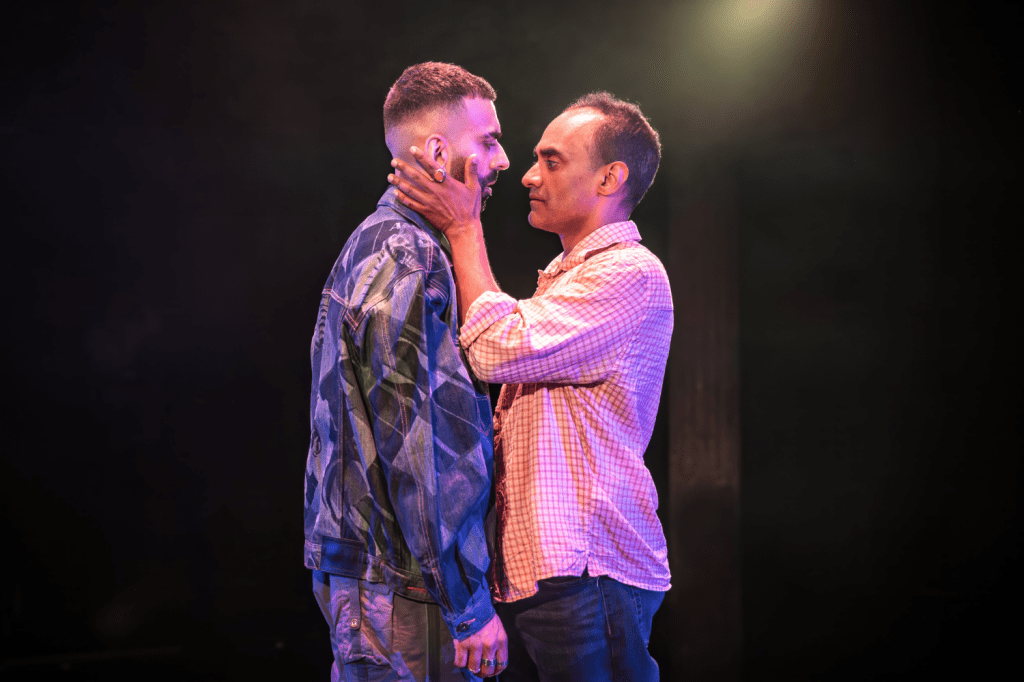
Jacoba Williams and Jonny Khan.

The Shitheads by Jack Nicholls – Royal Court Theatre, London

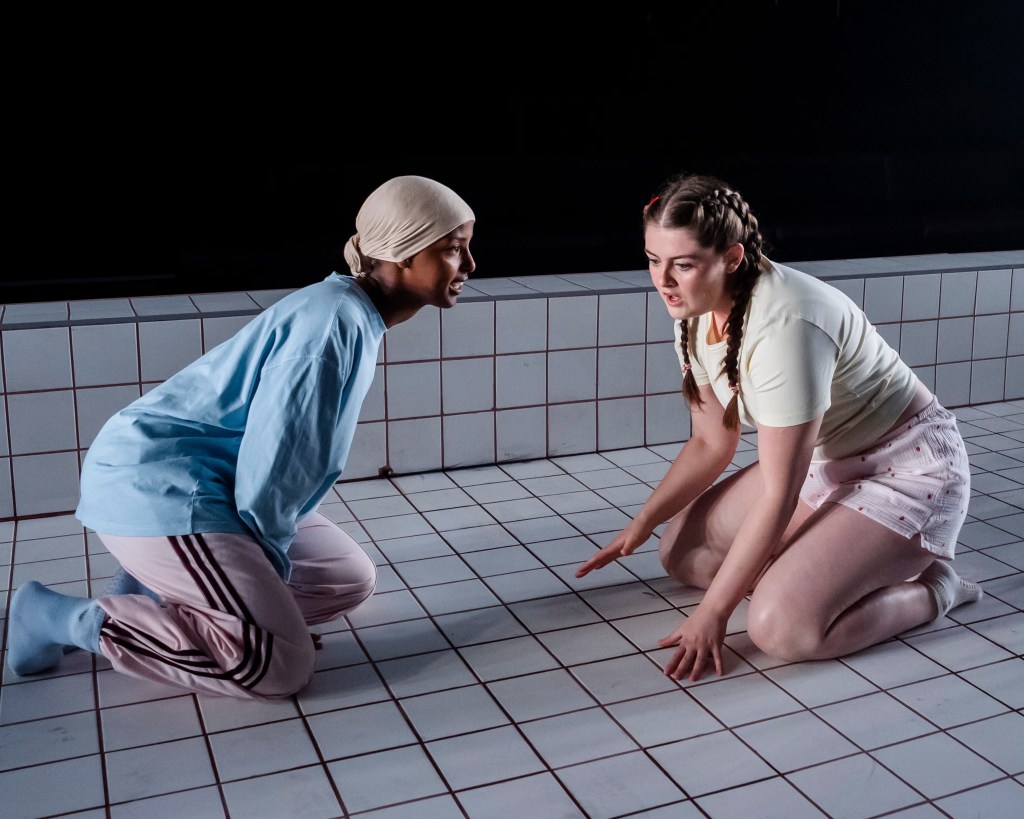
For starters, Jack Nicholls’ play The Shitheads is set in the Stone Age – specifically, the end of the Stone Age. I can only think of one other play with Stone Age scenes – Alistair McDowall’s The Glow, also staged at the Royal Court. It’s a bold and decisive approach from a writer who sent his work to the Royal Court on spec: they are staging submitted plays as part of their 70th anniversary season. Anna Reid has turned one end of the the Upstairs theatre into the interior of a cave with rock walls that are pretty convincing. It’s hard to make stage rocks that look real. But that’s only part of the setting. The play also uses puppets by Finn Caldwell, beginning with an elk hunting scene. The elk, real size, is operated War Horse style by two people, under puppetry captain Scarlet Wilderink. But this is definitely not War Horse. Nicholls creates a strange and thoroughly disturbing parable about inward-looking societies, fear of outsiders, resistance to change and violence which is entirely current.

The cast are all very watchable and convincing, at ease in their strange, compelling roles. The protagonist Clare is played by Jacoba Williams, a young woman venturing outside the cave where her father Adrian, played by Peter Clements, dictates the world view. Her sister Lisa, played by Annabel Smith, seems innocent but is capable of upending everything. Then a strange arrives – first a hunter, Greg (Jonny Khan), then his wife Danielle (Ami Tredera) who comes looking for him with their baby. The latter is the play’s other puppet, and possibly the most sinister thing in the whole evening. There’s competition for this: the cave is decorated with flesh and bones and the cave dwellers’ deceased mother is in a pit, along with discarded animal carcasses. Cannibalism features. Clare, asked why she lives in a cave, says “Because we’re very lucky” – but things are changing. The people they described as ‘Shitheads’ roam from place to place for better food and climate, and they’re leaving for good as the weather changes. The cave dwellers are doomed, but that may not convince them to change.

Directed by David Byrne, The Shitheads is a riot. The play, written in deliberately contemporary language, is very funny in a Martin MacDonagh, black comedy style. The idea of Stone Age characters called Adrian or Danielle is, in itself, very funny. The scenario also carries echoes of Enda Walsh – plays such as Walworth Road, where a closeted family group creates bizarre rituals to keep the outside world away. Nicholls is a clever and exciting writer, and this collaboration with a Royal Court on a high has all the excitement of the dramas that originally made the theatre’s name. It shows us ourselves in totally unexpected, entirely recognisabel ways, and providing gripping , unclassifiable entertainment while doing so.

Lost Atoms

Anna Sinclair Robinson and Joe Layton. Photo by Tristram Kenton

Lost Atoms by Anna Jordan – Lyric Theatre, Hammersmith

Published at Plays International

Lost Atoms, written by Anna Jordan, is the 30th anniversary production for Frantic Assembly, who are a staple of the UK’s 21st century touring scene. Led throughout by Scott Graham, the company is known for making movement the core of their expression, and devising their own method entwining the text and the physical. The Frantic Method has been very influential, shaping a performance style that is very distinctively of our time. Frantic have achieved a great deal, applying their approach to classic text and new writing with equal success. It is all the more impressive that their world is smaller touring venues rather than the big commercial or subsidised theatres, where experimental work that challenges audiences is needed most. It is entirely appropriate that Lost Atoms is a co-production between the Lyric Hammersmith, the Curve in Leicester and the Mayflower, Southampton.

For their anniversary tour they have chosen a new play by Jordan who, since her last play in 2018, has been working on television series such as One Day for Netflix. Lost Atoms is about ordinary living, and what that really entails. A couple meet, get together and go through experiences related to pregnancy which are both common, and unforgettably traumatic. There is a cast of just two: Joe Layton plays Robbie, and Anna Sinclair Robinson plays Jess. Their meeting involves coffee shop wifi, and they get together through a series of chances, gradually working out how much they like each other. They encounter each other’s families, and all they bring – cleverly staged through one-sided conversations. Then Jess gets pregnant. It is impossible to discuss the plot without giving too much away, but what follows tests their relationship to the limits.

There are remarkable similarities with Luke Norris’ play Guess How Much I Love You?, currently playing at the Royal Court, which also has a cast of two, and concerns a relationship beset by pregnancy trauma. However, under Scott Graham’s direction the style of Lost Atoms is very different. Layton and Sinclair Robinson use Andrezj Goulding’s set – a bank of filing cabinets – like a climbing wall. Drawers pull out to become seats, steps, even a toilet, but they also act as drawers, containing props but also memories. A massive slab, looking disturbingly like the door to an ancient tomb, flips up to form a bed, angling the couple towards the audience in mid-air. The physicality of the performers is, at times, mesmerising. They are frequently performing while horizontal, or suspended at gravity-defying angles. They move in relation to one another throughout, expressing the closeness and distance of an intimate relationship through their bodies as much as their words.

The story is told in flashback, as Jess and Robbie explain what happened to them for the benefit, it seems, of the audience. It takes time to get going and the first half, which shows us their developing relationship, tells us less than the second. The performers become more convincing as the stress mounts, and they move away from the sometimes exaggerated naivety of their initial personas. Lost Atoms truly draws the audience in when it starts to explore what happens to people behind closed doors, in cold NHS consulting rooms and tiny flats. We think we know what life is about, but human drama is at its most extreme in everyday settings, just out of sight. Frantic Assembly’s production showcases the strengths of their work, with complete physical commitment to storytelling. Actors do things you may never have seen on a stage before, but which seem strangely natural. Conventional theatre can seem static in comparison.

Guess How Much I Love You?

Rosie Sheehy and Robert Aramayo. Photo by Johan Persson.

Guess How Much I Love You? by Luke Norris – Royal Court Theatre

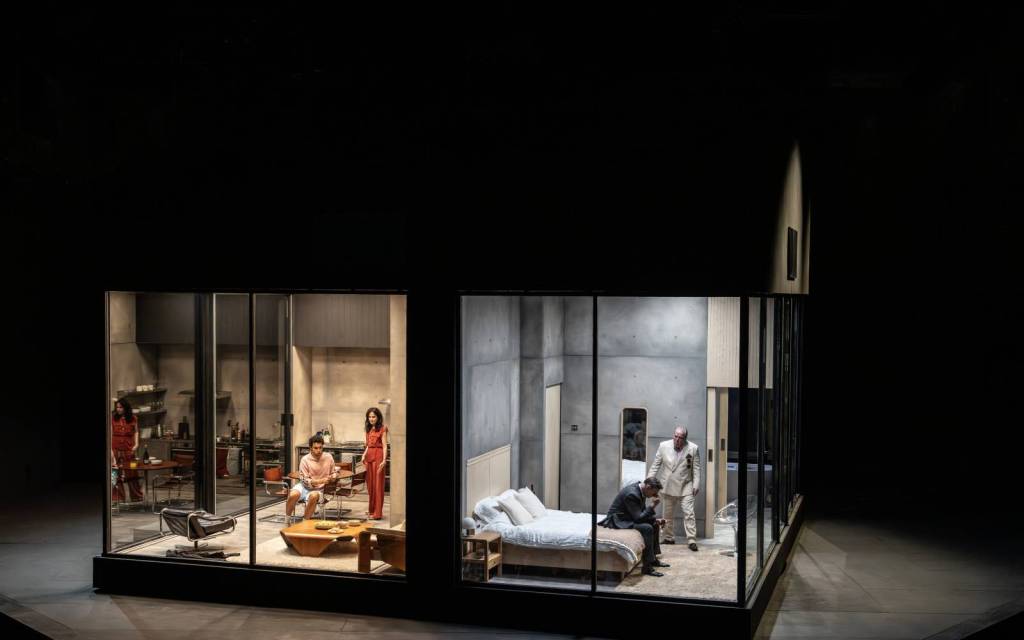
The first show in the Royal Court’s much-anticipated 70th anniversary season sets high standards. Luke Norris’s new play is a two-hander, with a brief appearance by a third performer, set in cramped interior spaces, but it fills the main stage effortlessly. It concerns a couple, played by Rosie Sheehy and Robert Aramayo, going through the emotional pressures that come with trying to have a baby. It is difficult to write about the plot of ‘Guess How Much I Love You?’ without giving key events away, but it is fair to say that things do not go as they had planned. The play has an intensity to it with is rarely seen on stage. Played in the corners of a series of rooms – their flat, a hospital room, a doctor’s examination room – there is both a claustrophobia and an ordinariness to their experiences, especially as Grace Smart’s sets make these corners just a little tighter than ninety degrees. The walls are closing in on them.

The pair, unnamed, are ordinary too, but Norris’s writing pulls apart what ordinary means. The initial tensions in their relationship – for example over whether porn is exploitative or not – hint at Sheehy’s resentment of the role she is already playing, as she waits, pregnant, mid-ultrasound. As events spiral, the pair are faced with impossible moral choices and the way they treat each other becomes brutal in a deeply uncomfortable way. There is more than a hint of ‘Who’s Afraid of Virginia Woolf’ about the deep levels of love/hate played out on stage in scenes which seem too private for us to be watching. However, there is more emotional truth in the play than in Edward Albee. Although they say the most appalling things, it is entirely believable that people in their situation would react the way they do. The horror of living has rarely been exposed so honestly.

Jeremy Herrin’s direction brings out two very powerful pieces acting from Aramayo and Sheehy. He is patient, defensive, desperate and unable to cope. She is a ball of grief and pure anger. Rosie Sheehy will surely be in the running for awards for her performance, which is simply extraordinary. She is incredibly vulnerable in her deep distress, and there are a couple of moments when she completely lets go, with speeches that are difficult to hear and impossible to turn away from. Her commitment is total.

‘Guess How Much I Love You?’ is a lean and brilliant play, with an unwavering focus on the nature of love, what happens when it goes wrong, and how people really behave in a crisis. Norris also weaves in themes of religion and gender roles in a way that feels natural. There is a particular moment in the play that makes the audience’s hearts drop as though they were an express lift, but the entire evening is an unrelentingly intense experience. A play which pushes the capacity of theatre to communicate to its limits is the perfect start to the year for the Royal Court.

The Dead

Photo by Kathleen Holman.

The Dead by James Joyce, presented by the Fourth Choir – Wilton’s Music Hall, London

The combination of Justine Mitchell, reading an abridged version of James Joyce’s peerless story ‘The Dead’, and the Fourth Choir singing pieces interspersed into the text, is a remarkable success. This is partly because the singers are exceptionally good. Led by James Powe, they are a queer choir consisting partly of trained singers, partly amateurs. They must be as good as a choir with an amateur element can get. With around thirty singers performing in the intimate Wilton’s Music Hall – which is perfect for the piece – there is absolutely nowhere to hide, and they are flawless.

The singing is beautiful, and successfully connected to Joyce’s writing. ‘The Dead’ is underpinned by music, including discussions of choir politics and of the folk song ‘The Lass of Aughrim’, one of the pieces performed, and one of several arranged by Powe. These also include ‘Bid Adieu’, the only song written by Joyce – both words and tune. Christmas pieces are included, ‘The Dead’ being set at a Twelfth Night party. Justine Mitchell does an excellent job as the narrator, wearing a dark green period dress and looking thoroughly Edwardian.

However, the evening only works because its elements are so expertly stitched together by the director, Séamus Rea, who has also adapted the text. He creates small but effective interactions between the choir and Mitchell. They hand her the pages she reads from, and form an attentive party crowd. They occupy the stage in shifting patterns that create visual interest, and even their phone-lit entrance has a surprising impact. The whole evening, being concerned with continuing presence of the dead in the lives of the living, is unsurprisingly moving – and performed to a very high standard. As Mitchell and the choir cast their pages into the air, to fall like the snow that is general across Ireland, few dry eyes are left dry.

Playboy of the Western World

Playboy of the Western World by J.M. Synge – National Theatre: Lyttleton

Caitríona McLoughlin’s production J.M. Synge’s masterpiece seems to be the first at the National Theatre since 1976, which is extraordinary. The play, once a staple of amateur dramatics, has perhaps become a little forgotten in the UK, although not in Ireland. McLoughlin is the artistic director of the Abbey Theatre, Dublin, and brings an all-Irish cast to London to familiarise new audiences with a play that once caused riots.

Synge’s writing is remarkable – both deeply lyrical, with a powerful ear for speech patterns in the west of Ireland, and blackly comic. Both must have been revelatory for 1907, when the play premiered in Dublin. The play is populated entirely with people of no social consequence living in a poor, even despised part of the country, but Synge makes their language a thing of beauty. It’s set in a pub, where characters talk in a way they might not elsewhere. At the same time, he punctuates the play with the kind of comic violence – Old Mahon, who just won’t die – which seems remarkably modern. Playboy could be seen as the origin play for the subsequent century of Irish drama, from Friel and to McPherson to McDonagh.

McLoughlin, on a widescreen set by Katie Davenport, gives the production life and movement, if not always consistency. The cast is fascinating, but offers a range of peformance styles that do not always gel. At one end of the scale is Siobhán McSweeney’s urbane Widow Quin, giving it her all when trying her luck with Christy Mahon, but experienced enough to let it go and change tack too. At the other end is Lorcan Cranitch’s Michael Flaherty. Cranitch gives a performance that threatens to steal the entire play. In a very thick Mayo accent, he builds up to a dramatically drunken entrance on his return from a wake where “You’d never see the match of it for flows of drink.” He plays an entire scene while in a highly unbalanced state, constantly threatening to topple over, and the audience cannot look away. It is a complete tour de force. However, the contrasting performances do illustrate the production’s inconsistent tone.

Elsewhere, Éanna Hardwicke is extremely unnerving as Christy, gurning and almost slithering around the set. He leaves the audience unsure whether he’s a fool or a cunning chancer, or whether he’s sincere. Nicola Coughlan is fierce and charming as Pegeen Mike, but perhaps lacks the presence the part demands, to dominate a barroom full of people. However, her final scene, howling on her knees as Christy departs, is chilling. Marty Rea’s Shawn Keogh exudes weakness from his apologetic frame, while Declan Conlon is excellent as a domineering, physically threatening Old Mahon. The supporting cast are strong, especially the gaggle of local girls led by Marty Breen as Sara Tansey and Fionnuala Gygax as Honor Blake.

Despite some reservations, however, the play is fascinating and entertaining and very much reconfirming its classic status. The themes around easy celebrity and fickle popular opinion seem extremely current, while Pegeen Mike’s sexual independence, and the unashamed interest of women in sex, which triggered the 1907 riots, is refreshing and seems well ahead of its time. And Synge’s language remains a thing of wonder. Its dense wordplay makes no compromise whatsoever for the watching, listening public and, as a result, draws them deep into a parallel world. Playboy remains thrilling after all these years.