The Passenger

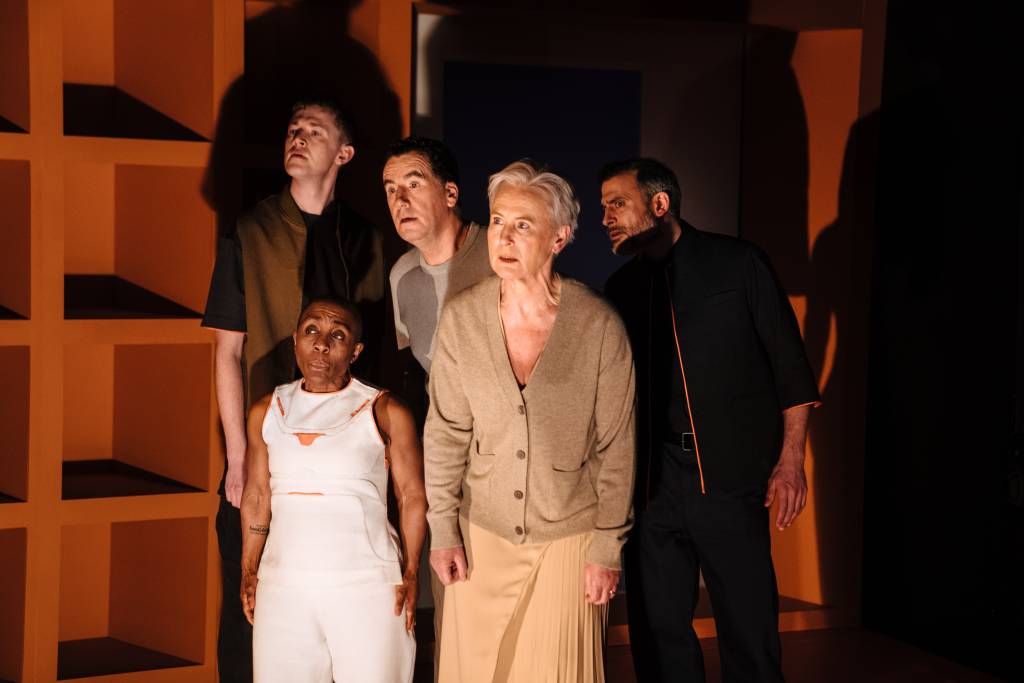
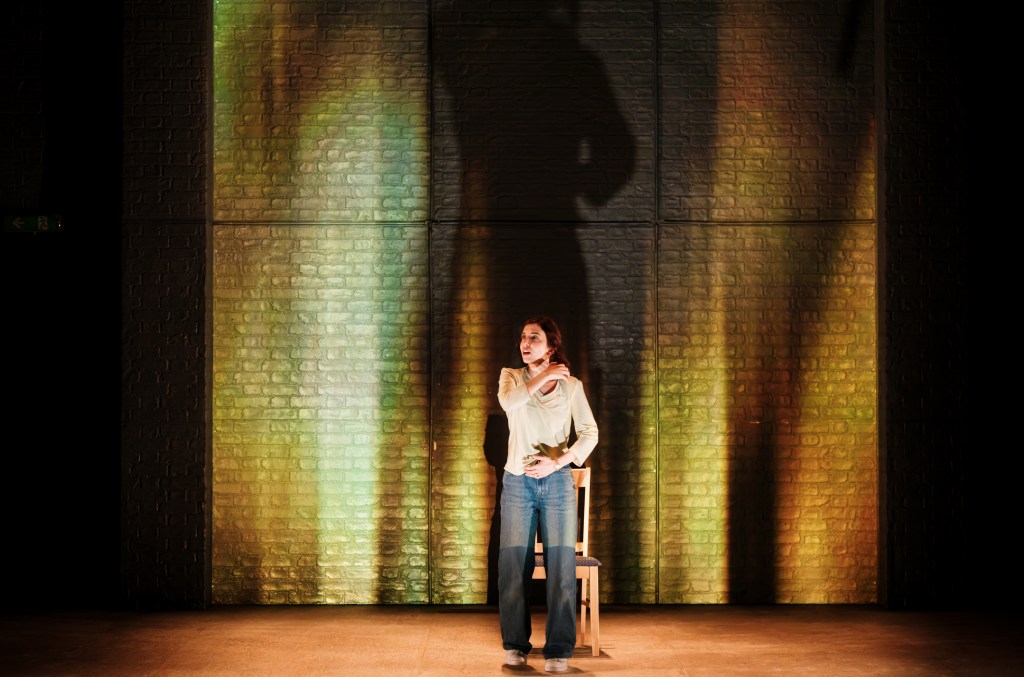
Robert Neumark Jones and company. Photo by Steve Gregson.

The Passenger by Nadya Menhuin – Finborough Theatre, London

Published at Plays International

The Passenger is adapted from a remarkable book. Ulrich Alexander Boschwitz was a German Jewish writer who fled the country in 1935 after the murder of his uncle, as the Nazi terror began to close in. Moving from country to country, he and his mother were eventually interned as enemy aliens on the Isle of Man. Deported to Australia, he was eventually freed, only to die when his ship was torpedoed by a U-boat on the voyage home. His last book was an account of the persecution of Jews which followed Kristallnacht in 1938. Forgotten for 70 years, it was republished in 2010 as The Passenger – a rare and powerful account of a terrible time from someone who was there.

The Passenger transfixes the onlooker with horror. Nadya Menhuin has adapted the novel with great skill to create a drama powered by escalating disbelief and panic. In the course of a week, well-to-do businessman Otto Silbermann, who imagines himself protected by his money, social status and Aryan wife, becomes a penniless refugee within his own country, constantly travelling the railway system to avoid arrest. He finds himself betrayed by everyone, from his relatives to his business partner, all of whom choose to protect and enrich themselves at his expense. The story is both familiar and surprising. We know what happened to German Jews persecuted by the Nazis – of course we do – but what that actually entailed is somethign revelation. From forced sales of assets, to being turned back at the border by armed Belgian guards, the reality of being rejected by the society you imagined you belonged to is laid out in all its humiliating minutiae.

As Silbermann, Robert Neumark Jones is driven by exasperation. He simply cannot believe that what happens to him is possible – “This is the 20th century!” he pleasds. As all his assumptions are dismantled, he makes a slow-burning transition into mounting fury, which culminates with a remarkable scene in which he screams at a Nazi policeman to give him the justice that will never be forthcoming. Around him, a resourceful and committed cast flip between multiple characters as Silbermann’s transient existence brings him into the orbit of other Jews on the run, and the anti-Semitic population that persecutes them, actively or passively. Kelly Price expertly plays six different women who offer both sympathy and threat. Eric MacLennan also plays six characters, including blustering Nazi nobodies relishing their sudden power. Dan Milne plays people with the misfortune to ‘look’ Jewish, who Silbermann finds himself abandoning to save himself. Ben Fox channels a resentful thuggishness as, among other parts, Silbermann’s business partner, who fleeces him with relish.

Using every inch of the Finborough’s postage stamp stage, Tim Supple directs the action with great skill. The play is all about movement and constraint, neatly represented by Hannah Schmidt’s waiting room and destination board with an endless round of dangerous destinations. Movement and tableaux are used expertly to generate flow and movement across multiple setting. The production is highly compelling, driven by Silbermann’s disbelief and matched by that of the audience. It is a significant achievement, making the concept that we should never forget the Holocaust something tangible and current. We may think we understand, but each experience of individual catastrophe was both comparable and entirely different. The Finborough has picked its moment perfectly to bring Boschwitz’s crucial the eye witness account to the stage. As clouds of authoritarianism gather across the globe, and immigrants are once again cynically demonised, The Passenger feels much more relevant than anybody would wish. It is both an urgent lesson from history, and theatre of the highest quality.

Macbeth

Cush Jumbo and David Tennant. Photo by Marc Brenner.

Macbeth by William Shakespeare – Donmar Warehouse (in cinema)

Max Webster’s production of Macbeth, screened in cinemas from the Donmar Warehouse, has a set by Rosanna Vize which places much of the action on a raised white square that looks like a sacrificial table. It is kept clean from blood until the very last moments of the show, when David Tennant’s Macbeths lies slain, finally staining the pristine surface with a lake of blood. The exposed stage is countered by a balcony, behind glass, where events outside Macbeth’s consciousness take places – the slaughter of the Macduffs for example, and where a Celtic folk band both play haunting music and transform into the witches and other characters, banging frantically on the transparent barrier. The spotlight arena emphasises the Macbeths’ terrifying internal world, which is clearly a toxic marriage. Cush Jumbo’s Lady Macbeth manipulates her husband in a way that is clearly the basis of their relationship while Macbeth himself responds habitually. passive-aggressively – until the murder of Duncan releases his own inner darkness. He rapidly transforms into something that scares even his wife, and there is no way back.

The intensity of the production is heightened by movement techniques by Shelley Maxwell which are reminiscent of Japanese horror films, with sinister walks that parody the human body and reveal the unnatural world into which the play descends. Tennant is a sociable, likeable Macbeth who performs his place in the Scottish aristocracy until he is no longer able to keep up the pretence. His performance is sophisticated and multi-layered, up there with the best of recent times. Cush Jumbo is force to be reckoned with, but her vulnerability is never far from the surface and she spends more of the play terrified than in charge. Other strong performances come include Cal MacIninch’s Banquo, one step ahead of his friend even as he becomes king. Rona Morison’s Lady MacDuff is justifiably angry at her abandonment, while Ros Wat plays Malcolm against type, physically small but fully equipped to root out evil. Jatinder Singh Randawa gives a good account of The Porter, with genuine laughs from his updated dialogue and audience interaction.

The production is known for its sound world which, in the theatre, is delivered through headphones. Although some of the intimacy is lost in the cinema, Gareth Fry’s sound design is still the defining feature. Alongside snatches of live music, it takes us into Macbeth’s head where the witches who, more often than not are invisible, make their presence known with layered, genuinely disturbing whispered and gasped dialogue. The sound complements the bleak interior world of the design with aural hallucinations which are more alarming than anything visible could ever be.

This is an intellectually rigorous Macbeth, stripping away distractions to focus on the unstoppable descent of its main character. Its simplicity and impact makes the play’s difficult reputation seem hard to fathom. Max Webster, whose concurrent production of The Importance of Being Earnest could not be more different, is revealing himself to be a director with a rare talent to bring out the value in plays we already think we know.

A Good House

Photo by Camilla Greenwell

A Good House by Amy Jephta – Royal Court Theatre, London

Published at Plays International

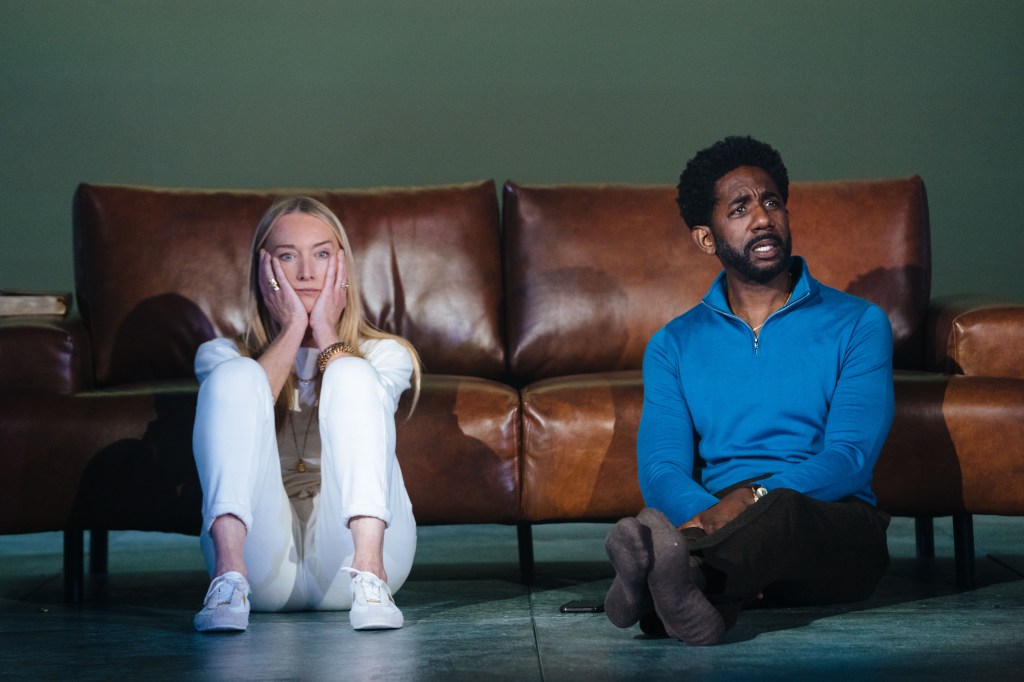
The set for A Good House starts empty, a bare stage surrounded by a strip of light which looks like an arena designed for combat. The set, by Ultz, transforms into a series of interiors over the course of the evening, as the living rooms of three different homes. Each scene is changed by the cast as they build their own interiors, carefully constructed to build or hide racial and social identity. These houses, it turns out, are battlegrounds.

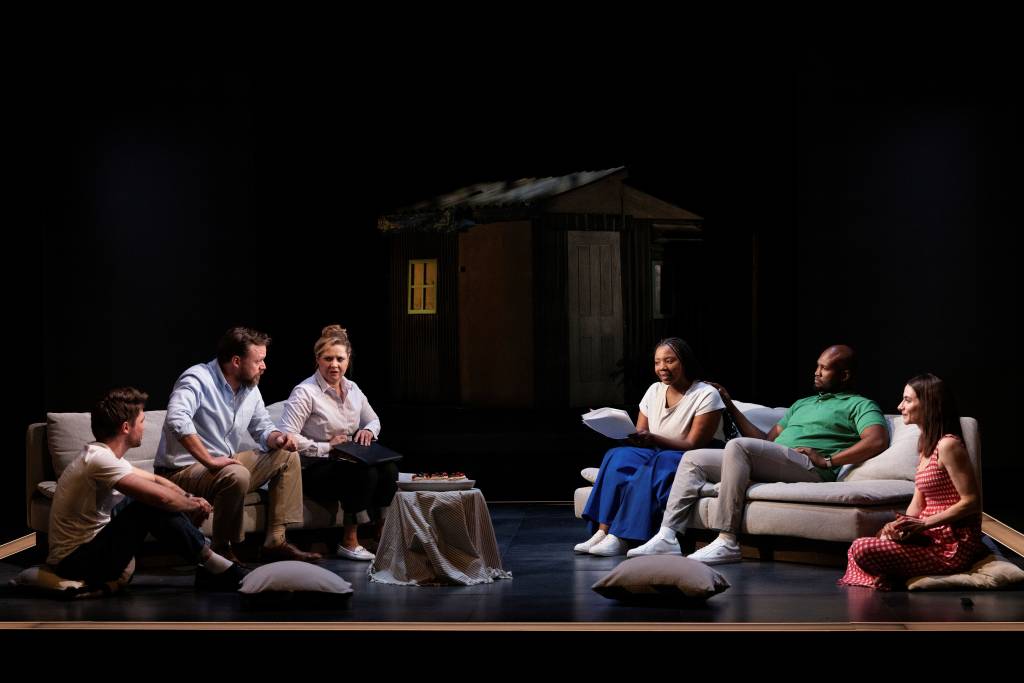
Amy Jeptha’s tense, funny satire is set on a new-build estate called Stillwater, somewhere in South Africa. In an echo of Harold Pinter’s ‘A Slight Ache’, a mute but menacing presence is enough to explode the conventions holding a fragile social consensus together. With Pinter it was a matchseller in the street outside; in ‘A Good House’ it is a shack, erected overnight on waste ground by unseen hands. It is visible from the sitting room belonging to young couple Chris (Scott Sparrow) and Jess (Robyn Rainsford), and seems to them to jeopardise their entire way of life. Attempts to form a ‘neighbourhood watch’ to deal with the perceived threat strips the covers off everyone’s assumptions about race, threat and social status – and about their most intimate relationships.

Jeptha’s writing is highly skilled and very funny, even as it lays middle-class South African society open. The young couple and the shack become a catalyst for an excruciatingly polite war of words between white couple Andrew (Kair Luke Brummer) and Lynette (Olivia Darnley) and black couple Bonolo (Mimî M Khayisa) and Sihle (Sifiso Mazibuko). The cast give highly entertainingly, finely calibrated performances. Brummer is hilariously tense as he tries to avoid saying the wrong thing, while sounding like a racist every time he opens his mouth. Darnley is equally amusing as a social manipulator not nearly as clever as she imagines. Jeptha mercilessly caricatures white hypocrisy, but also insecurity: Rainsford’s Jess quivers with the effort of maintaining her place on the social ladder, and Sparrow, as her partner Chris, descends into meltdown over his perceived social inferiority. 

However, the focus of the play in on Bonolo and Sihle. A financially successful black couple, they find themselves forced to choose between defending middle-class privilege, or the rights of the unseen shack dwellers. This opens up rifts in their relationship. Bonolo openly questions Andrew and Lynette’s motives, while besuited executive Sihle tries to keep the peace, and not make trouble: yet it is Sihle who grew up in poverty while, as he puts it, the activist Bonolo was always ‘bouji as fuck’. Khayisa and Mazibuko give excellent performances as a couple who love one another, but whose personal lives cannot be separated from the political choices engulfing them. There are a couple of remarkable cut-away scenes, as the tensely polite living room chat pauses and the pair give way to their real feelings about their neighbours, rolling around on the carpet helpless with laughter.

‘A Good House’ is a quality drama, directed with vision and control by Nancy Medina. Jeptha’s writing is honed and precise, exposing the tensions of a society where everything that matters goes unsaid. Her drama involves an intruder disrupting a supposedly cosy social setting, a classic theatrical scenario, but the play feels right up to the minute. The cosiness is superficial, and the self-interest entirely transparent, with characters such as Andrew principally concerned about ‘optics’. Everything and everybody feels closer to the edge than ever before, but ‘A Good House’ is also riotously funny. It is a fine production on every level.

The Invention of Love

Alan Williams and Simon Russell Beale. Photo by Helen Murray.

The Invention of Love by Tom Stoppard – Hampstead Theatre, London

Director Blanche McIntyre’s programme notes reveal an infectious enthusiasm for ‘The Invention of Love’, a play which inspired her when she saw its National Theatre premiere in 1997. It is certainly time Tom Stoppard’s most esoteric play, which has not been seen on a major stage since, was revived. The original production, directed by Richard Eyre, was notable for the performances of John Wood as the older A.E. Housman, and Paul Rhys as the younger. When McIntyre secured Simon Russell Beale for the former role, she couldn’t really lose. Whatever the long-term merits of the play he can fill the theatre on his own, and it is hard to imagine how watching him could ever be a waste of time.

Morgan Large’s low-key set is a series of dark backgrounds, reminiscent of a giant blackboard containing the cast of academics and their worlds. A vortex is chalked in the centre, which fits the fantastical structure of a play which begins in the Underworld. Russell Beale is being ferried across the Styx by Charon (Alan Williams), who has the manner and earthy sarcasm of a London cab driver. From the brink he reviews his life, as a renowned classical scholar who also became a successful poet. He is, of course, remembered only as the latter. Stoppard’s play, the result of three years researching the Oxford of the 1870s, is a full immersion in the intellectual movements and academic rivalries of the era. This is the sort of material only Stoppard, with his one-off ability to make the esoteric amusing, would contemplate. But it is not a complete success. Chunks of the play involve key figures – Walter Pater, Benjamin Jowett, John Ruskin, Mark Pattison – making pronouncements to one another while playing invisible games of croquet or billiards. There is a lot of fun to be had for the performers, and an excellent cast – Stephen Boxer as Jowett, Jonnie Broadbent as Pater, Dominic Rowan as Ruskin, Peter Landi as Pattison – take full advantage. But, while these scenes are amusing, Stoppard never convinces us we are watching real people rather than animated historical personages.

The play works much better when it brings characters together to talk about what really matters. It takes until the second half for it to become clear the play is about disappointed love. Gay relationships were idolised in theory at Oxford as ‘Greek love’, despised by society in practice. Russell Beale observes the progress of his younger self, played by Matthew Tennyson, at Oxford as he falls in love with the resoundingly heterosexual Moses Jackson (Ben Lloyd-Hughes). This unrequited passion haunted him for the rest of his life. Oscar Wilde (a brilliantly tough performance from Dickie Beau) appears, making the case for standing up for what you believe. Housman, who took the opposite approach, suffered as Wilde did but in an entirely different, private way. The scenes in which he talks to Tennyson, who gives a very confident portrayal, are fascinating and moving, personal feelings coded in metaphors about the classical texts that were Housman’s life. There are also affecting scenes with Jackson, who is played with great subtlety by Lloyd-Hughes – particularly the moment when he tells Housman he understands how he feels, and that he doesn’t mind.

The star of the show, however, is undoubtedly Simon Russell Beale. There is no actor better at simply talking to the audience, immediately making everyone forget that he is speaking lines. In every role he plays he talks directly to us, which is an incredibly rare thing to achieve as a performer and harder still when the lines are, on the surface, wilfully oblique. Russell Beale is completely at ease from start to finish, and he can take the audience wherever he pleases. ‘The Invention of Love’ is a flawed play which, as Stoppard acknowledges, would not be written now – not least because of its almost entirely male case, which feels like a relic from the last century. However, it is a highly intelligent and humane work, written with all the right intentions, and noone who enjoys supreme stagecraft will want to miss the great Russell Beale at work.

A Midsummer Night’s Dream

Andrew Richardson and Sirine Saba. Photo by Pamela Raith.

A Midsummer Night’s Dream by William Shakespeare – Barbican Theatre, London

Eleanor Rhode’s production for the RSC brings a wave of enjoyment to the Barbican on its transfer to the Barbican. A Midsummer Night’s Dream has darker aspects – at least those that appears so to 21st century audiences – but this is the not the production to reveal those. Instead, we are presented with a high calibre, high spectacle Dream which fits consciously into an RSC lineage. The show’s design by Lucy Osborne takes a gleefully 1980s approach to costumes, and a fanastical approach to the fairy scenes in the woods. The costumes are particularly well-observed, with echoes of John Caird’s punkish 1989 RSC production, and of the recent tv adaptation of Jilly Cooper’s ‘Rivals’. Demetrius (Nicholas Armfield) is in full Barbour, while Lysander (Ryan Hutton) is a working class upstart in red braces, tight slacks and brogues. Meanwhile, Helena (Boadicea Ricketts) roams the woods in a pierrot top. The detail is very enjoyable, and wandering lovers even have a 1980s sleeping bag and an Eveready torch.

The transition from the mortal to the fairy realm is managed in a delightful fashion, as Snug (Laurie Jamieson) enters a changing cubicle in her tailor’s shop and vanishes, replaces by Puck (Katherine Pearce) who picks up a ringing desk phone to find a fairy on the other end. All the fairies, in a unusual move, are voices represented by flitting, Tinkerbell-style lights, caught and held by the actors. This works remarkably well, and fits into a world of light, with the woods becoming a forest of dangling paper lanterns. Oberon (Andrew Richardson) also inhabits a dramatic forest of ladders, which rise from under the stage. The 1994 Adrian Noble production, with its dangling light bulbs and umbrellas designed by Anthony Ward, feels like an inspiration.

Although the show delivers spectacle in spades, it is subservient to the performances – an impressive achievement from Rhode. Matthew Baynton is effortlessly funny as Bottom, all long, prancing legs and physical presence. He is a more sympathetic Bottom than is often the case, less of a bombastic bully and more of a hero to his fellow mechanicals. His final death scene as Pyramus, in which he knifing himself in the heart, then proceeds to dramatically disembowel himself, ending the job by stabbing a knife into his head, is a tour de force. The Mechanicals are strong, but Helen Monks’ excitable, Midlands Rita Quince is particularly good. The lovers are a strong foursome, with Dawn Sievewright’s Hermia delivering frantic physicality, contrasting nicely with the elegant, angry Ricketts. Ryan Hutton’s Lysander stands out with a notably leggy, wild interpretation – going further over the top than seems reasonable with excellent results.

Sirine Saba’s performance as Titania / Hippolyta has shades of Clare Higgins 1989 performance. She is fired with energy, but of a different kind to Andrew Richardson’s Oberon / Theseus, who is dressed in full dandy highwayman gear and is willowy and volatile. The only interpretation that perhaps falls short is Katherine Pearce’s Puck. Usually the coolest character in the play, which sets up their failure, this Puck is out of their depth, out of breath from rushing to serve her master, mugging to the audience for laughs. It seems a missed opportunity. However, the production is a undoubted success: a thoroughly entertaining evening, deploying the RSC’s impressive resources – including the skills of illusionist John Bulleid – to bring the play’s strange, impossible world to life and to suspend our collective disbelief through traditional theatricality and spectacle.

The Legends of Them

Sutara Gayle. Photo by Harry Elletson

The Legends of Them by Sutara Gayle AKA Lorna Gee – Royal Court Theatre, London

Published at Plays International

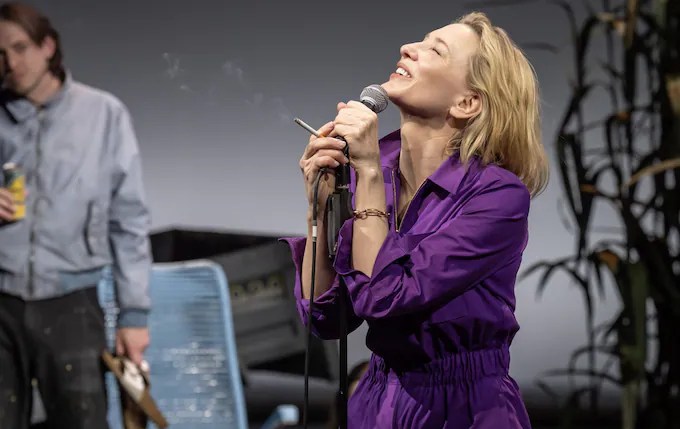
Sutara Gayle has had quite the life. Her one woman show expresses remarkable experiences through powerful, focused theatre. Gayle, born in Brixton, is a musician, singer, DJ and British reggae pioneer. She has lived in New York, opened for Shabba Ranks, spent time in Holloway Prison, and changed her name during a spiritual retreat in India. Her brother Mooji is a Hindu guru. Her sister Cherry’s shooting by police triggered the 1985 Brixton Riots. The Legends of Them combines music, film (projections by Tyler Forward and Daniel Batters) and a swirling array of characters, all played by Gayle, into a journey of awakening and discovery.

Gayle is also an actor, with a long career on stage and in film and television. This is the one aspect of her life she does not mention, and there is no need because it is obvious. Legends of Them is a performance tour de force. Gayle plays a long list of people she meets across eras and places – from Linton Kwesi Johnson to school friends, taxi drivers, dominoes players and policemen – who pass across the stage and through her life in sometimes dream-like fragments. She conveys each scene with minimum fuss and the maximum skill, using a vocal intonation, a tilt of the head, or a flick of the wrist. Gayle makes it look easy, but her performance is a masterclass in storytelling, from which other, far less subtle one-person shows could learn at lot.

The Legends of Them conjures up lost eras and events, knotting them loosely together as the bigger picture emerges, piece by piece. Although Gayle is the connecting presence, the show is explicitly about four legends in her life: her mother Euphemia, sister Cherry, brother Mooji, and the 17th century Jamaican freedom fighter, Nanny of the Maroons. Euphemia, who came to Brixton from Jamaica, brought up eight children, and pounded out living from her sewing machine. Cherry, who died in 2011, found herself thrust into the national news in disastrous circumstances, which she handled with great dignity. Her older brother Mooji is her guiding light, imparting Buddhist wisdom that helps Gayle see beyond tragedy and turmoil in her life. And Nanny is part of a suppressed history of resistance to empire, fighting the 17th century British occupation of Jamaica, and giving identity to those fighting the same battles today.

She threads together their stories expertly, never over-explaining but giving the audience enough to understand what is happening and why it matters. It is a high-wire act completed with supreme confidence, co-created with director Jo McInnes and dramaturg Nina Lyndon. Then there is the music. Gayle is a highly versatile writer and singer, and she sings at key moments. The set is dominated by a vast speaker stack covered in disco lights, which flash a backdrop to the action. Gayle strides on stage and immediately shows us what she’s capable of with her trademark reggae MC delivery, immediately raising excitement levels to eleven. Having established her formidable skills, she uses her full range, singing charming numbers influenced by pop and gospel, written with composer and musical director Christella Litras. She expresses herself directly and truthfully through music, which is clearly an essential part of her existence, and drives the show.

Gayle, with her collaborators, conjures an evening which is subtle, carefully woven, and at times exhilarating theatre, but it is more than that. The Legends of Them is a big success for the still-relatively-new Brixton House theatre, where it was first performed before moving the Royal Court – taking a show which is Brixton through and through into Belgravia. But it is more than a theatre production. Sutara Gayle’s life tracks the Black experience in Britain, through the terrible personal impact of racism and sexism, to personal fulfilment and self-knowledge. She is a local heroine, but her voice reaches far beyond SW9. She speaks from long, tough experience, and The Legends of Them sends a message which is proud, loud and clear.

The Importance of Being Earnest

Photo by Marc Brenner

The Importance of Being Earnest by Oscar Wilde – National Theatre: Lyttleton, London

In Max Webster’s new production intentions clear are from the opening moments. The play begins with a dance sequence. Ncuti Gatwa, playing Algernon, drapes himself over a grand piano wearing a shocking pink ballgown, split to reveal boxer shorts underneath. It sends an unambiguous message that this will not be The Importance of Being Earnest we have become familiar with, but a high camp, high glitter entertainment… and much more beside. Webster opens the play up to a much-need re-examination. One of the best known and loved – and overquoted – plays in the repertoire is reclaimed as the brutal social critique it has been all along.

For the National Theatre to stage Oscar Wilde’s best known play is a balancing act. It’s a sure audience pleaser, which is why every amateur group in the country has done it at some point, but there needs to be a reason to give it a major new production. Webster delivers this triumphantly, and his show is a revelation. The play has an excellent, highly entertainingly and disruptive cast. Gatwa is suave, shameless and very funny, with a commanding stage presence and a knack for comedy. He is matched with Hugh Skinner’s apparently more vulnerable Jack Worthing, constantly struggling to match his mental self image. The ingenue Cecily Cardew is played by Eliza Scanlen who channels Miranda Richardson to fine effect. And the excellent Ronkẹ Adékọluẹ́jọ́ is very funny as Gwendolen, teetering throughout between comic social propriety and crotch-grabbing sexual meltdown. Richard Cant and Amanda Lawrence, as Canon Chasuble and Miss Prism, deliver supporting performances of an exceptionally high calibre, while Julian Bleach has fun as two butlers: the scary Merriman and his derelict country counterpart, Lane.

However, every production of ‘…Earnest’ pivots on its Lady Bracknell. The part has become an old-fashioned star turn, somewhat divorced from the play itself. It is mystifying that Wilde has become so cosy, as though his annihilation by the society who had fêted him happened to someone else. ‘…Earnest’ is packed with bitter social recrimination fed to the audience in sugared pills. Sharon D Clarke’s Lady Bracknell undoes all that. Casting actors of colour in the key roles challenges some assumptions, and Clarke’s forbidding, stereotypical Caribbean matriarch works perfectly for the part. Wearing dramatic costumes combining western and Afro-Caribbean styles, by Rae Smith, she puts up a fierce resistance to her daughter’s wishes, but we gradually realise that this a façade relates directly to her origins. The key moments in the play are when she reveals that she had no money before she married Lord Bracknell; and when she discovers that Jack is very wealthy, and becomes suddenly supportive of his marriage to Gwendolen. She knows what it means to have nothing, and what it takes to stay afloat when you don’t belong. She can compete with any of the great Lady Bracknells, but her performance reinvents the part.

The entire play is explicitly about dissembling and façades. Nobody says what they mean, while revealing what they really think. We see clearly from Webster’s production that no-one can afford to be who they actually are. Wilde certainly couldn’t. But he devised a way to say things in a way that allowed his plays to become accepted and mainstream, all the while presenting an unequivocal condemnation of the British social order. Gatwa’s Algernon is certainly not a straightforwardly heterosexual character, but neither is anyone else. Algernon and Jack seem as interested in each other as their fiancees, and so do Celia and Gwendolen. Webster stages a spectacular pile-on in which they all seem on the brink of engaging in a foursome. On Rae Smith’s slightly psychedelic sets, reality is heightened and pushed to the brink of absurdity, which is where the truth lies. The show is as funny and entertaining as any production of the play, but it shows us what’s been lying in plain sight. Wilde deserves to be fully understood, and his work given the freedom of interpretation it could never receive at the time, and that has eluded it since. The evening ends with a masque dance, with all the characters in feathers and frills. It is a moment of joy, releasing us from the terrifying constraints of a world that forces everyone to pretend in order to survive.

Blood Show

Blood Show by Ocean Hester Stefan Chillingworth – Battersea Arts Centre, London

Blood Show comes with a spatter warning and plastic ponchos for the audience. The set, in Battersea Arts Centre’s small Member’s Bar room, consistsnof a pristine white carpet with a chair, a plant and a drinks flask filled with stage blood. The show, performed by the writer Ocean Hester Stefan Chillingworth, with Tim Bromage and Craig Hambling, is a surreal exercise in mimed violence. Hambling and Chillingworth stage a fight, the former painted all over in white, the latter slathered from head to toe in stage blood. It is a nasty and very believable fight with kicking, biting and gouging, and it ends with Chillingworth strangled to death in an alarmingly realistic manner. The white carpet, by this time, is smeared in blood. Then they do it again, and the shock of the violence wears off a little. Then again, and again, and each time the impact is reduced while the set becomes bloodier. There is also a ghost, adding unnerving comedy in a head-to-toe sheet costume, who glides around and sometimes sings – played by Tim Bromage I assume, although we never see his face.

The idea of repetition desensitising us to violence is a good premise, but the show takes a different course. The fight scenes end and Chillingworth becomes the sole performer, enacting a series of increasingly bloody and comic effects – including slamming plastic cups full of blood into their body foley-style. The volumes of blood grow, and it emerges from props and comes on stage in buckets to be sloshed around.

Blood Show is promising, but frustrating. It perhaps references violence against the trans body, violence in film, complacency about violence in society, or all of those things – but we never really know. The show seems to lack a driving rationale, and feels more like a scratch exercise than a coherent, finished production. The performers are physically committed to an impressive extent. However, the blood is a distraction and becomes the whole point. The need to produce more and more blood derails and defocuses the evening. And it turns out that when you examine it too closely, stage blood looks like stage blood, not the real thing,

The Duchess (of Malfi)

Jodie Whittaker as the Duchess. Photo: Marc Brenner.

The Duchess (of Malfi) by John Webster, adapted by Zinnie Harris – Trafalgar Theatre, London

Zinnie Harris has modernised John Webster’s classic revenge tragedy with a bold production that gives a new perspective on a wild, brutal story, while also stripping it of the language that has given its place in the repertoire, 400 years later. There are many good things about the production. Tom Piper’s modernist set is stripped back to concrete, with metal walkways, a suitable backdrop for slaughter. Jodie Whittaker is an appealingly defiant Duchess, a woman who will not give way to what men demand of her, however huge the price. In fact, she continues to haunt her brothers, Paul Ready’s Cardinal and Rory Fleck Byrne’s Ferdinand, after death. Ready stands out as the lascivious Cardinal, plausible but depraved, unable to resist humiliating his mistress Julia (Elizabeth Ayodele), as soon as she shows weakness. Fleck Byrne’s Ferdinand is convincingly unhinged, his sexuality tearing him apart. He appears, dramatically, wearing his sister’s red dress after ordering her murder. Fleck Byrne is generally watchable, but loses marks for tossing away the character’s most famous speech, “Cover her face. Mine eyes dazzle. She died young”, which an actor is surely contractually obliged to have fun with.

There is also a powerful performance from Jude Owusu as the murderer Bosola. Owusu’s ambiguity is subtlety delivered, keeping us guessing throughout as to who he really is. Harris’ version emphasises his role, letting him live at the denouement, unlike almost all the other characters, to regret his past and promise to look after the Duchess’ young son. She also highlights his class position as someone who cannot afford to turn down work, however grisly. In this, he is allied with the maid Cariola, who Matti Houghton plays with a great deal of character. In one of Harris’s best lines, she reveals that women wear make-up to hide their rage at the misogyny around them.

The production is an interesting and enjoyable evening, a valuable and committed experiment with a play that is usually hidden in the shadows. Harris brings it out into the light, shining an unforgiving fluorescent light on its themes like an autopsy. She makes the brutal treatment of women uncomfortably apparent, and the deep corruption that fuels the power of the few the unmissable cause of society’s ills. Unsurprisingly, it’s a play for our times. The use of music in the play, with Whittaker and Houghton delivering Webster’s songs with aplomb to the accompaniment of white-suited guitarist, contrasts nicely with the grim imagery – the bodies of the Duchess, Cariola and her young daughter left sprawled on the stage throughout the following scene. Whittaker death scene is delivered in astonishingly gruesome fashion, strangled unsuccessfully at length with a rope by incompetent goons before Bosola finishes the job himself, drowning her in a bath. However, it’s a shame about the poetry which, when it surfaces from time to time brings the show suddenly to life. For the most part it is missing, and an essential element in the play’s appeal disappears with it.