And the Rest of Me Floats

04 Outbox- Elijah W Harris ©fgstudiosElijah W Harris ©fgstudios

And the Rest of Me Floats by Outbox Theatre – Rose Lipman Theatre, Haggerston

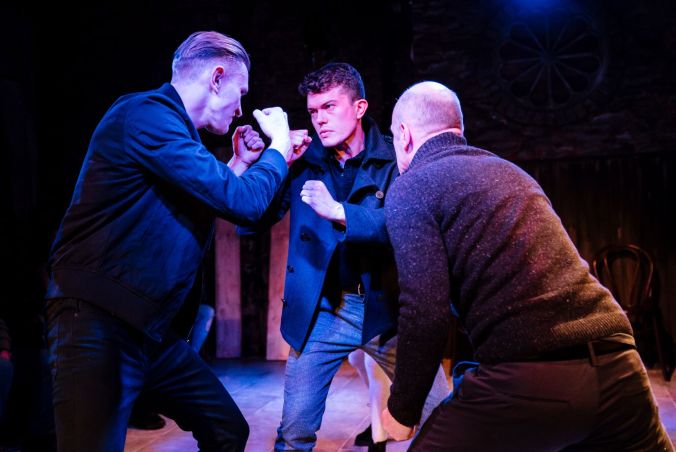
In a Haggerston community centre, seven young performers share their individual experiences of sexuality. They are a diverse LBGTQ group, including gay, non-sexual, men, women and transgender and various labels you might care to use but their stories are, of course, as individual as anybody’s. And the Rest of Me Floats is a highly enjoyable devised performance exploring queer space outside traditional gender definitions. There are costumes and glitter balls, dancing and singing, confession and affirmation. There is a great version of ‘Teenage Dirtbag’. It is very much theatre as it is in 2017, mashing together forms with ease, and applying genre-busting logic to break down the borders of perceived, sexual identity.

Directed by Ben Buratta, Outbox Theatre has devised a mesh of interlocking stories, staged with energy and commitment, and cunning use of minimal props. A torch beam provides crucial lighting effects, and a sheet of clingfilm performs a key role, but the stars are the performers who reveal their experiences of failing to fit in, to communicate with friends and family, and of seeking a definition. The internet is at the centre, not only bringing people together who thought they were alone, but also allowing them to shed their physicality and find their identities. There are stories of hardship and abuse, but the performers have as much to say about acceptance. They challenge the audience to really see them – as individuals, not as people defined by gender issues. And the Rest of Me Floats is a highly enjoyable evening, questioning social assumptions and having a great time doing it.


Horne A’Plenty

234fc4eacd904fa589c618c3bc6f385f.png

Horne A’Plenty by Brian Cooke and Johnnie Mortimer – White Bear Theatre, London

More than a decade ago original Round the Horne writer, Brian Cooke, and director Michael Kingsbury brought the much-loved 1960s radio series to the West End. Staged as a live BBC recording, the production was a reminder of a time when radio was at the cutting edge of popular culture, drawing vast audiences every week to BBC comedy shows. It also showed just how particularly subversive Round the Horne was – a mainstream show that was entirely based on expertly gauged innuendo, much of it referring to gay sex which was illegal for most of the time Round the Horne, and its predecessor Beyond Our Ken, were on the air. Now Cooke and Kingsbury are back with a surprise new production based on the fifth series of Round the Horne, cancelled after the sudden death of lead actor Kenneth Horne in 1969.

These scripts, which have never been heard before in any form, are a treat. The cast are masters of mimicry, bringing five well known voices back to life with consummate skill. Everyone deserves a mention. Jonathan Rigby as respectable businessman Horne ( in fact exactly what he was) makes manful attempts to keep the innuendo in check, failing entirely. Robin Sebastian’s Kenneth Williams, driven by eerily accurate gurning, is a crowing delight. Kate Brown as Betty Marsden has some of the funniest lines, as a particularly in the character of confused actress, Thespiana Boot. David Morley Hale as Hugh Paddick swtiches effortlessly from ancient, crusty barrister to raging camp. And Charles Armstrong has a great fun as self-aggrandising BBC announcer, Douglas Smith. There is even an onstage Foley artist, Lucy Sullivan, who slams a tiny door on cue.

The unheard scripts are fascinating. Written in 1969, after the decriminalisation of homosexual acts, they are more direct than previous series. There are new characters too including rattly old puffin Sir Inigo Parchmutter, recounting suggestive cases from his time at the Bar and the Brum Brothers. The latter are an evolution of the famed Julian and Sandy characters. They no longer speak in Polari, the coded gay slang popularised by the show, and for some reason they are now Brummies, but they are very funny and spent much of the time discussing someone called Clint (“Go on, purge yourself! Let it all out!”). It is fascinating to hear new material, still very much in the spirit of the earlier shows, but edging gradually in the direction of the 1970s. Horne A’Plenty is something of a triumph, both an essential social document and an endlessly funny ninety minutes. The audience leaves weak with laughter – Horne A’Plenty clearly deserves a bigger home and a longer run.

Yerma

HeaderBrendan-Cowell-John-and-Billie-Piper-Her-in-Yerma-at-the-Young-Vic.-Photo-by-Johan-PerssonBrendan Cowell and Billie Piper in Yerma, © Johan Persson

Yerma by Simon Stone after Gabriel Garcia Lorca – NT Live from the Young Vic

Simon Stone’s production of Yerma comes garlanded with Olivier Awards for Best Revival and for Billie Piper as the central character driven to desperation and destruction by her inability to have children. As an NT live broadcast to cinemas, it has been popular enough for repeat screenings. So what is the experience of seeing pretty much the hottest ticket in town like at one remove?

First of all, there is no question that Piper’s performance is a triumph. She really comes of age as a stage actor in the role, inhabiting it to the full. She is entirely convincing as a woman who starting with the apparently reasonable expectation that she might have children, sees her life come apart in every way as she discovers, excruciating step by excruciating step, that she cannot. Piper portrays complete mental disintegration while keeping the audience involved and sympathetic, beyond the point where her actions can no longer be justified. Unlike the rest of the cast, Piper’s character does not have a name – she is simply ‘Her’ – and Piper makes the universality of her experiences concept harsh and real. The supporting cast is strong, but it is Maureen Beattie as her contrary mother, Helen, who threatens to steal every scene in which she has a line.

The name of the main character – ‘Yerma’ meaning ‘barren’ in Spanish is just one of the many, substantial changes made by Simon Stone, who has adapted Lorca very freely, relocating it to a city like London, right now. In a short film shown before the screening, Stone gives the impression that his changes were designed to make the lyricism of the original more manageable for contemporary audiences, but has gone far beyond that, even changing the ending. For those who do not know the original it is hard to weigh the decisions he has made, but taken on its own terms his version is powerful. The action is very explicitly contemporary, showing how infertility can be as much of a curse now as it was in rural 1930s Spain. Stone’s text is too insistent on its 2010s setting: blogging, internet porn, female body hair, millennial sex, gender experiences in the work place, abortion, iPhones, internet privacy, and work-life balance all receive stage time. He also threatens to turn Yerma into a play about IVF, which would miss Lorca’s point. However, his version is, on the whole, a cleverly written, bold success.

The cinema experience has its downsides. The play is presented with inter-titles announcing the time period for each new scene. It is not clear whether these are just for the cinema, or whether the Young Vic audience sees them too, so we feel divorced from the theatrical experience. Because these are cut, we also seem to miss small pieces of the action on stage, for example coming back into the play’s final scene after it has apparently started. The glass box set is not ideal for broadcast, and its spatial properties do not translate to the screen – a problem with many live broadcasts, which struggle to replicate the physical presence of a stage set. There are also sound issues in some scenes: because the incidental music has the same dynamics as it would for a film it dominates the dialogue, which sounds much flatter and is indistinguishable when characters speak over one another.

Yerma is a visceral experience – an emotionally demanding spiral of despair and alienation, which rings much truer than we would like to admit. The NT live screening removes some of the viscerality, but it is a tribute to the production that much of its power and impact in the theatre makes it through the cinema screen.

The Shape of the Pain

The-Shape-of-Pain-DSC_4795-700x455

The Shape of the Pain by Rachel Bagshaw and Chris Thorpe – Summerhall, Edinburgh

A play about a sufferer from Complex Regional Pain Syndrome sounds tough to watch, and probably of limited relevance to those fortunate enough not to be afflicted. The fact it is neither is a tribute to the exceptionally high quality of the writing and performance in Rachel Bagshaw and Chris Thorpe’s play. The narrative is meticulously introduced by the sole performer, Hannah McPake, as an account of someone else’s experience. Chronic pain can be triggered by a minor injury which, for reasons doctors cannot entirely explain, results in permanent, debilitating, possibly lifelong pain. It is essentially an inability to shut off sensation. The play is an exercise in communicating an experience that is impossible to communicate.

With projected text and sound effects used to great effect, McPake explains the nature of pain in terms that are literally hallucinogenic, as she leaves her body in a bubble to preserve a basic version of herself as the rest is washed away. However, the play is as much about her attempts to negotiate a relationship in the shadowed of her condition. The narrator has the choice of feeling either everything or nothing, and despite everything the former remains just about preferable. The Shape of the Pain becomes a discussion of how far people can understand one another, and the extent to which love is just two people trying to make something work. It is a profound, touching and real examination of the basics of human experience, and one of the most powerful shows on the Fringe.

3000 Trees

7b235e57123e7fd4beb2197d1b1ed065ce41376f-original-LST245957.jpg

3000 Trees: The Death of Mr William MacRae by Andy Paterson – New Town Theatre, Edinburgh

3000 Trees begins with two gunshots, and the rest of the play is an attempt to explain what they mean. The violent death of SNP politician Willie MacRae, found in 1985 in his car off a remote Highland road, shot in the head, is one of the political mysteries of the time. However, outside Scotland these events are largely forgotten, and Andy Paterson’s compelling one man show aims to change at least that fact. MacRae, a Glasgow lawyer involved in opposing applications for nuclear waste disposal in Scotland, was a loner. He was probably gay, said to be a heavy drinker, and possibly depressed. He also carried a gun, for protection, and it was this which was found by his body, having delivered a bullet to his head. It carried no fingerprints. The play’s title, it turns out, refers to the forest planted in his memory.

Paterson, who also performs the show, portrays MacRae as a dry, self-aware man with a tendency to break into Jacobite song as he makes his way through a bottle of whisky while recounting his life story. His nationalist politics is anchored in colonial experiences in the Indian Navy, and the play reflects with a shocking directness on the bruality of the British in India with their special stocks of bullets marked ‘Not to be used on Christian troops.’ Paterson’s account of MacRae’s life and politics is convincing and affecting, particularly as he ponders his failure to achieve lasting relationships. No one is ever likely to know at really happened in 1985, but the circumstances are highly suspicious and MacRae certainly seems the kind of powerful, subversive figure likely to make an enemy of the state. 3000 Trees tells an important story with subtle power – a show well worth seeing.

Blackcatfishmusketeer

BlackCatfishMusketeer.jpg

Blackcatfishmusketeer by Malaprop Theatre

Written by Dylan Coburn Gray, Blackcatfishmusketeer at first seems like gentle entertainment, but gradually reveals itself ss omething rather more. Taking place in an online world of internet dating and fake identities, a man and a woman chat online and become friends, then something more. Both are apparently looking for someone, but connecting with a person with only text for communication raises difficult questions. Are they who they seem? Is anyone really who they seem anyway? And how do you know if you understand, never mind love, someone else?

Cleverly staged, the online conversations between the two take place with the mediation of the Internet, a cheerful character who explains the links they send to each other and their meaning, or lack of. Coburn Gray throws plenty at the play, including rapidfire debates over, amongst others, Kierkegaard, which at times seem excessive. However, the theoretical cleverness of the writing is matched with real heart, and the main characters are entirely human and believable in their ability to love, to tease and to self-destruct. Their Dublin-London relationship also explores the modern Irish diaspora experience of the distance between work and home in a unforced way. Blackcatfishmusketeer is an enjoyable show that stays with you a long time after it is finished.

No Show

No-Show

No Show dir by Ellie Dubois – Summerhall, Edinburgh

Five female circus performers occupy a remarkably small stage, all the more so given the spectacular tricks they are about the perform. It soon becomes apparent this is not a traditional show. Two of the troupe bully a colleague into holding harder and harder handstands. While one woman performs in the steel ring, another commentates on the precise nature of the injuries she will suffer if she misjudges a spin. The trapeze artist gives us a dummy version of her act, as the ceiling is around 10 metres too low for an actual trapeze. At one point, the five sit in silence and stare at the audience while eating doughnuts.

No Show is a brilliant, multi-layered piece of theatre. Fran, Kate, Michelle, Lisa and Alice are all astonishingly strong acrobats whose tricks make the audience gasp. It also emerges that they are less than impressed with their treatment as performers. As women, they are expected to look decorative, smile a lot and leave the strength work to the men. No Show systematically dismantles the veneers of the circus and, in an understated but cheerfully confrontational manner, exposes the sexism beneath. The result is not only the best circus you’ll see at the Fringe, but one of the best shows full stop.

Odyssey

Odyssey-1.jpg

Odyssey by George Mann and Nir Paldi – Pleasance Dome, Edinburgh

Odyssey, a one-man performance of Homer by George Mann, needs no reviews to boost its prospects. Having run since 2009, it continues to sell out at the Fringe and attract awed crowds. Despite this success, however, Odyssey is a mannered and at times infuriating show. Mann is a highly demonstrative storyteller, accompanying his tale with illustrative sounds effects and gestures like a dancer. He gives a technically accomplished performance, but nothing is left unremarked. When an eagle soars there is a squawk, when waves break there is a splash. Like a beatboxer, Mann is adept at making sounds with no equipment other than himself. However, he leaves little to the imagination.

While some ideas work well – the deathly slow creaking of a mast, for example – the rush of effects quickly overwhelms the story, leaving the listener no room to think or breath. The show becomes about Mann’s performance, rather than the story he is telling. This is unfortunate because the Odyssey is a strange and troubling tale crying out for some examination. Instead, we have the audience applauding a hero who has just hung 12 servant girls as part of a grim revenge. Mann presents the Odyssey as a triumph of the storyteller’s art, but the story cannot stand still and the focus should be on the tale, not the teller.

Stand By

99fb08d8-a8dd-4e90-8102-512f21c16b0d

Stand By by Adam Macnamara – Army @ Summerhall, Edinburgh

The partnership between The Army and Summerhall, the Fringe’s experimental flag-bearer, may seems unlikely, but the festvial depends on Edinburgh’s endless supply of churches, meeting houses and masonic halls. The new venue, a Territorial HQ in Broughton staffed by very polite squaddies, is become an ideal location for performances about the Army itself and, in the case of Stand By, the police. Adam Macnamara’s tightly written drama is set in the back of a riot van, as officers wait for the signal to end a siege. Four characters pass the time bickering, playing jokes on each other, asserting status and expressing various levels of cynicism about the police and, particularly, the public.

The situation is a classic dramatic set-up, reminiscent of Pinter’s hitmen on stand-by play The Dumb Waiter. Macnamara is a former policeman, and this proves the perfect showcase both for his inside knowledge and impressive writing skills. His dialogue is particularly strong, and it is clear that he knows exactly how the police behave behind the scenes. Each of his characters is well-defined and complex, behaving as themselves rather than to type. The cast makes the most of the parts, with fine performances from Andy Clark, Jamie Marie Leary, Laurie Scott and Macnamara himself. The play is very funny, but also credibly tense as the situation outside the van lurches alarmingly out of control. The consequences of police under-resourcing are addressed as a natural part of the drama. Stand By is top quality writing in the hands of actors with the talent to make it sing.