Nachtland

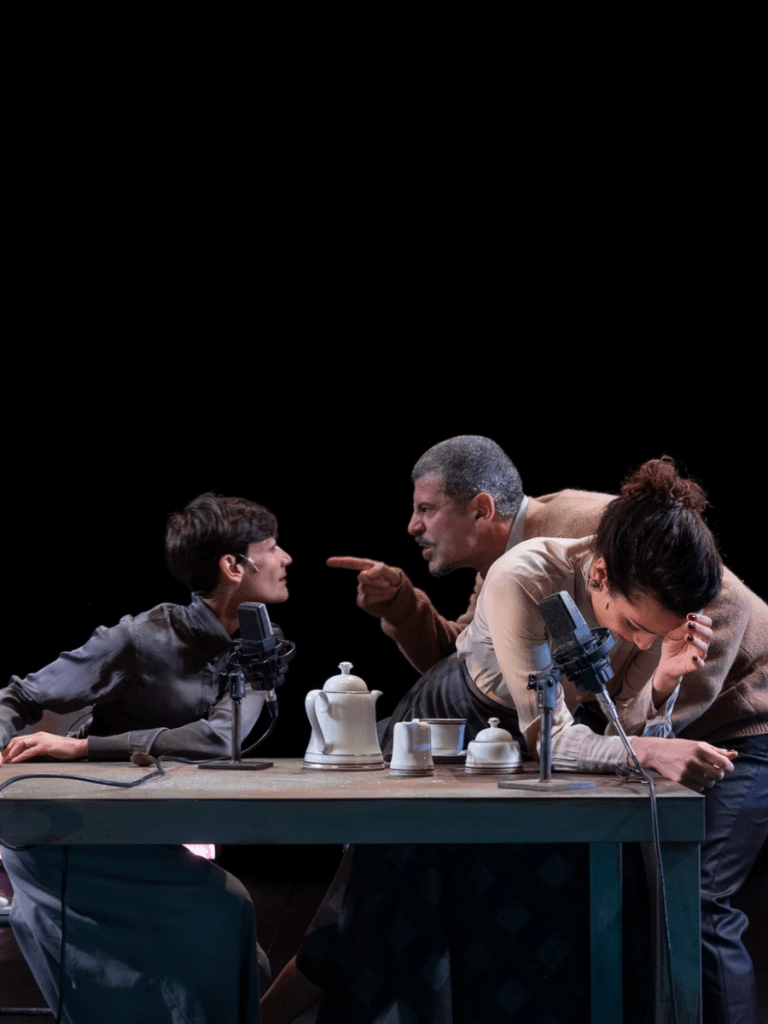
Angus Wright, John Heffernan and Dorothea Myer-Bennett. Photo by Ellie Kurtz.

Nachtland by Marius von Mayenberg – Young Vic, London

Translated by Maja Zade, Marius von Mayenberg’s play is a brutal satire on the hypocrisy and racism of the contemporary German middle-classes. Brother and sister Philipp (John Heffernan) and Nicola (Dorothea Myer-Bennett), who have a difficult relationship, come together to clear their recently deceased father’s house. In the attic, they find a painting, wrapped in brown paper which, on examination, appears to by Adolf Hitler. This provides a more than sufficient catalyst to strip away the pair’s principles and dignity, as they attempt to cash in.

Nachtland (an invented German word meaning something like ‘night-land’) is a broad, bitter comedy drawn with cartoonish strokes. Most of the cast have a lot of fun with their absurd characters. Myer-Bennett is extremely aggressive, particularly towards her brother, self-righteous and openly racist. Heffernan is patronising, passively aggressive, and racist in a more insidious way. The two performances complement each other very well, culminating in a jaw-dropping brother-sister masturbation scene, as their excitement about the money they can make from the painting boils over. They play off against their partners, Gunnar Cauthery as Fabian and Judith, played by Jenna Augen. The latter is Jewish, and the only remotely normal character in the play, who whips the rug from under everyone without blinking. The events take place in an aging house, set designed by Anna Fleische, where the past has clearly been shoved in the attic and left unexamined for too long.

The absurdity of Nachtland, managed beautifully by director Patrick Marber, is its strength. Jane Horrocks is restrained, and funnier because of it, as Hitler art expert Annamaria. Angus Wright puts in the most eye-catching performance as wealthy Hitler collector, Kahl. First appearing in a cut scene, dancing to techo in a jockstrap, he re-emerges in furs and coloured chinos to appraise the painting for sale. Wright rings every drop of potential out of Kahl’s quivering ecstasy at the sight of a ‘Hitler’, but also delivers the collector’s dismissal of morality and art with fine disdain, launching into a list of those we prefer to forget were anti-semitic.

It is a little hard to judge Nachtland from outside Germany. Its satire, which feels unrestrained and to some extent shocking, is clearly aimed at Germans themselves. Whether this is familiar territory, or an essential reality check is not obvious to us in the UK. The play is too obvious at times in its humour, and struggles to get off the ground until Wright’s entrance. Von Mayenburg also gives the Devil, in a long tradition, the best lines. But it an entertaining and disconcerting evening in equal parts, with some very memorable moments. And the overall suggestion, of deep-lying, unapologetic prejudice among those who should know better for all sorts of reasons, is highly disturbing and an urgent matter for the stage to address.

A Family Business

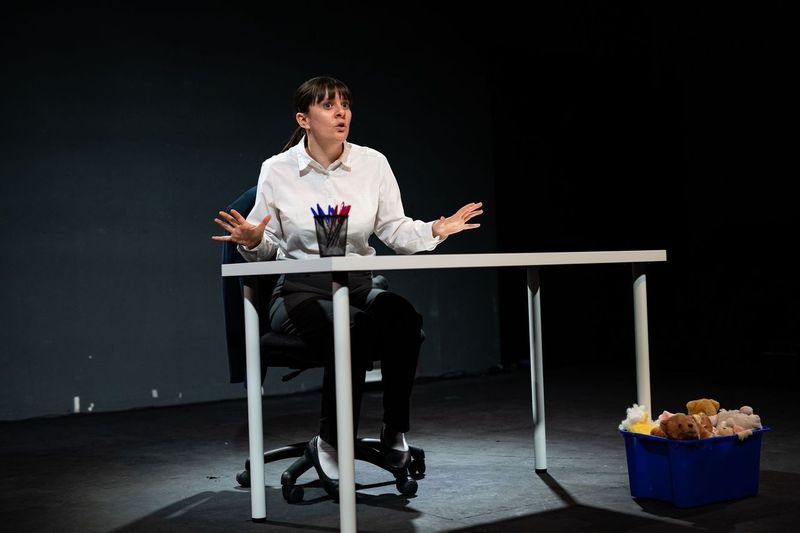
Chris Thorpe. Photo by Andreas J Etter.

A Family Business by Chris Thorpe – Omnibus Theatre, London

The Anthropocene Era, the Age of Humans when the future of the planet is geologically determined by the actions of our species, is now widely agreed to have begun at 05:29:21 on July 16, 1945, with detonation of the first atomic bomb at Alamagordo, New Mexico. Since the dawn of the nuclear era, nothing has been the same, bombs have increased in power and number. There are now around 13,000 nuclear warheads in existence, belonging to the world’s nine nuclear states, and most have the explosive power of 100 Hiroshima bombs. The nuclear threat is constant, and the consequences of any one of these bombs ever being used are dire for humanity. Can we really live indefinitely with the dull, constant background threat of annihilation?

Chris Thorpe’s new show, A Family Business, developed with Rachel Chavkin and produced by China Plate with Théâtres de la Ville de Luxembourg, opens up discussion about a subject most prefer to not even think about. Using his trademark conversational approach, Thorpe draws the audience into his own journey of discovery which began after meeting a woman working for International Campaign to Abolish Nuclear Weapons. Awarded the 2017 Nobel Peace Prize, ICAN has successfully campaigned to ratify the Treaty on the Prohibition of Nuclear Weapons. As a result of their actions, a coalition of countries from the Global South has united to deliver an international agreement that makes nuclear weapons illegal. The downside: no nuclear state has signed up.

By focusing on current, and in many ways successful, anti-nuclear action, Thorpe centres his piece on hope for change. His narrative sections are woven together with a dramatisation of the negotiations – bribery, threats, and coded discussions about nations that take place behind the scenes of international agreements. Three performers, Andrea Quirbach as the lead ICAN negotiator, Greg Barnett as the representative of a US-style power, and Efé Agwele from an African nation, talk behind the scenes. From a personal perspective, none supports the existence of nuclear weapons, but as diplomats their views are neither here nor there. They play the game that keeps the nuclear status quo intact, as though humanity were not ultimately a single family.

It is a good thing Thorpe has identified hope about the despair, because the show pulls no punches on the consequences and probability – certainty even – that nuclear war will one day take place, through accident or design. Thorpe draws the audience into cheerful conversation that reveals our general lack of knowledge about the greatest threat to our existence. He uses a web simulator to show how little of our world would remain if anyone ever pressed the button. A Family Business is engagingly performed, and directed by Claire O’Reilly, under a swag of cables designed by Eleanor Field. The show would benefit from editing in places, as the diplomatic drama has a tendency to drift. However, Quirbach, Agwele and Barnett all give nuanced, believable performances as ordinary people grappling with astonishingly high stakes. But, as Thorpe points out, the only places anything ever changes is in rooms of ordinary people, talking. His show is urgent theatre, engaging with something so big that no-one knows where to start. By bringing this discussion to the stage, he makes a powerful case for looking the threat in the face, rather than hiding our heads in the sand.

King Lear

Clarke Peters and Danny Sapani. Photo by Marc Brennan.

King Lear by William Shakespeare – Almeida Theatre, London

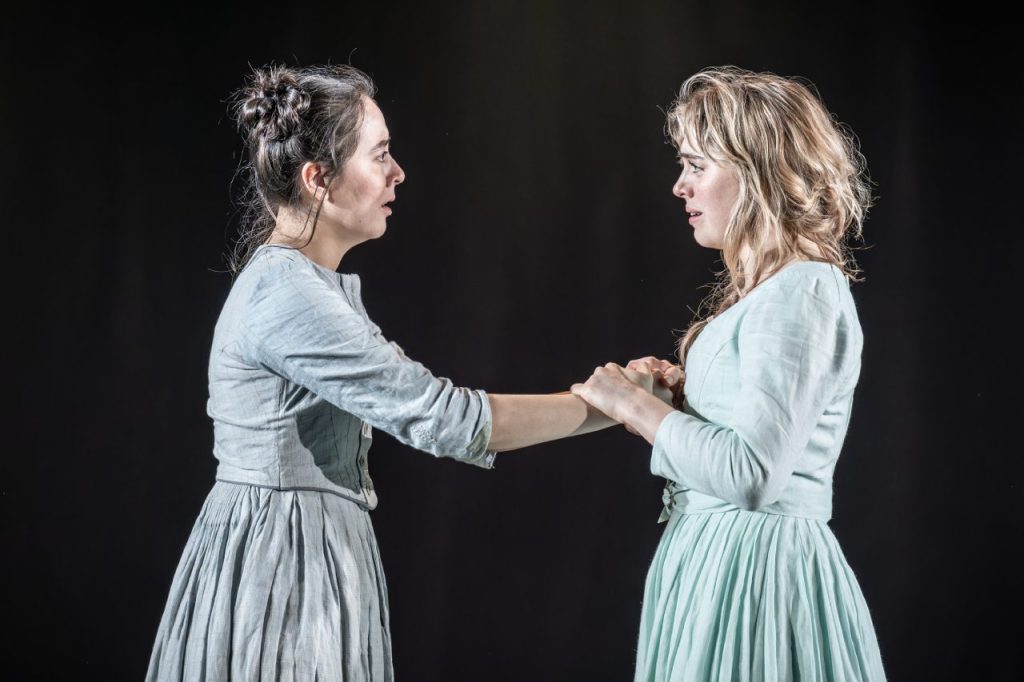
Yaël Farber’s directs King Lear on simple but very effective set by Merle Hensel – a round, black circle backed by a curtain of chains. With dramatic lighting by Lee Curran, it is the perfect space for a hard-edged, menacing production that brings out the violence that courses through the play. Danny Sapani’s Lead is a big, intimidating man. His anger cows those around him, and he rules through physical presence. But Farber suggests that this is also the basis of his relationship with his daughters. For the first time I saw Lear’s actions as those of an abuser: controlling, threatening and micro-managing his children’s lives. The opening scene leaves the impression that Goneril (Akiya Henry) and Regan (Faith Omole) are equally uncomfortably with their father’s egotistical antics, but it is Cordelia (Gloria Obianyo) who has been driven to the point of resistance. Later, in a supremely uncomfortable moment, Sapani forces Regan, his adult daughter, to sit on his knee in front of her husband. Whatever has happened before the play begins, the father-daughter relationship is undoubtedly dark and destructive.

The violence Lear demonstrates when he still has power – smashing news conference microphones to ground in his rage – is visited on him in turn by children brought up in his image. Henry and Omole are superb are Goneril and Regan, taking destruction of others and themselves as the only way out of the situation they can imagine. Obianyo’s Cordelia is detached and angry, her recourse to violence taking the form of a full-scale invasion with a foreign power’s army, which makes her embrace of love and forgiveness all the more dramatic and moving when it comes. It is impossible to sympathise with Sapani’s Lear in the first half, as he rages in the heath scene, but his transformation, which comes only through the complete disintegration of his ego, is startling. His Lear is entirely compelling, and he is a huge stage presence, an actor coming to the part as though made for it.

Farber production is both well-paced – 3 and a half hours feel like much less – and well cast. Michael Gould’s Gloucester is a reasonable man in a mad world, and his scenes with Lear are a high point. Matthew Tennyson’s Edgar is an ingenue from another world, much more at home as Poor Tom than himself. Fra Fee’s Northern Irish Edmund is the opposite – a lifelong charmer whose over-confidence will always be his downfall. Alec Newman’s Kent, likewise, channels his inner, fight squaddie with suspicious ease. Hugo Bolton’s uptight Oswald and Edward Davis’ louche Cornwall are also highly watchable.

The most controversial element of the show is Clarke Peters’ Fool, played as a manifestation of Lear’s inner voice, who no-one else can see. While theoretically interesting, this approach tends to sterilise the action by removing social context, and Peters’ style seems to belong to a different production. His singing talent is put to good use though, and the use of music, composed by Matthew Perryman and making use of an on-stage piano and repeated snatches of ‘A Hard Rain’s Gonna Fall’, is seriously eerie. This Lear is of the highest class, and brings new insight to one of the world’s most pored-over plays.

Macbeth

Ralph Fiennes and Indira Varma. Photo by Matt Humphrey.

Macbeth by William Shakespeare – Dock X, London

Simon Godwin’s production of Macbeth, starring Ralph Fiennes, touring non-traditional venues, is reminiscent of the Almeida’s double-header of Richard II and Coriolanus, staged in the pre-conversion Gainsborough Studios, with Fiennes playing both leads. That was in 2000, and Fiennes is still bringing in the crowds, burnishing his reputation as one of the great actors of his generation. This record includes, but does not depend upon, his Shakespearian work, with Mark Antony in both Antony & Cleopatra and Julius Caesar, Richard III, and Coriolanus (in the 2011 film) all performances of the highest calibre. His Macbeth is another major achievement, a portrayal that offers a persuasive account of a man veering rapidly into evil.

The show’s London venue is the Surrey Quays warehouse, Dock X, which provides a very successful auditorium with a large capacity, but excellent sight lines all the way to the back row. There is a gesture at immersiveness, with the audience entering through a miniature war zone with burned out car, but the production is surprisingly traditional in the right ways. Frankie Bradshaw’s concrete stepped set is simple but entirely effective, adapting with minimal fuss while creating the impression of Scotland as a militarised landscape. Soldiers wear battle fatigues so, when different costumes appear, they make a big visual impression: Lady Macbeth in a vivid green gown, Macbeth in a purple robe. The witches hover between ordinary and scary, three young women in dungarees and puffa jackets who might be hanging around on any street corner – a strong approach that normalises the extreme.

Fiennes himself is evidently an efficient soldier partly because he is single-minded to the point of lacking social skills. He is awkward and abrupt in the opening scenes, while Indira Varma plays Lady Macbeth as an influencer, who knows how to present people in their best light. It makes sense that these two are together, and that Lady Macbeth is in control. She can shape and direct her husband to make the most of his opportunities. But the production makes the tipping point clear, when her plans start to spin out of control. As soon as she tells her husband he is ‘lily-livered’, having declared that Duncan’s murder would make him a man, their pact is broken. After this betrayal, Macbeth is unleashed to live his worst life.

Godwin’s production is based around notably clear verse speaking, that makes the text sound fresh in a way that only the best productions can pull off. Fiennes leads the way in this, making all the great moments, especially the ‘brief candle’ speech, revelations. He is mesmerising, the best and most believable Macbeth I’ve had the good fortune to see, and Indira Varma is a match for his performance, making Lady Macbeth a great deal more comprehensible than is often the case, a woman who will give all in exchange for the rewards she confidently anticipates, only to disastrously miscalculated the cost.

The production also gives the wider cast weight and presence. Making the unusual, but understandable, decision to cut the Porter scene pays off through enhanced narrative drive. Another of Godwin’s achievements is to make the Macduff/Malcolm scene in England, often dismissed as an aberration, actually work. Malcolm (Ewan Black) is genuinely wrestling with self-doubt about his fitness to rule, not playing games, but it is swept away by the terrible revelation that Macduff’s (Ben Turner) family has been murdered. This moment is centre of the play’s second half, balanced against the murder of Duncan in the first, and showing how it can be played makes it complete.

A strong cast also features Steffan Rhodri as a poetically Welsh Macduff, Rebecca Scroggs as a justifiably furious Lady Macduff, and Jake Neads and Michael Hodgson as the two murderers. The ungainly presence of the latter, is used cleverly as the witches (Lucy Mangan, Daniella Fiamanya and Lola Shalam) channel their visions of the future through Hodgson’s twitching body. Christopher Shutt’s sound design creates an eerie backdrop to the action, with hints of The Exorcist that make this production not so much bewitched, as possessed. The combination of characters destroyed by their own personalities, excitingly portrayed by Fiennes and Varma, and a war-ravaged setting in which people are not what they seem, makes this a production to savour.

Double Feature

Joanna Vanderham & Ian McNeice. Photo by Manuel Harlan.

Rowan Polonski and Jonathan Hyde. Photo by Manuel Harlan.

Double Feature by John Logan – Hampstead Theatre, London

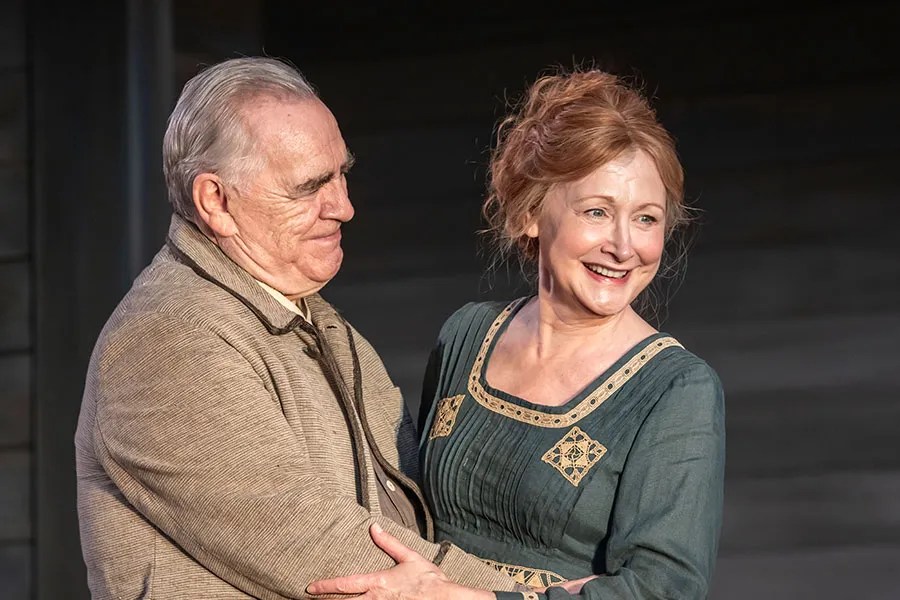
John Logan’s new play reanimates two moments of cinema history, taking us behind the scenes to the discussions that ended careers, in very different ways. The play opens with a man in a hat and cloak sweeping, Gothically, into a comfortable cottage. It is Vincent Price (Jonathan Hyde), and he is meeting Michael Reeves (Rowon Polonski), young, brilliant and doomed film director during the shooting of Witchfinder General. Soon, we realise that this time period, 1968, is woven with another, around four years earlier. Onto the same set step Alfred Hitchcock (Ian McNeice) and Tippi Hedren (Joanna Vanderham). Now we are in Hitchcock’s cottage on the Universal lot, during the filming of ‘Marnie’. The relationships between the two pairs are very different. Hitchcock is a sexual predator, offering stardom in exchange for giving him what he wants. And he always gets what he wants. Hedren is his creation, a model he made into a film star, and she fully understands the power Hitchcock has over he. Meanwhile, Reeves has no power and can only beg Price not to walk out on his film and, it turns out, persuade him he is for real. Price looks impressive, but his performance style is hopelessly out of date and the work has dried up.

Logan has written a very enjoyable play that raises multiple questions about reputations and the way we imagine people, as well as the creative process. He also pulls off some technically demanding effects, writing scenes that overlap between the two timelines, sharing moments of dialogue. Jonathan Kent, directing, delivers a production of undeniable quality, and Anthony Ward’s hyper-realist set is richly imagined, even allowing space for Jonathan Hyde to demonstrate Price’s cooking skills by whipping up some pasta in real time.

Ultimately the success or otherwise of ‘Double Feature’ depends on the play’s overriding vision and logic, and on the performances. On the former, it does not quite deliver. It is clear that Logan is very interested in the two relationships he portrays, and in the film history around them. Hitchcock’s poisonous relationship with Hedren has only been fully revealed in the last few years, and is certainly worthy of exploration. Meanwhile, Reeves short career (he died of a drug overdose at the age of 25), and his unlikely encounter with Price, is a fascinating topic. Despite his undoubted writing skills, it is never entirely clear why Logan has chosen to interweave these two subjects, other than as contrasting examples of creative connection. Really, they seem like two short plays that could just as easily have remained separate.

However, where ‘Double Feature’ really delivers is in its cast. Admittedly, Rowon Polonski, while an excellent awkward young man in a hurry, perhaps lacks enough of the underlying darkness that is surely part of Reeves persona. However, the scene in which he persuades Price to stop hamming up his performance is a brilliant moment, as we suddenly hear the voice that makes ‘Witchfinder General’ so chilling. As Price, Jonathan Hyde is a real pleasure to watch, both flamboyant and entirely real, explaining touchingly how he wears make-up to maintain the illusion as he ages.

Joanna Vanderham is entirely convincing, both playing the role of a Hitchcock blonde, and unravelling her fears and anxieties, before finally tells Hitch what she thinks of him. And Ian McNeice is both delightful and thoroughly nasty as Hitchcock himself, obsessing over everything from oysters to luncheon meat, and gradually making his sinister side more and more apparent. By the end it is clear that Hedren’s film career is over, and she will not play another lead – and that’s the way she wants it. Meanwhile, Price will go out on a career high, having finally found a film he really wants to make. There is plenty on offer here to entertain and to inform.

Exhibitionists

Robert Rees and Ashley D Gayle. Photo by Geraint Lewis

Exhibitionists by Shaun McKenna & Andrew Van Sickle – King’s Head Theatre, London

Exhibitionists was intended by its two writers, Shaun McKenna and Andrew van Sickle, to be a comedy in the vein of mid-20th century screwball capers, but concerned entirely with gay relationships. It revolves around five characters: two couples and a sexy, impossibly Norwegian hotel owner and chef. The latter, played by Øystein Lode, mostly provides straight-man – although not in every sense – comic relief. The two couples both combined an older and younger man. Conor (Ashley D Gayle) and Mal (Jake Mitchell-Jones), Robbie (Robert Rees) and Rayyan (Rolando Montecalvo). Visiting a gallery opening, they run into one another and Conor’s history with Robbie is revealed. Confusion ensues as couples fall apart and reform, while chasing each other around San Francisco.

The concept is promising, and there is both comic mileage and social innovation to be mined from presenting queer men in a stage setting where they are not expected. However, Exhibitionist does not deliver on this promise. The writing is not strong enough to convince the audience that either the characters or the setting are for real. Comedy only works if we believe there is jeopardy, but McKenna and van Sickle’s characters are simply walking clichés – devoted couple who can’t leave other men alone, twink, straight guy who’s discovered he’s gay, Norwegian – and nothing else. The cast work hard, but with dialogue including the line ‘Denial is a river in Egypt’, they are short of material. The art world setting at the start of the play is entirely unconvincing, with people talking about ‘video art’ as though it was a new and controversial thing. Likewise the hotel setting later on, with an unlikely room service menu that keeps getting in the way of the action and creates confusion rather than satire. Lacking a script to provide the motor, director Bronagh Lagan has too little to work with to generate a convincing farce.

Ulimately, Exhibitionists is most disappointing because it is very old-fashioned indeed. This kind of by-the-numbers stage farce died with the dodo, so it is baffling to see it resurrected in a queer context, as though that raise it from the dead.

Cowbois

Photo by Ali Wright.

Cowbois by Charlie Josephine – Royal Court Theatre, London

Published by Plays International

Transferring from Stratford-upon-Avon, Charlie Josephine’s queer fantasy Western breezes into town in a cyclone of colour and exuberance. We are in a nowhere town, somewhere out west. All the men have left to prospect for gold and they have been gone a long time, leaving just the women and the boozed-up sheriff. When the dangerous, sharp-shooting, irresistibly hot outlaw, Jack, arrives on the run everyone gets very excited. Jack is not just any outlaw, but flamboyant, gender-fluid and irresistible. Strict school marms, farm girls, uptight bible-bashers, and respectable married women all find themselves casting social expectations aside and expressing their true selves. Then the men return. 

Cowbois is in many ways a joyful experience. The idea of using the Western genre setting to upend attitudes to gender roles is clever. Cowboy stories are packed with stereotypes, and there is satisfaction in seeing these undermined: the sheriff in a dress, a young woman shaving her head, everyone donning wildly colourful stetsons and silk outfits – triumphant costume design by Grace Smart, who also designed the neat bar-room set. Co-directed by Charlie Josephine and Sean Holmes, with movement by Jennifer Jackson, the production flows beautifully, from energetic set piece dance sequences to small, neat touches, such as Jack whisking a teaspoon from a saucer as though they are drawing a Colt.

The most enjoyable aspect of Cowbois, however, is a series of very entertaining performances. The show is expertly cast, including performers more often seen on fringe stages. Chief among these is the much-loved, under-appreciated Paul Hunter, of Told by An Idiot fame. Remarkably, he last performed with the RSC 20 years ago. His beautiful, subtle, brilliantly physical performance as the Sheriff is sheer delight. Vinnie Heaven is both super-cool and loveable as Jack. Sophie Melville’s bar-owner, Lillian, slides into an amusing sexual trance when she meets Jack. LJ Parkinson plays bounty hunter Charley with comic timing and explosive relish. And Lucy McCormick, better known for her provocative solo shows, gives the teacher, Jayne, a remarkable level of swivel-eyed mania. The evening has a cabaret atmosphere, with performers delivering turns to raucous audience approval.  

However, Cowbois also has some significant limitations. It is too long, with a first half that seems to mark time, and a sex scene between Jack and Lillian, in a pool revealed beneath the stage, that goes on for a long time. More importantly, there is a feeling that, while the show is an admirable celebration of gender difference, it does not tell us much that we do not already know. Despite aiming to undermine expectations, everything turns out the way we would expect. Baddies are baddies, and people who are good at heart come round in the end. The music also seems under-powered. The show keeps threatening to turn into a musical, but the big numbers are not there. 

The link-up between the RSC and the English Stage Company is promising. Cowbois appears to be the first Stratford production to play at the Royal Court, and suits the main stage very well. If the RSC can commission the kind of plays the Royal Court wants to stage, everyone wins. Cowbois has all the right intentions. The message that people can escape their designated roles and be what they want still needs to be shouted from the rooftops, and the RSC has a megaphone. Although flawed, Cowbois is both enjoyable and memorable, helping to give important mainstream recognition to the queer fringe performance scene.

Kin

Vanessa Guevara-Flores. Photo by Mark Sepple.

Kin by Amit Lahav – National Theatre: Lyttleton, London

Published by Plays International

Founded in 2001, Gecko Theatre are a collective with an unmistakable style born, literally, from years of preparation. Remarkably Amit Lahav, founding artistic director and performer, spends at least three years with his performers researching, exploring ideas, and storyboarding to develop a show. The latest, Kin, was commissioned by the National Theatre and explores migration and ideas of home.

The cast of nine transform from a cohort of drunken border guards into groups seeking refuge and experiencing the fear and humiliation of rejection. Gecko perform in a style that fills a gap you never knew existed between contemporary dance and theatre. They move in highly stylized ways that are dance-based but illustrative, and always strangely compelling. The cast advance like fencers, stride in low lunges, sway together like a field of wheat in the wind, and pile themselves into a celebratory tower. They dance constantly.

Movement is at the heart of Kin, but there is language too: just not in the way we have learned to expect on stage. Characters talk constantly, but in multiple different languages from around the world. These are the mother tongues of the cast members, whose stories of immigration the show tells. They range from an escape from Yemen to Palestine in the 1930s to scenes escaping conflict and taking small boats that relate to what is going on right now around Europe. We may not speak the language, but the audience has little doubt what is happening. When a single segment of English breaks into the verbatim accounts of being a refugee, it hits hard.

Kin also has an impressive visual impact which ties its themes together. The stories spread across nearly a century, but the overall look is very Gecko, with mid-20th-century costumes (by designer Rhys Jarman) and middle European music (composed by Dave Price) – Kafka and klezmer. It translates cleverly to the large Lyttelton stage which is a dark space illuminated by pools of light, often provided in unconventional ways by lighting designer Chris Swain. At one point a family scene is entirely lit by a small television set, an electric fire, and a standard lamp, carried by characters dancing in a circle. The stage is shaped like an island, white cliffs gleaming around the edges. There are some stunning moments, including a family from India wiping their faces with clothes that turn their skin white.

While repetition is part of the point of Kin, with different generations experiencing the same discrimination, it causes some drift during the middle of the show as narrative threads become harder to distinguish. However, its emotional and political heft cannot be questioned. The final scene, in which the cast tells us who they really are, where they come from, and where they live, is a moving moment.

The issues this show examines – what happens to people caught up in circumstances outside their control who want to find a home – could not be more relevant. With political discourse on immigration in the UK more extreme than at any point in recent memory, the timing is perfect for a play about humanity and the value of human life. Both Gecko and National Theatre director Rufus Norris should be congratulated on bringing this urgent, beautiful, and devastating show to a big stage.

Cold War

Photo: Marc Brenner

Cold War – book by Conor McPherson, music by Elvis Costello, based on the film by Paweł Pawlikowski – Almeida Theatre, London

Cold War, adapted from Paweł Pawlikowski’s 2018 film, is a dark story about dislocation. Wiktor and Zula leave their Polish folk singing troupe to escape the control of the 1950s Communist regime, but freedom in Paris does not solve their problems. The film, in black and white, has a charged atmosphere and air of strangeness that is sadly lacking in the Almeida’s musical version, by stellar pair Conor McPherson and Elvis Costello. Rupert Goold pulled off a triumph with Tammy Faye, by the equally exciting combination of James Graham, Jake Shears and Elton John, but Cold War does not repeat the trick. It is far too conventional a musical, taking flight when the dialogue builds tension, then dissipating it immediately with the next musical number.

The production strengths are movement, directed by Ellen Kane, and ensemble performance, with some dramatic Polish folk song and dance numbers and a wild ‘Rock Around the Clock’. Costello music sounds just like songs written for a musical, lacking distinctive character. The set by Jon Bausor – shabby piano, distressed interior – remains the same in Poland and France, from era to era, lacking any sense of place. Of the cast, Anya Chalotra as Zula has energy and strength, and Elliot Levey, always reliable, plays older impresario Kaczmarek very well. But the show takes itself very seriously indeed and, as a result, never achieves the levels of glee that made Tammy Faye a hit.