Guess How Much I Love You?

Rosie Sheehy and Robert Aramayo. Photo by Johan Persson.

Guess How Much I Love You? by Luke Norris – Royal Court Theatre

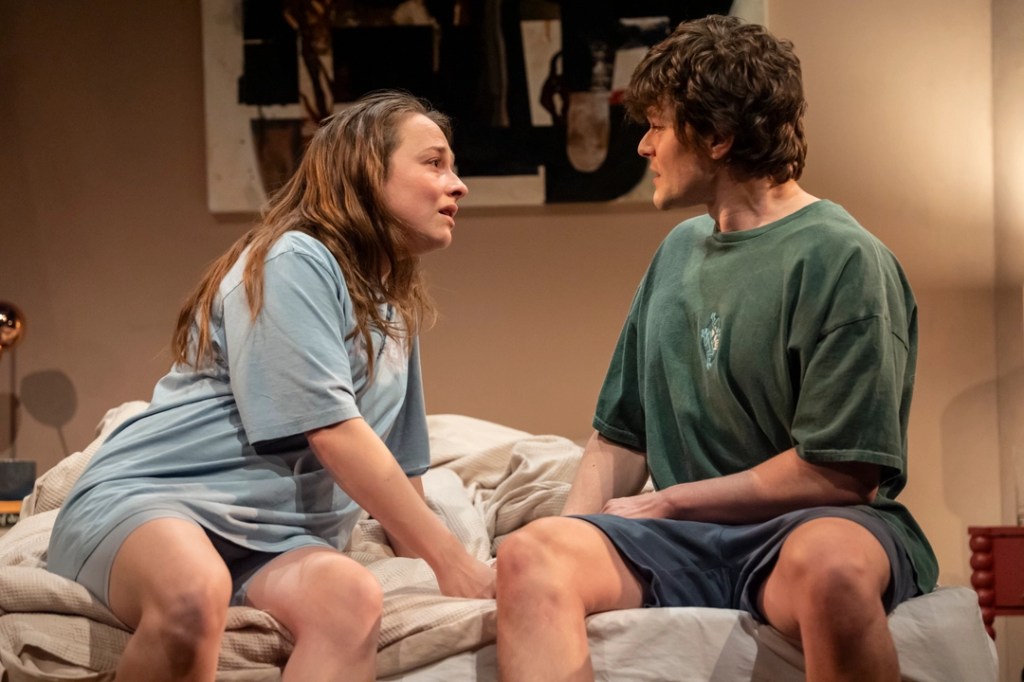
The first show in the Royal Court’s much-anticipated 70th anniversary season sets high standards. Luke Norris’s new play is a two-hander, with a brief appearance by a third performer, set in cramped interior spaces, but it fills the main stage effortlessly. It concerns a couple, played by Rosie Sheehy and Robert Aramayo, going through the emotional pressures that come with trying to have a baby. It is difficult to write about the plot of ‘Guess How Much I Love You?’ without giving key events away, but it is fair to say that things do not go as they had planned. The play has an intensity to it with is rarely seen on stage. Played in the corners of a series of rooms – their flat, a hospital room, a doctor’s examination room – there is both a claustrophobia and an ordinariness to their experiences, especially as Grace Smart’s sets make these corners just a little tighter than ninety degrees. The walls are closing in on them.

The pair, unnamed, are ordinary too, but Norris’s writing pulls apart what ordinary means. The initial tensions in their relationship – for example over whether porn is exploitative or not – hint at Sheehy’s resentment of the role she is already playing, as she waits, pregnant, mid-ultrasound. As events spiral, the pair are faced with impossible moral choices and the way they treat each other becomes brutal in a deeply uncomfortable way. There is more than a hint of ‘Who’s Afraid of Virginia Woolf’ about the deep levels of love/hate played out on stage in scenes which seem too private for us to be watching. However, there is more emotional truth in the play than in Edward Albee. Although they say the most appalling things, it is entirely believable that people in their situation would react the way they do. The horror of living has rarely been exposed so honestly.

Jeremy Herrin’s direction brings out two very powerful pieces acting from Aramayo and Sheehy. He is patient, defensive, desperate and unable to cope. She is a ball of grief and pure anger. Rosie Sheehy will surely be in the running for awards for her performance, which is simply extraordinary. She is incredibly vulnerable in her deep distress, and there are a couple of moments when she completely lets go, with speeches that are difficult to hear and impossible to turn away from. Her commitment is total.

‘Guess How Much I Love You?’ is a lean and brilliant play, with an unwavering focus on the nature of love, what happens when it goes wrong, and how people really behave in a crisis. Norris also weaves in themes of religion and gender roles in a way that feels natural. There is a particular moment in the play that makes the audience’s hearts drop as though they were an express lift, but the entire evening is an unrelentingly intense experience. A play which pushes the capacity of theatre to communicate to its limits is the perfect start to the year for the Royal Court.

The Dead

Photo by Kathleen Holman.

The Dead by James Joyce, presented by the Fourth Choir – Wilton’s Music Hall, London

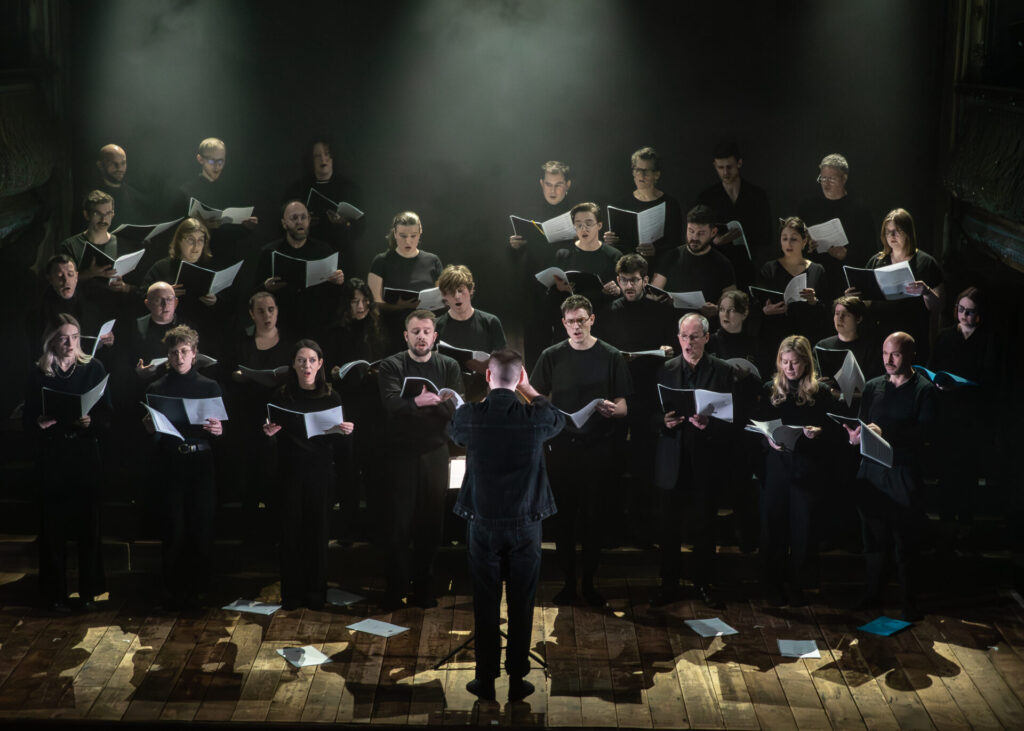
The combination of Justine Mitchell, reading an abridged version of James Joyce’s peerless story ‘The Dead’, and the Fourth Choir singing pieces interspersed into the text, is a remarkable success. This is partly because the singers are exceptionally good. Led by James Powse, they are a queer choir consisting partly of trained singers, partly amateurs. They must be as good as a choir with an amateur element can get. With around thirty singers performing in the intimate Wilton’s Music Hall – which is perfect for the piece – there is absolutely nowhere to hide, and they are flawless.

The singing is beautiful, and successfully connected to Joyce’s writing. ‘The Dead’ is underpinned by music, including discussions of choir politics and of the folk song ‘The Lass of Aughrim’, one of the pieces performed, and one of several arranged by Powse. These also include ‘Bid Adieu’, the only song written by Joyce – both words and tune. Christmas pieces are included, ‘The Dead’ being set at a Twelfth Night party. Justine Mitchell does an excellent job as the narrator, wearing a dark green period dress and looking thoroughly Edwardian.

However, the evening only works because its elements are so expertly stitched together by the director, Séamus Rea, who has also adapted the text. He creates small but effective interactions between the choir and Mitchell. They hand her the pages she reads from, and form an attentive party crowd. They occupy the stage in shifting patterns that create visual interest, and even their phone-lit entrance has a surprising impact. The whole evening, being concerned with continuing presence of the dead in the lives of the living, is unsurprisingly moving – and performed to a very high standard. As Mitchell and the choir cast their pages into the air, to fall like the snow that is general across Ireland, few dry eyes are left dry.

Playboy of the Western World

Playboy of the Western World by J.M. Synge – National Theatre: Lyttleton

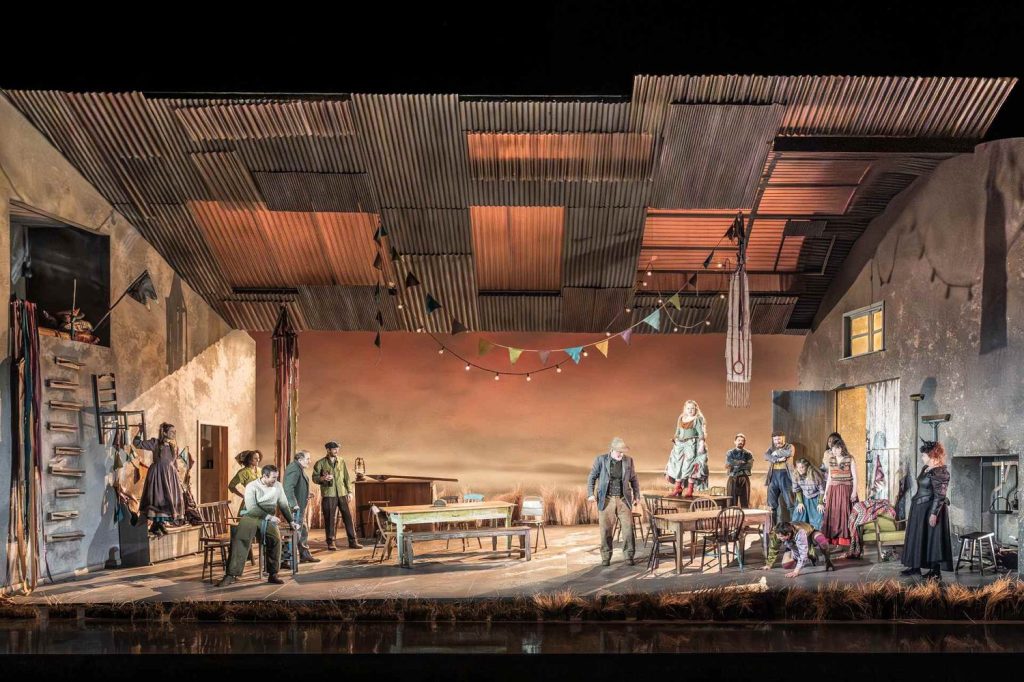
Caitríona McLoughlin’s production J.M. Synge’s masterpiece seems to be the first at the National Theatre since 1976, which is extraordinary. The play, once a staple of amateur dramatics, has perhaps become a little forgotten in the UK, although not in Ireland. McLoughlin is the artistic director of the Abbey Theatre, Dublin, and brings an all-Irish cast to London to familiarise new audiences with a play that once caused riots.

Synge’s writing is remarkable – both deeply lyrical, with a powerful ear for speech patterns in the west of Ireland, and blackly comic. Both must have been revelatory for 1907, when the play premiered in Dublin. The play is populated entirely with people of no social consequence living in a poor, even despised part of the country, but Synge makes their language a thing of beauty. It’s set in a pub, where characters talk in a way they might not elsewhere. At the same time, he punctuates the play with the kind of comic violence – Old Mahon, who just won’t die – which seems remarkably modern. Playboy could be seen as the origin play for the subsequent century of Irish drama, from Friel and to McPherson to McDonagh.

McLoughlin, on a widescreen set by Katie Davenport, gives the production life and movement, if not always consistency. The cast is fascinating, but offers a range of peformance styles that do not always gel. At one end of the scale is Siobhán McSweeney’s urbane Widow Quin, giving it her all when trying her luck with Christy Mahon, but experienced enough to let it go and change tack too. At the other end is Lorcan Cranitch’s Michael Flaherty. Cranitch gives a performance that threatens to steal the entire play. In a very thick Mayo accent, he builds up to a dramatically drunken entrance on his return from a wake where “You’d never see the match of it for flows of drink.” He plays an entire scene while in a highly unbalanced state, constantly threatening to topple over, and the audience cannot look away. It is a complete tour de force. However, the contrasting performances do illustrate the production’s inconsistent tone.

Elsewhere, Éanna Hardwicke is extremely unnerving as Christy, gurning and almost slithering around the set. He leaves the audience unsure whether he’s a fool or a cunning chancer, or whether he’s sincere. Nicola Coughlan is fierce and charming as Pegeen Mike, but perhaps lacks the presence the part demands, to dominate a barroom full of people. However, her final scene, howling on her knees as Christy departs, is chilling. Marty Rea’s Shawn Keogh exudes weakness from his apologetic frame, while Declan Conlon is excellent as a domineering, physically threatening Old Mahon. The supporting cast are strong, especially the gaggle of local girls led by Marty Breen as Sara Tansey and Fionnuala Gygax as Honor Blake.

Despite some reservations, however, the play is fascinating and entertaining and very much reconfirming its classic status. The themes around easy celebrity and fickle popular opinion seem extremely current, while Pegeen Mike’s sexual independence, and the unashamed interest of women in sex, which triggered the 1907 riots, is refreshing and seems well ahead of its time. And Synge’s language remains a thing of wonder. Its dense wordplay makes no compromise whatsoever for the watching, listening public and, as a result, draws them deep into a parallel world. Playboy remains thrilling after all these years.

Twelfth Night

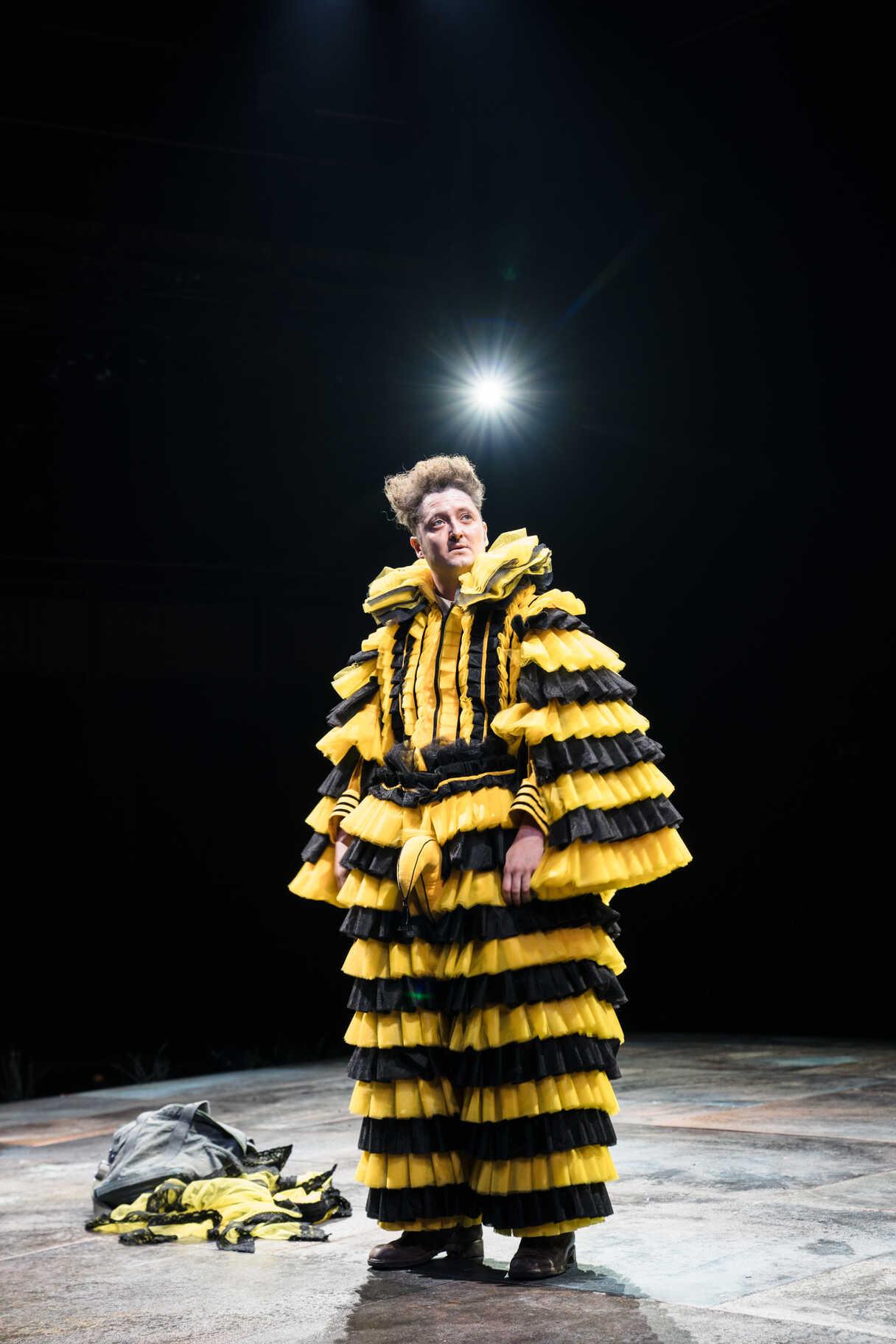
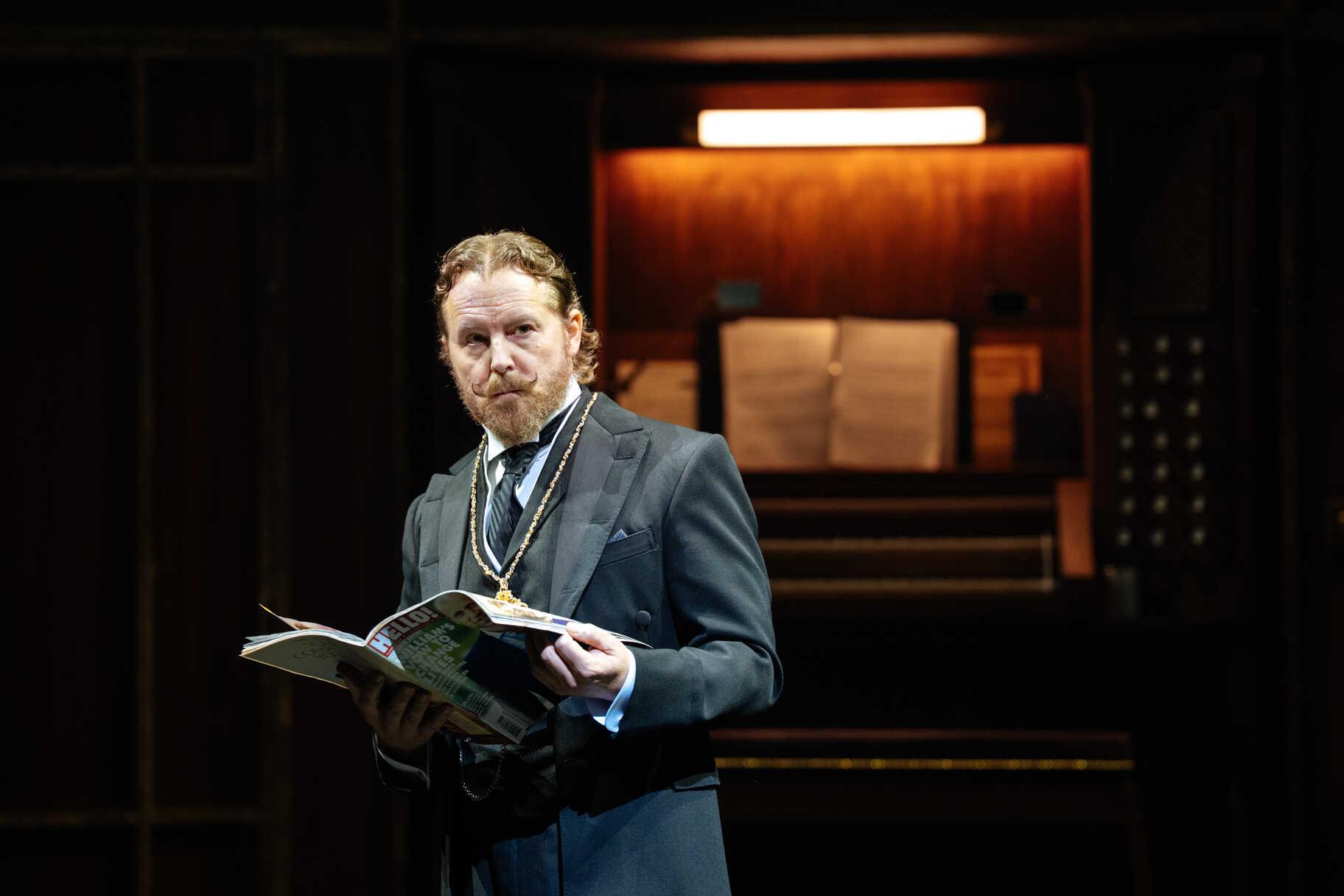
Michael Grady-Hall, Gwyneth Keyworth and Samuel West. Photos by Helen Murray.

Twelfth Night by William Shakespeare – Barbican Theatre, London

Prasanna Puwanarajah’s production of Twelfth Night is a fascinating combination of genuinely funny comedy, and the underlying darkness that hangs over the play. There’s greater emphasis on the comedy though than in many productions, driven by the central figure of Feste, played with great presence by Michael Grady-Hall. He opens the evening, descending on a wire playing a guitar and singing, and takes a prominent role as intermediary between the stage and the audience. His post-interval audience interaction – an extended game of catch – goes on much longer than most performers could get away with, but no-one resents it. Dressed like a bumble bee in one of James Cotterill’s entertaining costumes, he performs a number of impressive physical turns but also spans the melancholy elements of the play, bringing tears to the eye with his performance of the play’s songs.

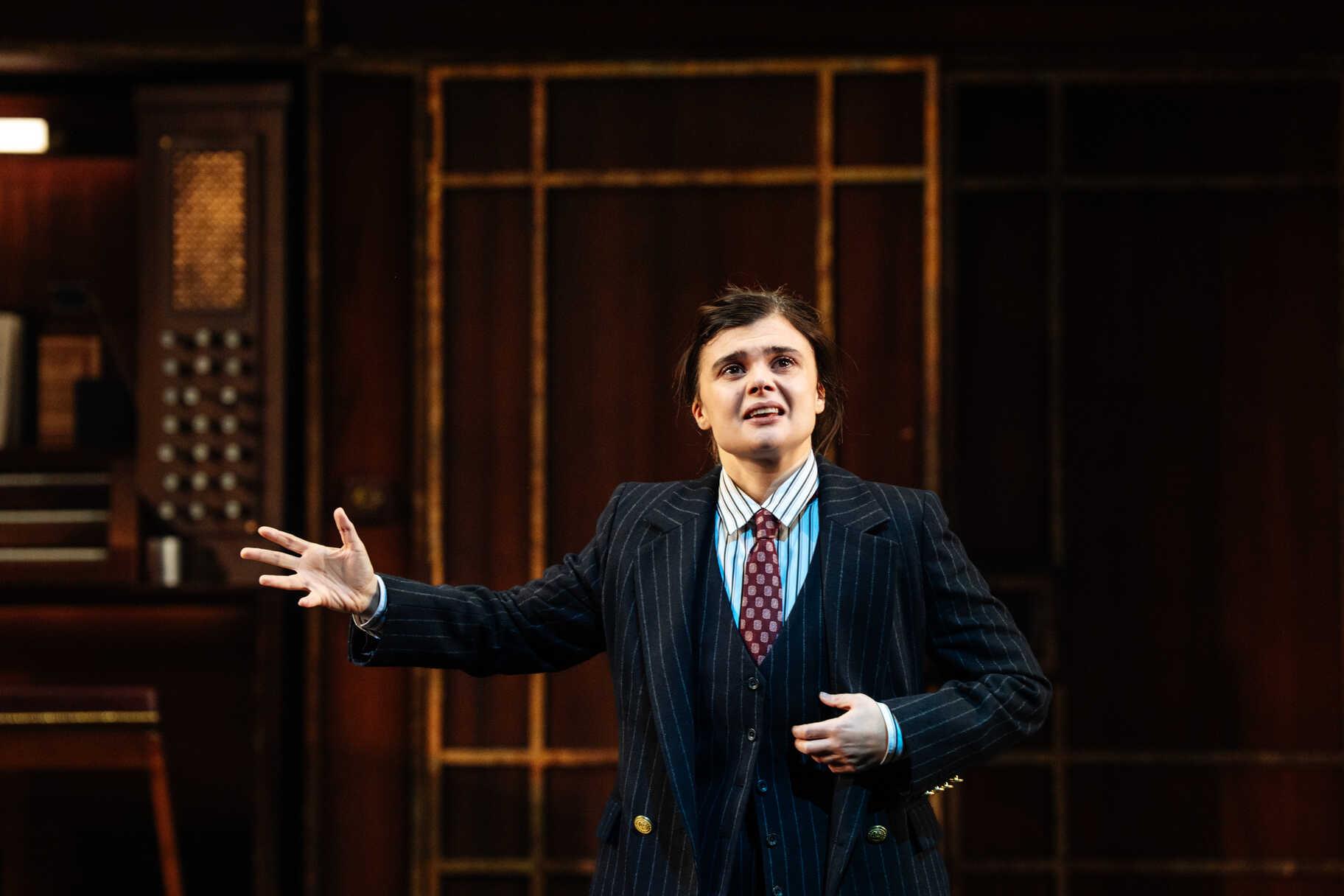
The production has a strong cast, offering distinctive interpretations. Gwyneth Keyworth’s Viola is no-nonsense, but rapidly flustered at the idea of dressing as a boy. Daniel Monks brings a certain incel quality to an Orsino with an edge. Joplin Sibtain’s Toby Belch is a tragic figure destroyed by alcohol, tall and lurching like a 1970s French House drunk. Danielle Henry makes Maria the character in the play you would actually want to spend time with, sharp and human. Freema Agyeman was off the night I saw the play and, annoyingly, her excellent understudy as Olivia was not identified, either in the theatre or through my subsequent enquiry to the RSC press office.

Sam West’s masterful Malvolio adds complete assurance to the production. He is one of those performers whose presence makes the audience relax, ready to sit back and enjoy his skills. He takes the character from chippy to hilarious – a ludicrous cross-gartered scene – to alarmingly vengeful, as though it was a natural character arc. Played against James Cotterill’s surreal giant church organ set, Puwanarajah delivers a show that fully understands of the humour and complexity of this strange but irresistible play.

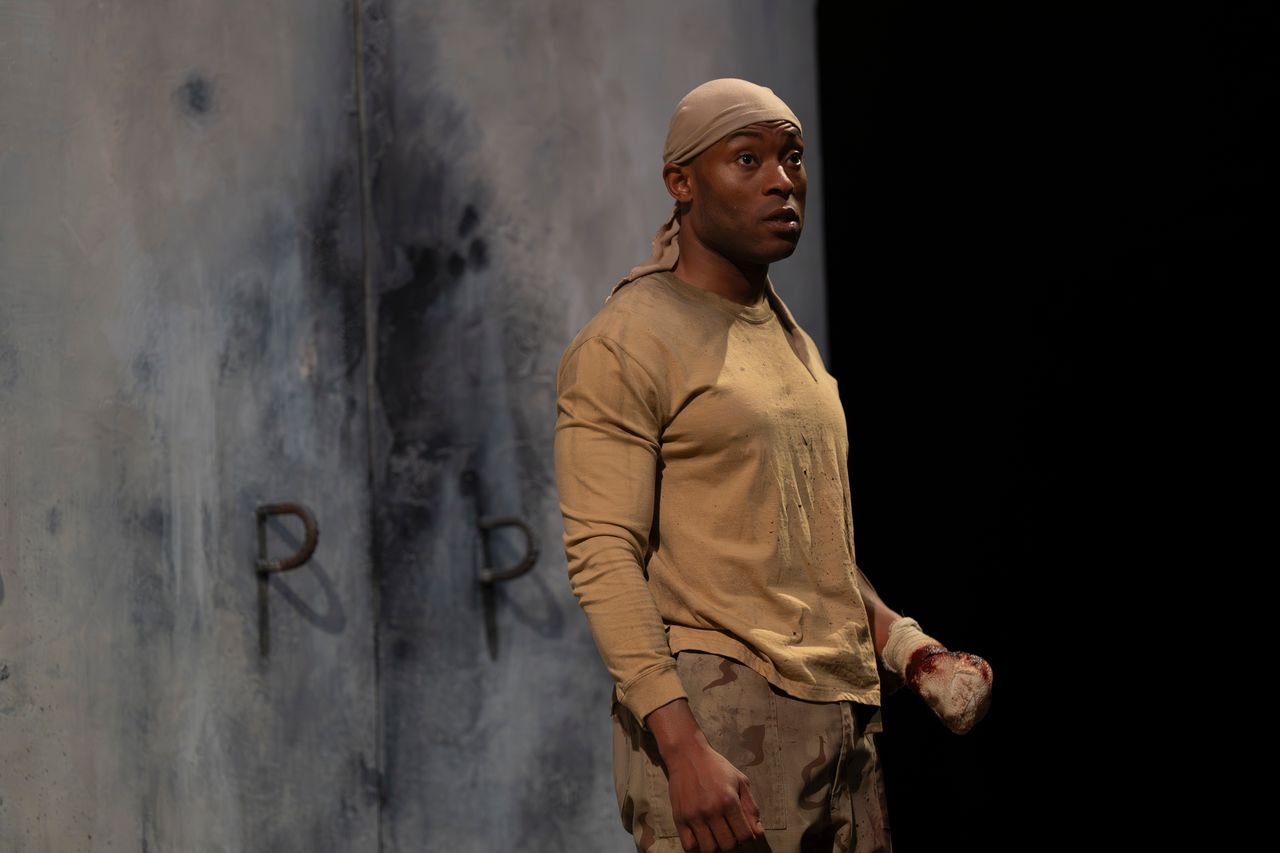
Bengal Tiger at the Baghdad Zoo

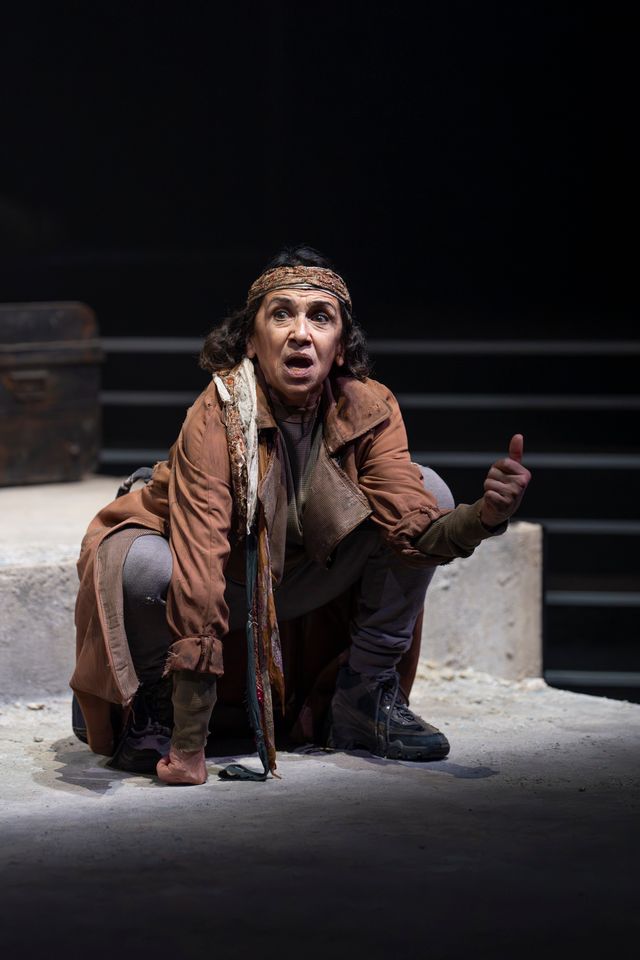
Arinzé Kene and Kathryn Hunter. Photos by Ellie Kurttz .

Bengal Tiger at the Baghdad Zoo by Rajiv Joseph – Young Vic, London

Published at Plays International

Rajiv Joseph’s play, which premiered in Los Angeles in 2009, is revived by Young Vic artistic director Nadia Fall as part of her first season. It deals with a world at war, physically and culturally, but the context is the US invasion of Iraq, now more than 20 years ago. It is obvious why Fall, and director Omar Elerian, think ‘A Bengal Tiger at Baghdad Zoo’’ may have something to tell us, nearly a generation on, helping us reflect on how little we seem to have learned from the mistakes of the past.

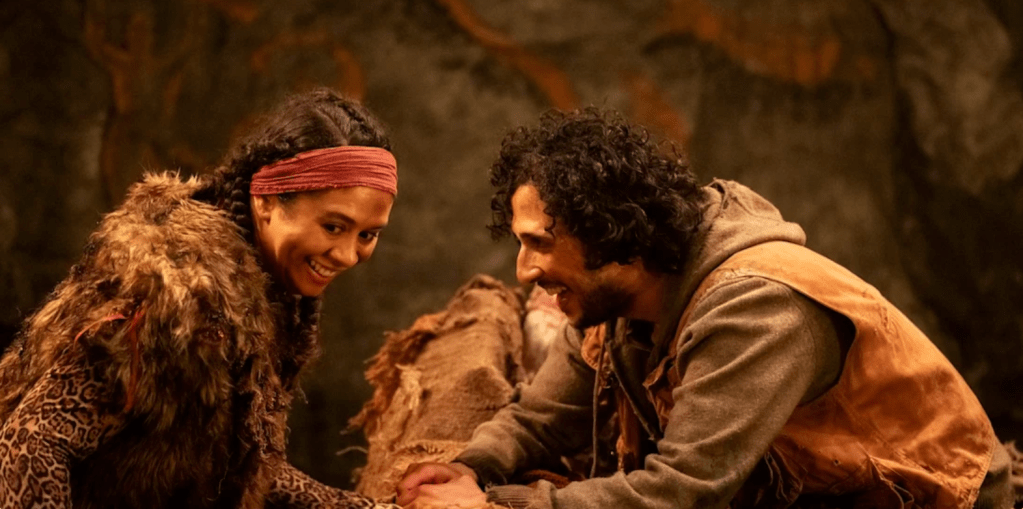
The show opens in the ruins of Baghdad Zoo, illuminated by the scope torches of two US soldiers, Tom (Patrick Gibson) and Kev (Arinzé Kene), as they discover a tiger still prowling its concrete enclosure. The tiger, played by Kathryn Hunter, has a better perspective on humans and war than any soldier, or indeed the lions of whose intelligence she takes a very dim view. Soon, Kev has shot her dead after she takes off Tom’s hand, and she begins an afterlife, inhabiting the play as a ghost. ‘A Bengal Tiger…’ is a reflection on war and conflict, with hefty doses of both brutality and absurdity. In some ways it is an old-fashioned play, reminiscent of non-naturalistic post-war dramas such as John Arden’s ‘Sergeant Musgrave’s Dance’. Its characters are types, rather than individuals, representing different aspects of a conflict which, deeply controversial at the time, has come to seem less forgivable with each passing year.

The two soldiers are at the heart of the play. Patrick Gibson plays Tom with obnoxious conviction as shallow, aggressive and avaricious, coveting a gold gun and a gold toilet seat looted from the palace of Uday Hussain, Saddam’s son. Arinzé Kene has the better part as Kev, who is staggeringly naïve and child-like, and he inhabits the role in a way that seems almost eerie at times. The play is very episodic, moving between set pieces. Uday himself makes several appearances as a ghost, having been gunned down by US troops, and is played with triumphant glee by Sayid Akki, whose stage presence is remarkable for an actor with only two previous credits in his CV. Ama Haj Ahmad, as Uday’s gardener Moussa, now working as translator for the US military, brings humour and despair to his role in equal measure.

The titular tiger was to have been played by David Threlfall, who had to temporarily withdraw with illness. Kathryn Hunter stepped in at the very last moment, to the extent her lines are provided on monitors in the auditorium, but you would never know it. In a cast that is uniformly excellent, her charisma stands out in a way that captivates the audience. She uses her physicality with apparent ease to embody a tiger, casually twitching her tail, while conducting an annoying existential debate with the audience about moral responsibility. She has real star power.

While the cast give their all, and director Omar Elerian powers the play along, it is nevertheless flawed. Some grim scenes that illustrate the horrifying impact of the conflict, and the brutal Hussain regime, on everyone from teenage girls to soldiers, leave us in no doubt about the war. Joseph is scathing about the arrogance and venality of the US troops, and the sinister love of torture exhibited by Uday. However, the philosophical commentary offered by the tiger, and the metaphysical elements of the play seem overblown and lacking in depth, while the episodic nature of the narrative reduces it to a set of show pieces. Hunter’s late casting is fortunate, because the play would otherwise feature just two women in bit parts, as a sex worker (Sara Masry) and a mysterious leper (Hala Omran). The appearance of the latter, singing an atmospheric but untranslated Arabic lament, seems like superficial cultural exoticism.

Rajha Shakiry’s broken concrete set and Jackie Shemesh’s lighting, with night scopes and ceiling fan shadows, are imaginative and effective. The Young Vic has given ‘A Bengal Tiger…’ an excellent production, but it does not make a convincing case that this is a play that stands up to scrutiny many years on, or tells us anything new about a time we risk forgetting.

End

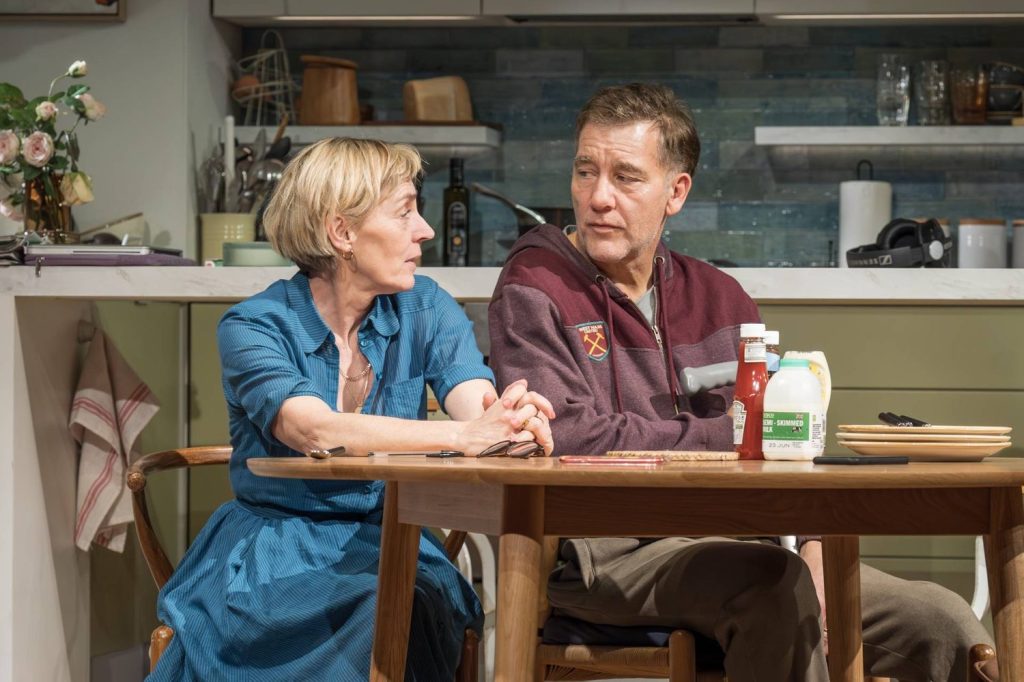
Saskia Reeves and Clive Owen. Photo by Marc Brenner.

End by David Eldridge – National Theatre: Dorfman

End is the final instalment of David Eldridge’s trilogy about a couple at different life stages, which began with Beginning in 2017, then Middle in 2022. It brings Saskia Reeves and Clive Owen together, recalling their 1991 incest film drama Close My Eyes. Gary McCann’s set is full of details which make it clear that Alfie and Julie are a 90’s couple – CDs, DVDs, a hi-fi. Alfie is a DJ who, in the opening lines of the play, is diagnoses with terminal cancer. Owen and Reeves create a fully convincing married relationship, still close despite a history that, as the play unfolds, is revealed to be less than smooth. Eldridge’s writing takes a straightforwardly narrative approach, documenting the pair as they wrestle with the decision about whether to continue with chemotherapy. Their daughter, who is coming round that night but never arrives, is the focus of their dilemma – whether to buy more time at the cost of a reduced quality of life.

Rachel O’Riordan’s direction gives dynamism to what is essentially a long conversation between the pair. Clive Owen conveys the sense of a man used to people, including his partner, deferring to him – even in the context of his funeral playlist. Saskia Reeves, a writer, comes into her own as her power in the relationship is gradually revealed, and her ability to interpret what is happening to her through fiction, becomes apparent. The play is not revelatory – there is little in here that is not familiar – but the experience of Generation X characters facing death is, in itself, new. Eldridge also uses very specific London geography well – the annoyance of having to change between Forest Gate and Wanstead Park to reach the cemetery for example – to convey the sense of real relationship, happening in real time.

Porn Play

Ambika Mod and Lizzy Connolly. Photo by Helen Murray.

Porn Play by Sophie Chetin-Leuner – Royal Court Upstairs, London

Published at Plays International

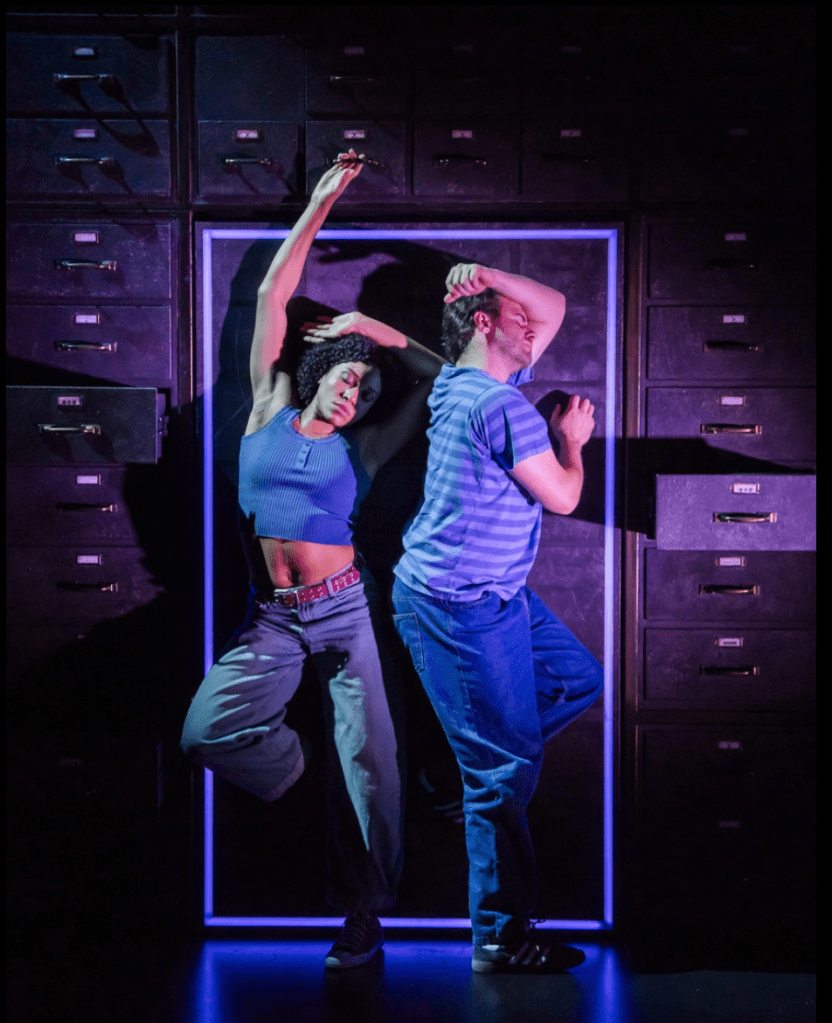
Yimei Zhao, the designer for Porn Play, has upholstered the entire Royal Court Upstairs space in soft beige furnishings which spread from the stage out over the audience benches. It is simultaneously cosy and oddly creepy, especially when characters start reaching down into the cracks between cushions to pull out props – laptops, phones, pillows, even the giant paper towels that cover GP’s examination tables. The image of a cocoon that is not as cosy as it seems fits the subject matter of Sophia Chetin-Leuner’s play perfectly. Her drama deals with a young woman’s addiction to pornography: specifically porn based on violence to women.

The central character Ani, played by Ambika Mod, is a rising academic star who has just won a prestigious prize for her new book, on Milton’s Paradise Lost. On the surface everything is going brilliantly for her, but almost immediately her private obsessions get in the way of her happiness. Her inability to relate sexually to her boyfriend Leo (Will Close) without watching videos of women being humiliated drives him away from her. At the same time, the gender power balance seems to lie behind her increasingly self-destructive urges. The passive aggressive suggestions that she has it easy, and that her achievements are not on the same level as the men begin with Leo, and escalate throughout the play.

Chetin-Leuner has chosen a fascinating, and wildly uncomfortable theme for her Royal Court debut. The prevalence of pornography in society is a major contemporary concern, but the debate generally sees men and boys as users, and women and girls as victims. Porn Play turns this on its head by examining female sexuality through pornography, including the revealing information that women are much more likely to search for violent porn. Ani reacts angrily when challenged, refusing to let anyone else shame her for her sexual preferences, but it becomes increasingly clear that she is not in control of her choices, as her life and mental health disintegrate around her. How has this happened? Is it tied in some way to the normalisation of sexual violence in the male authors she teaches? One of her students confronts her in her office to complain that she is enabling John Milton in glamourising rape. Or is it connected to her mother’s death when she was a teenager?

Josie Rourke’s production brings the best out of a highly versatile and entertaining cast who play numerous parts, and give the show a lot of energy. The performers move well together in a small space, with Wayne McGregor, no less, the show’s choreographer. Lizzy Connolly is excellent, switching constantly between roles and playing a sort of fantasy muse who manages scene changes in between. She is very funny as Ani’s sleepover friend, who is all “It’ll be ok, babes, you’re overthinking it”, before Ani’s masturbation forces her to sleep on the couch. She is equally funny parodying a GP talking in NHS style, who becomes a sexual predator as Ani tunes out of reality and into fantasy. Will Close is similarly versatile, needy and passive aggressive as Leo, and entirely different as a cocky student who gets worrying into the idea of tying Ani up and humiliating her. Asif Khan is awkward and clumsy in a ‘dad’ way as Ani’s father, and very moving as a result. He is also horribly hilarious as a misogynist academic.

Ambika Mod is the only performer to play a single part, and is on stage throughout as Ani. It is essential that we believe her, and she does a very convincing job of making her porn addiction seem credible. She also plays some of the most excruciating scenes imaginable, from frequent masturbation to a GP examination, and a scene with her father towards the end which redefines embarrassment. She brings a fine balance of confidence and vulnerability to the role, pulling the audience along with her to places they really do not want to go.

Porn Play is a fascinating piece because it looks at female experience from an entirely unexpected perspective. There are complex questions for society to address around what we are doing to women. The porn boom is era-defining, potentially shaping the expectations men have of women, and their future personal and social relations, but we do not know as much about what it is doing to women. Does it liberate or constrain? Is it reprogramming women’s expectations of themselves? Perhaps porn is just another tool men use to put women in their place, like the academic gender hierarchy, and the literary canon of abusive male authors.

All these issues are raised, although there can be no definite conclusions, and the play is as much about addiction as gender politics. It does trail off a little, as Ani enters the trajectory of an addict, pushing away everyone around them – a story that seems much more familiar than what has come before. This is where the relationship with her father becomes central, and the scenes in which he tries desperately to connect with her are very moving. Porn Play is a timely and involving show, with a fine young cast, and an author with fresh, compelling perspectives to offer.

The Line of Beauty

Photo by Johan Persson.

The Line of Beauty by Alan Hollinghurst adapted by Jack Holden – Almeida Theatre, London

Alan Hollinghurst’s much-loved novel, The Line of Beauty, won the Booker Prize in 2004. Looking back to the rise of Conservative politics in 1980s Britain, and the parallel AIDS crisis, it explored gay life and consciousness through the eyes of ingenue Nick Guest, who learns a lot in a short space of time. Now, adapted by Jack Holden and directed by Michael Grandage, it reappears two decades later on the Almeida stage.

Adapting novels as plays can be a thankless task, especially when they’re well known, but Holden does a good job in not allowing the book to kill the drama. Covering the period between the Conservative victories at the 1983 and 1987 elections, the play dramatises the collision of personal and political from the perspective of Nick, played engagingly by Jasper Talbot and his experiences in love, and while lodging with the family of a Conservative MP. Performances are universally strong, and Grandage’s production is very tightly delivered. Alistair Nwachukwu gives a standout performance as Nick’s first lover Leo, charming, clever and vulnerable. Arty Froushan, as cocaine-snorting playboy Wani, Charles Edwards as smooth, fatherly MP Gerald Fedden, Robert Portal’s menacing Badger, and Ellie Bamber as bipolar Cat Fedden are all excellent performances. Hannah Morrish channels the demeanour of Fergie in a way that is both hilarious and disturbing. Doreene Blackstock, as Leo’s mother, and Claudia Harrison as Gerald’s wife are also very strong, but their roles are rather limited – a problem with both book and play. The staging is sumptuous – sets and costumes by Christopher Oram – who has clearly delighted in recreating and subtley parodying the high society 1980s with its odd combination of frumpiness and glamour.

Some of the more literary aspects of the book get a bit lost in the dramatisation, such as the thematic significance of Henry James and of the ogee, a shape which swings both ways. What is more significant is how much of a period piece the play feels. Hollinghurst was writing about a period 20 years earlier, a time now approaching half a century from the present day. The key issues of the time – homophobia, social conservatism, privilege and the devastation wrought by AIDS should not be forgotten, but are not undiscussed. The play offers a highly professional and entirely entertaining evening, but it is unclear exactly why this novel needs to be staged at this particular moment.

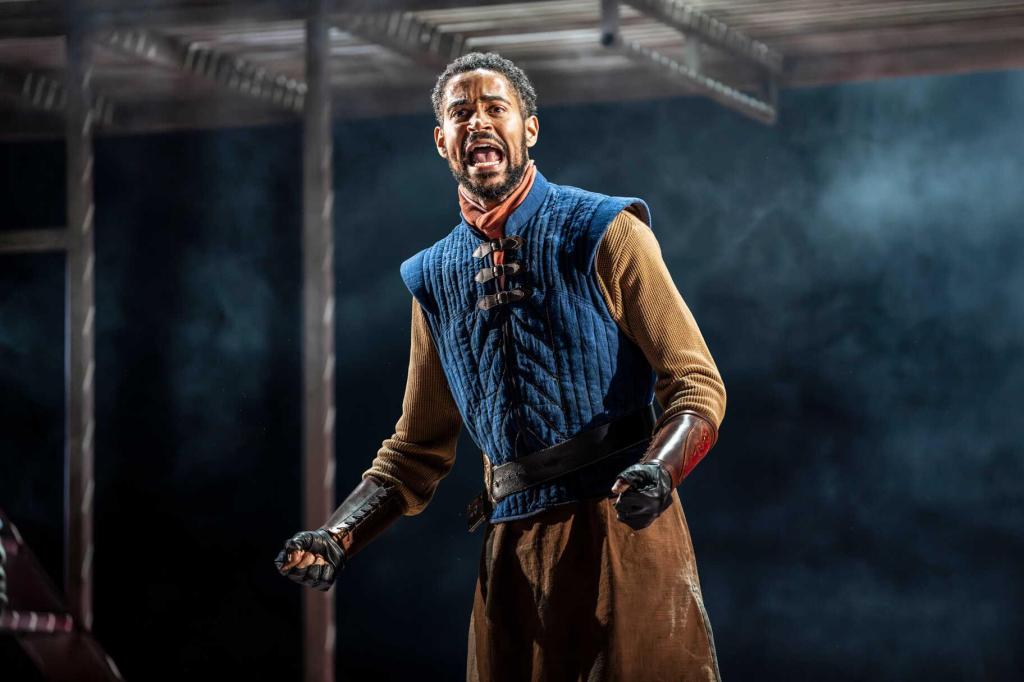
Cyrano de Bergerac

Photo by Marc Brenner.

Cyrano de Bergerac by Edmond de Rostand – Swan Theatre, Stratford-upon-Avon

Simon Evans’ production of Cyrano is a very convincing and enjoyable account of a play which stands up well to re-examination. Evans has also adapted the play, with Debris Stevenson, giving the language a contemporary flavour without undermining the period setting, in a fantasy 17th century France. The play is held aloft by an exceptionally strong case who bring a notable level of star wattage to the stage. Adrian Lester, as Cyrano, exudes leading man skill and control, to the extent that at times he reminds us of Derek Jacobi, who triumphed in the role at the RSC for Terry Hands in the early 1980s, and at others of Simon Russell Beale. Cyrano is a part that requires a dashing, confident, yet vulnerable performance, and Lester provides this with apparent ease. He is brash in the tavern scenes, charming with Roxanne, conflicted with love rival Christian and, in the play’s final scene, when he drops the letter he is reading, supposedly the last missive of the dead Christian, and recites it to Roxanne from memory, devastating. Up until this point the play has been hugely entertaining, but it is this culminating encounter which makes it something special. The play’s emotional weight all builds to this moment of revelation, as Roxanne realises he has loved her all along, and Cyrano realises the same. There is not a dry eye in the house.

Lester’s triumphant performance helps create the conditions for the whole cast to shine brightly. Susannah Fielding, as Roxanne, is exemplary – riding a wave of breezy, charming detachment until her emotions catch up with her. Her outrage at discovering she has been deceived by Cyrano all along unleashes a fascinating cascade of conflicting impulses. Levi Brown is excellent as a casuallly insulting Christian de Neuvillette, cocky and doomed. Scott Handy’s Comte de Guiche is very funny, appearing to belong to a parallel aristocratic world where nothing quite makes sense to him. And Greer Dale-Foulkes makes Abigail, Roxanne’s companion, a very amusing comic adjunct to the action.

Performed on Grace Smart’s sets of torn posters, worn plaster and red velvet curtains, the play fills the Swan stage as though written for it. Evan’s has conjured a hit, somewhat old-fashioned – in a good way because it successfully revives a classic for a new generation without significantly remaking the play. It’s a significant achievement, and makes for a very satisfying evening watching very good actors show us their skills.