Re-Member Me

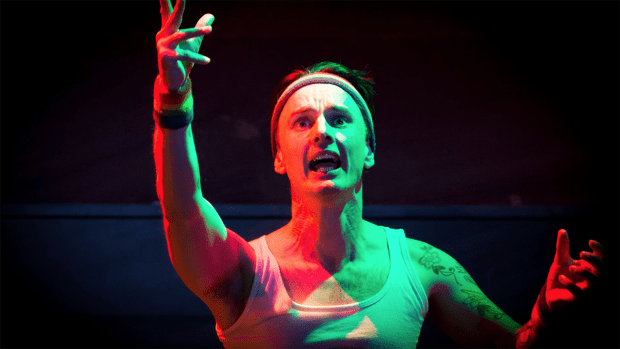
Dickie Beau © Robin Fisher

Re-Member Me by Dickie Beau – Hampstead Theatre, London

Dickie Beau’s one-man show is an original, charming and clever project. The evening is presented as a theatrical history of, or meditation on, Hamlet and those who have played him. In fact, it is a more a queer history told through the medium of Hamlet. Beau, in full Chariots of Fire running gear plus rainbow headband, is a very appealing stage presence, drawing us into his research – a series of interviews with some of those who worked front and backstage at the National Theatre in 1989. The date is significant because it is when Daniel Day-Lewis dropped out of the lead role in Richard Eyre’s production of Hamlet, still a somewhat notorious theatrical event. But, while this remains well remembered, his replacement by Ian Charleson, of Chariots of Fire fame, who went on to give the performance of his life – perhaps the best Hamlet of them all – while suffering with AIDS and only months from death, seems to have faded from memory, Charleson was the first celebrity whose death was publicly acknowledged to have been caused by AIDS, and his Hamlet an unforgettable experience for those lucky enough to see him, and a social milestone.

Beau’s role in bringing this ignored history to the stage is as an interpreter, not least because he is a lip-sync artist. He takes this obscure stage technique and makes it sing, sliding effortlessly into the words and personalities of interviewees including a hilarious John Gielgud, and Day Lewis’s dresser. The way he channels long-departed characters is almost spooky, and deeply impressive. His interview material is full of insights, including the dresser slipping the cloak from Day Lewis’s shoulders as he weeps in his dressing room to give to a white-faced Jeremy Northam, going on halfway through the show. The one-night only production of ‘Bent’ staged to launch Stonewall, with a heroic performance from an ailing Charleson, is recreated from the memories of those who were present.

The structure of the show lacks a little clarity. A significant amount is pre-recorded and shown on screens, where four Beaus voice conversations about Charleson’s Hamlet between characters including Richard Eyre, Ian McKellen and Sean Matthias. While these play, Beau himself seems wasted as he rearranges the stage, while the screen has similarly to be kept occupied when he is performing live. The Hampstead Theatre’s broad stage is not the ideal setting for a show that would set a smaller venue alight. But it is hard to hold this against a show that manages to be so likeable and funny while performing an important service in educating a new generation about recent history, so quickly forgotten. But Beau, who voices ‘Withnail and I’s Uncle Monty to acknowledge that he “will never play the Dane” should put himself front and centre even more, performing live. He may not be Hamlet, but the audience loves him.

August in England

Lenny Henry. Photo by Tristram Kenton.

August in England by Lenny Henry – Bush Theatre, London

August in England is Sir Lenny Henry’s first play, a one man show which he also performs. As August Henderson, who arrived in London from Jamaica with his mother at the age of eight, he has no difficulty winning the audience over. It’s no surprise that Henry is a charismatic performer, but keeping an audience engaged and entertained for 90 minutes is not easy. To be debuting as a writer/performer at the age of 64 marks an impressive next chapter in a career that continues to fascinate. He just keeps on getting better. The story he tells, of a life threatened by the Windrush scandal, in which the Government’s ‘hostile environment’ policy deported and attempted to deport hundreds of Commonwealth citizens who had lived in the UK for decades. August is a victim, receiving demands from Capita to demonstrate his citizenship, setting impossible levels of proof, and finally being wrestled to the ground on his doorstep by immigration enforcement officers.

This part of the story comes at the very end. The majority of the play is August’s life story, growing up in the Black Country as Henry himself did. His story is funny and engaging, and Henry communicates powerfully with the audience, many of whom clearly recognise his descriptions of Caribbean family life in Britain in the 1960s and 70s. Henry is funny, and the play includes a significant amount of punchline-based material. Every anecdote is rounded off with a joke. These, while amusing, at times undermine the urgent underlying drama, especially during the denouement when August’s arrest involves an exploding shed, an uncomfortable injection of farce just as the play reaches its emotional peak. The Windrush events are also relegated to the very end of the evening. While we have great sympathy with August by that point, knowing his full life story, the balance does not seem quite right.

However, August in England is a high quality entertainment that also packs an emotional punch. August’s personal travails are raw and entirely believable, and when Henry finally breaks down it is truly upsetting. Co-directors Lynette Linton and Daniel Bailey end the show with a series of short video interviews with real Windrush victims, which opens the show up, taking it beyond social history and showing us the brutal and disgraceful reality. The ‘hostile environment’ continues to shame the UK, and Henry plays an important part in revealing the human cost of inhuman government policy.

Hate Radio

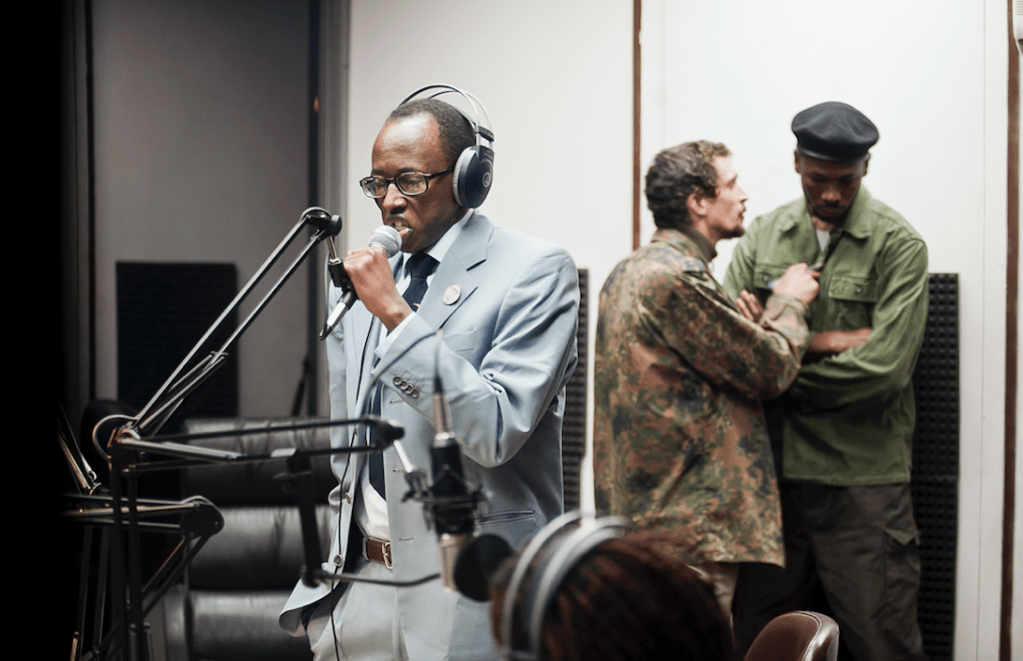
Photo by Daniel Seiffert

Hate Radio by Milo Rau – Battersea Arts Centre, London

Milo Rau’s Hate Radio takes us into the heart of the Rwandan genocide of 1994, when Hutus rose up following the assassination of the President, and slaughtered their Tutsi neighbours using whatever they could lay their hands on. Thirty years on it remains one of humanity’s darkest episodes. As a character in the play notes, it is not just that ordinary people – a priest’s son for example – became enthusiastic murderers, but that they went to extraordinary lengths to torture, rape and mutilate their victims. Up to 662,000 people died.

Orchestrating the killing from an office building in the capital, Kigali, was RTLM (Radio Télévision Libre des Mille Collines) a pro-Hutu radio station which denounced Tutsis as ‘cockroaches’ and broadcast details of their whereabouts so vigilantes could find and kill them. Rau’s play sets the scene with filmed testimony from four genoicide survivors, whose accounts are jaw-droppingly terrible. Then we are in the studio, during an hour-long show with three hosts and their MC/link man, which plays out in real time. We hear the relentless pushing of hatred, the repetition of racial slurs, the historical propaganda and the lies. It is like verbatim theatre, replaying real life events in all its ordinariness and horror. It is relentless and chilling – and extraordinary. It is impossible to turn away for a moment.

The three presenters are real characters: Kantano Habimamba (Diogène Ntarindwa), Valérie Bemeriki (Olga Mouak) and Georges Ruggiu (Sébastien Foucault), all now either in prison or vanished, presumed dead. Their interplay is hosts is horribly convincing, and their voices (the play is in French and Kinyarwanda, with subtitles) pound into our heads through the headphones we wear, making the show seem both intimate and separate, just as real radio does. Some of the moments that stay in the mind pass without comment such as when Kantano, as he was known, takes off his jacket revealing that he the gun strapped to his business shirt. Or they are heart-stopping, especially when the radio show goes to a song, each track played in full. Nirvana’s ‘Rape Me’, complete with enthusiastic drumming from the presenters, is almost impossible to bear. The way Kantano dances wildly in his suit to Reel 2 Reel’s ‘I Like to Move It’ encapsulates the frenzy of killing. And the show’s sign-off song, Joe Dassin’s ‘Le Dernier Slow’, is staggeringly sinister and intensely sad. Hate Radio is a stunning piece of theatre, showing us utter evil in all its ordinariness, and delivering a timely warning. If it happened then, it can happen again.

After the Act

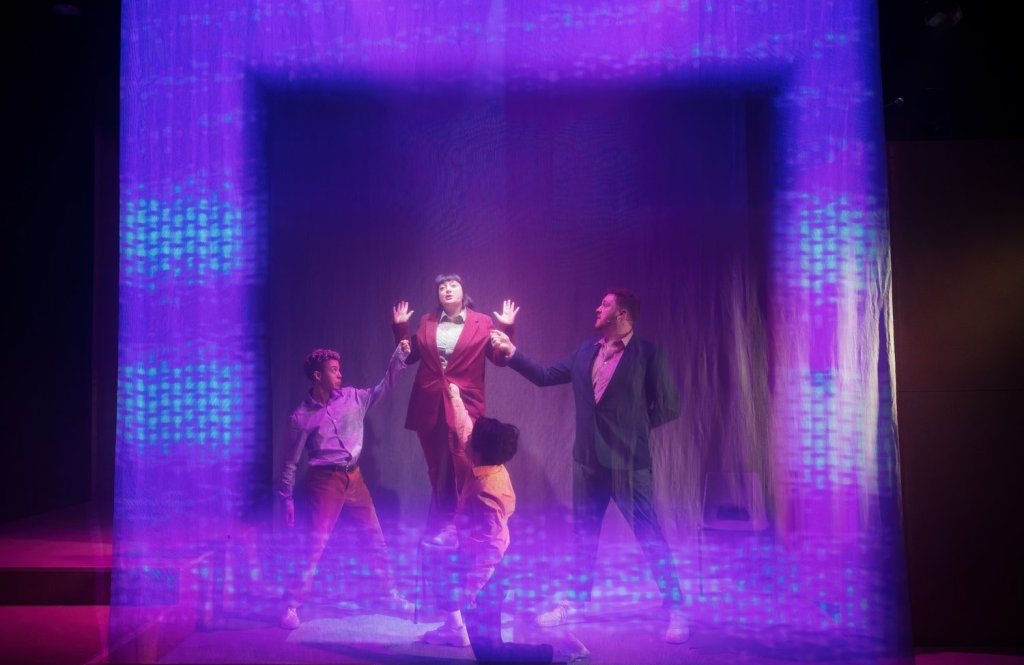
EM Williams, Elice Stevens, Tika Mu’tamir and Zachary Willis (c) Alex Brenner

After the Act: A Section 28 Musical by Breach Theatre – New Diorama Theatre, London

The New Diorama’s Intervention 01, a season with no shows during the second half of 2022 is over. Its aim was to take stock post-Covid, regain excitement, and focus resources on building ambitious work that would not otherwise get staged. On paper, it was a bold and forward thinking, but the test lies in the quality of the work that comes out of the process. Breach Theatre’s After The Act strongly suggests this was an artistically inspired move. Their musical about Section 28 – legislation passed 35 years ago by Margaret Thatcher’s government banning “the promotion of homosexuality” in schools – is a wild, moving, engaged and essential piece of theatre. It tells audiences to look much harder at their assumptions about the supposedly progressive society they live in, and does so from the throes of a brilliantly unhinged party.

Co-writers Ellice Stevens and Billy Barrett have devised a verbatim / musical / agitprop / physical theatre with strong echoes of Tammy Faye and the film Blue Jean, but with an identity all of its own. Directed by Billy Barrett the four performers, including Ellice Stevens as well as Tike Mu’tamir, EM Williams and Zachary Willis put on a high energy show. Their movement and physical occupation of the stage is beautifully choreographed, as they create the show’s all-action atmosphere by impersonating an entire dance troupe. The music, played live by composer and musical director Frew and by Ellie Showering, is synth-driven, catchy and entirely appropriate to a show about the 1980s, without entering the realms of pastiche.

While the music is highly entertaining, the show’s power comes from the sophistication of its writing, which draws on deep analysis of the circumstances around the Section 28 controversy. It’s safe to say this the first time anyone has put former Manchester City Council leader Graham Stringer’s protest rally address to music, still less the grimly bigoted Parliamentary speeches made by Conservative MPs Elaine Kellett-Bowman and Jill Knight in support of the bill. The clause stated that a local authority should not “promote the teaching in any maintained school of the acceptability of homosexuality as a pretended family relationship.” It is a shocking piece of hate that had serious consequences for some and gave rise to iconic cultural moments. The ‘invasion’ of BBC News studios by protestors is very entertainingly staged, Nicholas Witchell and Sue Lawley still gaining plaudits today for the way they dealt with those awful lesbians. The accounts of the two women who abseiled into the House of Lords debate on the bill are funny and moving. Breach Theatre also cleverly stage scenes from the pages of Danish children’s book ‘Jenny Lives with Eric and Martin’, which became a lightning rod for the fear and hatred that exploded from the bill’s supporters.

The show boldly switches mood several times. Verbatim-style scenes, including accounts of the experiences of a teenager bullied for being gay and a teacher forced to hide her real self, are powerful and make the arguments against Section 28 by themselves. The clause was only repealed in 2003, showing our society had not progressed nearly as far as people imagined by the early 21st century. Importantly, Breach also makes the link with current debates around Trans rights explicit, pointing out that it remains fundamentally wrong to tell someone they must change who they are. Unfortunately, this message remains as urgent today as it did in 1988. The show is full of invention, variety and sophistication. It is a tribute to the New Diorama’s leadership that they have found a way to support and enable work this good. After the Act is Breach’s best work to date, and an exciting leap forward for a company who have always promised much.

Farm Hall

Julius D’Silva, Archie Backhouse, Forbes Masson, Alan Cox, Daniel Boyd and David Yelland. Photo: Alex Brenner

Farm Hall by Katherine Moar – Jermyn Street Theatre, London

After the Nazi defeat in 1945, the Allies flew ten of Germany’s leading nuclear scientists to the UK. They were interned at a farmhouse in Godmanchester, near Cambridge, for six months while their conversations were recorded to discover how close the Nazis had come to producing an atom bomb. While in captivity they heard the news of the Hiroshima and Nagasaki bombs which, as holders of Nobel prizes for significant advances in nuclear technology, they had helped to enable. In January 1946 they were all released, and returned to their academic careers in Germany.

This scenario is a ready-made play, a situation where some of the greatest scientific minds of their time are confronted with the consequences of their personal and political actions. The transcripts of the Farm Hall recordings were published in the 1990s, and other plays have been produced using their contents. However, Katherine Moar’s play, which has its first full production at the Jermyn Street Theatre, makes good use of the material to create a compelling drama, in which a large cast is handled well.

Only six of the scientists are represented on stage, a sensible decision which gives each character enough room to develop. Moar boldly holds off discussing the war or nuclear weapons for several scenes, during which the men stage amateur drama, play games, bicker and try not to discuss what really matters. Reality intrudes when a newspaper reports the Soviet capture of parts of East Germany, where Bagge (Archie Backhouse)’s wife lives. The social tensions emerge between characters, and then the political ones. Support for Hitler varies among the group from disengagement (Heisenberg) to clear support (Diebner) and regret that the bomb was not built in time for Germany to use it.

The performers are an excellent group of actors, who play convincingly off one another. Julius D’Silva’s Diebner is awkward and unsociable, but likeable too, a portrait of man who convinced himself that the Nazis were essential to his career. So, in a way, did Heisenberg who Alan Cox plays with an ability to separate himself from the everyday that is both disarming and sinister. He charms his way around his leadership of Hitler’s nuclear weapons programme, leaving enough doubt about whether or not he deliberately worked to stop the bomb being made. Backhouse’s working class Bagge, a wired young man, has most to lose while his friend Weizsäcker (Daniel Boyd) is privileged and connected. Forbes Masson is the most likeable of the group as Hahne, the man who discovered nuclear fission and feels the weight of what he imagines could be 300,000 deaths at Hiroshima. David Yelland’s older Von Laue is difficult and prickly, and the most anti-Nazi of the lot.

Director Stephen Unwin manages the show effectively. He somehow makes the Jermyn Street Theatre’s tiny stage seem like a spacious living room, with plenty of room for all. Designer Ceci Calf’s dilapidated interior with semi-stripped William Morris wallpaper is very atmospheric, and neatly represents the end of a pre-war world. The heart of the play is a prolonged pause, as the cast waits for the 9pm radio bulletin with news of Hiroshima. They listen to Home Service light classical music as the minutes tick down, knowing that nothing will be the same once the clock strikes. There are no clear moral lessons from Moar’s play – the scientists did what they did through fear, expediency, selfishness and a desire to pretend everything was ok, much as people have always acted and always will. Only this time, the consequences were far greater than anything humans had encountered before.

Medea

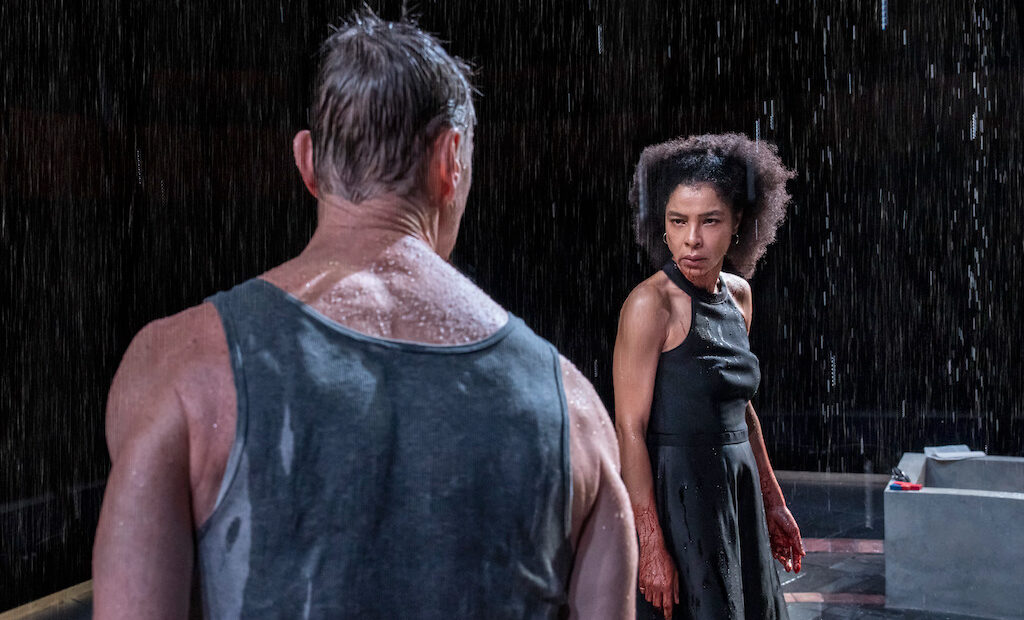
Ben Daniels and Sophie Okonedo. Photo: Johan Persson.

Medea by Euripides – Soho Place Theatre, London

Soho Place remains a strange theatre – an in-the-round jewel box concealed inside a weirdly bling office block in the new Elizabeth Line era Tottenham Court Road. Vast LED screens, gold-effect facades, low ceilings and high bar prices create an eerie setting, a non-place that belongs no more to London than to any other global city. All the more fortunate, then, that the theatre itself is the best small space in the West End, albeit with few competitors. As the setting for Dominic Cooke’s production of Medea, it could not be bettered. Viki Mortimer’s design consists of a tiled Mediterranean oval and a set of stairs that lead down to an unseen place below. Within the oval, the action takes place. Around it, consequences gather. Below, the worst deeds of all occur. Ben Daniels, playing all the male roles including Jason, Creon, Aegeus and the tutor to Medea’s sons, circles around the oval, approaching in slow motion as Medea speaks, while she is always trapped at the centre of the stage. Cooke also takes the ingenious decision to place the three actors playing the Women of Corinth, who form the Chorus, in the audience. Penny Layden, Jo McInnes and Amy Trigg interject from their seats, stand up and shout advice and eventually come up on stage, where they are reluctantly drawn into the unfolding horror.

As Medea, Sophie Okonedo is entirely herself, but also a woman whose revenge is to become what other people want her to be. The logic she applies to the decision to kill Jason’s offstage lover Glauce and then her two sons makes sense not just to her, but to us as well. She has been stripped of all power – used by Jason to climb the ladder, discarded for another woman and thrown out of Corinth with nothing. She could seek the protection of another man, Aegeus, but if everyone including her husband thinks she’s a witch and an evil influence, proving them right is the obvious course of action. Okonedo is mesmerising, fully inhabiting a role that develops agonising step by agonising step, as Medea strips away all her options until only one remains. Marion Bailey, in the Chorus-like role of the Nurse, expresses the horror at Medea’s actions which she herself is unable to feel.

Ben Daniels’ performance is just as good as that of his co-star, if entirely different. He switches roles with impressive ease, even drawing laughs for his camp Aegeus, while delivering a convincing brutal Creon and a Jason so self-centred he genuinely cannot understand what the problem is. Medea is simply there to do as he says, and trust him even as he destroys her. The test is by Robinson Jeffers, a classic translation first used by Judith Anderson and John Gielgud in 1947 which remains clear, direct and entirely modern. Cooke’s production is superb. The cauldron of ancient hatred he has set swirling behind the theatre’s glass walls brings some essential wildness to an urban landscape of surfaces. It is important that Soho Place continues to programme theatre that would not otherwise be seen outside the subsidised sector – such as Medea and As You Like It – which gives the West End some much-needed depth.

Macbeth

Macbeth by William Shakespeare – Southwark Playhouse (Borough)

Published at Plays International

It is an unusual Macbeth that comes to life with the Porter’s scene, the play’s disconcerting post-murder comic interlude – even more so when it is performed without words. Dale Wylde’s mimed scene is a weird and captivating interlude. It encapsulates the strengths and weaknesses of Flabbergast Theatre’s version, which is a powerful physical spectacle, but frequently seems encumbered by the play’s text, which gets in the way of the performers’ urge to express themselves. The company is on stage throughout, dressed in braces and sackcloth kilts and daubed with mud. As the audience arrives, they are already moving as a group, twisting and grasping at things in the air around them. This haunted atmosphere defines the show. The performers generate a powerful physical presence, driven by their commitment to a form of theatrical expression rarely seen from a British company.

Flabbergast Theatre was set up by Henry Maynard, who directs and designs Macbeth, and plays the title role. At the first opportunity after lockdown, in 2020, the new collective lit out for the Grotowski Institute in Poland to work with performer Matej Matejka, who then joined them as movement director on Macbeth. The togetherness and collective purpose that came from this process is obvious. It is exciting to see such a bold, expressive, and startling interpretation, entirely unlike the standard English Shakespearian production. It is visceral, animalistic and strange. However, the approach has some significant downsides, and the main victims are the text and the nuances of the play.

The performers tend to play their parts with exaggerated vocal mannerisms, accompanied by bold physical expression. This creates types rather than individuals with, for example, Daniel Chrisostomou’s Duncan a Pere Ubu-style grotesque. Yet Macbeth does not lend itself to this approach. Despite its all-action surface, the play is full of intuition, off-stage disasters, unspoken thoughts and social awkwardness. These subtleties are absent from Flabbergast’s version, and it is often difficult to hear what is being said. Emotions are signalled in to reinforce what the text says, including Briony O’Callaghan’s Lady Macbeth dragging her husband by the hair to help screw his courage to the sticking post, and Maynard having an epileptic seizure when confronted with the Witches’ prophecy. The company’s approach delivers impressive energy but not clarity and, without prior knowledge of the play, it is difficult to follow what is happening on stage.

Adam Clifford’s music is a key driver of the play’s atmosphere. Four drums at the rear of the stage, beaten simultaneously, create propulsive ritual rhythms. The cast prowl the stage brandishing staves, which they pound on the stage, especially effective during battle scenes, and hand chimes which sound eerie notes. The ritual element is strong, and much of the play feels like a whirlpool of fate, from which none of the characters will emerge. Interestingly, this includes Malcolm whose crowning by the witches at the play’s end is an ominous moment, a reminder that we already know his children will not succeed to the throne. 

Flabbergast’s strengths are movement and spectacle, and there are memorable scenes throughout. The Macbeths lie on a vertical bed, held up by witches and spirits whose gurning faces frame the couple. The cast moves as a single snorting, menacing cluster to send Banquo on his fatal horse ride, and lurches across the stage in unison, staves akimbo, like a cohort of samurai, as the armies advance on one another. However, the decision to include the tricky scene in which Malcolm tests Macduff by declaring himself unfit to be king, shows us what is missing. Sometimes cut from the play, it is tough to make the dialogue credible, but Maynard and Daniel Chrisostomou play it straight and, counter-intuitively, it is a moment of clarity and relief. Suddenly, the audience is absorbed in the dialogue but, when another character enters, the performance style reverts and the atmosphere dissipates.

It is tempting to think that Maynard could have achieved what he wanted by ditched much more of the script. Flabbergast’s style is exciting and, in many ways, what our text-constrained theatre needs. The company’s ambition is admirable, but Macbeth, at least in this form, is not an ideal vehicle for their skills. Perhaps it is a staging-post, en route to the fully free physical expression that these performers are clearly well-equipped to deliver.

Lemons Lemons Lemons Lemons Lemons

Jenna Coleman and Aidan Turner. Photo: Johan Persson

Lemons Lemons Lemons Lemons Lemons by Sam Steiner – Harold Pinter Theatre, London

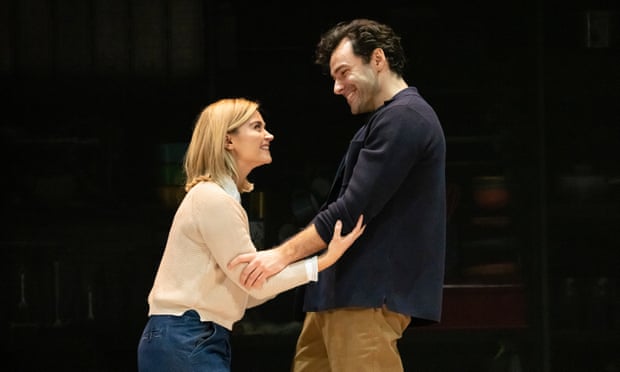
Sam Steiner’s play has followed a well-documented path from student drama to West End, thanks partly to the simplicity of its central concept (a society much like ours restricts everyone to a maximum of 140 words, written or spoken, per day), but also its structure as a two-hander with a pair of attractive parts for an attractive male and an attractive female lead. From the balcony of the Harold Pinter Theatre, it seems like a play better suited to the Paines Plough mobile Roundabout auditorium where it became known. The play’s strongest suites are charm and intimacy, but it’s hard for even the most skilled performers to hit the back of the stalls with their loveability. Aidan Turner (who seems to have grown a beard during the run) and Jenna Coleman give it a good try though, and their interaction is convincing and enjoyable.

Set on a Roundabout-sized carpet circle walled in with domestic detritus, the action focuses on the two actors, who meet, get together and cycle through the phases of a normal relationship while politic turns dark in the background. Too much of the play, around two thirds, is spent on the build-up which, although nicely written, does not tell us enough that is new about the way men and women relate to one another. The political concept, distopian and fascinating, has great potential that is not entirely fulfilled. Steiner seems unsure whether the word limit is to be taken entirely literally, or whether it is primarily a metaphor. If the former, the writing needs to be more precise, with word limits actually enforced in each conversation rather than only sometimes. The absurdities of a situation where a couple cannot communicate because they have used up all their language elsewhere has potential that seems underexplored. As a metaphor, the idea is powerful and it is hard to believe that Lemons… predates the pandemic. The sense of claustrophobia, and the need to make the best of an inconceivable loss of freedom feels darkly familiar. The play also contrasts unjustified male certainty with restricted female expression in a way that feels agenda-setting for 2015, when it was written.

In the end, Lemons… falls between stools, providing neither a dystopian alternative near future nor a full exploration of character. Neither of the two characters, Oliver and Bernadette, feels entirely real. Nevertheless, it is a play that asks questions and at its best makes the audience shiver in recognition as well as laugh in sympathy.

Truth’s a Dog Must to Kennel

Tim Crouch – photo by Stuart Armitt

Truth’s a Dog Must to Kennel by Tim Crouch – Battersea Arts Centre, London

For Tim Crouch, challenge is inherent to performance. Walking onto a stage to address an audience immediately raises questions about who we imagine we are, both audience and actor. ‘Truth’s a Dog Must to Kennel’ is as stripped back as performance can be with no set and only Crouch, wearing a suit and a virtual reality headset, talking to us on a bare stage. He warns us that this is all we will get, and that there is nothing inside the headset either. Then, having set the bar for audience engagement very high indeed, he tangles us in a net of his own devising, leaving us amused, baffled, embarrassed and horrified during an intellectually fascinating, theatrically irresistible hour and ten minutes.

The show could be entitled ‘I, Fool’, and it clearly relates to Crouch’s series of monologues imagining Shakespeare from the perspective of marginalised characters: ‘I, Banquo’, ‘I, Cinna’, ‘I, Malvolio’ and ‘I, Peaseblossom’. For some of the time he is The Fool from ‘King Lear’, and the show plays around the character’s disappearance in Act III of the play, his fate unexplained, never to return. Crouch, with his headset on, describes a theatre to us. ‘King Lear’ is playing on stage but he, The Fool, cannot take the horrors happening around him anymore. He walks out, or tries to, away from the aristocrats torturing and destroying one another. But he also turns us gaze on the audience in a West End-style venue, from bored corporate Deloitte executives to those on pre-theatre dinner deals, in the £95 seats, or who have snuck down from standing. He describes the nature of a theatre dominated by money, where the motivations of those attending are shaped by spending power and privilege. 

The chaos on stage is just a spectacle to the West End audience, a story with no direct relevance. But Crouch also tells us about ourselves, the Battersea Arts Centre audience, in virtual reality, suggesting we are a Guardian-reading, self-satisfied tribe. He questions whether there is any point in performance or theatre.  All “this” is dying, he says, everyone watches television now. Only people like us are interested, and we do not matter. It is a stark assessment of the arts in Britain, and contains more truth than performers generally like to acknowledge. Yet he also simultaneously counters his argument with his powerful, seemingly effortless presentation of a blank slate, where a stage can be used to do and say anything.

Crouch, however, is not just interested in the small world of the stage, but in culture much more widely. The show contains a scene of jaw-dropping depravity, in which the repeated use of the phrase “you know” does nothing whatsoever to disguise the scenes of gruesome, ‘Naked Lunch’-style sex acts he describes, in detail. It is a disconcerting sequence as Crouch, whose charm makes the audience complicit with him from the start, becomes a suddenly menacing figure asking us whether we are entertained and why we think we should trust him. It is a brutal parody of reality culture, strongly suggesting that we are culturally in a dark place. 

The show’s title is a quotation from The Fool and reads, in full, “Truth’s a dog must to kennel / He must be whipped out”. The Fool is a character who says ‘no’ and stands up to the horror. He shows us that truth is something that society claims to value but rarely wishes to acknowledge. The truths about us are unpalatable. We are deluding ourselves when we think that we do not exploit others, that theatre is a medium of equality, or that we can really see what is going on. But at least we are willing to listen while Crouch shows us ourselves, in a virtual reality mirror. At its best his work is extraordinary, taking big questions and turning them into theatre that possesses a remarkable clarity. ‘Truth’s a Dog to Kennel’ is Tim Crouch on top form.