Evita Too

Louise Mothersole and Rebecca Biscuit. Photo by Holly Revell.

Evita Too by Sh!t Theatre – Soho Theatre, London

In development since earlier this year, when they presented a highly entertaining scratch version performed in part by interns, Evita Too is a Sh!t Theatre show – and that brings expectations, which are rather brilliantly fulfilled. In the years since their first success, Letters from Windsor House, Rebecca Biscuit and Louise Mothersole have forged a style that is entirely their own. They combine the personal, the political and the extremely silly in a way that is both very enjoyable and powerfully satirical. Their last show, Sh!t Theatre Drink Rum With Expats combined a boozy Med holiday with an exposé of the corruption in Maltese politics that became much better known shortly afterwards, when the assassins of the journalist Daphne Caruana Galicia were brought to justice. Evita Too is a more layered show, hitting a range of targets closer to home, which becomes apparent in the opening scene. After taking an audience vote on the options of a mind map of the show or the pair of roller skating naked to Starlight Express, the pair gives us what we want, obviously option two. This is very funny and also a neat way to introduce a wide-ranging debate about the nature of entertainment on stage, and the pressures of performing.

On the one hand, Sh!t Theatre have no love for “Tory peer” Andrew Lloyd-Webber and “UKIP donor” Tim Rice, but they know a good tune when they hear one. In fact, they’ve written a whole series for the show which they perform with a professionalism that reveals the talent underpinning their seemingly haphazard approach. They have also been on a research trip to Buenos Aires to inquire into Isabel Perón, Argentina – and the world’s – first female president. She is the apparent focus of the show, which exposes the misguided nature of the search for heroes and heroines. Perón, now forgotten rather than reviled, was the wife of Juan Perón who moved from popular left wing hero to right wing dictator, returning to from exile in 1974 and announcing his arrival with an airport massacre (audience members are drafted in as, among other things, massacred victims). When he died unexpectedly of a heart attack, Isabel took over for a turbulent two years during which she ran a death squad (only a modest one, as Sh!t Theatre are keen to clarify) before she was overthrown in a coup. She is still alive, in exile in Madrid, but Rebecca and Louise were sadly unable to meet her, although they film themselves trying and staging an exhibition nearby in an attempt to lure her out. There is a great deal of research behind the show, including jaw dropping details of the true Eva Perón story involving, amongst other things, a fascist wizard advisor, Eva’s lobotomy, and Juan and Isabel keeping Eva’s mummified corpse in their dining room. These are used to gleefully expose the artistic and political sham that is the Evita! musical.

The show is not just about Rice and Lloyd Webber and the monetised, post-Thatcher attitude to the arts that they represent, but uses this to reflect back on the experience of putting on a show in the current political climate. Evita Too is produced on a shoestring (not that any Sh!t Theatre show looks expensive) because they didn’t get the Arts Council funding they applied for. Their work is also becoming more personally precarious, and they intersperse an account of the fertility tests they take to find out whether either could still have children with their partners, while knowing that doing so could finish the other’s career. The scenes in which they drop the lights and talk to one another in silhouette about their fears are moving. Evita Too pretends to be chaotic, but it’s something of a triumph – a multi-layered performance that brings us laughter, tears and, for one lucky gentleman, the opportunity to make the performers mojitos live on stage while crushing ice in time as Louise and Rebecca perform a song and dance number, Evita!-style.

All’s Well That Ends Well

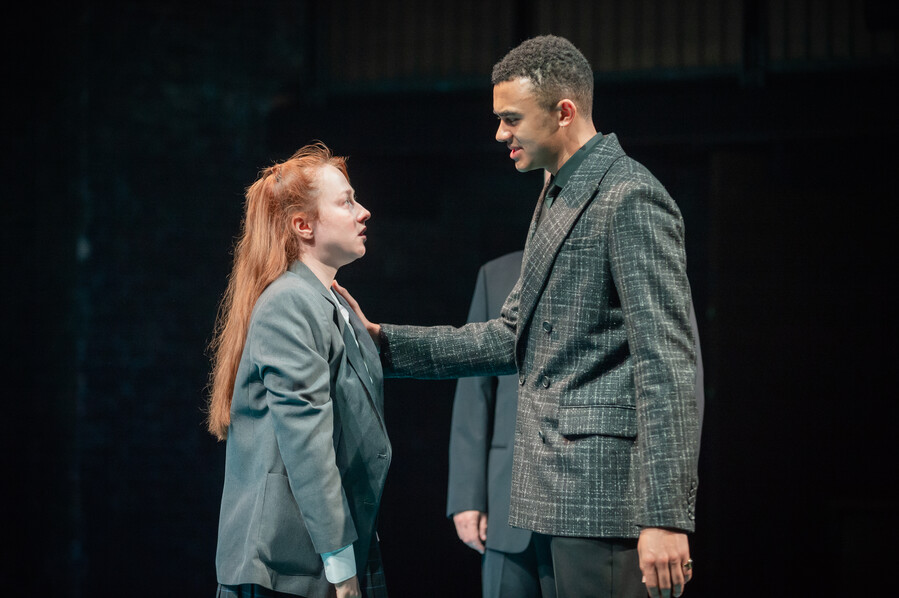
Rosie Sheehy and Benjamin Westerby – photo by Ikin Yum

All’s Well That Ends Well by William Shakespeare – Royal Shakespeare Theatre, Stratford-upon-Avon

All’s Well is the definition of a tricky play, with its combination of the fantastical and the emotionally brutal, its historically specific yet confusingly vague setting and its hard-nosed, difficult-to-love main characters. Embracing the oddness is probably the only way to make it work on stage but, despite some promising ideas and strong individual performances, Blanche McIntyre’s production does not feel coherent.

The programme focuses on the vulnerability of teens on the internet, which the production seems keen to use as a way to understand the young anti-lovers, Helena and Bertram. The staging uses back projections of social media posts and reels. As the play begins, this which works well with the online announcement of the of the Count of Roussillon’s off-stage demise. However, the idea never amounts to more than a series of interludes between scenes, and adds little to our understanding of the play.

Nor is the set by Robert Innes Hopkins a success. A large wooden domed frame is raised and lowered over the stage to distinguish between setting, but feels clumsy and functional, especially when hung with a cloth for back-projected phone footage which, for much of the time, remains blank.

The set also contributes to a lack of distinction between the play’s settings especially Roussillon and the French court, which is also reflected in the staging. Helena leaves her home, and the care of the Countess, to cure the French king of a fistula, offering her life as a sacrifice if she fails, a bid to secure Bertram as her husband in exchange. However, the court is full of louche, idling young men who play computer games, and any sense of threat is left to Bruce Alexander as the King. Fortunately, he gives the stand-out performance as a grizzled charmer whose demeanour turns when crossed into rumbling menace.

If the King wears his heart on his sleeve, and makes no secret of his authority, Helena becomes more guarded as she understands her lack of power. Rosie Sheehy is young and naive enough to imagine fairytales can come true (although dressing her a schoolgirl labours the point). She also possess fairytale powers of healing so when she cures the King, off-stage and without explanation, it is perhaps understandable that she expects he will make her happy ever after in return.

Her mortification when she realises that Bertram has no wish to play the part she has assigned him is total. From then on, she works differently to achieve her aim. Faking her death, disguising herself as a backpacker (an updated version of the original pilgrim) and concocting a plot that deceives Bertram into getting her pregnant, she plays very dirty indeed. In a modern context she would be sent to prison for what she gets up to. However, we are left in no doubt that Bertram is a wrong-un, and Benjamin Westerby very successfully conveys a disdain for Helena that goes beyond the horror of an excitable young man, careless of others, discovering his freedom has been taken away without his consent.

The success of the play requires some particularly disparate characters to convincingly create a world the audience can believe in. Some parts are notoriously challenging, especially the braggart Parolles who is less amusing than Shakespeare, in granting him a great deal of stage time, seemed to imagine. Jamie Wilkes works very hard indeed and entertains the audience with his physical daring and a spectacular meltdown when tricked by his fellow soldiers, Falstaff-style, into revealing himself as an abject coward. However, his wider role in the play as a foil and warning to Helena is not clearly communicated.

Simon Coates, as the courtier Lafew, makes his scenes baiting Parolles very enjoyable. However, Funlola Olufunwa’s manic Widow seems unrelated to the play around her, while the character of the clown Lavache, despite Will Edgerton’s best efforts, is peripheral. The Countess, usually seen as a star role, fades into the background. Claire Benedict seems to lack opportunities after the opening scenes to make her presence felt, and is not helped by the production which shunts her to the back of the stage in most of her scenes.

Blanche McIntyre can do difficult Shakespeare well, as she demonstrated with her Measure for Measure at the Globe last winter. However, with All’s Well she does not locate the conceptual unity needed to bring the story together and help us believe in its sharp changes in tone and the moral opacity of its world. Rosie Sheehy’s performance is involving and legitimately low-key, but seems at times to be undermined by the production which tries too hard to create noise; but not hard enough to help us understand the motivations of characters who refuse to behave the way we would expect.

Who Killed My Father

Hans Kesting – photo by Jan Versweyveld

Who Killed My Father by Édouard Louis – Young Vic, London

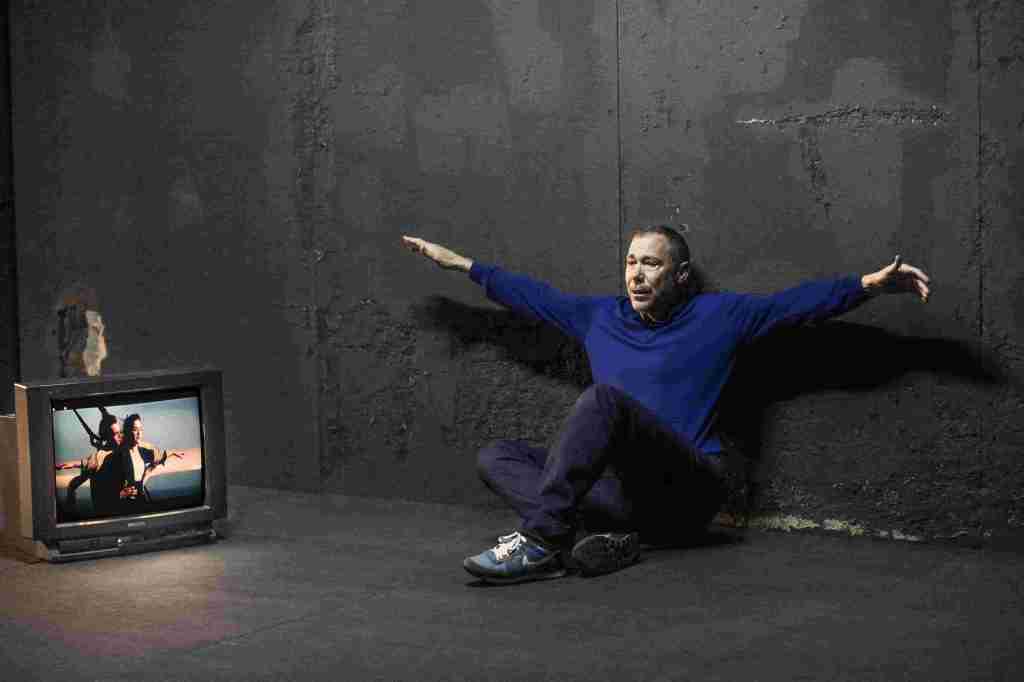
The set of Who Killed My Father looks like a prison cell – tv, bed with bare mattress, concrete walls. The only indication that it’s something else is the oxygen cylinder hanging on the wall. This grim room represents the home of Hans Kesting’s father, where he lives and suffers in poverty and poor health after a lifetime of physically destructive labour. The play, based on Édouard Louis’ novel, looks back on the harsh childhood of the narrator and sole character, unnamed, in industrial northern France. Growing up gay in a working class town with a father who believed men should be men was harsh, but Ivo van Hove’s spellbinding production digs much further than that. By confronting the truth of his father’s behaviour towards him head-on, Kesting exposes the system that condemned him to work until he was broken, the violence generated by society as much as him, and the demonisation of men like his father for political purposes. It also reveals, despite it all, love.

Kesting, performing unusually in English, is remarkable in the role. Physically he dominates the space, a large man like his father, but he is capable of transformation. One minute he is the bloated and hunched figure of his father, the next he becomes his light-footed teenaged self again. His story is told through his body as much as his words. A stand-out moments include Kesting breaking into a wild dance in a desperate attempt to impress his father The key scenes are perhaps repeated cigarette breaks when he stands in the doorway at the rear of the set, wreathed in smoke, hacking. Van Hove and Jans Versveyweld, responsible for scenography and lighting, use subtle but haunting visual ideas, including the floor level tv that floods the room with eerie light and the holes punched in the plaster by the father whose boast is that, unlike his own father, he would never hit his family. The personal story becomes political towards the end, when Kesting’s rage erupts and he directs his condemnations at French politicians of the past decade who have cut benefits and, as he sees it, abandoned the working class. This is the gilet jaune story too but, while the movement was a magnet for crackpots, Louis cuts to the heart of why people who have missed out feel abandoned. The production is a minor masterpiece.

Sap

Sap by Rafaella Marcus – Summerhall, Edinburgh

Rafaella Marcus’ debut play is a tale set in modern London with ancient roots. Daphne (Jessica Clark) is bisexual, but finds herself in an increasingly complex situation with her new partner (Rebecca Banatvarla), who she had omitted to tell about her previous relationships with men. Meanwhile, she is seeing plants and trees growing inside houses, from the bus to work and in the office, which are apparently invisible to others. The myth of Daphne, the nymph who turned herself into a tree to escape Apollo’s attempted rape, begins to play itself out. The concept has potential, and the Roundabout’s bare, in-the-round stage is filled very effectively by director Jessica Lazar with nothing but the bodies of the two performers. The writing, however, falls short of its objectives. Clark works hard in her role but Daphne is a superficial and annoying character, speaking in a rush of cliches, but it is not clear this is the intended effect. The urban setting is also dominated by cliched tropes, such as lesbian poetry nights and anonymous Docklands apartment blocks, that don’t seem real. And the plot is stretched by the role of the creepy brother (also played by Banatvala, very well) whose motivations seem unlikely. It’s a promising debut that doesn’t quite succeed as intended.

The Rest of Our Lives

The Rest of Our Lives by Jo Fong and George Orange – Summerhall, Edinburgh

Jo Fong is a dancer, director and choreographer. George Orange is a performance artist and clown. Both are middle-aged, and have decided that the rest of their lives start here. Their highly engaging double-act begins with getting very involved in seating the audience, and progresses into a series of apparently chaotic and rather brilliant dance and movement pieces. Exuding eccentricity, the pair do exactly as they please which consists of playing floor-filling tunes and dancing, or sitting down looking knackered, or ordering the audience about. The hour flies by in a series of low-tech, high-impact set pieces. The audience plays a messy game of ping pong with many, many bats and balls. Jo and George compete to get higher than the other, including clambering up the raked seats. George contorts himself through a school chair. Jo deadfalls towards the front row at various angles, always caught at the last minute by George. They sit nodding and looking smug to Rage Against the Machine’s ‘Killing in the Name Of’. They draw the audience into a riotous karoaoke version of Foreigner’s ‘I Want to Know What Love Is’. The show is both ludicrous and surprisingly moving, as their oblique approach explores the impact of getting older and wondering what’s next. It ends in a remarkable moment of mass dancing as the audience descends on the stage, suddenly finding themselves at full emotional stretch thanks to an unashamed expression of personality from these two delightful performers.

40/40

40/40 by Katherina Radeva – Zoo Southside, Edinburgh

Katherina Radeva’s one-woman show is a rare piece of authentic self-expression. Not many people decide to mark their 40th birthday with an Edinburgh Fringe show, especially not a dance show if they are neither a performer nor a dancer. Radeva is not everyone, so this is exactly what she has done. Watching her is a cathartic and surprisingly moving experience. Her stated aim is to “fuck about and have fun”, but she also includes her own recorded voiceover explaining who she is and why she’s doing this – apparently added after misgivings that anyone would want to watch her just dancing for her own amusement. She’s no professional dancer, but she still mesmerises with her expressive movement to everything from Sweet Dreams to Bulgarian folk music. As we discover, she came to the UK aged 16 and her experience as an immigrant has been all about working – as a printmaker and stage designer. Now she gets to do something for herself, throwing herself completely into physical performance, cheerfully undressing on stage and looking authentically knackered at the end of each dance. She is very funny, and entirely herself. Just seeing that on stage is a remarkable experience.

Receptionists

Receptionists by Kallo Collective – Summerhall, Edinburgh

Receptionists is a totally enjoyable hour of clowning, mime and laser focused fooling. Finnish performers Inga Björn and Kristiina Tammisalo make the perfect comedy duo as they inhabit their domain behind the reception desk of a 5 star hotel. They arrange their fruit bowl, turning an apple to hide the eaten half, keep each other awake with the service bell, and engage in ludicrous routines in which they entirely fail to answer the phone or to retrieve a stray neckerchief. Later, they do some chaotic chambermaiding. There are few words, and both are exceptional physical performers, but when they do speak it’s in an invented Euro-gabble involving words such as ‘flappety’, which is very funny. There are no serious themes – it’s shamelessly just fun – but it is a pleasure to see such precisely choreographed, expertly delivered comedy. Kallo are proper artists, and their work really is as good as it gets.

This Is Memorial Device

Paul Higgins.

This Is Memorial Device by Graham Eatough & David Keenan – Wee Red Bar, Edinburgh

David Keenan’s novel has become a cult in its own lifetime. His completely convincimg and entirely fictional etymology of the early 1980s Airdrie alternative music scene is beautifully written and can only have come from someone who was there. As a stage version it has a ready-made audience consisting of people of a certain age who were also there. Yet it’s not obvious how such a literary work could be successfully staged. Fortunately, as a one-man show fronted by the excellent Paul Higgins, it works a treat. Adaptor and director Graham Eatough casts him as the central narrator Ross Raymond, and we believe him entirely as he explains how legendary band Memorial Device played a gig “in this very room”. Higgins gives a masterclass, constructing the characters from shop dummies as he describes them, and even playing their instruments for them. Other characters give their testimony on filmed clips, including Mary Gapinski, Julie Wilson Nimmo and Sanjeev Kohli – all very funny. Keenan’s achievement is to create something that seems more real than the reality, a shared myth that we can all claim a part of because none of us were there. Of course it ends in disappointment and failure as all mythologised times must do. At the end of the evening, the man sitting behind me, big, bearded and in his 50s, was in tears, which says it better than any review.

The Silent Treatment

Sarah-Louise Young. Image by James Millar Photography.

The Silent Treatment by Sarah-Louise Young – Summerhall, Edinburgh

Sarah-Louise Young is a professional singer with an impressive career that includes West End shows such as the Julie Andrews musical Julie, Madly, Deeply, smaller scale work like An Evening Without Kate Bush, and directing. She is brisk, charming and authoritative, engaging the audience in vocal warm-ups as they take their seats. Her confident stage demeanour sets the scene for a one woman show that becomes remarkably revealing and painfully honest. She tells us about her visits to a consultant about her growing vocal problems, traced to cysts on her vocal chords which have been there since she was 7 years old. That’s when something traumatic happened that made her scream so hard she permanently altered her voice.

Young’s storytelling techniques are light touch but clever. She uses a looped scarf to represent the vocal chords, taking us on a tour of the anatomy of the throat and climbing inside her own pharynx. She also songs her own original songs, in a beautiful voice cured, as we discover, by surgery. Her tone is bright and at times seems like a jolly front. However, the material uncovered in her story around the sexualising of young women and the treatment of performers, is anything but. Young strikes a clever balance between entertainment and challenge, distilling all her experience to captivate the audience from start to finish.