Playing Latinx by Guido Garcia Lueches – Camden People’s Theatre, London
Guido Garcia Lueches is not Mexican. Nor is he Peruvian. Nor Puerto Rican. Nor the emotional Latinx (pronounced Latinks) type people expect. This does not stop him playing all those parts as an actor, in the guise of either fighter, lover or comic relief. Guido’s one-man show tackles the experience of the Latinx performer in the UK, where these stereotypes cover people from “one and a half continents”. Fellow actors and casting directors can be anything from clumsy to rude, and rarely see Latinx actors as people but as a distinct, controllable type. “I was white before I came here”, says Guido, in typically understated but piercing aside.
Although the show deals with some sobering themes about our not-so-post-colonial attitudes, it does so with enormous humour and grace. Guido is a superbly engaging performer, who has the audience at his mercy from the start. Humour is his medium, and he loves to work with the audience. Ostensibly delivering a seminar in how to be a stereotypical Latinx in a ludicrous accent, he is constantly interrupted by calls from his agent to attend auditions, for sexy pool cleaners, gang members, revolutionaries, and samba dancers. Each time, the agent is played by an audience member who has to occupy the casting chair on stage before the show can continue. By the end, half the audience has been on stage, while the other half has become involved in other ways – and everyone seems to be enjoying it hugely.
Playing Latinx makes neat use of light touch stage techniques such as these, but it is Guido who makes it all work. He is the kind of performer you are happy to trust because his motives are clear. He has written a piece of smart, funny and reflective entertainment that will send you home delighted with what you’ve discovered. Whether he ever gets to play “Ricardo Tres”, as he puts it, is another matter but Guido deserves big audiences for a standout piece of fringe theatre.
After The End by Dennis Kelly – Theatre Royal Stratford East, London
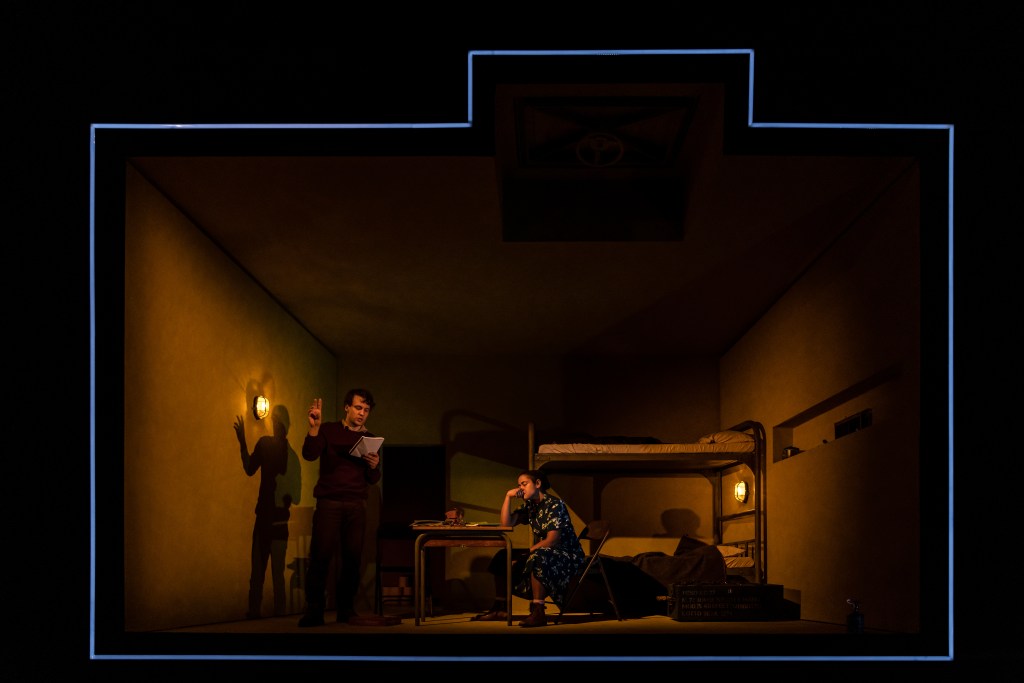
Dennis Kelly’s 2005 play, After The End, is set inside a nuclear fallout shelter, so it is not surprising that it deals with situations beyond the boundaries of what passes for normality. It has a cast of just two: Mark and Louise, who are colleagues and friends… sort of. Mark has apparently rescued Louise from a nuclear blast. “Terrorists. Probably.” he says, “Suitcase nuke”. There is no information on what might have happened to everyone else, although Mark says he saw charred bodies, and there is no signal on the radio. Fortunately, he bought a flat with fallout shelter under the garden, built in the 1980s – not because of the shelter, although everyone at work laughed at him for it, but… well… lucky he did, isn’t it?
Kelly builds, with some glee, an atmosphere of intense awkwardness between the two, who find themselves living together in a confined space for the two weeks that, according to Mark, it will take for the radioactive dust outside to settle. It is all too easy to believe that if the apocalypse happened, it would be distressingly ordinary in its mechanics. People would behave in exactly the way we would expect, only more so. Fear and boredom would go in tandem, and a complete lack of any agency would drive everyone insane. Inevitably, we would not get to choose who we faced the future with.
After The End is about the idea of a catastrophe that renders everything else irrelevant, and leaves us with little more than ourselves to fall back on. However, it is also about more than this. For a reviewer the plot is mostly off-limits, as it hinges around a big twist that changes our perceptions of what we are watching. It is safe to say, though, that Kelly is writing about other types of conflict than just nuclear war. We wait in fear for a war that is already taking place, without our noticing. The power that men exercise over women is the territory of daily violence and oppression, and this is what plays out in Mark’s bunker.
Lyndsey Turner’s production is expertly crafted. As tensions rise, Mark and Louise use the confined space differently, spreading to press one another against the concrete walls, and warily covering one another’s sightlines. Designer Peter McKintosh has letter-boxed a shelter space into the Theatre Royal’s proscenium arch, like a section through a subterranean world. It is a thoroughly claustrophobic setting. The two performers – Amaka Okafor as Louise and Nick Blood as Mark – are excellent. Blood is entirely convincing in his neediness, very much the creepily socially awkward colleague, resentful of the apparently easy friendships and connections enjoyed by others. Okafor is the opposite – a confident, competent woman under pressure from people who want things from her. The friendship between the two is unhealthy. Mark is obsessed with her, too immature to express himself or relate as an equal. He seems amiable but, as we soon see, is capable of exploiting his power over Louise, and maybe of much more.
Although they are played very well, After The End falls short through these two characters. Mark is too much of a cliché to be entirely believable: a man whose genuine obsession is having Louise to himself, so they can play Dungeons and Dragons. Louise is defined by her reactions to the situation she finds herself in, and it is not until the play’s final scene that we see a fuller version of her, and understand a little more about who she is and what she wants.
Okafor’s performance is compelling, and her explosion when finally able to do as she chooses is visceral. However, the final note of rapprochement between the two feels odd in light of what has gone before. It is very difficult to have any sympathy for Mark, who emerges as an unpleasant character on every level, from the petty to the fundamental. His behaviour is, from any perspective, unforgivable. After The End is an intriguing, but not entirely successful play. Turner’s revival is high quality and Stratford East should be commended for programming challenging work, giving us a chance to look again at the new writing of our recent past.
‘The Merchant of Venice’ is seen as a problematic play but, increasingly, it seems that the problems are with us, as much as they are with Shakespeare. We only have to look back a couple of decades to see Shylock portrayed as an ‘other’, a character who, if not quite the author of his own problems, certainly makes life difficult for himself. In her first production for the Globe, director Abigail Graham makes these interpretations seem like something from the dark ages. She reclaims the play, triumphantly, with a production that reveals a powerful expose of racism that has been there all along, but that as a society we did not see.
Against a silvered backdrop, an indoor Venice is revealed, filling the jewel box Sam Wanamaker Playhouse and its disconcertingly dark corners. Graham cuts the comic scenes involving the Gobbos, but Lancelot survives – wheedling his way into the employment of Bassanio at a testosterone-fuelled party of young, white, traders in masks – and the older Antonio. The lads force him to drink a shot every time he says the word ‘Jew’, leaving us in no doubt about the nature of the society they represent. The cast give unnervingly credible performances as a privileged cabal who protect their own interests by viciously demeaning those who do not belong. Michael Gough’s excellent Antonio is perhaps an outsider, working hard to stay on the inside. His relationship with Bassanio, played by Michael Manus as a self-centred, calculating chancer, is physically close and makes him vulnerable. His reaction is to outdo everyone in his anti-semitism, and is shocking to see an older man deploying his experience to be the cynical and vicious of all.
The contrast with Adrian Schiller’s superb Shylock is heart-breaking. This money lender is a low-key businessman in an old-fashioned suit, windcheater and yarmulke. He is softly spoken, as though long experience has taught him it does not pay to stand out. When Antonio asks him for a loan, while repeatedly expressing his scorn and threatening to spit on him, Shylock adds the numbers up in a pocket book with a trembling hand. He clearly wants to be left alone, a luxury not afforded to a Jew in Venice. The hatred on display is a powerful illustration of how racism works in practice, ringing through the centuries like an alarm bell.
Shylock’s subsequent actions are entirely defined by his position in society, and his treatment by people who are open in their contempt for him, and his right to be treated like a fellow human. Schiller provides many stand-out moments. His tears when told that his daughter Jessica’s has not only eloped with his goods, but has pawned a ring given to him by Leah, who we assume to be his dead wife, are truly moving. He arrives in court for his pound of Antonio’s flesh, carrying a folding table and chair and a tupperware box, like a pensioner out for a picnic. He is very much on his own, but determined to take a rare chance to stand up to a society that victimises and bullies him. His hand shakes so violently as he holds the knife to Antonio’s chest that it is clear he cannot go through with it.
The toughest parts to play and direct in ‘The Merchant of Venice’ are Portia and Jessica. Sophie Melville plays the former as a sparkling, brittle performer, toughened to snapping point by her social position. Her father’s cruel bequest, of a husband to be chosen by lottery, leaves her powerless. The suitor scenes are staged as a gameshow, with Portia wheeled out to be displayed as the prize, in a nod to Rupert Goold’s 2011 Las Vegas-set RSC production. Open racism is part of the equation at Belmont too, seen in Portia’s horrified reaction to the Prince of Morocco. Yet, when she finds herself in a position of influence in court, she seizes her chance to join the boys club, turning on Shylock with relish, to the delight of Antonio, Bassanio and their cronies, a victim turned abuser. She receives her come-uppance when, at the conclusion of the scene, the men slam the door in her face, her usefulness at an end.
Jessica is, if anything, an even more difficult part. There is little to like about Shylock’s daughter, who betrays him completely. She disappears within the play, apparently content to live with Lorenzo on the share of her father’s wealth extracted through the corrupt Venice courts. Graham, taking a cue from Jessica’s single, desolate line “I am never merry when I hear sweet music” tops and tails the production with her singing – “Today’s gonna be a good day” at the start, a Hebrew lament at the end – which imply she too has been used and deceived. Eleanor Wyld’s performance is compelling and charismatic, greatly helping to position her as a rounded character.
Other cast members to make an impression are Raymond Anum as a champagne-swigging Gratiano, Daniel Bowerbank as an opportunistic Lorenzo and Morocco, and Tripti Tripuraneni’s ambiguous Nerissa. The ensemble performs as a unit, connected by Abigail Graham’s fearless vision of the play. The final image of Shylock, walking away to an uncertain future clutching his briefcase, makes a natural connection to images from many eras of persecuted people, fleeing with what they can carry. Graham’s ‘Merchant of Venice’ sets a newstandard for future productions, and showcases the talents of the under-rated Adrian Schiller in a definitive performance. It is the highlight of the Globe Theatre’s winter season.
Jonathan Kent opened his tenure as Artistic Director of the Almeida Theatre with a production of Henrik Ibsen’s final play, ‘When We Dead Awaken’. When, years later, he was asked for his advice to young directors he supposedly said “Don’t start with ‘When We Dead Awaken’”. Kent’s production was well-received and his time at the Almeida a triumph, but the play is famously difficult. If anyone can get to grips with its strange combination of symbolism and despair, it is surely The Norwegian Ibsen Company. Previously seen at the Coronet Theatre with strong versions of ‘Little Eyolf’ and ‘The Lady from the Sea’, they return with a production directed by Kjetil Bang-Hansen. If the play remains difficult to love, it is hard to imagine a more powerful, well-produced account of its strengths and weaknesses.
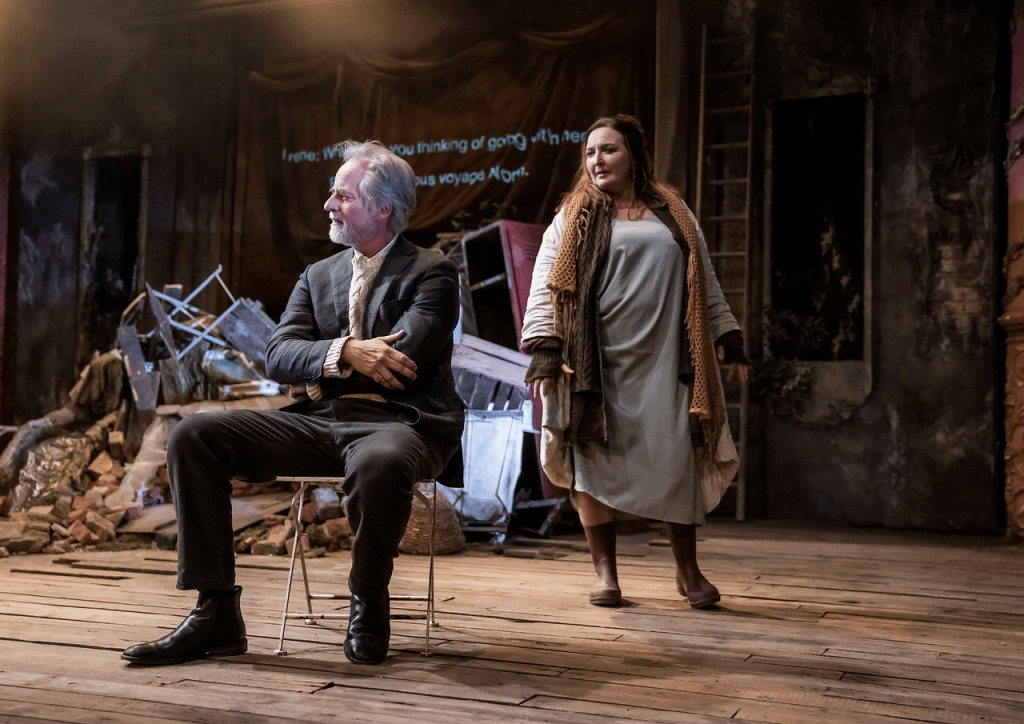
The set, designed by Mayou Trikerioti, extends the abandoned 19th century music hall atmosphere of the Coronet onto the stage itself. Peeling paintwork on the balconies give way to a derelict stage, floorboards torn up, dominated by a pile of junk heaped into front of a painted proscenium arch. These are the remnants of an abandoned theatre, where the audience has departed for the last time. It neatly sums up the ruined atmosphere of Ibsen’s final work, which seems to be a complete renunciation of his artistic achievements. It is an astonishing play in many ways, but not all of them are good. Ibsen was apparently dissatisfied with what we now regard as his great works – plays such as ‘Little Eyolf’ and ‘The Master Builder’ that he felt said nothing new. The central character of ‘When We Dead Awaken’ is the aging sculptor Arnold Rubek, his greatest work behind him, also condemned to what he regards as ‘hack work’. His young wife Maia can no longer connect with him and, when he encounters his former model Irene, who posed for his greatest work, he follows her where she leads. His final journey with her to the top of the mountain is heavy with symbolism – Lohengrin, boats that run ashore, the ‘murder’ of children, resurrection, light, darkness, seagulls, swans, and a stream that erupts, startlingly, from the set.
The cast, who perform mostly in Norwegian with subtitles, with some scenes in English, inhabit the unreal world of the play completely. Øystein Røger, as Rubek, has natural authority which conceals a complete collapse in his confidence or sense of self. He has returned to his Norwegian home town, against his better judgement, to look for meaning in his life. Maia, played by Andrea Bræin Hovig with frustrated energy, has given up hope that her husband will take her, as he promised, to the top of the mountain to see the glories of the whole world. The supposed settings – a country hotel and a mountain retreat – seem like painful fantasies and, when other figures appear, they appear to have been conjured from the troubled minds of Rubek and Maia. First Ulfheim (James Browne), a bear hunter, captivates Maia and takes her away to show her something exciting (apparently his dogs, feeding). He later offers to tie her up with their leashes. Then Rubek recognises Irene von Satow, his muse and saviour/nemesis, played by Ragnhild Margrethe Gudbrandsen. She glides into the picture, accompanied by a nun, both real and spectral, and leads Rubek to the top of the mountain, up a path that Maia and Ulfheim find much too dangerous. What happens next is not entirely clear, and Ibsen was apparently unsure how to end the play, but both Rubek and Maia are set free in contrasting ways.
There are a number of problems with ‘When We Dead Awaken’. In abandoning the realism that proved so effective in plays such as ‘Little Eyolf’ when combined with elements of the supernatural, it seems self-indulgent. The dreamlike setting makes it hard to take events seriously but, while it could perhaps be said that Ibsen is mocking his status as a great artist, the play contains little in the way of humour. Rubek, unlike the characters for whom Ibsen is famous, seems a cliché – a tortured, self-absorbed artist who treats others, both Maia and Irene, abominably. Our sympathies for Rubek are rapidly lost as he retreats inside his own self-pity, and it is hard for us to care much about his redemption. Meanwhile, it is disturbing to see how Ibsen, at last writing about what he really felt, had nothing left to say. The darkness that overwhelms him is like an onstage breakdown, distressing to watch and a harsh coda to a life that, more than a century later, seems a triumph.
However, despite the play’s inherent strangeness, the Norwegian Ibsen Company offers a rare and valuable opportunity to see ‘When We Dead Awaken’. The confidence of the performers and the memorable staging, not to mention the alluring sound of Norwegian spoken on stage, make this an evening of high quality theatre for more than just Ibsen completists. The Coronet continues to play an important role in the London theatre scene, hosting European companies who would not otherwise be seen in the UK, and widening our cultural horizons in ways that we should not take for granted.
Tonderai Munyevi is a charming performer. His one man show, which opens the new Brixton House Theatre – home of the relocated Oval House Theatre, and the first in Brixton for a very long time – is a spirited combination of personal and global histories. The two are hard to separate when, as Munyevi was, you are brought up in Zimbabwe and relocate to London to make your life. His experiences include different types of marginalisation, growing up as a gay man and a Zimbabwean immigrant in London. His family story is messy, but the show moving unearths the trauma that led to his father alcoholism, the root of his problems. This is inextricably linked with the fight for independence that led to the end of the apartheid Iain Smith regime in 1981, and the rise of Robert Mugabe as the new leader bringing hope to an oppressed nation. Of course, the Mugabe era did not turn out as anyone hoped, and part of Munyevi’s stated aim is to explain how, far from being a standalone despot, Mugabe was the product of a desperate colonial past.
He succeeds in this only to some extent. As a history lesson, ‘Mugabe, My Father and I’ is sometimes frustratingly lacking. The land disputes that blew up in the 1990s, leading to Mugabe’s transformation into a pariah, are the theme that underlies the show, but are never fully explained. Those without background knowledge may be a little baffled. It is also strange that no reference is made to Mugabe’s infamous homophobia, despite Munyevi’s sexuality being a theme throughout. However, the show is engagingly performed and very well staged. John R. Wilkinson’s direction fills the relatively large Brixton House stage with the help of Nicolai Hart-Hansen’s set of outfits, from military uniforms to Spice Girl dresses, suspended over the performers. Although it is a one-man show, there is also a woman – Mille Chapanda, who plays the Mbira, a haunting Zimbabwean instrument, as well as occasional characters in the show. The Mbira is the name for both the instrument and the story it tells in in music, a different tale for each one of us. This is Tonderai’s tale, and a strong way to open an exciting new theatre space.
There are very few companies who do what Lost Dog does so well – seamlessly combining theatre and contemporary dance, as though this was an obvious way to tell a story. In fact, their work is exceptionally skilled and original, and very easy to get wrong. With ‘A Tale of Two Cities’, they have taken on a complicated and occasionally baffling Dickens tome, which could be a Nicholas Nickleby-style epic in different hands. Naturally, they do not put a foot wrong. Ben Duke directs a larger cast than previous Lost Dog productions, with five dancers juggling multiple roles. His approach owes something to the company’s brilliant Juliet & Romeo – looking back at a well-known story and questioning the assumptions of its main characters. Dickens’ ‘Tale of Two Cities’ is examined by Lucie Manette, who was seven when her mother (of the same name) whisked her and her father Charles Darnay out of revolutionary Paris, escaping the guillotine. She is making a documentary about what happened, interviewing her reluctant parents and brother on camera.
The camera provides our view of past events in many scenes, filmed out of our sight behind the ruined walls of a Parisian hovel, and projected onto screens. Her parents’ secrets – the sacrifice of their friend Sydney Carton who sends himself to execution in place of Charles, and his love for Lucie, and Charles’ evil aristocratic family – are drawn out through Lucie probing. So is the kidnapping and rape of Mme. Defarge’s sister by said aristocrats. Lucie (an engaging and amusing Nina-Morgane Madelaine) guides the audience through these complex events, but Lost Dog does such a good job of expressing the key moments that we are never in any doubt about what’s happening.
The production thrills in the scenes where the cast go beyond words and burst into movement. The combined forces of Temitope Ajose-Cutting, Valentina Formenti, John Kendall and Hannes Langolf alongside Madelaine, are something to be reckoned with. A slow motion riot scene, cast wrestling grimly with one another, and a ship-board scene on a cross-Channel ship, Formenti and Langolf hanging onto the imagined rigging as they talk, are familiar techniques but rarely performed with such precision. Other scenes – Ajose-Cutting losing her core, physically, as she discovers what really happened to her sister, and Kendall dancing a jig on the end of a hangman’s rope, while a timer counts down the excruciatingly slow 3 minutes it takes him to die – are actively astonishing. The show is both an intellectually rigorous re-examination of a tale taken for granted, and a piece of pure entertainment. Ben Duke continues to be one of the theatre-makers of our time, demonstrating exactly why dance matters.
Sean Holmes’ production of Hamlet in the Globe’s indoor space opens with a snatch of “Oh mother I can feel the soil falling over my head”, from The Smiths’ song ‘I Know It’s Over’. Then the candles are doused, the theatre plunges into complete darkness, and we are on the walls of Elsinore. This is about as conventional as the production gets. The next scene, rather than introducing Hamlet through his meeting with The Ghost, skips forward in the play and it is several scenes before we return to the castle walls. Every production of Hamlet is an exercise in editing and rearranging competing versions of the play into a version that is not only coherent, but also short enough for the audience to get home afterwards. Usually, the audience barely notices how the effect has been achieved. If they do, the rationale should be clear. Radical re-edits of Shakespeare can work brilliantly. Joe Hill-Gibbins’ 2018 production of Richard II for the Almeida is a recent example of how taking a cleaver to the structure of a play can change all expectations of how it should be performed. However, the intention behind Holmes’ rearrangements is never clear, and the confusion feeds into many aspects of his production.
The set, by Grace Smart, uses the neat device of an ornamental pool in the centre of the stage. This is used in inventive ways: for Hamlet to teeter on its brink, to douse chandeliers by lowering them into the water and, eventually, to contain the dead. One of the evening’s most effective moments comes when the lights suddenly go up to reveal Ciarán O’Brien’s semi-clad, furious Ghost standing in the water. It is hard to imagine a more threatening Ghost, full of rage at his treatment. However, this interpretation unbalances the play a little, especially when he later returns to waterboard his indecisive son. It is hard to escape the feeling that the elder Hamlet may not have been a pleasant man or a good king, and sympathies begin to tip unexpectedly towards his murderer.
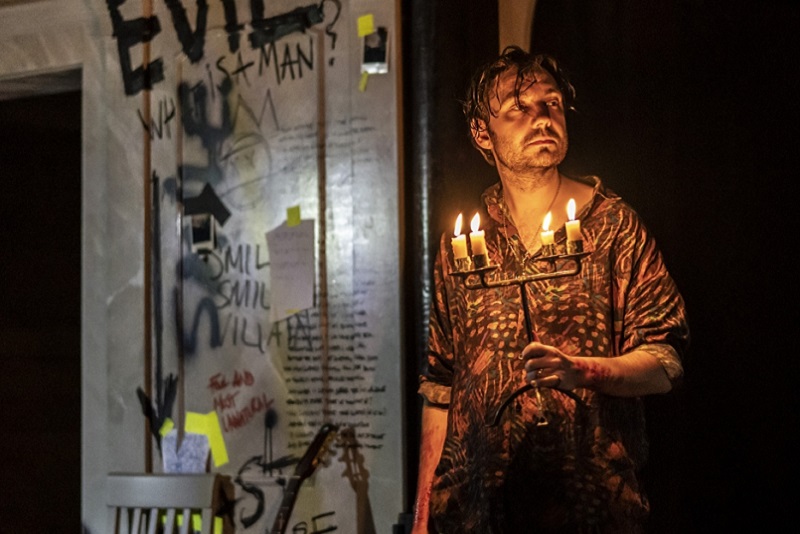
The feeling is amplified by the portrayal of the prince himself. Hamlet is played by George Fouracres, an actor who made his name as part of the comedy trio, Daphne. He is a Black Country prince, delivering the famous lines in a broad Wolverhampton accent. Despite the efforts of companies such as Northern Broadsides to normalise regional accents in Shakespeare, this is still something that is rarely seen. His distinctive tones resonate with the language, giving it a different musicality and revealing new inflections on well-known speeches. Shakespeare and his contemporaries are thought to have spoken in an accent much closer to modern West Country than to received pronunciation, so this arguably a more authentic approach. However, Fouracres is a very downbeat Hamlet, and a remarkably unsympathetic one. Holmes’ decision to dress him as Morrissey, in a far-from-subtle continuation of The Smiths theme, seems to match his misanthropic spirit. In a paisley shirt, skin-tight black jeans and sixteen-hole Doc Martens, Fouracres resembles someone working behind the counter of the Oxford Street Virgin Megastore around 1995. There has rarely been a more morose Dane, but the characterisation feels unsubtle, and foregrounds the least attractive aspects of the character’s behaviour. Hamlet seems most alive when viciously attacking both Ophelia and Gertrude, as though this was his real revenge. Misogyny may be a true reflection of the entitled ‘90s male, but it makes Hamlet very hard to like.
The production’s confused approach manifests itself in a very uneven set of performances from the cast, who fail to present a unified approach to the play. Polly Frame, as Gertrude, is an honourable exception and her scenes have a coherence and weight that is unfortunately lacking elsewhere. Irfan Shamji plays Claudius as a klutz, without any sense of menace or the ruthlessness needed to seize the throne. John Lightbody’s Polonius is broad and comic, a fool through and through who plays to the crowd, but eliminates any sympathy for the character with his ludicrous behaviour. Rachel Hannah Clarke’s portrayal of Ophelia seems to change from scene to scene, and she appears most at home when involving the audience in the call-and-response popular with drunken cricket fans: ‘Everywhere we go / the people want to know / who we are / where we come from’. This, it can safely be said, undercuts the effectiveness of her mad scene, substituting emotional impact for brief, irrelevant audience engagement.
Holmes contrives to make Hamlet much more confusing than needs to be. Cuts mean that Hamlet is suddenly considered mad, without any apparent lead up, while his relationship with Ophelia progresses in jump cuts. The director takes the surprising decision to include the two courtiers, Cornelius and Voltemand, whose tiny parts are usually absent, but transfers Claudius’ confusion over which is which from Rosencrantz and Guildenstern to them. Later, the same actors morph into Rosencrantz and Guildenstern anyway, without explanation. Individually, decisions such as these are quibbles but there are too many of them to avoid.
Holmes approach strongly implies a lack of confidence in the play to engage the audience, or in the audience to last the course. The Gravedigger is played by composer and on-stage guitarist Ed Gaughan, who breaks the fourth wall to explain how difficult it is to make his scene funny, and how by this point in the play everyone is usually getting tired. As if to illustrate, he then delays the final scenes by another few minutes with a series of lame jokes about tv quiz The Chase , as if the audience need to be cajoled into paying attention with some second-rate stand-up. This sums up the problems with a production that seems most comfortable when it can find a way to avoid taking the play seriously.
The Glow by Alistair McDowall – Royal Court Theatre, London
The Glow is an absurdly ambitious play. Its first act is set in 1863, in the household of a Victorian medium, Mrs Lyall, who exploits a patient, extracted from an asylum. Her powers, unlike those of her mistress, are not fraudulent but terrifyingly real. So far, the dramatic structure is conventional, although the subject matter – reality buckling under the harsh gaze of the supernatural – is not. Then Alistair McDowall drops his characters into Roman Britain, 343 AD. Then 1348. Then 1993. Then 1979. Then 1348 again. At one point we pay a brief visit to 500,000 BC, described in the script as the Lower Palaeolithic Age, where an act of brutal violence takes place. The linking character is ‘The Woman’, brilliantly played by Ria Zmitrowicz, a figure who has apparently existed throughout time, an everywoman who reappears in each eras, glimpsed in the backgrounds of paintings. The script even includes an amusing fake academic essay on the myth of The Woman as an appendix. The concept is like a Doctor Who plot opened up beyond the confines of a genre, to encompass limitless possibilities. It is both enthralling and disturbing.
Zmitrowicz continues to bolster her ever-growing reputation with an otherwordly performance, in which she contrives to seem both vulnerable and very dangerous in equal measure. Although she has the power to destroy people, and is seen doing some extremely nasty things to people, she suffers more than everyone else put together – rejected, reviled and used across centuries. In a remarkable final speech, she explains what it is like to watch and participate as humanity comes miraculously to life, then destroys itself, and then to carry on existing. She becomes part of the universe, cradling the life spark that could begin the process over again – The Glow. She is a fantasy – saviour, conspiracy theory, universal outsider, and consciousness of humanity in one frail character, who should never be underestimated.
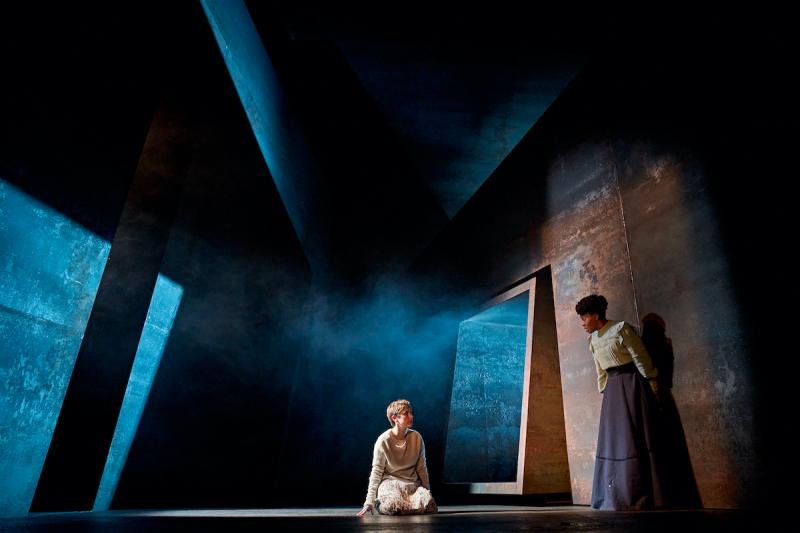
Alongside Zmitrowicz, a cleverly chosen cast deliver equally fine performances. Rakie Ayola plays the cruel Mrs Lyall and the kind Ellen, 130 years on, with equal command. Fisayo Akinade plays four characters with an anxious intensity that stands out. Tadgh Murphy is a medieval warrior (and briefly a caveman), who seems to have stepped out of a Walter Scott fantasy and is starting to wonder who he really is. Vicky Featherstone directs a very challenging script by sticking to a simple approach, which gives McDowall’s characters and their words space to breathe, and to convince us that we are seeing real people, whether from pre-history or otherwise. Space is provided literally by Marie Hensel’s cavernous corten steel slab set, like a chamber located outside time.
The sort of world-swapping, era-jumping epic structure of The Glow has been the aim of many playwrights, but notably few have come close to pulling it off. That McDowall does is perhaps the highest tribute to his skill. The Glow is the kind of work that, in ten years’ time, people will still be wondering at. It is reminiscent of Caryl Churchill, specifically her most recent work for the Royal Court, and of Annie Baker, one of the finest playwrights working today. Both they and McDowall freely combine the everyday with the inexplicable in a way that splits open our literal, conservative, over-documented times. It provides no answers, no plot-driven conclusions, and no compromises. Instead, McDowall spins ideas that won’t leave your head, plays with our fantasies of how we might be saved – half laughing at us and half sympathising with the human plight – and demonstrates that theatre can take us absolutely anywhere if it has the nerve to try. This is one of the most exciting plays to emerge so far, in this stalled decade.
On a spare, skewed platform a man (Nathaniel Christian) in RAF uniform and and a woman in a 1940s dress (Becky, played by Rachel-Leah Hosker) are enacting a goodbye in stilted, Brief Encounter tones. He’s off to war, naturally, but she doesn’t seem to want to play the role he expects. And she is wearing a leather jacket that is surely too modern for the era. Then, mid-sentence, we are in the present day and Becky is trying to avoid committing to buying a house with her boyfriend (played by Hamish McDougall), apparently distracted by her phone. She speaks news alerts and social media messages out loud as they interrupt her thoughts and conversation.
The Winston Machine is a typically inventive piece devised by Kandinsky theatre company, directed by James Yeatman with dramaturgy from Lauren Mooney. Their collaboration is key to the show’s energy, which is often captivating, sliding boldly between eras mid-sentence and flattening timelines into a single feed, in a way that feels genuinely innovative. This approach is a logical way to approach an exploration of the mythologies of the past – in the form of the wartime experiences of Becky’s grandparents – and its place in the present, where it haunts Becky’s imagination and that of the organisers of a 1940s themed festival where she is booked to sing. Hosker’s voice is at the centre of the evening, as she sings songs of the time confidently, and beautifully. The performers are very adept at bringing a complex show to life, and Nathaniel Christian’s is impressive in what is apparently his professional debut.
Christian morphs from Becky’s grandfather, a complicated character rather than the hero some would like to imagine him, into an old school friend, Lewis, now a successful musician. Becky and Lewis are drawn to one another, and may have a future that looks different to her grandparent’s existence and that of her uptight father, scarred by proxy. However, the focus starts to dissipate towards the end of the play, as it becomes apparent there’s no real ending. The themes of the evening are potent – the dangers of Second World War fantasy nostalgia (given a new lease of life through Brexit), the blurring of past and present online, the things that connect us (music, shared understanding) and what to do with your knowledge of the past. It doesn’t entirely work, but The Winston Machine opens up fascinating questions even if it cannot resolve them. Kandinsky have a fearless performance energy that means their work should be taken seriously, and may well realign your perceptions before you realise what is going on.





 Tom Bolton