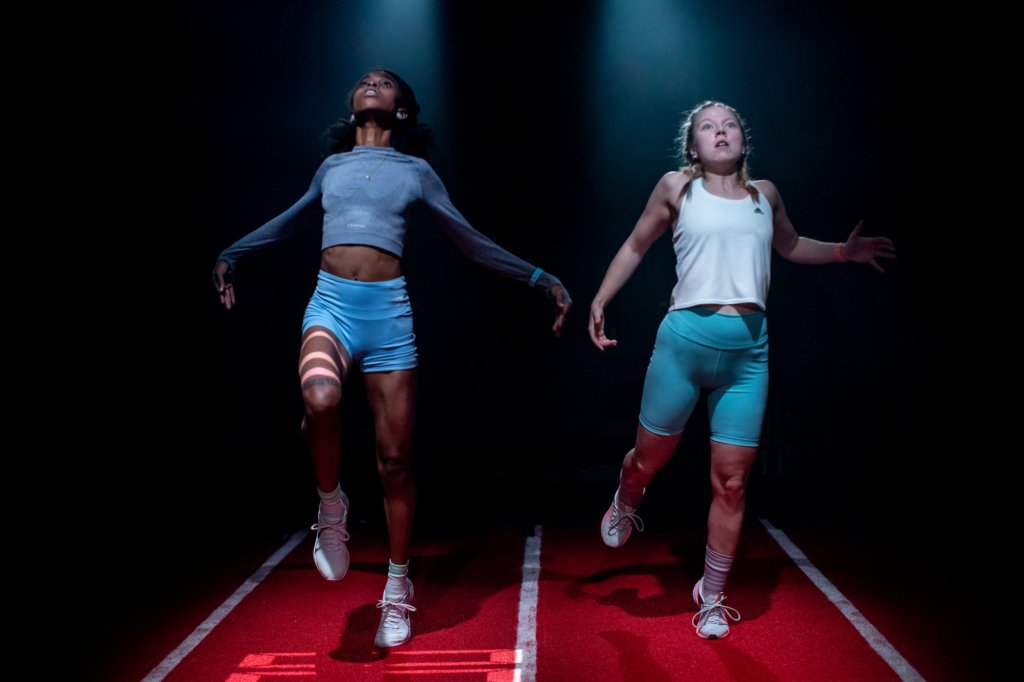
Ella Road’s new two-hander is set in the world of track athletics but the two characters, Ann (NicK King) and Sophie (Charlotte Beaumont) are not just any runners. They are young, promising, female 800m runners. They train under the instruction of an off-stage coach to fulfil their potential. If they do the reps, eat the right food and, above all, commit they can follow a pathway that goes from national to European to world championships and, eventually, the Olympics. At first Road’s play seems to be concerned with the friendship between two young women, sharing the particular pressures of pursuing a career in athletics alongside school and the pressures of growing up. Her writing is very engaging. We quickly feel we are witnessing the ups and downs and the shared experience of Ann and Sophie. The play’s structure is short and sharp, divided into the reps that govern their training. As the progress to championship level, they become closer, Sophie’s cockiness complementing Ann’s worried elegance. The play’s headline theme – gender definitions in athletics – is kept until daringly late, and therefore comes as a shock. Ann’s disqualification and the effective end of her career after her testosterone levels register too high for her to qualify as a female competitor, open up a gulf between the two. Road pulls off the difficult trick of dramatising an argument that is familiar from news headlines without allowing the debate on stage to seem contrived.
Director Monique Touko’s staging is dynamic, energetic and paced like an 800m race. She builds the tension on Naomi Dawson’s running track set gradually until, without realising, we are flying at full throttle. Both performers bring a convincing physicality to the play, with stretching, limbering up and running as the rhythm of their lives. Their practice sequences cross the line between athletics and dance. Beaumont and King carry the audience with ease, strong performers who work well together. The issues ‘Fair Play’ raises are wide ranging, and troubling. The use of an arbitrary hormone cut-off point, decided by white men, to decide who is and is not a woman appears indefensible. Although Road works hard to build a counter-argument in the form of Sophie’s relief at having an explanation for why her friend’s times are faster than hers, and her resentment at this advantage, she clearly has limited enthusiasm for doing so. But this is a play about more than the issues of gender testing, important although that is. It raises questions about the demands placed on young athletes, especially young women, and the nature of competitive sport itself which demands that everyone sacrifices all to be the best, while knowing that very few ever can. Winning seems a delusion that chews up lives for our entertainment, but athletes still choose to do what they think it takes. ‘Fair Play’ provides a genuinely thought provoking evening, and new writing of a very high calibre.
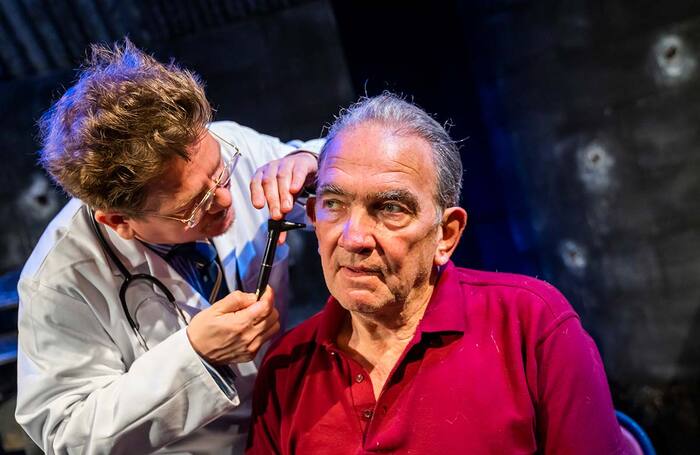
The mental disintegration begins early in David Ireland’s play about a former loyalist gunman. Alan ‘Snuffy’ Black (Daragh O’Malley) is complaining to a doctor about his headaches, his problems sleeping, and the barking dog that keeps him awake. It is this, rather than the many people he admits to killing, that troubles him. The doctor (Kevin Trainor) seems inappropriately flip as he establishes that Alan has nothing in his life. He also seems inappropriately sexual. From this point, the play unmoors itself completely from any expectations of conventional drama, and launches into a gleeful, horrifying cascade of surreal events and forced sex. The dog in question (also played by Kevin Trainor) starts talking to him, and they get surprisingly intimate. Two masked Loyalist comrades with ludicrous names (played by Declan Rodgers and Kevin Murphy) show up to shoot him, repeatedly. A psychiatrist (Laura Dos Santos) gets involved, and stands in judgment. His neighbour ( Owen O’Neill) demands reparation. Ireland’s writing is packed with digs at sectarian mentalities, failure to change with the end of conflict, and the absurdities of people who take themselves so seriously. The cast launches into a script that, on the page, appears almost unperformable, with total commitment. They bring the audience with them all the way, mostly to places they would rather not go.
Written in 2011, before Ireland’s huge successes with Cyprus Avenue and Ulster American, Yes So I Said Yes is epically offensive but very finely honed. Ireland is not a writer who upsets his audience for the sake of it, but this earlier work cuts closer to the bone that either of his better know works. This production, directed by Max Elton, is advertised as the first in Great Britain. It’s perhaps not a surprise that a larger theatre has yet to take a punt on it, so the Finborough is to be congratulated for staging such a ludicrously provocative, yet unforgettable play. The final rape scene, which is both awful and comic, matches anything produced by writers such as Edward Bond during the 1960s assault on censorship. Writing of this nature demonstrates the purpose of theatre. Something this extreme yet also surreal could hardly be produced on film, but the stage allows for both realism and metaphor to combine, to maximum effect. This is an excellent production, and exactly what one would hope to see in a pub theatre in the back streets of Brompton.
Measure for Measure by William Shakespeare – Sam Wanamaker Playhouse, London
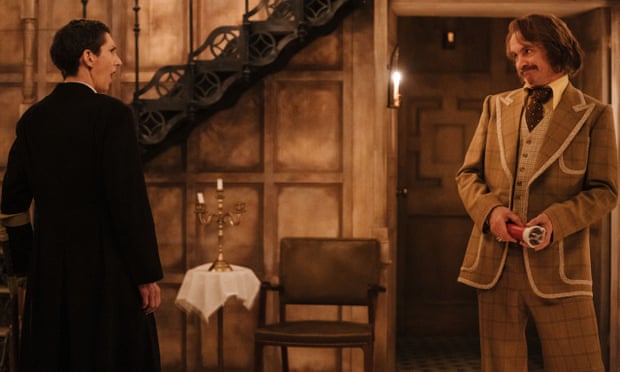
For her last production in the Globe’s candlelit Sam Wanamaker Playhouse, Ben Jonson’s Bartholomew Fair, Blanche McIntyre expertly conjured the life of a city onto a tiny stage. Her Measure for Measure is another city play, but of a very different kind. It is an enclosed affair, in which the action takes place in the private chambers of Vienna – hidden manors, courtrooms, confession booths, jail cells – and in the tortured heads of its leaders. The Playhouse is built for dark interiors, but not usually for the 1970s settings that feature in James Cotterill’s design. McIntyre has taken the cheeky decision to set the play in 1975, which allows the use of some very enjoyable costumes. She also uses the neat trick of a power cut at the start to justify the use of candles throughout the play. It is debatable whether the choice of time period adds to the play’s interpretation, but the cast looks great in a succession of chic pantsuits and wide boy outfits.
The Duke is played by Hattie Ladbury in an ankle-length white coat which sets her apart from her subjects. In disguise, wearing a friar’s black habit, she becomes her own hidden reverse, a provocateur prowling the jails and brothels, throwing lives into chaos. The Duke’s motivations are the abiding mystery of Measure for Measure. Ladbury is a tall, socially awkward presence. There is a hint early on that she has been unable to communicate her true feelings towards Angelo (Ashley Zhanghaza), and her decision to flee her responsibilities is a way to regain some level of control. Her activities seem increasingly strange and cruel, as she uses her subterfuge to toy with the lives of her subjects, pretending to Isabella that her brother Claudius has been executed long after any justification for this story has evaporated. However, her behaviour seems to stem less from malicious intent than from a clumsy desire to play the fairy godmother.
Georgia Landers as Isabella has the wide-eyed certainty of the young about her, convinced about the rightness of everything she does. Her moral certainty makes her much more dangerous than the supposed villains of Vienna, the pimps and bawds. Yet, when Angelo corners her in a sudden fit of rage and demands her body, she cries out “To whom can I complain?” in a way that seems entirely modern. So too, perhaps, is her polarised position which allows for no flexibility of thinking. From a 2020s perspective, it is becoming easier again to understand the right-or-wrong mindsets with which she, and other moralists in the play, back themselves into corners.
The cast is strong and versatile, ensuring McIntyre’s production is always compelling to watch. Ishia Bennison plays four roles, including a concerned Escalus, a brassy Mistress Overdone and a triumphant cameo as the prisoner Barnardine, drunkenly insistent from a hole in the ground. Eloise Secker puts her mark on the production as both a flatly insolent, androgynous Pompey, and a Greta Garbo Mariana in headscarf and sunglasses.
Gyuri Sarossy’s Lucio, with dirty blond hair, moustache and brown suit, is first seen collecting his belongings from the street, where Pompey has slung them from a bawdy house window. His line in comedy and sleaze fits the 1970s setting very well. Sarossy also delivers a twitchy, white-coated version of the executioner, Abhorson, dragging a giant axe behind him. Daniel Millar plays both the Provost and Elbow, opposite ends of the law enforcement spectrum. His Elbow is a chaotic fantasist wielding a malfunctioning bull horn which punctuates his tall tales.
These many entertaining parts do not always coalesce, and a coherent account of this elusive play is never quite delivered. There is plenty of food for thought however, not least in the gender-swapping of the Duke’s role. This allows the character’s motivations to be separated from the exercise of male power that has always dominated interpretations. Both Zhanghanza’s Angelo and Ladbury’s Duke are ill at ease with themselves. For Angelo, this leads to downfall and public disgrace, which does not appear to be eased in the slightest by the Duke’s closing instruction that he should marry Mariana. For the Duke, her appearance belies the woman beneath. In the final scenes, with her cropped hair and dressed head-to-toe in white, she strongly resembles the sexily evil Servalan, from 1970s sci-fi sensation Blake’s 7.
For her last production in the Globe’s candlelit Sam Wanamaker Playhouse, Ben Jonson’s Bartholomew Fair, Blanche McIntyre expertly conjured the life of a city – London – onto a tiny stage. Her Measure for Measure is another city play, but of a very different kind. It is an enclosed affair, in which the action takes place in the private chambers of Vienna – hidden manors, courtrooms, confession booths, jail cells – and in the tortured heads of its leaders. The Playhouse is built for dark interiors, but not usually for the 1970s settings that feature in James Cotterill’s design. McIntyre has taken the cheeky decision to set the play in 1975, which allows the use of some very enjoyable costumes. She also uses the neat trick of a power cut – echoing those dark years in the UK when electricity use was restricted by strikes and government action – at the start to justify the use of candles throughout the play. It is debatable whether the choice of time period adds to the play’s interpretation, but the cast looks great in a succession of chic pantsuits and wide-boy outfits.
The Duke is played by Hattie Ladbury in an ankle-length white coat which sets her apart from her subjects. In disguise, wearing a friar’s black habit, she becomes her own hidden reverse, a provocateur prowling the jails and brothels, throwing lives into chaos. The Duke’s motivations are the abiding mystery of Measure for Measure. Ladbury is a tall, socially awkward presence. There is a hint early on that she has been unable to communicate her true feelings towards Angelo (Ashley Zhangazha), and her decision to flee her responsibilities is a way to regain some level of control. Her activities seem increasingly strange and cruel, as she uses her subterfuge to toy with the lives of her subjects, pretending to Isabella that her brother Claudius has been executed long after any justification has evaporated. However, her behaviour seems to stem less from malicious intent than from a clumsy desire to play the fairy godmother.
Georgia Landers as Isabella has the wide-eyed certainty of the young about her, convinced about the rightness of everything she does. Her moral certainty makes her much more dangerous than the supposed villains of Vienna, the pimps and bawds. Yet, when Angelo corners her in a sudden fit of rage and demands her body, she cries out “To whom can I complain?” in a way that seems entirely modern. So too, perhaps, is her polarized position which allows for no flexibility of thinking. From a 2020s perspective, it is becoming easier again to understand the right-or-wrong mindsets with which she, and other moralists in the play, back themselves into corners.
The cast is strong and versatile, ensuring McIntyre’s production is always compelling to watch. Ishia Bennison plays four roles, including a concerned Escalus, a brassy Mistress Overdone, and a triumphant cameo as the prisoner Barnardine, drunkenly insistent from a hole in the ground. Eloise Secker puts her mark on the production as a flatly insolent, androgynous Pompey and as a Greta Garbo-like Mariana in headscarf and sunglasses.
Gyuri Sarossy’s Lucio, with dirty blond hair, moustache, and brown suit, is first seen collecting his belongings from the street, where Pompey has slung them from a bawdy house window. His line in comedy and sleaze fits the 1970s setting very well. Sarossy also delivers a twitchy, white-coated version of the executioner, Abhorson, dragging a giant axe behind him. Daniel Millar plays both the Provost and Elbow, opposite ends of the law-enforcement spectrum. His Elbow is a chaotic fantasist wielding a malfunctioning bull horn which punctuates his tall tales.
These many entertaining parts do not always coalesce, and a coherent account of this elusive play is never quite delivered. There is plenty of food for thought however, not least in the gender-swapping of the Duke’s role. This allows the character’s motivations to be separated from the exercise of male power that has always dominated interpretations. Both Zhangazha’s Angelo and Ladbury’s Duke are ill at ease with themselves. For Angelo, this leads to downfall and public disgrace, which does not appear to be eased in the slightest by the Duke’s closing instruction that he should marry Mariana. For the Duke, her appearance belies the woman beneath. In the final scenes, with her cropped hair and dressed head-to-toe in white, she strongly resembles the evil, sexually charged character Servalan, from 1970s sci-fi sensation Blake’s 7. However, she lacks the sexual confidence her appearance implies, leading to an intriguing final moment. Her offer of marriage to Isabella, which comes out of the blue and is now usually played as a disastrous misstep, is embarrassed and tentative. She and Isabella linger, facing one another, neither knowing what their next move should be. It is a surprisingly romantic ending for a play that has some of the fairy-tale elements of Shakespeare’s later comedies. Will they or won’t they? We will never know and neither, probably, will they.
Force Majeure by Tim Price – Donmar Warehouse, London
Adapted from Ruben Östlund’s film, Force Majeure is an exercise in family breakdown set among a group of well-off Swedes on a skiing holiday. Threatened with a avalanche, heading straight for his wife and two children, Tomas (Rory Kinnear) grabs his phone and runs. His wife Ebba (Lyndsey Marshall) grabs the children and dives under the table. The play deals with the consequences of his instincts, and his refusal to admit what happened. Ebba and Tomas’s marriage is clearly strained before this incident. He spends all his time on work, leaving her to manage the children, who he doesn’t really know. The combination of an unfamilar setting and a sudden crisis brings it all tumbling down. Kinnear is the master of tight lipped denial, and his casting is very good. He is excellent at being superior while entirely in the wrong. Marshall is equally good, combining steeliness and vulnerability. Their children, Vera and Harry played on this occasion by Bo Bragason and Harry Hunt, are all too recognisable as a sarcastic teen and a wired pre-teen.
Michael Longhurst’s production makes creditable efforts to bring ski slopes to Covent Garden. The stage is covered in white matting, and cast members ski across its rake with admirable control. The otherworldy neon of ski gear, and the somewhat hellish Euro-dance bar atmosphere is evocative and convincing. It’s not clear, though, that this particular film needed a stage adaptation. The script is not entirely convincing, resorting to unlikely stereotype characters as foils for Tomas and Ebba – a blokeish mate separated from his wife (Sule Rimi) and a liberated swinger (Natalie Armin). Kinnear delivers his eventual meltdown as both funny and pitiable, but the ending seems contrived and the message murky. However, the evening is an enjoyable spectacle, and includes neat touches such as the ever-present hotel staff who interrupt every significant scene trying to get their work done, their minimum wages lives contrasting grimly with the privileged families they look after.
The Tempest by William Shakespeare – Jermyn Street Theatre
The Jermyn Street Theatre is a tiny place to stage a play that is more usually seen filling all the space on offer at the RSC or the National Theatre , but the scale gives Tom Littler’s production of The Tempest particular meaning. The set, designed by Anett Black, is Prospero’s rather cosy cell, lined with desirable, wavy bookshelves. The fantastical happenings on the island seem conjured from his head to a greater degree than most productions and even, perhaps, take place only in his imagination. The part is played by Michael Pennington, whose performance is intriguing in several ways. He wrote, in his book ‘Sweet William’ about his reluctance to play the part, which he attributed to failing to fully understand Prospero. However, in the programme for this production he also discusses his concern that this is the final part a Shakespearean actor plays, after which there is no more. Pennington’s Prospero is stooped and elderly, trying to put his affairs in order and provide neat endings for all the loose ends in his life before it is too late. Pennington’s voice is remarkable, carrying all the power and cadence of a man used to bestriding the big stages. It is a treat to watch him so close up. His performances is all the more remarkable because he reads the part from a book, a very rare situation on stage. Presumably this is what he needs to do to be able to play the part and, to some extent, it fits the conceit that Prospero is directing events. It also adds to the vulnerability of his performance, and to the sense that Prospero is running out of time.
The rest of the cast are strong, with some enjoyable performances. Rachel Pickup’s Miranda and Tam William’s Ferdinand are both older than actors often cast in these roles, adding to the sense that Prospero’s grasp on time has eroded. Richard Derrington and Peter Bramble double, to great effect, as Antonio and Stephano, Sebastian and Trinculo, playing both ends of the social spectrum with relish. Derringtons’ Welsh Stephano is a particular pleasure. However, the driving force is Whitney Kehinde’s Ariel, who works very hard indeed for her master. Her movement style makes her seem alien, and her energy compensates for Prospero’s lack of it. She even performs the entire masque sequence herself, as three different characters in quick succession. The production is expertly managed and the tiny stage expands to fill the dimensions of an island, with only a painted sheet to change the scene. It provides an opportunity that should be missed to see a fine actor giving the performance he never thought he would.
Like all theatre companies, the Royal Shakespeare Company has experienced a tough 18 months, so it is fortunate that artistic director Gregory Doran’s complete cycle of Shakespeare’s plays, derailed by the pandemic, had reached The Comedy of Errorswhen the curtains went down in 2020. No Shakespeare play is better placed to provide the pure entertainment that has proved a hit with returning audiences. Directed by Philip Breen, now established as the RSC’s comedy specialist, the production transfers from Stratford-upon-Avon, where it played in the temporary Garden Theatre. Honed in the open air with nowhere for the actors to hide, it is a riot.
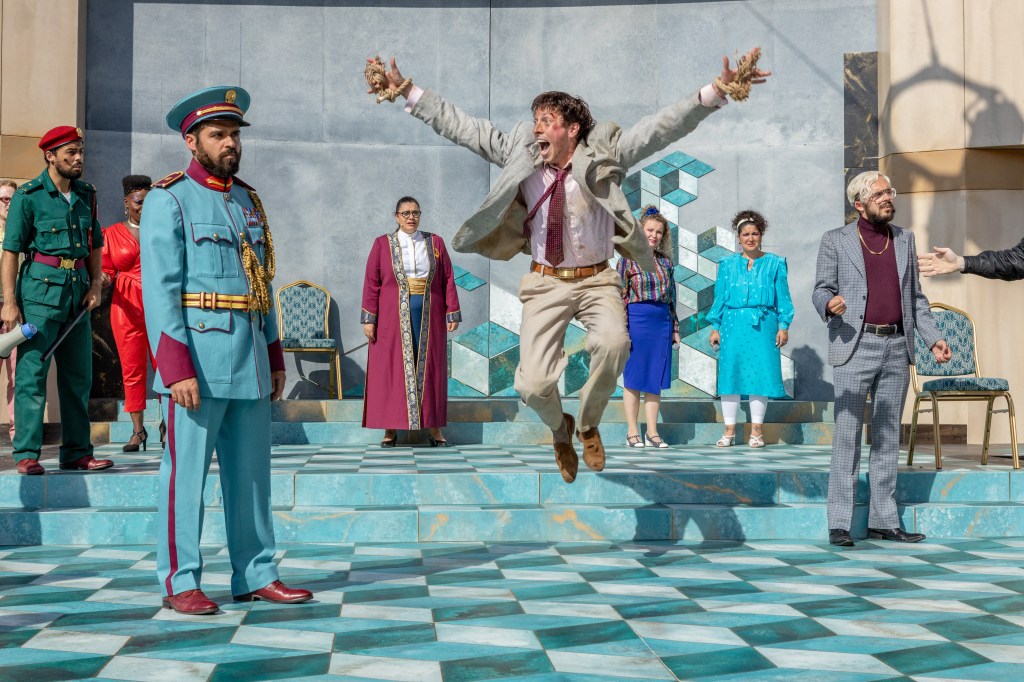
Breen and designer Max Jones have conjured a 1980s Ephesus, overrun with gleefully realized costumes. Dresses are teal, tights are cerise, shirts are splashed with geometric pastels, and braces are in evidence. Military uniforms are in fetching pale blue or green from a Tintin fantasy South American republic. Pale stone walls and a chequered marble floor suggest a Mediterranean setting, but the ambience is that of a parallel, heightened, frantic version of reality.
The mood is carefully balanced between oppression and anarchy. The chill of the first scene, as Antony Bunsee’s gaunt, abject Egeon is sentenced to death for passport offences, dissolves as the dignity of the Duke of Ephesus and his courtiers is dismantled in the escalating chaos. A few scenes are needed to wind up the tension caused by the confusion between two sets of identical twins – the Antipholus brothers and their servants, the Dromios. Hedydd Dylan’s excellent Adriana, pregnant and furious, marches on her supposed husband and, haloed in hairspray, delivers an inspired rant about fidelity. From then on, the production cannot be stopped.
The pairs of twins are passably similar in appearance but are distinct characters. Guy Lewis plays Antipholus of Syracuse, newly arrived in town, as the naive victim of events beyond his control. Rowan Polonski’s Antipholus of Ephesus is all sharp suits and moneyed front. This makes it all the funnier when the provocations finally become too much and he loses it completely, leaping about in a manic fury that terrifies the entire theatre. Breen carefully builds the farce to a sustained peak, releasing the tension in a series of sustained physical comedy masterclasses. Lewis spends an entire scene wrestling an officer into increasingly unlikely positions, while trying to explain himself to Dromio. Polonski’s star appearance at a ribbon-cutting ceremony is derailed with inventive use of the scenery. Lewis and Broadbent turn hoary jokes about an amply proportioned kitchen maid into a strange stand-up routine. A live barbershop quartet soundtracks the entire performance, as much part of the action as the rest of the cast.
Jonathan Broadbent, as Dromio of Syracuse, is initially more suave than his twin (played by Greg Haiste), who is always heading for a pratfall. His disintegration in the face of provocation is a delight, but the two also share a surprisingly moving final reunion scene. The darker aspects of the play are also highlighted, masters and mistresses showing a disturbing tendency to beat them both at every opportunity.
The production features many other enjoyable performances. Avita Jay’s Luciana is the beleaguered, outraged voice of normality. Baker Musaka has a lot of fun as Angelo, the goldsmith, first saucy then outraged then fearful, as he is menaced by “merchants” to whom he owes money. These come in the inspired form of criminal boss William Grint, a deaf actor who signs his lines, and his Russian bodyguard (Dyfrig Morris) who interprets his threats, which are made in gory dumb show. Riad Richie makes the most of his background role as a guard with scene-stealing antics that turn him into an audience favourite. Toyin Ayedun-Alase’s Courtesan wears a full Grace Jones catsuit and hair, and has the presence to match.
Farce is a difficult genre to get exactly right, but Breen does the play and the company proud. His awareness of RSC history, handled lightly, brings an extra layer of pleasure: a black and white chequered shopping bag, a tribute to Ian Judge’s wild 1990 production, or the ginger Dromios, reminiscent of Jonathan Slinger and Forbes Masson in Nancy Meckler’s 2005 version. His production brings people together in the shared enjoyment denied for so long, but also succeeds in drawing out impressive nuance from a play that can seem shallow in the wrong hands. The final scenes bring the mood down from high farce to an almost Winter’s Tale-like redemption, as the reunited twins circle each other in wonder and their family reappears all around them. It is the culmination of a triumphant evening, and a production that has the quality to fill the Barbican up again.
Endurance by Jennifer Jackson – Battersea Arts Centre, London
Endurance takes the form, disconcertingly, of an endurance test for the main performer, Jenni Jackson. Emerging from a Bolivian carnival costume with outsize demon head, she turns out to be dressed for running. Lacing up her shoes in silence, she begins a series of curving, 6 second runs from one corner of the stage to the other and back again. She continues this, more or less, for nearly an hour, becoming more and more physically distressed. A monitor projects her heart rate and a computerised voice, also captioned onto the screen, offers commentary, encouragement, advice, discouragement and alarming predictions in a computerised voice. The stream of Jackson’s thoughts is revealed to us, ranging from funny – unhinged motivational messages and failures to get out of bed to train – to wider cultural context – her Bolivian mother, the carnivals of La Paz and the story of Bartolina Sisa, a 17th century Aymaran resistance leader, dismembered by the Spanish. Her own life is also drawn into the mix, including an experience of sexual harassment in public and an apparent betrayal. The computer voice is male, and Jackson seems to struggle against the sometimes controlling messages projected onto her by men. At one point the voice just repeats her name, again and again, as her heart rate soars. Then she breaks free, somehow finding the energy to perform a moving and very impressive dance piece with a besuited carnival figure of death who appears from nowhere.
There is lot going on in Endurance, too much at times. In the absence of any information for the audience, it is impossible to know who directed or worked on the show, but it could certainly be tightened to focus its effect. Nevertheless, it is quite an experience. Jackson’s running is a conceptual art performance in itself. The audience feels a growing affinity for Jackson as she tires and enters the pain zone, and some concern as her heart rate rises far beyond her supposed maximum. Her total physical commitment makes this an exceptional piece, while as a dancer she completely convinces. Jackson opens up in a way that is both captivating and disturbing. When she finally speaks, in her North Warwickshire accent, we have a real sense of relief that she has made it. Perhaps the questions about her identity that swirl through her head as she runs have reached some form of resolution.
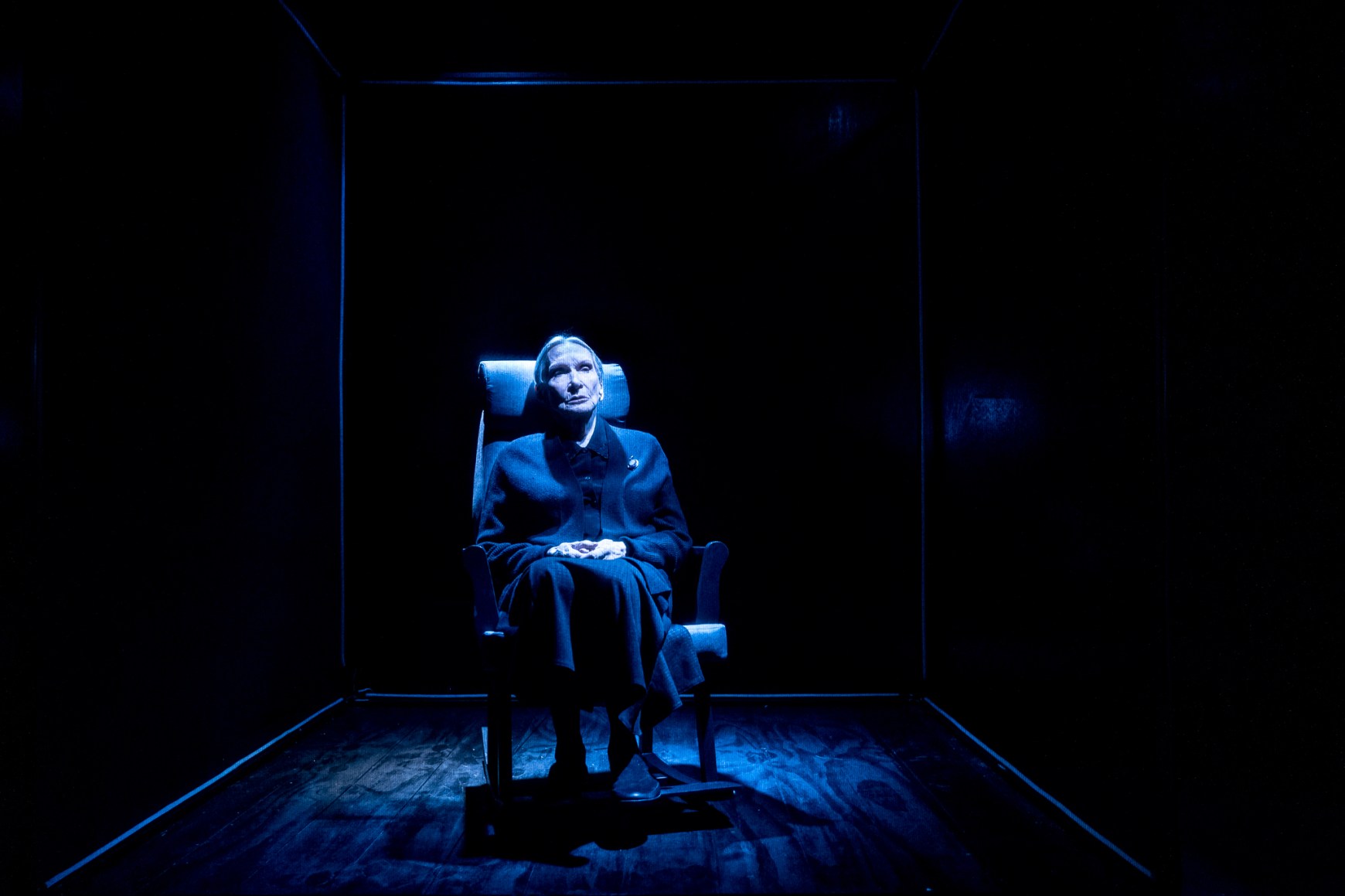
In the tiny, pub theatre-esque Jermyn Street Theatre Samuel Beckett’s two monologues, Footfalls and Rockaby, exert a powerful hold. The performers appear ghost-like, illuminated against the blackness with space defined only by strips of white neon. These form a cage around Siân Phillips in Rockaby, rocking back and forth on her chair, ticking down her final hourse. In Footfalls, the light creates an edge against which Charlotte Emmerson leans her head when she finally stops pacing, counting her nine steps across the room and nine back. The double bill, directed by Richard Beecham, brings together late Beckett pieces, from the late ’70s and early ’80s that work well together. Both are about women counting down time, with only one possible outcome.
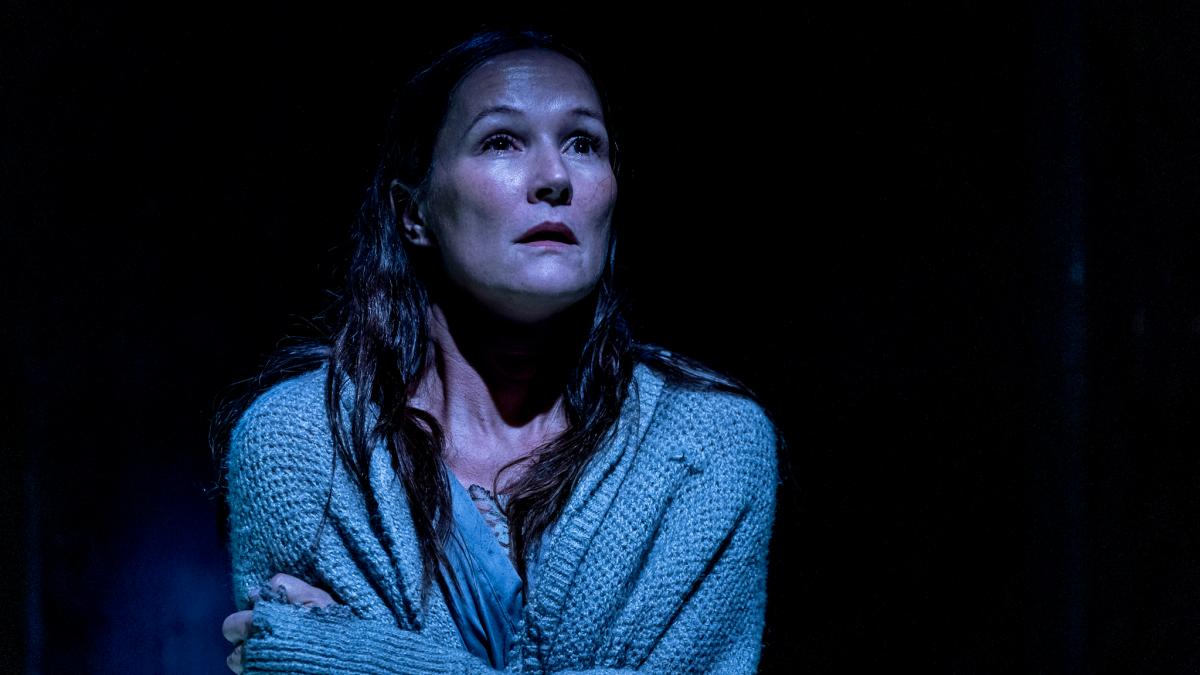
Emmerson, on Simon Kenny’s neat, two platform set, paces a raised rectangle of space, beating out rhythms in her movement and speech. Something undefined has happened to leave her in this state, a ghost of a person with only rituals to show she is still alive. The voice of her mother, off-stage, asks “Will you never have done … revolving it all … In your poor mind?” Emmerson, working within Beckett’s strict stage directions, reveals desperation and resilience as two sides of the same coin. She is mesmerising, part of play that seems to stop time.
When Phillips enters, it seems for a moment that she is the unseen mother from Footfalls, but the transition is between plays to the stiller, even more musical Rockaby. In a chair, rocking gently, Phillips part is mostly pre-recorded with occasional comments as she listens to the voices in her head. Beckett’s poetry is particularly absorbing, with lulling, repetitive patterns of speech matching the rocking of the chair, soothing the unnamed character as she sinks away. The repeated phrase “Till in the end / the day came / in the end came / close of a long day” is a mantra with the power to close down a life. Dame Siân’s rich voice is perfect for this role, and the Beckett’s writing does not bring the terror of death into the theatre, but rather it’s inevitability.
Beecham’s production is top quality theatre, with a well chosen and beautifully cast pair of plays performed in a magically unlikely space that feels like a leftover from a lost West End of dive bars and characterful landladies. In fact, it’s an essential piece of the London theatre scene, and there can be few places in the world where the best performers around will play in such an unglamorous setting. We should be grateful for the Jermyn Street Theatre for serving up unbeatable evenings such as this.
Sh!t Theatre’s approach is entirely unique – a potent combination of extreme silliness and penetrating political critique. In a succession of award-winning shows, from Letters to Windsor House to Sh!t Theatre Drink Rum with Expats, they have tackled violence, corruption, hypocrisy, sexism, migration, racism and a great deal more. They blend this with a fascination for areas of pop culture most performers probably think beneath them, such as Dolly Parton in Dollywould and their ridiculously amusing Love Actually parody-tribute, Sh!t Actually. Now Rebecca Biscuit and Louise Mothersole return with a show-in-development piece at Camden People’s Theatre, their spiritual home. Everyone is keen to discover what insights they have developed during lockdown. It soon turns out that they have mostly been listening to ‘Evita!’ and taking on interns.
The show is presented by two epically out-of-their depth work experience interns, who have taken on the donkey work while Rebecca and Louise relax in the corner, emerging only to deliver the big musical numbers. It also becomes apparent from film footage, a Sh!t Theatre trademark, that the interns have been disturbingly exploited, although they seem not to realise it. Their duties include non-stop dancing in the garden and bathing Rebecca and Louise, together. Their employers’ behaviour may have been influenced by their research into the life of Argentinian dictator Juan Perón, his doomed wife Eva and his second wife, ex-dancer Isabella. The latter, who became the first female leader of a country in the modern era when Perón died in 1974, is not quite the feminist icon her CV might imply. Calling herself Isabelita, she was best known for running death squads to enforce her right-wing dictatorship before fleeing into exile in Madrid, where she escaped prosecution. She and Perón are less remembered for embalming Eva’s body and hanging it in their dining room. The full, fascinating Gothic horror of the Perón era does not feature in ‘Evita!’ written, as Sh!t Theatre put it, “by Conservative peer Andrew Lloyd Webber and UKIP donor Tim Rice.” They are in the process of correcting this, rewriting several numbers to reflect the story as they see it, to hilarious and probably illegal effect. It will be a tense wait to discover how Louise and Rebecca will complete the show, as they claim to be planning a visit to find Isabelita, who is still alive in her 90s, somewhere in Madrid. As long as they survive their research phase, this has the makings of their best show yet.



 Tom Bolton