The Line of Beauty

Photo by Johan Persson.

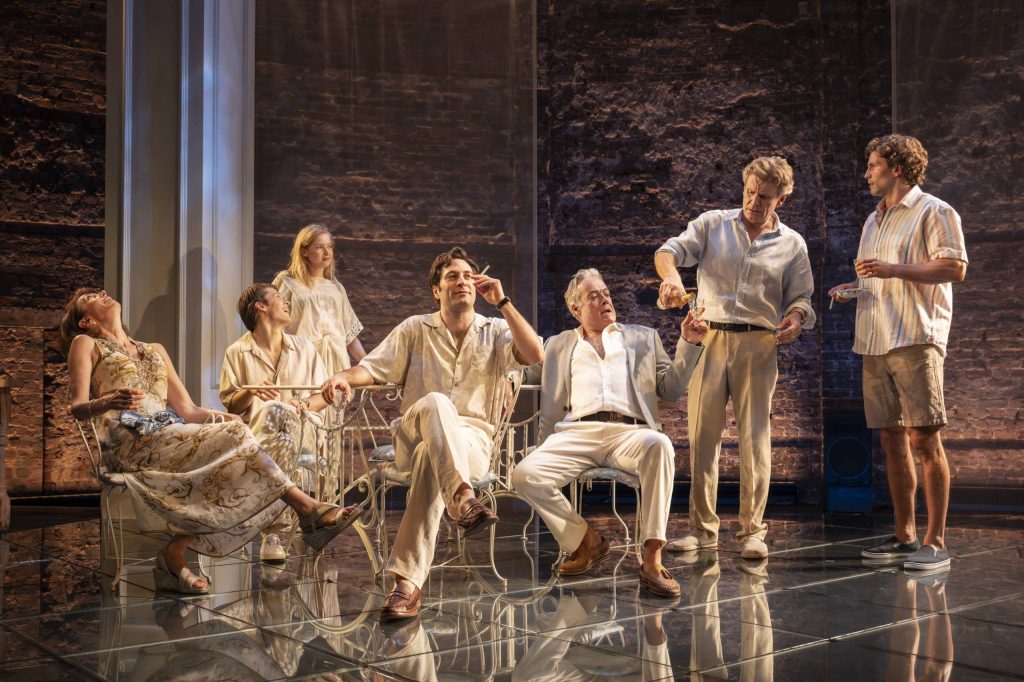
The Line of Beauty by Alan Hollinghurst adapted by Jack Holden – Almeida Theatre, London

Alan Hollinghurst’s much-loved novel, The Line of Beauty, won the Booker Prize in 2004. Looking back to the rise of Conservative politics in 1980s Britain, and the parallel AIDS crisis, it explored gay life and consciousness through the eyes of ingenue Nick Guest, who learns a lot in a short space of time. Now, adapted by Jack Holden and directed by Michael Grandage, it reappears two decades later on the Almeida stage.

Adapting novels as plays can be a thankless task, especially when they’re well known, but Holden does a good job in not allowing the book to kill the drama. Covering the period between the Conservative victories at the 1983 and 1987 elections, the play dramatises the collision of personal and political from the perspective of Nick, played engagingly by Jasper Talbot and his experiences in love, and while lodging with the family of a Conservative MP. Performances are universally strong, and Grandage’s production is very tightly delivered. Alistair Nwachukwu gives a standout performance as Nick’s first lover Leo, charming, clever and vulnerable. Arty Froushan, as cocaine-snorting playboy Wani, Charles Edwards as smooth, fatherly MP Gerald Fedden, Robert Portal’s menacing Badger, and Ellie Bamber as bipolar Cat Fedden are all excellent performances. Hannah Morrish channels the demeanour of Fergie in a way that is both hilarious and disturbing. Doreene Blackstock, as Leo’s mother, and Claudia Harrison as Gerald’s wife are also very strong, but their roles are rather limited – a problem with both book and play. The staging is sumptuous – sets and costumes by Christopher Oram – who has clearly delighted in recreating and subtley parodying the high society 1980s with its odd combination of frumpiness and glamour.

Some of the more literary aspects of the book get a bit lost in the dramatisation, such as the thematic significance of Henry James and of the ogee, a shape which swings both ways. What is more significant is how much of a period piece the play feels. Hollinghurst was writing about a period 20 years earlier, a time now approaching half a century from the present day. The key issues of the time – homophobia, social conservatism, privilege and the devastation wrought by AIDS should not be forgotten, but are not undiscussed. The play offers a highly professional and entirely entertaining evening, but it is unclear exactly why this novel needs to be staged at this particular moment.

Cyrano de Bergerac

Photo by Marc Brenner.

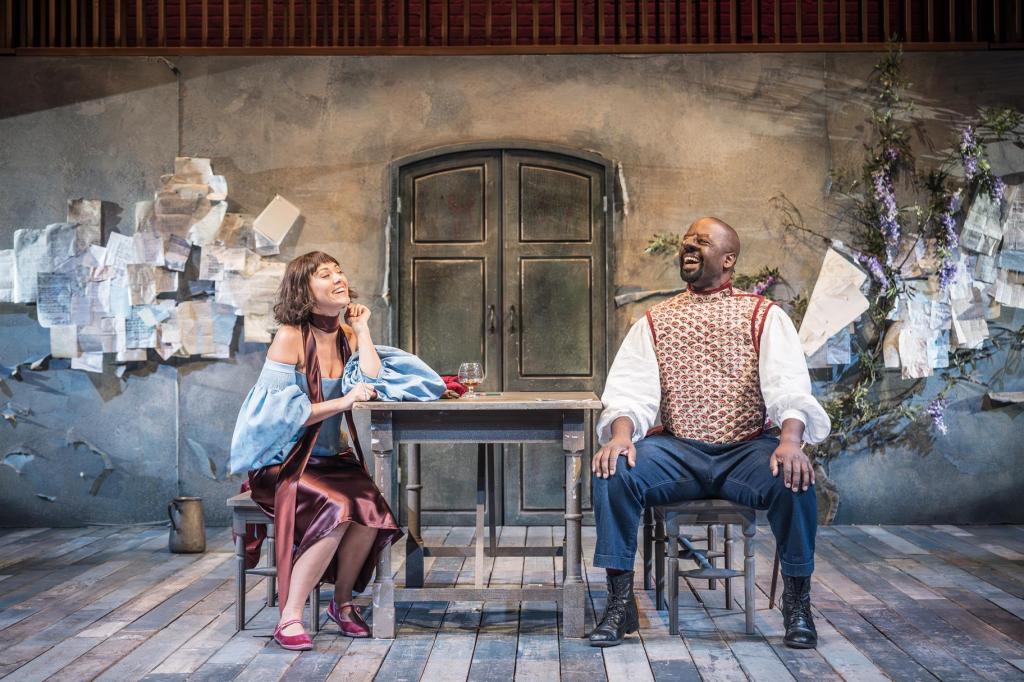
Cyrano de Bergerac by Edmond de Rostand – Swan Theatre, Stratford-upon-Avon

Simon Evans’ production of Cyrano is a very convincing and enjoyable account of a play which stands up well to re-examination. Evans has also adapted the play, with Debris Stevenson, giving the language a contemporary flavour without undermining the period setting, in a fantasy 17th century France. The play is held aloft by an exceptionally strong case who bring a notable level of star wattage to the stage. Adrian Lester, as Cyrano, exudes leading man skill and control, to the extent that at times he reminds us of Derek Jacobi, who triumphed in the role at the RSC for Terry Hands in the early 1980s, and at others of Simon Russell Beale. Cyrano is a part that requires a dashing, confident, yet vulnerable performance, and Lester provides this with apparent ease. He is brash in the tavern scenes, charming with Roxanne, conflicted with love rival Christian and, in the play’s final scene, when he drops the letter he is reading, supposedly the last missive of the dead Christian, and recites it to Roxanne from memory, devastating. Up until this point the play has been hugely entertaining, but it is this culminating encounter which makes it something special. The play’s emotional weight all builds to this moment of revelation, as Roxanne realises he has loved her all along, and Cyrano realises the same. There is not a dry eye in the house.

Lester’s triumphant performance helps create the conditions for the whole cast to shine brightly. Susannah Fielding, as Roxanne, is exemplary – riding a wave of breezy, charming detachment until her emotions catch up with her. Her outrage at discovering she has been deceived by Cyrano all along unleashes a fascinating cascade of conflicting impulses. Levi Brown is excellent as a casuallly insulting Christian de Neuvillette, cocky and doomed. Scott Handy’s Comte de Guiche is very funny, appearing to belong to a parallel aristocratic world where nothing quite makes sense to him. And Greer Dale-Foulkes makes Abigail, Roxanne’s companion, a very amusing comic adjunct to the action.

Performed on Grace Smart’s sets of torn posters, worn plaster and red velvet curtains, the play fills the Swan stage as though written for it. Evan’s has conjured a hit, somewhat old-fashioned – in a good way because it successfully revives a classic for a new generation without significantly remaking the play. It’s a significant achievement, and makes for a very satisfying evening watching very good actors show us their skills.

Bog Witch

Photo by Lucy Powell

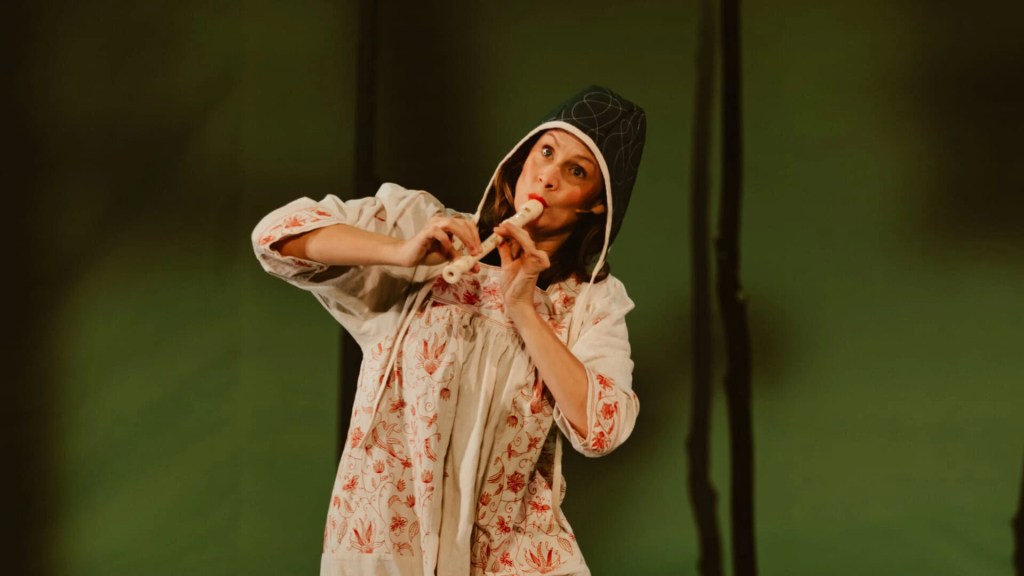
Bog Witch by Bryony Kimmings – Soho Theatre, Walthamstow

Bryony Kimmings’s last show was in 2018, in a different era. Her disturbingly personal and raw shows made her a 2010s fringe star. Her unpredictable, apparently chaotic style proved highly influential on the style of alternative theatre performers. Now she’s back with her first show since having a son, separating from her partner (Tim Grayman, well known to audiences from their joint show, Fake it ‘til you Make it), and moving to the countryside with a man called Will. Bog Witch unpicks this experience. To some extent it is classic Kimmings. She is disconcertingly direct, about herself and the way she feels, tells rude jokes, and wears ludicrous costumes. She is a very engaging performer, always undercutting herself with double takes at her own explanations. The audience loves her, and there is a very welcoming atmosphere in the vast, gleaming, newly refurbished Walthamstow branch of the Soho Theatre.

However, Bog Witch does not deliver the energy levels of previous Kimmings work. The size of the venue does not help. Beautiful although it is, the new venue is much larger than any comparable fringe venue and there is a sense that this show would have worked better in a more intimate space, more suited to Kimmings confessional style. Working (for the first time?) with a co-director, Francesca Murray-Fuentes, Kimmings works hard to occupy the cavernous stage, using everything from a long white backcloth to an epic witch costume, rustic paraphernalia and an amusing ‘burning at the stake’ tableau. However, the work to achieve this detracts from the show, with Kimmings often engaged in moving props around.

There is also a lack of the wildness and abandon apparently promised by the title. Bog Witch is a controlled show, which threatens to flatline at a couple of points in the second half (not that there is an interval, despite the near 2-hour running time). The themes she is addressing are very grown-up – depression, miscarriage, social compromise, climate responsibility. She (her performance persona, that is) seems changed by her experiences of getting older and having to compromise more, with some of her edges rubbed away. We have to buy into her changed self to stay involved in the show. The story of redemption she has to tell lacks excitement at times, and the audience-participation finale is somewhat flat. Although watching Kimmings on stage is always a good use of time, this is not the most driven or electrifying of her shows.

The Mistake

The Mistake by Michael Mears – Arcola Theatre, London

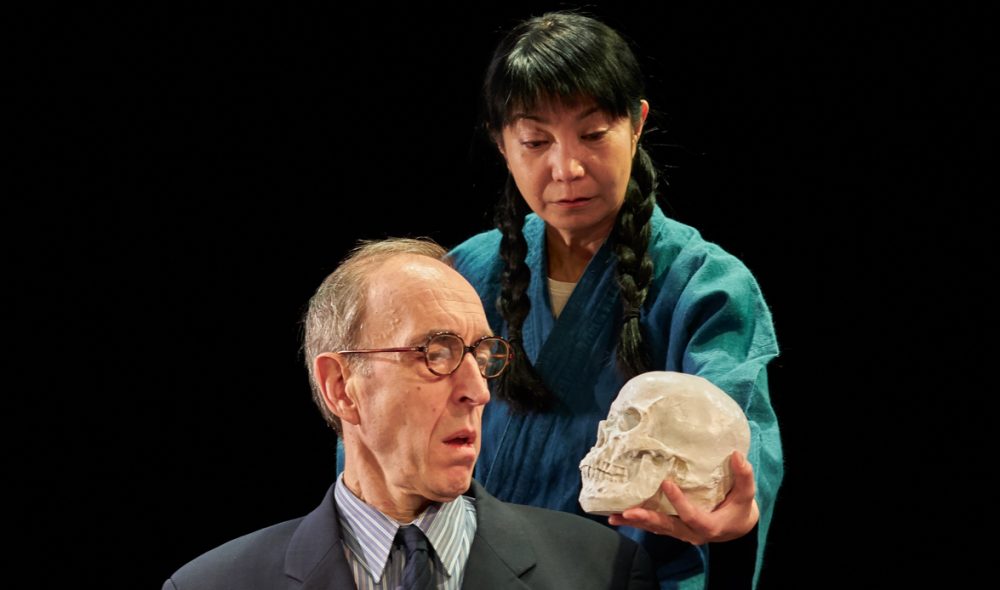
The Mistake, which returns to the Arcola for a short run during a global tour, is a two-person show about something that happened 80 years ago, but still reverberates through our culture: the atomic bombing of Hiroshima. Michael Mears is both writer and performer, switching between multiple roles alongside Riko Nakazono. The play combines close examination of the bombing and its terrible aftermath with inventive staging that brings a topic that risk become a lecture to life with ingenuity and moments of powerful emotion.

Mears focuses key figures in the development and deployment of the first atomic bomb, who are often forgotten: atomic scientist Leo Szilard, who made the breakthrough that led to the successful testing of the first atomic reactor; and Paul Tibbets, the pilot who dropped the Hiroshima bomb, flying the Enola Gay – a plane named after his mother. Szilard was immediately aware of what he might have unleashed, and campaigned valiantly, an in vain, to prevent the bomb being dropped on a populated city. Tibbets, whose later interviews with Studs Terkel form part of the play’s source material, was unapologetic to the end about his role and said he’d do it again in a heartbeat. Mears plays both these constrasting characters and a host of others, including Robert Oppenheimer and Albert Einstein, with great conviction.

His white, male authority figures are set against a parallel storyline about the horrific impact of the bombing itself, told through the eyes of a young Hiroshima woman played by Nakazono. Using minimal props, the pair make a big impact, staging the moment-by-moment approach of the B-29 as a normal day unfolds in the city below. The impact of the bomb is graphically evoked with nothing but a model plan and a set of metal steps, while Nakazono’s account of the terrible injuries and the mass deaths it caused is heartbreaking. Rosamunde Hutt’s direction gives the show life and energy, and Mears’ writing gives it strong purpose. It is very well-informed and researched, full of fascinating or alarming pieces of information, such as the fact that the possibility of a critical nuclear reaction came to Szilard, living in London, as he waited to cross the road on Southampton Row; or the little-know fact that the USA made preparations to bomb a third Japanese city. The Mistake – which, needless to say, refers to Szilard’s discovery of the chain reaction – is a campaigning play, seeking to prevent us forgetting what a terrible thing we once did, so we do all we can to prevent it from ever happening again.

Entertaining Mr Sloane

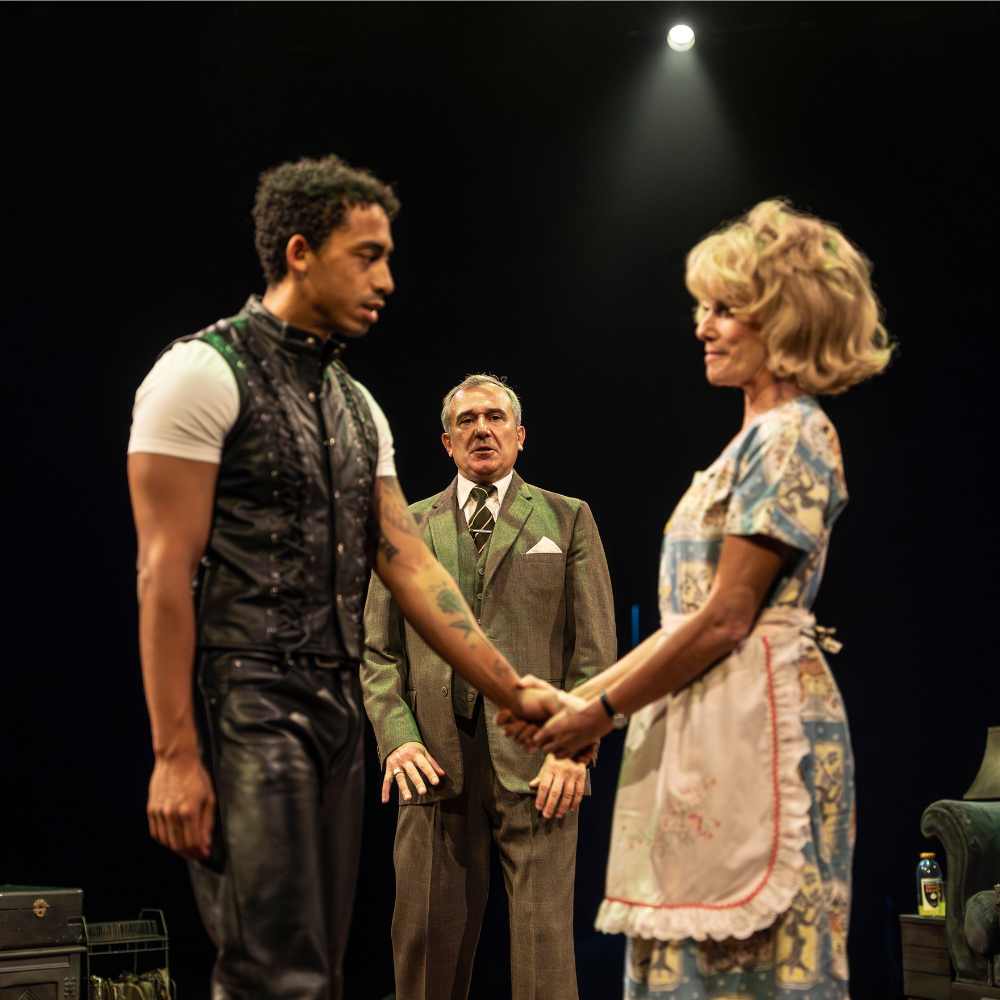
Jordan Stephens, Daniel Cerqueira and Tamzin Outhwaite. Photo by Ellie Kurttz.

Entertaining Mr Sloane by Joe Orton – Young Vic, London

Joe Orton’s 1964 play is revived, 60 years on, in a production by Young Vic artistic director Nadia Fall. She stages in in the round, on a carpeted living room podium surrounded by a tidal wave of detritus, which also hangs above the stage. Orton sets the play in a house perched beside a rubbish dump, and in Peter McKintosh’s set this consists of abandoned prams, furniture, buckets – the remains of collapsed domesticity. The play is a farce gone badly wrong, highly confrontational and very controversial when first staged. Over the years, it’s meaning has changed significantly. Orton was writing the thin veneer of respectability that hid the unmentionable lives of queer people, and a swell of sexual desires that were not acknowledged. Now, these elements of the play seems less remarkable than the social assumptions that are unwittingly revealed. Passing references to sexual predation in children’s homes and scout troupes, casual racism and the staggering sexism which drives the evening’s climax are somewhat jaw dropping. There’s a distinct sense that this play is no longer what we imagined it to be.

The cast play Orton’s scabrous dialogue with a slightly strangled formality which emphasises the sense that we are spying on a very different time. Tamzin Outhwaite is compelling as Kath, equal parts calculating and naïve in her pursuit of the new, sexy lodger Sloane (Jordan Stephens). This is Stephens (Rizzle Kicks) first professional stage role and, although he is enjoyably self-satisfied he lacks the air of menace that is essential to the role. Sloane has to appear a threat, who could destroy everyone around him, but he seems more a passive object of lust for Kath and her brother Ed, played by Daniel Cerqueira with a deliciously upright campness. His failure to conceal his excitement when he first encounters Sloane, asking him “Do you wear… leather?” is very funny. Their elderly father, Kemp (Christopher Fairbank) is impressively dilapidated and seedy, like Eric Sykes if bitter experience had displaced his sense of humour.

The first act is a highly entertaining competition between brother and sister for the same man. It’s the second half when things start to fall apart. Entertaining Mr Sloane bears a resemblance to Harold Pinter’s The Homecoming, staged in 2023 at the Young Vic on a similarly furnished set. A disruptor arrives in an apparently settled household, opens up the cracks and realigns the sexual relations. However, Pinter is a much more subtle writer, implying but rarely confirming what’s going on beneath the surface. Orton makes everything very explicit, which provides diminishing returns. Pulling this off requires more comic energy than this production can muster. The final scenes, where Orton has Ed and Sloane brutally humiliate Kathy, come across as nasty rather than subversive. Although she gets her comeback, the verbal and physical violence is unpleasantly one-sided. Orton seems to be enjoying himself, which makes for very uncomfortable viewing. The audience is left with a sense that this revival reveals the flaws in the play, and that it’s time may have passed.

The Bacchae

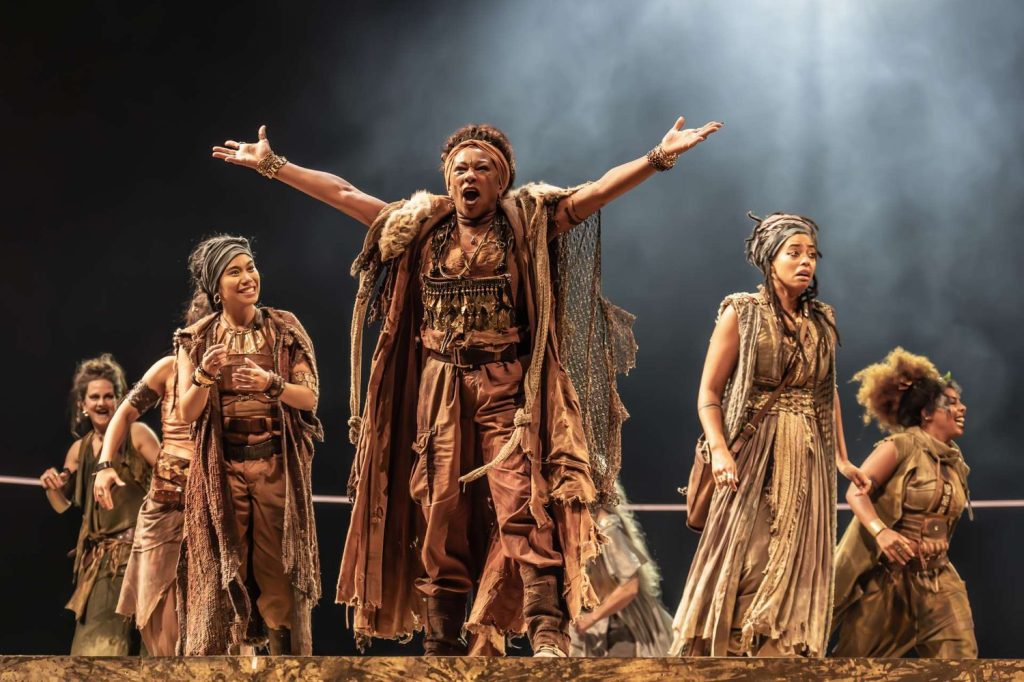
Clare Perkins and the company. Photo by Marc Brenner.

The Bacchae by Nima Taleghani after Euripides – National Theatre: Olivier, London

Indu Rubasingham’s first production as National Theatre director is a statement of intent. It is full of energy and irreverance. The opening image is a giant, white, bloody horse head designed by Robert Jones, lowered over his set of moving marble slabs. Clare Perkins, as Bacchae leader Vida, dominates the opening scenes with the help of Nima Taleghani’s rude, slangy script. In the opening She tells Melanie-Joyce Bermudez’s impulsive follower “Chill out, you little shit”, setting the tone for a representation of Euripides classic text in unashamedly modern language. Kate Prince choreographs energetic group dance which fills the vast Olivier space.

There are powerful performances from Simon Startin as exasperated seer Tiresias, Ukweli Roach as a golden Bacchus, Sharon Small as a wild Agave and James McArdle as Pentheus, especially in the scenes where he discovers his feminine side. Some aspects of Taleghani’s debut play work well – especially the group scenes, Pentheus’ transformation from dictator to damaged victim, and the super confident tone. Others are less successful, including the attempt to give the Bacchae individual identities which comes across as rather Spice Girls, and the presentation of Bacchus which lacks the cold menace that usually lies at the heart of this play.

The production lays down a marker for theatre, as a forum for debate in a messy world, and gives a clear sense of a manifesto for the National to be a place where everyone is welcome, and all voices are heard. Rubasingham’s intent is strong, and if this show is anything to go by, her tenure will be exciting and always watchable, if not conceptually rigorous.

The Land of the Living

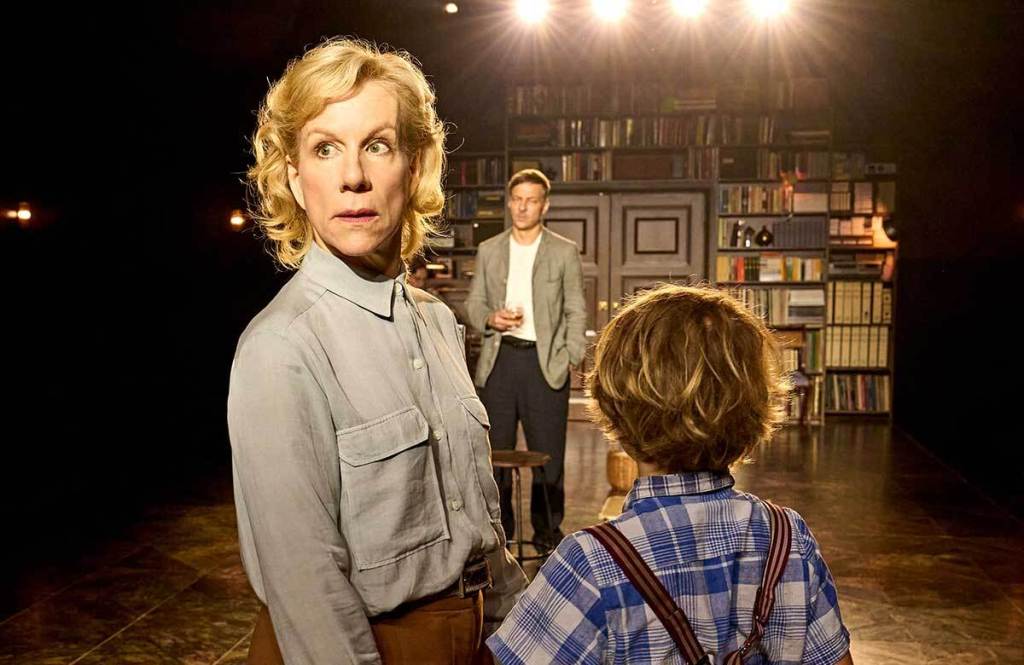
Juliet Stevenson, Tom Wlaschiha and Artie Wilkinson Hunt. Photo: Manuel Harlan

The Land of the Living by David Lan – National Theatre: Dorfman, London

Stephen Daldry’s production of David Lan’s new play, about the moral dilemmas in the aftermath of World War II and their lifelong consequences, piles the pressure on relentlessly. Juliet Stevenson plays Ruth, now in her 70s, living in London. Someone she hasn’t seen for 50 years arrives – Thomas (Tom Wlaschiha) – and we watch the story of what happened to him unfold over the next two and a half hours. Ruth was a young woman working for the UN in Bavaria, the American sector, after the German surrender. She and her small team of women look for children stolen by the Nazis from Eastern Europe and checked for Aryan characteristics. Those who passed the tests were given to German families with new names. Those who did not were murdered. Once the children are identified, the hard part begins. Thomas is with parents who hide his real identity, but are distraught when he is removed. Ruth becomes attached to him, saving him from the fate of many children – removed en masse by the Russians or by the Americans to be rehomed. But she doesn’t send him back to Poland either, where he might have rediscovered his original family. He has flown to London from New York to reveal the consequences.

Daldry crosses the play’s two time periods over one another – literally, with Ruth and Thomas occupying either end of a long traverse stage holding Miriam Buether’s London apartment set .while the events of 1945 play out across the middle. The pacing is effective, with the flashback action erupting into the civilised lives they have both built. Stevenson is remarkable, her calm demeanour drawing the audience’s attention to the emotions shifting tectonically below the surface. Wlaschiha is blank faced, traumatised, and expressing himself through music – although it’s a shame he stands aside from the action for much of the play, providing a catalyst rather than participating. The character Thomas is a pianist, and Wlaschiha has remarkable skills too, performing live on the apartment piano as a number of other characters also do, including Stevenson. It is an ensemble performance, with strong performances from Kate Duchêne as Ruth’s mother, Marek Oravec and Cosima Shaw as Thomas’s adopted parents and Caroline Lonq as Elise in a cast that includes several European stage actors appearing at the National Theatre for the first time.

Lan has uncovered a little documented set of events from a time that is much pored over, and has constructed a rigorous, emotionally hard-hitting story. It is an excellent vehicle for the talents of its very high end cast and production team.

Much Ado About Nothing

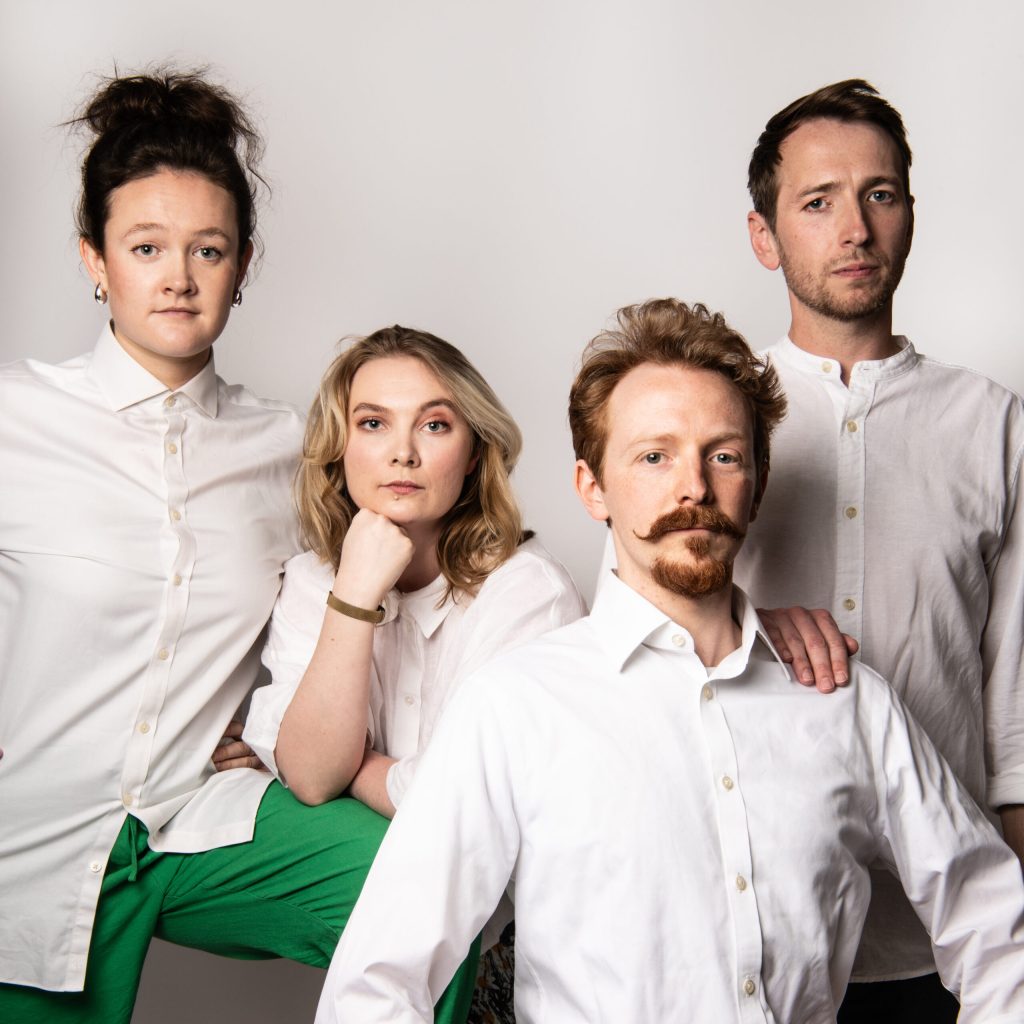
Emma Hadley-Leonard, Sarah Bulmer, William Ross and Andrew Armfield. Photo © Rah Petherbridge

Much Ado About Nothing by William Shakespeare – Dulwich Picture Gallery, Londom

This outdoor production of Much Ado, by genuinely itinerant cycling performers Handlebards, is a glimpse into the travelling player ethos that was most people’s experience of theatre in the pre-modern era. In rain – stair rods for about 15 minutes – the four performers worked tirelessly to maintain the energy, and keep the audience from walking away. They achieved this by turning Much Ado into a sort of clown show – like pantomime Shakespeare – with lots of physical comedy, general silliness, audience participation (the same two audience members were brought on stage repeatedly to fill in the character gaps, and to become a self-generating running gag), and musical interludes. On the surface Handlebards attitude is to take nothing seriously, and the darker moments of the play are certainly not to the forefront. However, their casual approach disguises serious skills. Their timing is impeccable when it matters, and provides a deep comedy well when it doesn’t. Their music-making – lute and ukele tunes and four-part harmony – is of a standard not many people could deliver in a rainstorm.

And Much Ado isn’t dumbed down. It’s simplified, but nothing important has gone missing. And it is communicated clearly, so no-one is in doubt about what is going on, rain and planes notwithstanding. There’s a lot to like here, particularly the four tireless performers who are constantly switching roles, playing voices while someone else does the hands, and generally rushing around. It’s a very enjoyable couple of hours.

Cascando

Photo by Greta Zabultye

Cascando by Samuel Beckett – Jermyn Street Theatre, London

Irish company Pan Pan’s production of Beckett’s radio play, Cascando, is a promenade piece. The audience gathers at the theatre to put on hooded black cloaks and an mp3 player with headphones. With the tech hidden under their hoods, they walk at a measured pace through the streets of, in this case, St. James’s for half an hour while the piece plays in their ears. It is both an intense experience, immersive in the true sense, and a public performance.

Audience members are directed to walk in single file, heads down, focusing on the feet of the person in front ‘as if you were slightly depressed’. The result is a quietly disruptive experience, as a procession of, apparently, monks files slowly through the central London rush hour, amusing and bemusing passers-by, stopping both them and the traffic. The experience of becoming the performance is both very simple, and exhilarating. It is a fundamental twist in the audience contract which turns everything on its head. And that’s without the play itself. Cascando was written for radio and first broadcast in 1963. There are two male voices – Opener (Daniel Reardon) and Voice (Andrew Bennett) – whose rich tones fill our heads. They tell a disjointed story in language stripped to the essentials. Opener sets the scene for Voice, who is apparently trying to finish a story about a man called Woburn, on a journey, ‘same old coat’. The journey seems to be a pilgrimage of sorts, and the Opener a God-like presence. There are also intervals of music by Jimmy Eadie.

The overall production, which premiered in 2016 and has since been performed in venues around the world, is directed by Gavin Quinn. It is quietly astonishing, bringing Beckett disconcertingly alive in a new, modern ritual. As Woburn drifts out to sea clinging to a boat, we know that there is only one way the story will end for all of us, but we measure our steps anyway, one foot in front of another, along the pavements.