What Shadows

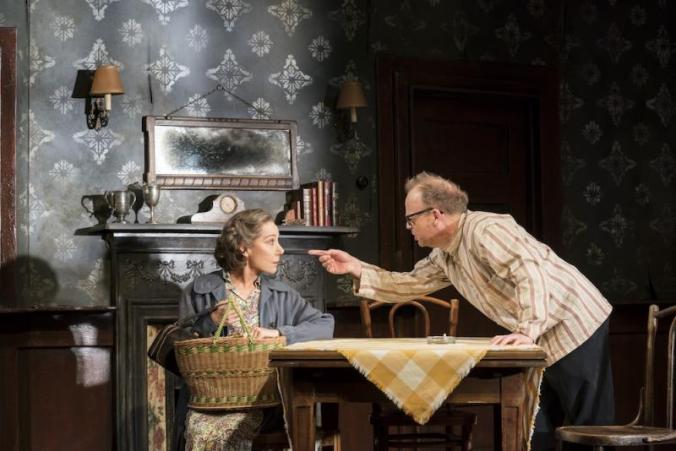
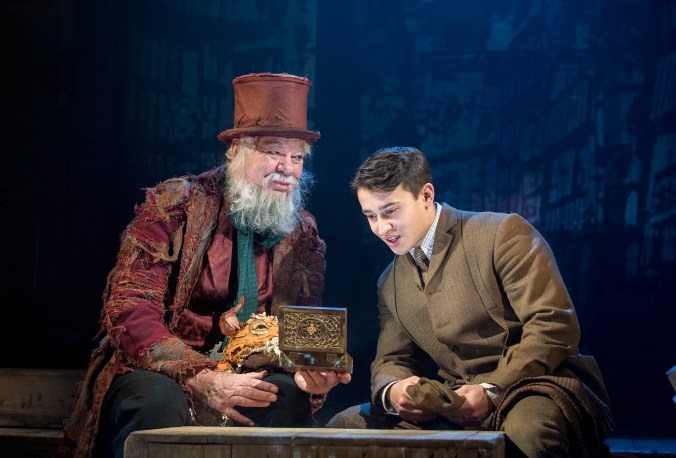
D7DAD9CD-D9BE-F240-A0FF6A503838CCCAIan McDiarmid as Enoch Powell. Image by Mihaela Bodlovic

What Shadows by Chris Hannan – Park Theatre, London

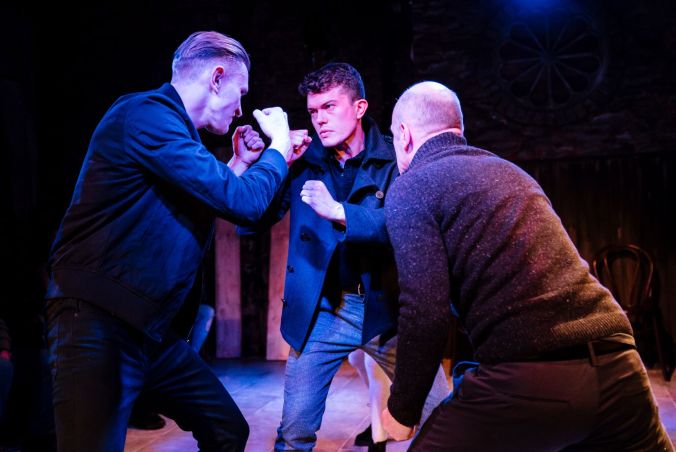
Like Enoch Powell himself, Chris Hannan’s new play about the man and his notorious speech comes to us from Birmingham – the Rep in the case of ‘What Shadows’, directed by Roxana Silbert. Tackling a historical pariah is a potentially fascinating assignment, but a difficult one to pull off. Can a close focus on Powell help us to understand his ignorant, unpleasant views? Despite his lasting reputation as a racist, Powell was a highly educated and respected man who drew tributes from the Prime Minister downwards when he died. So how did he become a rabble-rouser, remembered only for stepping outside the boundaries of civilised political discourse?

What Shadows has weakness, but also some very strong points. The action centres around Powell, his wife and two close friends, as he builds up to his ‘Rivers of Blood’ speech, delivered Birmingham in 1968. This is counterpointed with a story involving two fictional female academics, one black and the other white, who meet again after falling out over race in the 1990s. One has retreated to a remote Scottish farm, while the other has apparent success but a drink problem, and only a meeting with the by-now aging Powell can deal with questions left unanswered. Unfortunately, no aspect of this storyline seems at all convincing and the two seem to be devices for interrogating the impact of Powell’s rhetoric 25 years on. There are several other narrative elements, including an Indian man, Sultan (Ameet Chana) now living in Wolverhampton, who fought with Powell in the war, and his touching connection with a white war widow. There is a great deal going on, and much of remains fragmentary and therefore instrumental.

However, the play’s strength is the main narrative and Ian McDiarmid’s performance as Powell. His performance is subtle and fascinating, of the highest quality. He eerily reproduced the Black Country tones of a man who, despite appearing an insider, never seems to have felt he belonged. His relationship with close Quaker friend Clem and his wife, torn apart by the speech, is loving rendered with fine work from Nicholas Le Prevost as Clem and Paula Wilcox as Marjorie, with Joanne Pearce as Pamela Powell. At the centre of the play, the delivery of the notorious speech is compelling and illuminating. Hannan suggests that Powell’s projected his sense of personal rejection into a national crisis, and the full text of the speech supports this theory. Powell reports his constituents’ fury about declining services, but placing the blame for this on immigrants, never mind people of a different colour, seems to be his own interpretation. His own discontent seems to have combined with his ego to produce a disastrous political explosion. While ‘What Shadows’ is flawed, the chance to see McDiarmid becoming Powell, but in middle-age, and in old age suffering from Parkinson’s Disease, is one not to be missed.

Dollywould

event_dw1

Dollywould by Sh!t Theatre – Camden People’s Theatre

Since their 2017 Edinburgh hit, ‘Letters to Windsor House’, Rebecca Biscuit and Louise Mothersole have been hot fringe property. Under the cover of an amusingly self-deprecating company name, Sh!t Theatre, they created their own form of agit-prop theatre using cardboard boxes and unlikely make-up, personal, political and funny in equal measure. Their much anticipated Dolly Parton-themed follow-up, ‘Dollywould’, sold out in Edinburgh and, on the face of it, could not be more different. In fact, Sh!t Theatre lure us to Tennessee and Dolly’s theme park under false pretenses, offering a comedy fan-girl trip only to head down some disturbing alleys.

‘Letters to Windsor House’ revolved around the pair’s flat share, ending as they fell out and went their separate ways. Apparently this was for real, so they took a friendship-mending holiday to Tennessee (with lighting tech, Jen) to share their love for Dolly. The trip is presented in their signature home-made style, much more sophisticated than they would have you believe. There is verbatim-style re-enactment of a 1977 TV interview with Dolly, just before she made it big; videos of their trip, including toilet visits; karaoke sung by the light of a photocopier; tattoos; and breasts. Adept at discomforting the audience, Biscuit and Mothersole spend much of the show with nipples showing through holes snipped in their tops, before eventually covering up with giant model breasts. This is their way of presenting the physical barrier between Dolly Parton and the rest of the world.

However, ‘Dollywould’ is concerned with much more than Dolly’s public image. The two are fascinated and sometimes appalled by her self-made status and her focus on making money, evidenced by the relentless merchandising at Dollywood. They also trace her long-term lesbian relationship, well-known but never publicly acknowledged. And they provide inimitable context by visiting the nearby Tennessee Body Farm, where corposes are left to decay for forensic purposes and souvenirs are also available. They also dress up as sheep from time to time, slipping between Dolly Parton and Dolly the sheep. An apparently light-hearted piece becomes increasingly unsettling, as Dolly Parton’s identity becomes blurred and questions swirl as to who we really are. These intriguing themes delivered with skill, charm and sophistication. Sh!t Theatre remain essential fringe performers.

DeadClub

DeadClub™-(Photo-by-Manuel-Vason)-web

DeadClub by Requart and Rosenberg – The Place Theatre, London

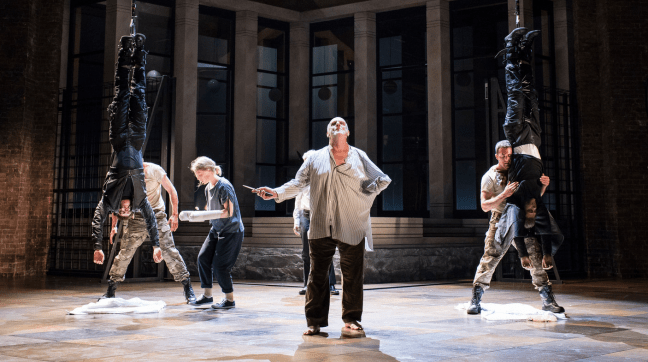
Like spectators at a boxing match, the audience stands around a raised platform painted in Bridget Riley black and white stripes, for a show that pits dance, theatre and music at each other, emerging with a mix that surprises and entertains. Dancers emerge from the space beneath via trap doors, and disappear back through them, sometimes head first, sometimes rear first with head and feet the last to vanish. The Alice in Wonderland proportions of big people – and a couple of the dancers are seriously tall – in small spaces is enhanced by child-like bright green shorts, white ankle socks and Bo-peep dresses, and by scenes involving tiny pop model people who engage in cryptic discussions. Four men and one woman stalk the stage in ritualistic fashion, as dead crows rain from above, and perform torch song numbers. There is also a random selection system, as spotlight picks audience members for personal attention which, for one lucky woman, involves a personalised funeral oration.

Deadclub is disconcerting and entirely unpredictable. The style of the choreography on show is angular and odd, and performance conventions seem to have been comprehensively realigned. The theme of death flickers in and out of focus to the accompaniment of melancholy songs. It is the antithesis of Follies, the Stephen Sondheim extravaganza I happened to have seen earlier in the day, offering no defined narrative and certainly no explanation of anything. On that basis, it provocative and irresistible, a strange and fascinating evening.


Follies

00285-FOLLIES-at-the-National-Theatre-c-Johan-Persson

Follies by Stephen Sondheim – National Theatre

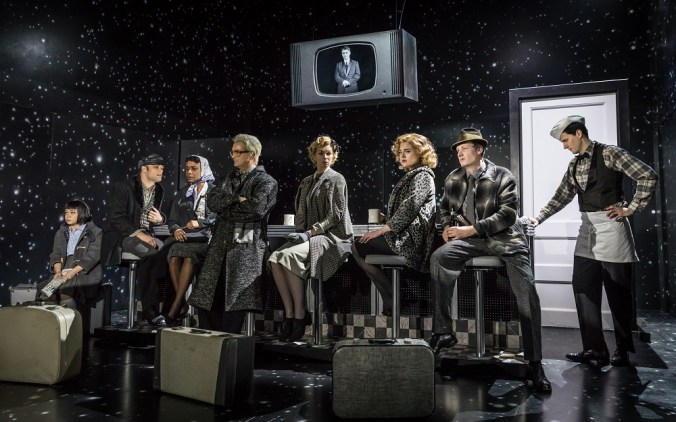
Musicals are not really my area of expertise, so a trip to see Dominic Cooke’s production of Follies was a chance to get up to speed. Also, I have never seen any Sondheim, and the chance does not seem to come round very often. As soon as the lights goes down in the Oliver it becomes clear why this is the first London production of Follies in thirty years: it is an absolute extravaganza. Vicki Mortimer’s revolving sets are vast – the façade and rear of the soon-to-be demolished Weismann Theatre, a New York fire escape cascading down its back wall, and a battered auditorium strewn with broken up seating. And the cast is even bigger, with almost every character played twice. As the aging former Weismann’s girls gather for a final reunion, thirty years after the show closed, their younger selves appear simultaneously on stage, in breath-taking chorus girl costumes meticulously designed to match the era, from 1918 to 1941. No expense is spared, and really there is no room to make savings on a show like this which demands to be done properly.

Of course Follies is much more than a spectacle. It is simultaneously a nostalgic tribute to the showgirl era and, a show written to consign it to history. Like all reunions, the demolition party forces characters to face up to the lives they have made. Sondheim’s writing is sharp and without sentiment. The beauty and glamour of the onstage world is fully acknowledged, but quickly stripped of any pretension to reality. The central characters – Imelda Staunton and Peter Forbes, Janie Dee and Philip Quast play the quartet who met at the Follies and have each committed their own folly as they chose the wrong partners, or think they did. There are no happy endings, but an entirely believable, compromised denouement. A number of remarkable songs track the emotional unravelling, in particular Dee’s angry, bitter ‘Could I Leave You?’, and Staunton’s upsetting ‘Losing My Mind’, together the antithesis of comfort theatre.

However, the strength of Follies is the breadth of Sondheim’s world. Some of the most memorable numbers belong to characters outside these four. In particular, Di Botcher’s ‘Broadway Baby’, recalling her ingénue days, is a fine song stunningly performed. Even more so, Tracie Bennett’s defiant ‘I’m Still Here’, a ‘Je Ne Regret Rien’ for the American musical, seems to break free altogether from the context of the show. Follies is sophisticated, complex and rewarding as theatre, not least when the parallel timelines slip and characters mingle and dance with their younger selves. It is hard to imagine this show being done better. It did make me think about how rarely I see shows where high production values are crucial to the result. I enjoyed the polish, but regretted the lack of ambiguity that came with it. The entertainment is presented to the audience as something complete, to sit back and enjoy. There seemed to be limited space for the imaginative engagement I realise I am used to experiencing, as part of more stripped-back theatre. However, there’s no doubt this is a big hit for the National – big enough, with any luck, to recoup the serious cost of staging it.

Knives in Hens

Christian-Cooke-Pony-William-and-Judith-Roddy-Young-Woman-in-Knives-in-Hens-at-the-Donmar-Warehouse-directed-by-Yael-Farber2-700x455Christian Cooke as Pony William and Judith Roddy as Young Woman. Photo: Marc Brenner

Knives in Hens by David Harrowver – Young Vic, London

David Harrowver’s 1995 play is unlike other drama of the time. While new writers focused on the freedoms and horror of late 20th century urban life, Harrowver went right back to the start for his first piece, stripping everything away including characters, dialogue and context. What is left is dark, relentless and hard to forget. Twenty years on, Yaël Farber’s fascinating revival at the Donmar shows how well this play has lasted, growing in strangeness and significance since the shock of its first performance at the Traverse.

The highly symbolic set, by Soutra Gilmour, is almost entirely black, dominated by a vast sphere that turns out to be a mill wheel, its unstoppable grind at the heart of the play. Costumes are also black, and the only contrast comes from flashes of white – a drift of plucked feathers, a cloud of flour. There is also ink which, significantly, is the blackest thin of all. Three characters step through a grim dance – a Young Woman (Judith Roddy), her ploughman husband Pony William (Christian Cooke) and the Gilbert, the village miller (Matt Ryan). The play begins in a darkness of ignorance, as the Woman learns the most basic of words to describe objects and connects them to feelings. When she meets the miller she becomes able to write, and the unstoppable transition from a passive object of God’s creation to a distinct individual, able to record thoughts, begins. However, the arrival of individual expression brings both terror and hope.

Harrowver sets the play somewhere in medieval England, in an entirely unromantic rural setting where life is harsh, bestial and carries no possibilities. His language has the same characteristics: aggressive, simple and direct. He taps into rural prejudice, including a rich seam of forgotten hatred for millers. The action rolls forward as inevitably as Greek drama, just as the new millstone is rolled through the village, and the arrival of ideas from outside disrupts assumptions and sows discontent. We never see beyond the three characters, but Harrowver achieves a remarkable sense of a society surrounding them. The cast are very strong, inhabiting these both familiar and alien types: Judith Roddy awakened and dangerous, Christian Cooke rough and tender and Matt Ryan trouble, but able gaze beyond the farthest field. Farber’s production is deeply striking, marrying sound and images, from the ripping of plucked chicken feathers to the roar of the turning mill wheel. Knives in Hens is a top quality production of a play that affirms its status as a modern classic.

And the Rest of Me Floats

04 Outbox- Elijah W Harris ©fgstudiosElijah W Harris ©fgstudios

And the Rest of Me Floats by Outbox Theatre – Rose Lipman Theatre, Haggerston

In a Haggerston community centre, seven young performers share their individual experiences of sexuality. They are a diverse LBGTQ group, including gay, non-sexual, men, women and transgender and various labels you might care to use but their stories are, of course, as individual as anybody’s. And the Rest of Me Floats is a highly enjoyable devised performance exploring queer space outside traditional gender definitions. There are costumes and glitter balls, dancing and singing, confession and affirmation. There is a great version of ‘Teenage Dirtbag’. It is very much theatre as it is in 2017, mashing together forms with ease, and applying genre-busting logic to break down the borders of perceived, sexual identity.

Directed by Ben Buratta, Outbox Theatre has devised a mesh of interlocking stories, staged with energy and commitment, and cunning use of minimal props. A torch beam provides crucial lighting effects, and a sheet of clingfilm performs a key role, but the stars are the performers who reveal their experiences of failing to fit in, to communicate with friends and family, and of seeking a definition. The internet is at the centre, not only bringing people together who thought they were alone, but also allowing them to shed their physicality and find their identities. There are stories of hardship and abuse, but the performers have as much to say about acceptance. They challenge the audience to really see them – as individuals, not as people defined by gender issues. And the Rest of Me Floats is a highly enjoyable evening, questioning social assumptions and having a great time doing it.


Horne A’Plenty

234fc4eacd904fa589c618c3bc6f385f.png

Horne A’Plenty by Brian Cooke and Johnnie Mortimer – White Bear Theatre, London

More than a decade ago original Round the Horne writer, Brian Cooke, and director Michael Kingsbury brought the much-loved 1960s radio series to the West End. Staged as a live BBC recording, the production was a reminder of a time when radio was at the cutting edge of popular culture, drawing vast audiences every week to BBC comedy shows. It also showed just how particularly subversive Round the Horne was – a mainstream show that was entirely based on expertly gauged innuendo, much of it referring to gay sex which was illegal for most of the time Round the Horne, and its predecessor Beyond Our Ken, were on the air. Now Cooke and Kingsbury are back with a surprise new production based on the fifth series of Round the Horne, cancelled after the sudden death of lead actor Kenneth Horne in 1969.

These scripts, which have never been heard before in any form, are a treat. The cast are masters of mimicry, bringing five well known voices back to life with consummate skill. Everyone deserves a mention. Jonathan Rigby as respectable businessman Horne ( in fact exactly what he was) makes manful attempts to keep the innuendo in check, failing entirely. Robin Sebastian’s Kenneth Williams, driven by eerily accurate gurning, is a crowing delight. Kate Brown as Betty Marsden has some of the funniest lines, as a particularly in the character of confused actress, Thespiana Boot. David Morley Hale as Hugh Paddick swtiches effortlessly from ancient, crusty barrister to raging camp. And Charles Armstrong has a great fun as self-aggrandising BBC announcer, Douglas Smith. There is even an onstage Foley artist, Lucy Sullivan, who slams a tiny door on cue.

The unheard scripts are fascinating. Written in 1969, after the decriminalisation of homosexual acts, they are more direct than previous series. There are new characters too including rattly old puffin Sir Inigo Parchmutter, recounting suggestive cases from his time at the Bar and the Brum Brothers. The latter are an evolution of the famed Julian and Sandy characters. They no longer speak in Polari, the coded gay slang popularised by the show, and for some reason they are now Brummies, but they are very funny and spent much of the time discussing someone called Clint (“Go on, purge yourself! Let it all out!”). It is fascinating to hear new material, still very much in the spirit of the earlier shows, but edging gradually in the direction of the 1970s. Horne A’Plenty is something of a triumph, both an essential social document and an endlessly funny ninety minutes. The audience leaves weak with laughter – Horne A’Plenty clearly deserves a bigger home and a longer run.

Yerma

HeaderBrendan-Cowell-John-and-Billie-Piper-Her-in-Yerma-at-the-Young-Vic.-Photo-by-Johan-PerssonBrendan Cowell and Billie Piper in Yerma, © Johan Persson

Yerma by Simon Stone after Gabriel Garcia Lorca – NT Live from the Young Vic

Simon Stone’s production of Yerma comes garlanded with Olivier Awards for Best Revival and for Billie Piper as the central character driven to desperation and destruction by her inability to have children. As an NT live broadcast to cinemas, it has been popular enough for repeat screenings. So what is the experience of seeing pretty much the hottest ticket in town like at one remove?

First of all, there is no question that Piper’s performance is a triumph. She really comes of age as a stage actor in the role, inhabiting it to the full. She is entirely convincing as a woman who starting with the apparently reasonable expectation that she might have children, sees her life come apart in every way as she discovers, excruciating step by excruciating step, that she cannot. Piper portrays complete mental disintegration while keeping the audience involved and sympathetic, beyond the point where her actions can no longer be justified. Unlike the rest of the cast, Piper’s character does not have a name – she is simply ‘Her’ – and Piper makes the universality of her experiences concept harsh and real. The supporting cast is strong, but it is Maureen Beattie as her contrary mother, Helen, who threatens to steal every scene in which she has a line.

The name of the main character – ‘Yerma’ meaning ‘barren’ in Spanish is just one of the many, substantial changes made by Simon Stone, who has adapted Lorca very freely, relocating it to a city like London, right now. In a short film shown before the screening, Stone gives the impression that his changes were designed to make the lyricism of the original more manageable for contemporary audiences, but has gone far beyond that, even changing the ending. For those who do not know the original it is hard to weigh the decisions he has made, but taken on its own terms his version is powerful. The action is very explicitly contemporary, showing how infertility can be as much of a curse now as it was in rural 1930s Spain. Stone’s text is too insistent on its 2010s setting: blogging, internet porn, female body hair, millennial sex, gender experiences in the work place, abortion, iPhones, internet privacy, and work-life balance all receive stage time. He also threatens to turn Yerma into a play about IVF, which would miss Lorca’s point. However, his version is, on the whole, a cleverly written, bold success.

The cinema experience has its downsides. The play is presented with inter-titles announcing the time period for each new scene. It is not clear whether these are just for the cinema, or whether the Young Vic audience sees them too, so we feel divorced from the theatrical experience. Because these are cut, we also seem to miss small pieces of the action on stage, for example coming back into the play’s final scene after it has apparently started. The glass box set is not ideal for broadcast, and its spatial properties do not translate to the screen – a problem with many live broadcasts, which struggle to replicate the physical presence of a stage set. There are also sound issues in some scenes: because the incidental music has the same dynamics as it would for a film it dominates the dialogue, which sounds much flatter and is indistinguishable when characters speak over one another.

Yerma is a visceral experience – an emotionally demanding spiral of despair and alienation, which rings much truer than we would like to admit. The NT live screening removes some of the viscerality, but it is a tribute to the production that much of its power and impact in the theatre makes it through the cinema screen.

The Shape of the Pain

The-Shape-of-Pain-DSC_4795-700x455

The Shape of the Pain by Rachel Bagshaw and Chris Thorpe – Summerhall, Edinburgh

A play about a sufferer from Complex Regional Pain Syndrome sounds tough to watch, and probably of limited relevance to those fortunate enough not to be afflicted. The fact it is neither is a tribute to the exceptionally high quality of the writing and performance in Rachel Bagshaw and Chris Thorpe’s play. The narrative is meticulously introduced by the sole performer, Hannah McPake, as an account of someone else’s experience. Chronic pain can be triggered by a minor injury which, for reasons doctors cannot entirely explain, results in permanent, debilitating, possibly lifelong pain. It is essentially an inability to shut off sensation. The play is an exercise in communicating an experience that is impossible to communicate.

With projected text and sound effects used to great effect, McPake explains the nature of pain in terms that are literally hallucinogenic, as she leaves her body in a bubble to preserve a basic version of herself as the rest is washed away. However, the play is as much about her attempts to negotiate a relationship in the shadowed of her condition. The narrator has the choice of feeling either everything or nothing, and despite everything the former remains just about preferable. The Shape of the Pain becomes a discussion of how far people can understand one another, and the extent to which love is just two people trying to make something work. It is a profound, touching and real examination of the basics of human experience, and one of the most powerful shows on the Fringe.