Kin

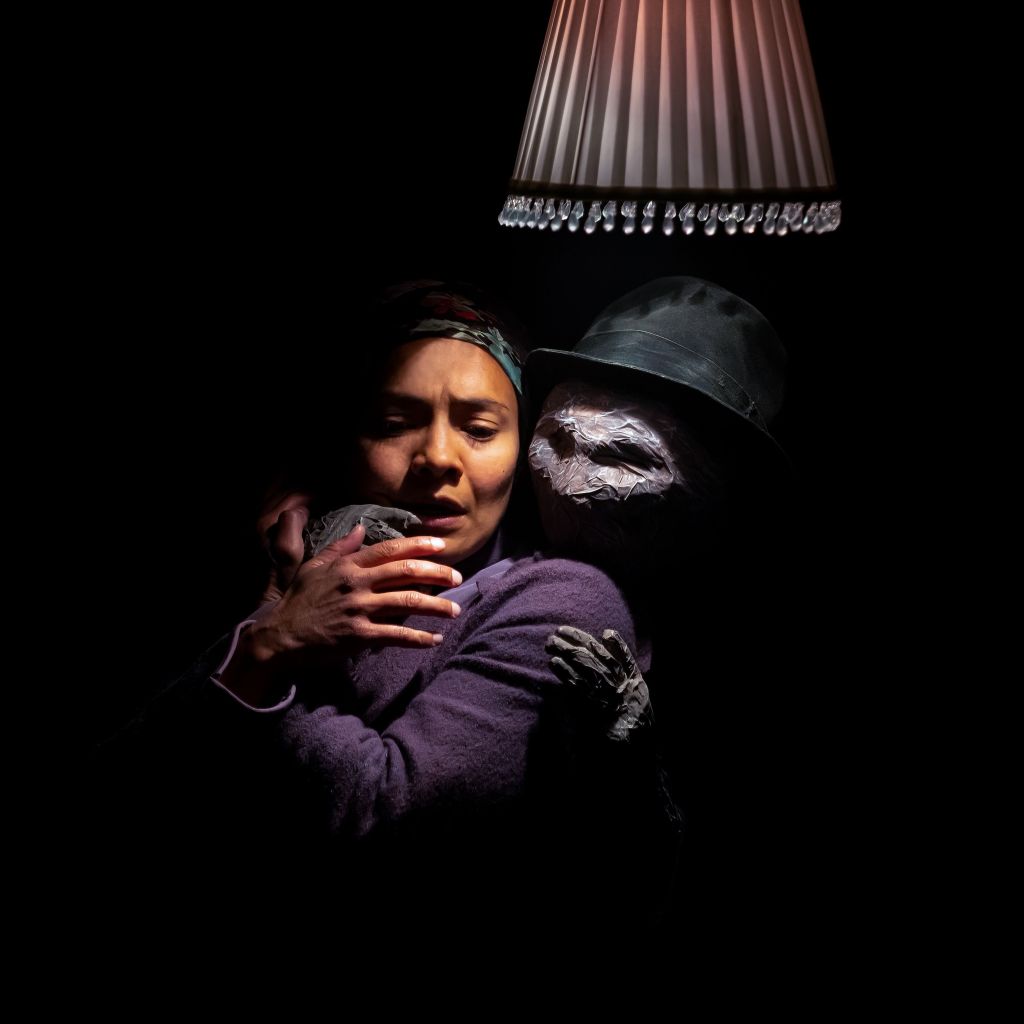
Vanessa Guevara-Flores. Photo by Mark Sepple.

Kin by Amit Lahav – National Theatre: Lyttleton, London

Published by Plays International

Founded in 2001, Gecko Theatre are a collective with an unmistakable style born, literally, from years of preparation. Remarkably Amit Lahav, founding artistic director and performer, spends at least three years with his performers researching, exploring ideas, and storyboarding to develop a show. The latest, Kin, was commissioned by the National Theatre and explores migration and ideas of home.

The cast of nine transform from a cohort of drunken border guards into groups seeking refuge and experiencing the fear and humiliation of rejection. Gecko perform in a style that fills a gap you never knew existed between contemporary dance and theatre. They move in highly stylized ways that are dance-based but illustrative, and always strangely compelling. The cast advance like fencers, stride in low lunges, sway together like a field of wheat in the wind, and pile themselves into a celebratory tower. They dance constantly.

Movement is at the heart of Kin, but there is language too: just not in the way we have learned to expect on stage. Characters talk constantly, but in multiple different languages from around the world. These are the mother tongues of the cast members, whose stories of immigration the show tells. They range from an escape from Yemen to Palestine in the 1930s to scenes escaping conflict and taking small boats that relate to what is going on right now around Europe. We may not speak the language, but the audience has little doubt what is happening. When a single segment of English breaks into the verbatim accounts of being a refugee, it hits hard.

Kin also has an impressive visual impact which ties its themes together. The stories spread across nearly a century, but the overall look is very Gecko, with mid-20th-century costumes (by designer Rhys Jarman) and middle European music (composed by Dave Price) – Kafka and klezmer. It translates cleverly to the large Lyttelton stage which is a dark space illuminated by pools of light, often provided in unconventional ways by lighting designer Chris Swain. At one point a family scene is entirely lit by a small television set, an electric fire, and a standard lamp, carried by characters dancing in a circle. The stage is shaped like an island, white cliffs gleaming around the edges. There are some stunning moments, including a family from India wiping their faces with clothes that turn their skin white.

While repetition is part of the point of Kin, with different generations experiencing the same discrimination, it causes some drift during the middle of the show as narrative threads become harder to distinguish. However, its emotional and political heft cannot be questioned. The final scene, in which the cast tells us who they really are, where they come from, and where they live, is a moving moment.

The issues this show examines – what happens to people caught up in circumstances outside their control who want to find a home – could not be more relevant. With political discourse on immigration in the UK more extreme than at any point in recent memory, the timing is perfect for a play about humanity and the value of human life. Both Gecko and National Theatre director Rufus Norris should be congratulated on bringing this urgent, beautiful, and devastating show to a big stage.

Cold War

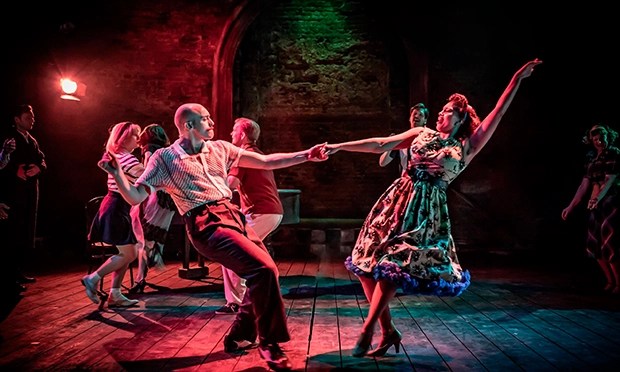
Photo: Marc Brenner

Cold War – book by Conor McPherson, music by Elvis Costello, based on the film by Paweł Pawlikowski – Almeida Theatre, London

Cold War, adapted from Paweł Pawlikowski’s 2018 film, is a dark story about dislocation. Wiktor and Zula leave their Polish folk singing troupe to escape the control of the 1950s Communist regime, but freedom in Paris does not solve their problems. The film, in black and white, has a charged atmosphere and air of strangeness that is sadly lacking in the Almeida’s musical version, by stellar pair Conor McPherson and Elvis Costello. Rupert Goold pulled off a triumph with Tammy Faye, by the equally exciting combination of James Graham, Jake Shears and Elton John, but Cold War does not repeat the trick. It is far too conventional a musical, taking flight when the dialogue builds tension, then dissipating it immediately with the next musical number.

The production strengths are movement, directed by Ellen Kane, and ensemble performance, with some dramatic Polish folk song and dance numbers and a wild ‘Rock Around the Clock’. Costello music sounds just like songs written for a musical, lacking distinctive character. The set by Jon Bausor – shabby piano, distressed interior – remains the same in Poland and France, from era to era, lacking any sense of place. Of the cast, Anya Chalotra as Zula has energy and strength, and Elliot Levey, always reliable, plays older impresario Kaczmarek very well. But the show takes itself very seriously indeed and, as a result, never achieves the levels of glee that made Tammy Faye a hit.

Ghosts

Ghosts by Henrik Ibsen – Sam Wanamaker Playhouse, London

Joe Hill-Gibbins’ production of Ghosts is the first Ibsen to be staged in the candelit glow of the Sam Wanamaker Theatre, and it looks remarkable. Set and costumes, designed by Rosanna Vise, are from a decadent mid-20th century society. The back wall consists of mirrors and the floor a cocoon of blood red, deep pile carpet. It is alluring and disturbing like the costumes – the upper class characters in velvet dresses and satin waistcoats, enfolding iron gloves. From the upper levels, the production takes place beneath a bank of six chandeliers which, while offering more of a glimpsed view than a theatre audience would expect, show the action in soft focus. The whole production looks like Visconti’s 1963 film, ‘The Leopard’, in its low light designed to reveal only costly surfaces. Osvald, infected with syphilis, compares his softening brain to “cherry-coloured velvet”, and the setting depicts suffocating interiors from which there is no escape.

It remains hard to imagine how Ibsen’s play, still direct and shocking, would have seemed to its original audience. Hill-Gibbins deploys the high end cast at his disposal with relish, and they make the most of Ibsen’s brutal exposé of hypocrisy. Paul Hilton’s Parson Manders is a canting fool, a man whose only show of strength lies in his moral convictions, which are thoroughly mistaken. It is hard to imagine why Hattie Morahan’s Helene Alving loved him, but the fact she did makes the poverty of her existence plain. She gives a riveting performance, quivering with a lifetime’s suppressed rage, then collapsing with absolute despair. Stuart Thompson as her son, Osvald, conveys the character’s conflicting emotions and failure to escape his social constraints very well indeed. Sarah Slimani’s Regene is blunt and unsentimental, the only character with any hope of achieving any freedom. And Greg Hicks is brilliant as the wheedling, deceitful Engstram, who has Manders in the palm of his hand. He creeps around the stage with his bad leg, like Richard III without the social position. Yet we feel a residual sympathy for a man whose class has limited his opportunities to opening a brothel and getting others to fund his drinking.

Hill-Gibbins, consistently one of the most interesting British directors of the classics, pulls off a sophisticated, layered account. He has also adapted the play, and the version is crisp and startling. This production shows the quality of productions that the Globe Theatre, frustratingly inconsistent in the past, can and should be staging. It also reconfirms the reputation of Ghosts as one of the touchstone plays that made modern theatre.

A They in a Manger

A They in a Manger by Wardrobe and Sons – Camden People’s Theatre, London

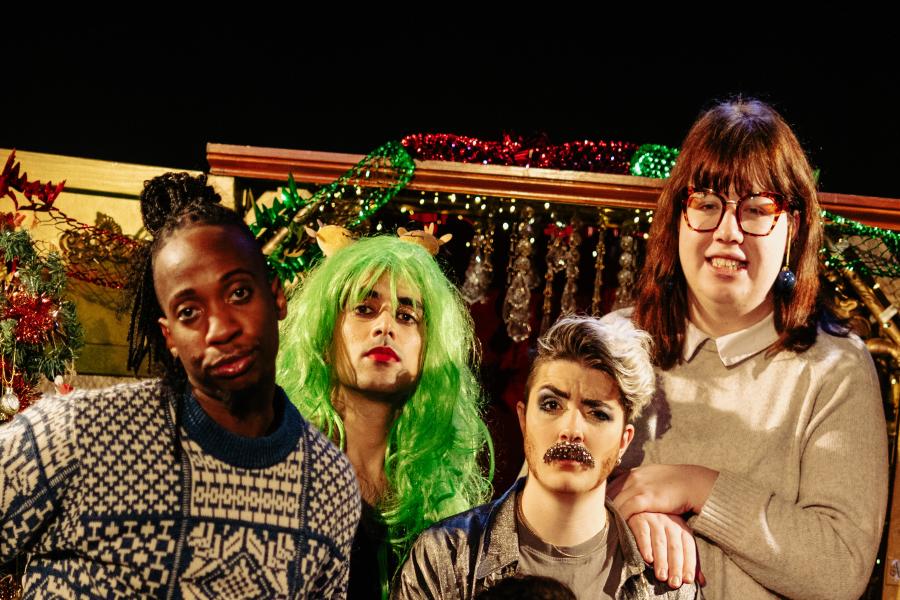
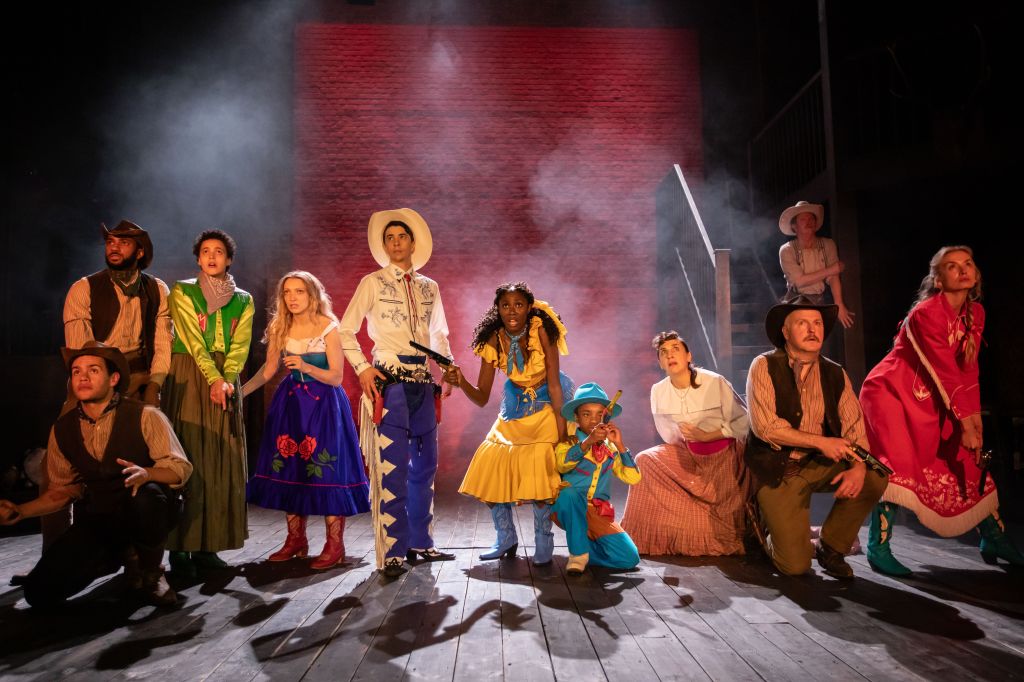
Four queer performers tie their diverse acts together with the help of a wardrobe, built by Em Tanner. A They in a Manger is appealing home-made, with the artists looking as though they’ve been rummaging through the Camden People’s Theatre dressing-up box. Anømaly pole dances in a style very much their own, blurring gender boundaries and expectations right, left and centre. They also do an excellent Grinch, Danielle James is vulnerable, funny as she challenges our assumptions in an entirely different way, and displays an impressive singing voice. Vijay Patel lip-syncs Olivia Newton-John’s Xanadu with heart and soul. And Len Blanco, drag king and, apparently, ex-member of a Welsh boy band called M4. hosts the evening with style, humour and a lot of personality. The show, directed by Frankie Thompson, is a perfect CPT alternative Christmas offering.

The Homecoming

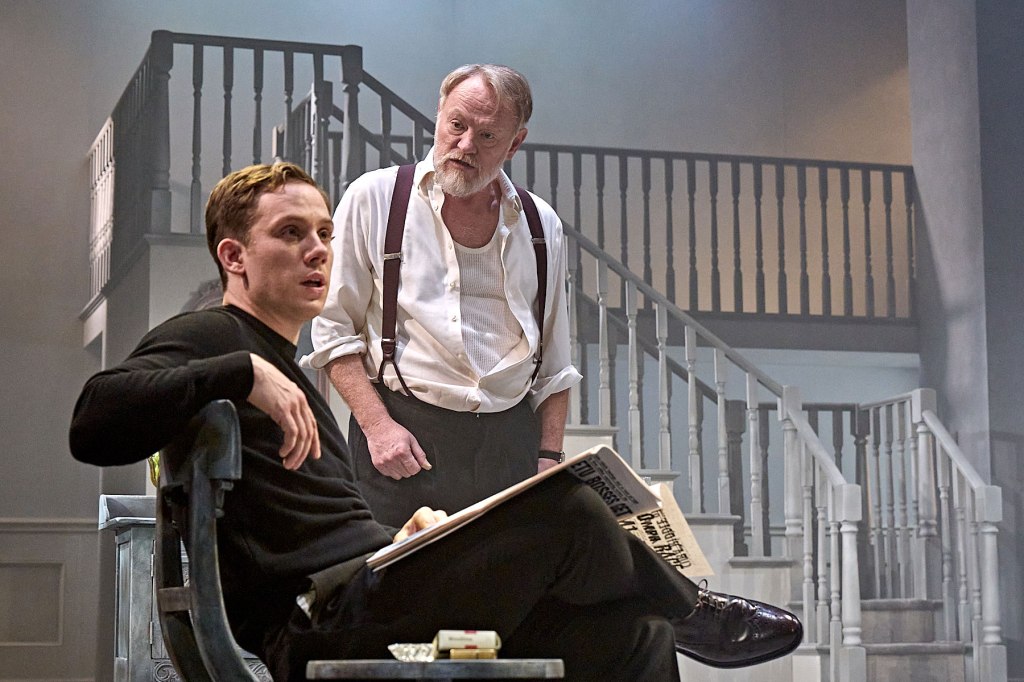
Joe Cole and Jared Harris in The Homecoming © Manuel Harlan

The Homecoming by Harold Pinter – Young Vic, London

It feels like a new era for Harold Pinter’s work. Jamie’s Lloyd’s 2019 Pinter West End season came before the pandemic and, since then, his plays no longer seem to pop up everywhere as they did throughout his life and for a decade after his death. A lot has happened since 2019, and audiences are now much less willing to take 1960s sexual politics for granted. The Young Vic’s revival of The Homecoming, directed by Matthew Dunster, is therefore something of a test of how Pinter’s work comes across in the 2020s. While critical reactions have been mixed, I think the play is darker, funnier and more socially incisive than at any point since it first burst onto the stage.

The Homecoming is set in a 1960s a household occupied by two generations of working class men with underworld connections, and the outsized absence of the deceased woman of the house, Jessie. When brother Teddy makes a surprise return from academic exile in the States with his wife Ruth, the men have a new focus for their hostile energies. What happens next remains properly shocking, as Ruth appears to agree to their seedy proposition that she should abandon her husband and children to make herself available to them all, while bringing in money as a sex worker. The charge is that Pinter has written the only woman in the play as a passive reflection of male sexual fantasies.

Dunster’s production makes two things clear – that Pinter’s writing is just as precise and brilliant as ever, and that the play may not be what we imagine. Moi Tran’s heavily carpeted set filled with assorted post-war furnishing, ashtrays and soda siphons, places the action in a very precise time, but Sally Ferguson’s lighting, which spotlights characters and objects, repeatedly lifts us away at key transition points. The men in the play are individuals but also types. Jared Harris as patriarch Max is brilliantly angry and volatile, flailing at the family around him, a classic tyrant. Joe Cole is born to play Lenny, a sinister pimp whose charm thinly conceals his capacity for violence. Joey (David Angland) is an aspiring boxer, all muscle and not much else. Nicholas Tennant’s Uncle Sam is in some ways the star of the show, and his twitchy performance as a bullied chauffeur clinging onto the shreds of his dignity is inspired. He stands as a critical presence outside the trio of toxic males. Meanwhile, the house represents society as much as it does a particular place, and its inhabitants the system of male control exercised through threats and manipulations – financial, emotional and physical.

Pinter, whose dialogue is a lot funnier than people think, balances the conversation throughout on the brink of farce. Characters speak in a heightened, exagerrated form of normality which is close enough to real life to be familiar, but far enough away to be hilarious. The characters of Teddy (a passively aggressive Robert Emms) and Ruth fit into this parody. As Ruth, Lisa Diveney seems beamed in from a quirky mid-60s social comedy, quickly seeing the power she has over everyone in the house as a replacement for the missing Jessie. The scenes in which the men press their sexual attentions on her are thoroughly disturbing, and it is hard to imagine how the original audiences would have reacted to the play’s full-throttle transgressiveness. Incidentally, the implication that she will happily abandon her children is, surely, a reference to Hedda Gabler, with Nora’s willingness to leave her family literary cause célèbre for a previous generation. However, in a play that twists reality so gleefully it seems a mistake to take anything too literally. Pinter gives us the strong impression that Ruth is playing the men, who think they have her under their thumbs. They imagine themselves cunning and in control, but they are completely at her mercy. The play is an unashamedly nasty tale, and a very effective metaphor for a society where men are cocky, self-confident and fatally vulnerable. Dunster’s production is horrifying and compelling in equal measure.

The House of Bernarda Alba

The House of Bernarda Alba by Federica García Lorca – National Theatre: Lyttleton, London

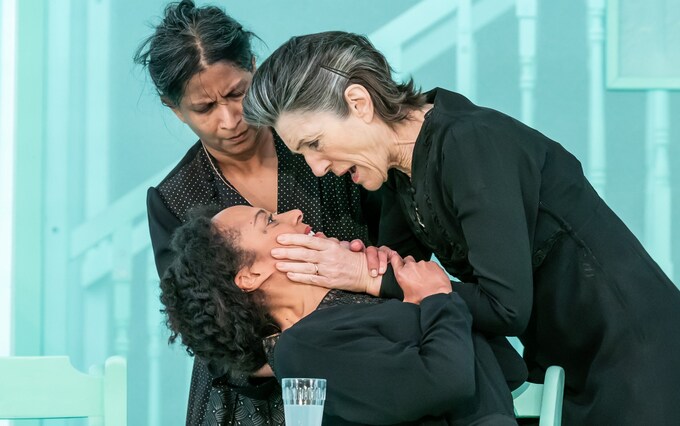
The titular House of Bernarda Alba, as directed by Rebecca Frecknall for the National Theatre, is laid out before us like a doll’s house with the front removed. Merle Hensel’s set exposes two floors of rooms – bedrooms where the tortured, insanely oppressed women of the house sit alone and brood, and the downstairs living room, kitchen and yard where they talk to and gradually destroy one another. The house, where Harriet Walter’s matriarch Bernarda plans to shut up her five adult daughters for a supposedly traditional eight-year mourning period, is shut off from the outside world. The only, fateful, interaction comes through illicit encouters over the high gate. Frecknall stages sone scenes as taking place simultaneously, dialogue overlapping in different parts of the house, a clever device that enhances the claustrophobia and the realism of events.

Harriet Walter’s performance is central to Lorca’s dark but fascinating play, an brutal allegory of fascism, religion and sexual oppression. Traditionally, she is a dragon but Walter plays her as a surprisingly sympathetic character. While she dominates her daughters and is violent towards them, we have the strong impression that her social conditioning has led to act this way. It is impossible to take your eyes off her as she wrestles with her family’s seething frustrations. Performances across the board are excellent. Lizzie Annis is perfect as a Martirio, boiling up just below the surface. As Magdalena, Pearl Chanda’s spirit is turning to bitterness, directed at those around her. Rosalind Eleazar as Angustia is the oldest daughter, and the most terrified that she will never marry and leave the house. As Emilia, Eliot Salt is younger, with a kindness that does not serve her well. And the doomed youngest daughter, Adela, is played by Isis Hainsworth as a very convincing teenager, thoughtless and heedless in a way everyone is at her age.

The family also includes Thusita Jayasundera as all-knowing housekeeper Poncia and Bryony Hannah as the maid, providing a commentary as household tensions built. Frecknall brings the world outside into the house in the form of stylised movement sequences involving the wordless Pepe El Romano, the external male disruptor who will tear the house apart. She also stages a shocking scene in which the reported pursuit of a local woman who has killed her baby bursts into Bernarda’s living room, as a mob seizes their quarry, like a tableau of a mythical hunt. This is a key moment in a play that is about society rather than events in a private house, and how the two are inextricably linked. Frecknall’s excellent production reveals the play’s continued power, 87 years after its author was murdered by a state he could clearly see coming for him.

Infinite Life

Christina Kirk and Marylouise Burke. Photo by Ahron R Foster.

Infinite Life by Annie Baker – National Theatre: Dorfman, London

Following a string of remarkable shows at the National Theatre, including The Flick, John and most recently The Antipodes, Annie Baker is back as perhaps the most anticipated playwright writing today. Loungers set against a decorative cement block wall (the set designed by dots) fill up with women who are all, we discover, undergoing fasting treatment for chronic pain. We cannot see beyond the unappealing wall, but the cast gaze out towards us and a view of what they describe as a parking lot behind a bakery. If this is purgatory, and metaphorically at least it may be, it is highly unpromisin. The ordinariness of the setting is a classic Annie Baker trope, where places, events and people appear at first glance to be of little great significance but increasingly carry a strange weight. There aren’t really any conventional events, just talk, but the conversations that ensue between the characters are powerful and compelling.

The attraction of Baker’s work is her characters, who often seem almost too real in the way they speak and behave to be allowed on a stage. Ginnie (Kristine Nelson) is in charge, asking the questions of new arrival Sofie (Christina Kirk). The relationship between the women on stage is full of minor tensions, occasional squabbling and kindness. Each gradually reveals the effects, sometimes horrifying, of pain that cannot be cured. Yvette (Mia Katigbak) unrolld a deadpan list of complaints that hits a level of absurdity which is both funny and awful. We feel guilty for laughing and for doubting her account of what has happened to her, because one of the play’s themes is the invisible trauma experience by women, whose experiences of pain and much else besides are disbelieved and discounted. There is a man too, Nelson, played by Pete Simpson with perfect poise as a ridiculous yoga-trousered, open-marriaged dude. He is very funny, but his account of his health, when it comes, is perhaps the darkest and most unlikely of alll.

There is a great deal going on below the surface in Baker’s plays, which makes thinking about them afterwards a very satisfying experience. For instance, Sofie is trying to read George Eliot’s ‘Daniel Deronda’, from which she at one point she reads out a particularly dense sentence. Is the book’s plot, involving bad marriage choices and outsiders doomed to watch from the sidelines, providing commentary on her life? Christina Kirk’s performance as Sofie is exceptional. She controls the play’s progress, forwarding the action with announcements such ‘Eight hours later’. Younger than her companions, she is both poised and nervous in equal measure and extraordinarily vulnerable. Baker, who has a quiet history of identifying and busting theatrical taboos, gives her a scene which is the first I can recall to show female masturbation on stage. It forms part of her mysterious sexuality, tied up and dictated by her pain where the border between fantasy and reality has melted away.

Infinite Life is a subtle play, crossing meditations on philosophical questions of whether pain really exists if it can only be experience subjectively, with the messy realities of life in 21st century America. It is charming, funny, raunchy, cerebral, tear-inducing and strange in equal measure, directed expertly by James Macdonald. When Eileen (a wonderful performance by Baker favourite Marylouise Burke) lays her hand on Sofie’s head as she is about to leave for home, she conveys the impression that something supernatural is happening – a moment of healing. And for the audience, it really is.

Nan, me and Barbara Pravi

Nan, me and Barbara Pravi by Hannah Maxwell – Stanley Arts, London

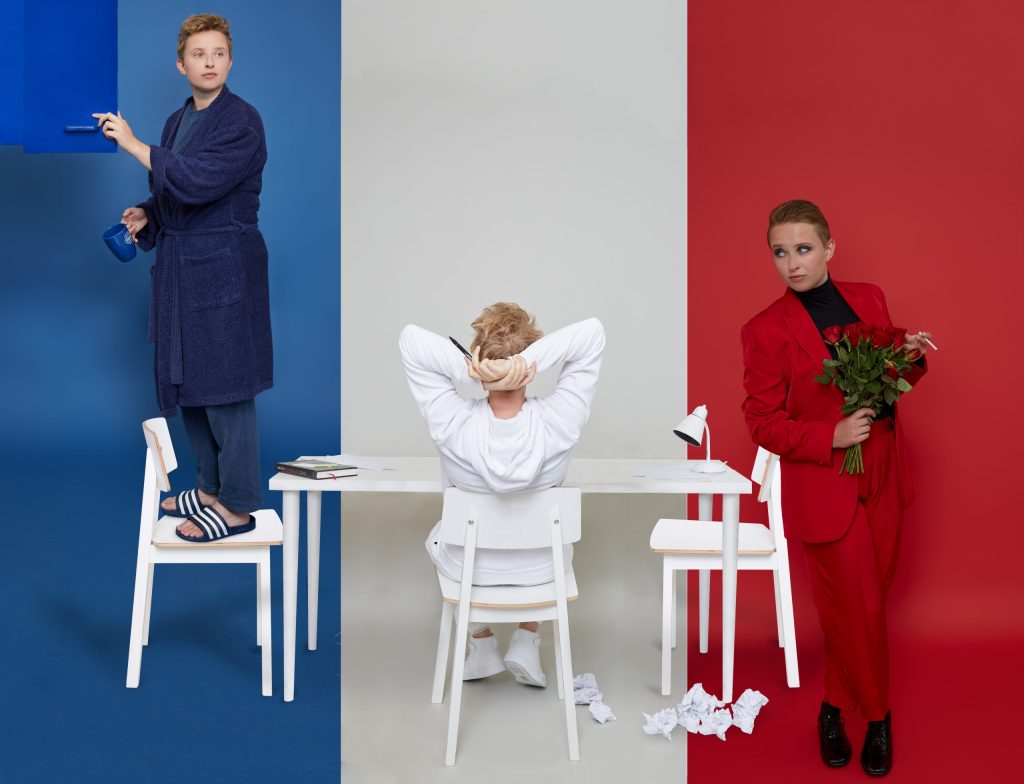
Hannah Maxwell’s single-handed show is a beautifully structured piece of fringe theatre, combining the personal and the confessional while making it seem new and different – quite an achievement. Maxwell is deeply charming, cultured and slightly aloof, at least at first. She is in control, and we believe her implication that she once worked for the security services – she seems like the kind of person who easily might. Of course, it is an illusion – no-one, after all, is really in control. Moving in with her grandparents in Luton to look after her dying grandfather, and then her widowed nan, has left her suspended between duty and the London life she has left behind, with its big highs and deep lows. Watching Eurovision with her nan leads a stalkerish obsession with French singer Barbara Pravin, which is both funny and believable. The show is about working these things through.

Maxwell has the audience in the palm of her hand from the start, instantly sympathetic. Crucially though, she can also surprise. Her staging is a neat balance between clever and silly, and never gratuitous – making Oat So Simple in collaboration with the audience, managing her nan’s medication via a giant pill organiser, delivering a final killer ballad in French – are cleverly judged. She plays with the contrast between her artistic life as a gay woman in London, and the suburban family background that is also part of her, whatever her instinct to deny it. She delivers a powerfully understated show about identity, happiness and the importance of connecting between generations. She also concludes that being an obsessive fan is probably not a good thing, which is good life advice for us all. Maxwell is a fringe favourite for a very good reason: she makes the complete shows that so many performers aspire to, but which are so difficult to pull off.

The Making of Pinocchio

The Making of Pinocchio by Cade and MacAskill – Battersea Arts Centre, London

Published at Plays International

Cade & MacAskill – Rosana Cade and Ivor MacAskill – are a performance duo whose work draws on their personal experience of gender fluidity and transition. They take the Pinocchio story, which they have been working on for five years, as a mechanism for interrogating their own experience as a couple, blending real life and fiction in a compelling and original show which keeps the audience on its toes, never quite sure what they are going to do next. ‘The Making of Pinocchio’ is staged in a film studio, the action simultaneously shown on a big screen at the front of the stage, so we see both what is really going on and the illusion crafted for the camera. This is technically impressive and very funny. Cade, as the ancient Gepetto, stalks around in a pair of giant wooden glasses doing a ludicrous and very amusing old man act. Gepetto crafts a puppet from a tree, played by MacAskill in a wood effect costume equipped with sockets from which phallic branches protrude. After the first scene, though, the traditional narrative breaks down and the pair delve into their own lives, and MacAskill’s experiences taking testosterone and transitioning into a male body.

The show is delightfully and ingeniously staged, constantly playing with the illusion created by the camera perspective, making characters appear much larger or smaller than they really are. As the camera operators circle the stage (wielding cameras made of wood), they build a tension between the way we present ourselves and what we really are that goes to the heart of the pair’s gender identities, as well as the role of a performer. Pinocchio’s motivation, to “become a real boy” raises more questions than it answers, and leads Cade & MacAskill to affirm their own identities separately from social expectations. “We’ve always been here, and we always will be” says MacAskill of trans people like himself. The show is courageous in the way the performers expose themselves, literally and metaphorically, in their search for agency. It is also very funny, with some surreal and dirty scenes, one of which imagines Battersea Arts Centre’s artistic director in a way he is most unlikely to have expected. 

The creative team, which includes designer Tim Spooner, responsible for the combination of red drapery and weird wood effects, and camera operator Jo Hellier who both appear throughout, are an essential part of the show’s success. Cade & MacAskill are not figuring things out on their own: they are part of a community, reinforced by a supportive audience, which is making a queer journey together and living lives that are based on understanding, mutual support and real freedom. ‘The Making of Pinocchio’ appears casual on the surface, but reveals multiple layers of technical expertise and creative theatre-making. It is a humane and forward-looking production that places Cade & MacAskill at the forefront of challenging, questioning, communal queer theatre narrative.