Triumph by Caryl Churchill – Almeida Theatre, London
Published at Plays International
Ten or more years ago, there were regular complaints that no-one was writing political plays any more. It seems like a very long time ago now. These days, post-Brexit, post-COVID, mid-climate and cost-of-living crisis and deep into the second coming of Trump, there is no ignoring politics. It looms large in everyone’s lives. It is in this context that a new play by Caryl Churchill feels like an event, and all the more so when it is a piece that runs for a mere 20 minutes, presented as a standalone production at the Almeida over a handful of performances. Triumph feels very much an occasion. The Almeida foyer is peppered with familiar faces, people whispering about who they have spotted, and front of house staff “unable to confirm or deny” whether Churchill herself is in the audience. There is real buzz of the kind not generally found on a Sunday afternoon.
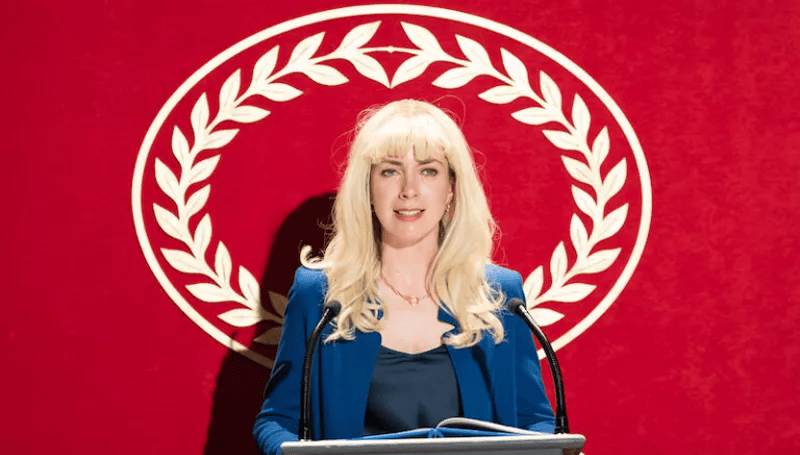
Churchill is 88, but her work still feels essential. With new Churchill plays scheduled at the Almeida in the New Year, Triumph is statement of intent from new artistic director Dominic Cooke. Not since the theatre staged Harold Pinter’s final works in the mid-1990s has been associated with a writer making urgent, late-career statements on where society has got to. Tr(i)u(m)p(h) is a piercing, conceptually powerful piece about a Karoline Leavitt-esque press spokesperson, standing behind a lecture to deliver mind-boggling statements on behalf of their boss, combining terror with hubris and farce on a gothic scale.
Directed by James Macdonald, Triumph plays out on a set by Miriam Buether lit with burning braziers, half blood-red press conference dais and half blood-red double-bed. Spokesperson Iris (Kate O’Flynn) dons a blonde wig to read prepared statements, and takes it off to sleep with the opposition – journalist Marcus (Matthew Beard). The thing is, everything she says on behalf of ‘The Emperor’ is taken directly from Suetonius’ compendium of tyranny, The Twelve Caesars. Her announcements rang from the bizarre – “The Emperor has installed a gold throne” – to the ludicrous – “The Emperor is paying for 250 young Romans to learn how to applaud.” The tone becomes darker, as the consequences of crossing the leader become clear, for Marcus and for everyone else. The press conference acquires a section introduced as “In other amputations”, and the violence inflicted on opponents by the state increasingly grotesque. Iris thinks she is exposing the truth The Emperor wants to conceal, but discovers that the more ruthless he seems the more popular he becomes, and the happier he is.
Triumph is a short but very pointed broadside about what people do to keep the Emperor happy – “a grim joke about where we are today.” The conceit of quoting Suetonius is inspired, allowing Churchill makes brutal connections between the the lies, cruelty and decadence of the last days of ancient Rome and the horror show we find ourselves in, under the megalomaniac rule of a very current leader. The running time may be short, but Triumph is the length it needs to be, no more or less. It takes just 20 minutes to draw persuasive performances from the cast, and lodge a succession of horrific images firmly in the audience’s mind. It only takes 20 minutes to make the point, forcefully, that we have enabled monsters before and we have done it again, creating a situation where leaders, and one leader in particular, can do whatever they please. This bodes ill for society, but political theatre is right at the centre of our cultural response to despairing times.