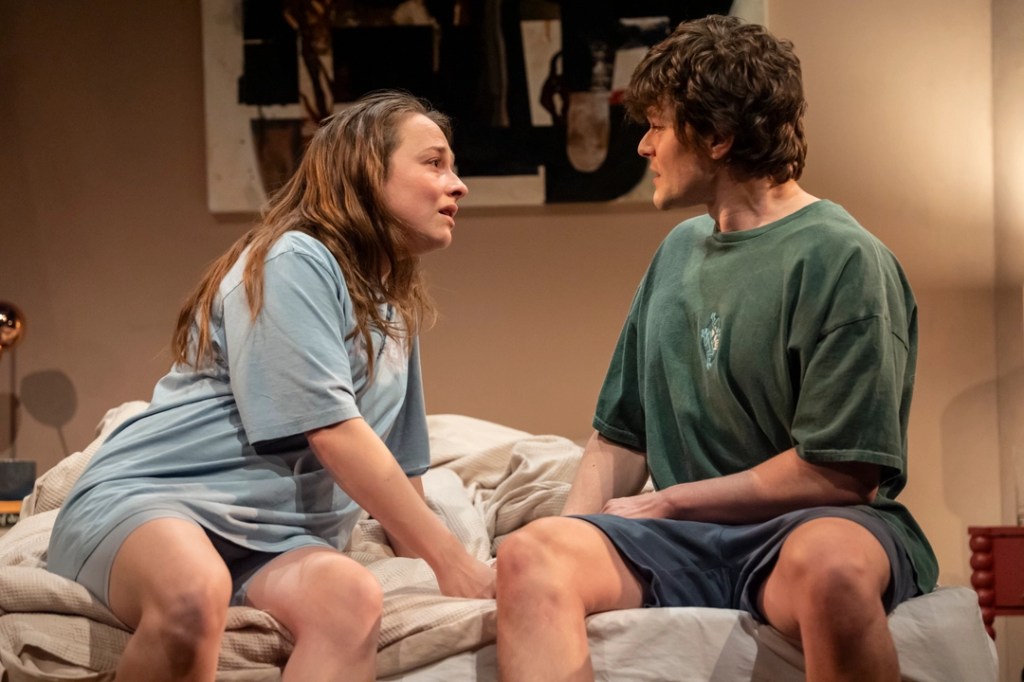
Porn Play

Ambika Mod and Lizzy Connolly. Photo by Helen Murray.

Porn Play by Sophie Chetin-Leuner – Royal Court Upstairs, London

Published at Plays International

Yimei Zhao, the designer for Porn Play, has upholstered the entire Royal Court Upstairs space in soft beige furnishings which spread from the stage out over the audience benches. It is simultaneously cosy and oddly creepy, especially when characters start reaching down into the cracks between cushions to pull out props – laptops, phones, pillows, even the giant paper towels that cover GP’s examination tables. The image of a cocoon that is not as cosy as it seems fits the subject matter of Sophia Chetin-Leuner’s play perfectly. Her drama deals with a young woman’s addiction to pornography: specifically porn based on violence to women.

The central character Ani, played by Ambika Mod, is a rising academic star who has just won a prestigious prize for her new book, on Milton’s Paradise Lost. On the surface everything is going brilliantly for her, but almost immediately her private obsessions get in the way of her happiness. Her inability to relate sexually to her boyfriend Leo (Will Close) without watching videos of women being humiliated drives him away from her. At the same time, the gender power balance seems to lie behind her increasingly self-destructive urges. The passive aggressive suggestions that she has it easy, and that her achievements are not on the same level as the men begin with Leo, and escalate throughout the play.

Chetin-Leuner has chosen a fascinating, and wildly uncomfortable theme for her Royal Court debut. The prevalence of pornography in society is a major contemporary concern, but the debate generally sees men and boys as users, and women and girls as victims. Porn Play turns this on its head by examining female sexuality through pornography, including the revealing information that women are much more likely to search for violent porn. Ani reacts angrily when challenged, refusing to let anyone else shame her for her sexual preferences, but it becomes increasingly clear that she is not in control of her choices, as her life and mental health disintegrate around her. How has this happened? Is it tied in some way to the normalisation of sexual violence in the male authors she teaches? One of her students confronts her in her office to complain that she is enabling John Milton in glamourising rape. Or is it connected to her mother’s death when she was a teenager?

Josie Rourke’s production brings the best out of a highly versatile and entertaining cast who play numerous parts, and give the show a lot of energy. The performers move well together in a small space, with Wayne McGregor, no less, the show’s choreographer. Lizzy Connolly is excellent, switching constantly between roles and playing a sort of fantasy muse who manages scene changes in between. She is very funny as Ani’s sleepover friend, who is all “It’ll be ok, babes, you’re overthinking it”, before Ani’s masturbation forces her to sleep on the couch. She is equally funny parodying a GP talking in NHS style, who becomes a sexual predator as Ani tunes out of reality and into fantasy. Will Close is similarly versatile, needy and passive aggressive as Leo, and entirely different as a cocky student who gets worrying into the idea of tying Ani up and humiliating her. Asif Khan is awkward and clumsy in a ‘dad’ way as Ani’s father, and very moving as a result. He is also horribly hilarious as a misogynist academic.

Ambika Mod is the only performer to play a single part, and is on stage throughout as Ani. It is essential that we believe her, and she does a very convincing job of making her porn addiction seem credible. She also plays some of the most excruciating scenes imaginable, from frequent masturbation to a GP examination, and a scene with her father towards the end which redefines embarrassment. She brings a fine balance of confidence and vulnerability to the role, pulling the audience along with her to places they really do not want to go.

Porn Play is a fascinating piece because it looks at female experience from an entirely unexpected perspective. There are complex questions for society to address around what we are doing to women. The porn boom is era-defining, potentially shaping the expectations men have of women, and their future personal and social relations, but we do not know as much about what it is doing to women. Does it liberate or constrain? Is it reprogramming women’s expectations of themselves? Perhaps porn is just another tool men use to put women in their place, like the academic gender hierarchy, and the literary canon of abusive male authors.

All these issues are raised, although there can be no definite conclusions, and the play is as much about addiction as gender politics. It does trail off a little, as Ani enters the trajectory of an addict, pushing away everyone around them – a story that seems much more familiar than what has come before. This is where the relationship with her father becomes central, and the scenes in which he tries desperately to connect with her are very moving. Porn Play is a timely and involving show, with a fine young cast, and an author with fresh, compelling perspectives to offer.

The Line of Beauty

Photo by Johan Persson.

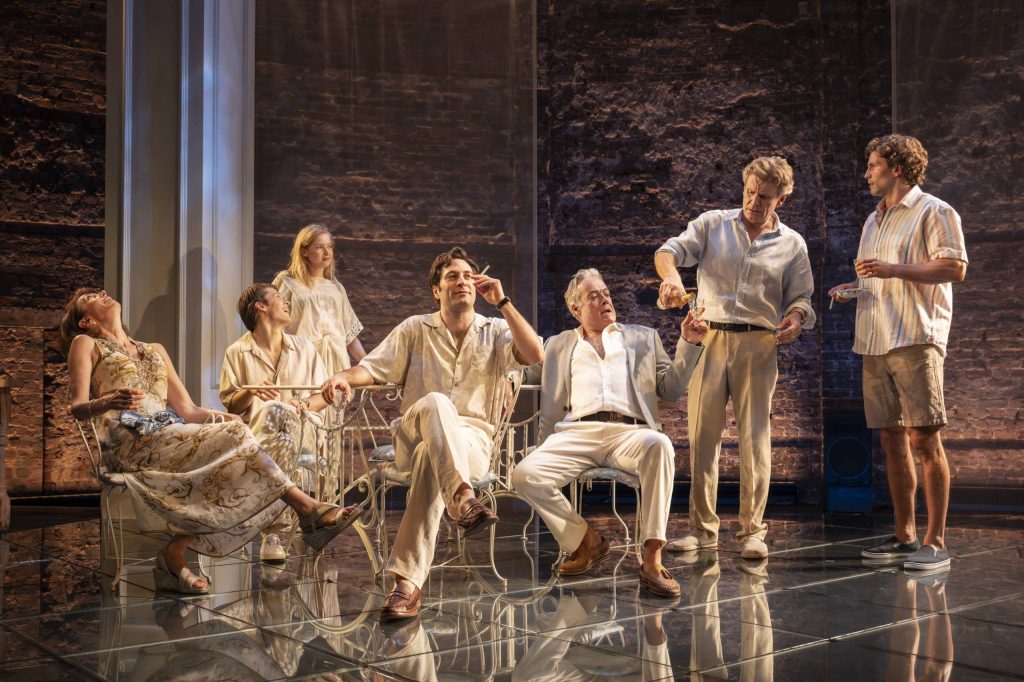
The Line of Beauty by Alan Hollinghurst adapted by Jack Holden – Almeida Theatre, London

Alan Hollinghurst’s much-loved novel, The Line of Beauty, won the Booker Prize in 2004. Looking back to the rise of Conservative politics in 1980s Britain, and the parallel AIDS crisis, it explored gay life and consciousness through the eyes of ingenue Nick Guest, who learns a lot in a short space of time. Now, adapted by Jack Holden and directed by Michael Grandage, it reappears two decades later on the Almeida stage.

Adapting novels as plays can be a thankless task, especially when they’re well known, but Holden does a good job in not allowing the book to kill the drama. Covering the period between the Conservative victories at the 1983 and 1987 elections, the play dramatises the collision of personal and political from the perspective of Nick, played engagingly by Jasper Talbot and his experiences in love, and while lodging with the family of a Conservative MP. Performances are universally strong, and Grandage’s production is very tightly delivered. Alistair Nwachukwu gives a standout performance as Nick’s first lover Leo, charming, clever and vulnerable. Arty Froushan, as cocaine-snorting playboy Wani, Charles Edwards as smooth, fatherly MP Gerald Fedden, Robert Portal’s menacing Badger, and Ellie Bamber as bipolar Cat Fedden are all excellent performances. Hannah Morrish channels the demeanour of Fergie in a way that is both hilarious and disturbing. Doreene Blackstock, as Leo’s mother, and Claudia Harrison as Gerald’s wife are also very strong, but their roles are rather limited – a problem with both book and play. The staging is sumptuous – sets and costumes by Christopher Oram – who has clearly delighted in recreating and subtley parodying the high society 1980s with its odd combination of frumpiness and glamour.

Some of the more literary aspects of the book get a bit lost in the dramatisation, such as the thematic significance of Henry James and of the ogee, a shape which swings both ways. What is more significant is how much of a period piece the play feels. Hollinghurst was writing about a period 20 years earlier, a time now approaching half a century from the present day. The key issues of the time – homophobia, social conservatism, privilege and the devastation wrought by AIDS should not be forgotten, but are not undiscussed. The play offers a highly professional and entirely entertaining evening, but it is unclear exactly why this novel needs to be staged at this particular moment.

Cyrano de Bergerac

Photo by Marc Brenner.

Cyrano de Bergerac by Edmond de Rostand – Swan Theatre, Stratford-upon-Avon

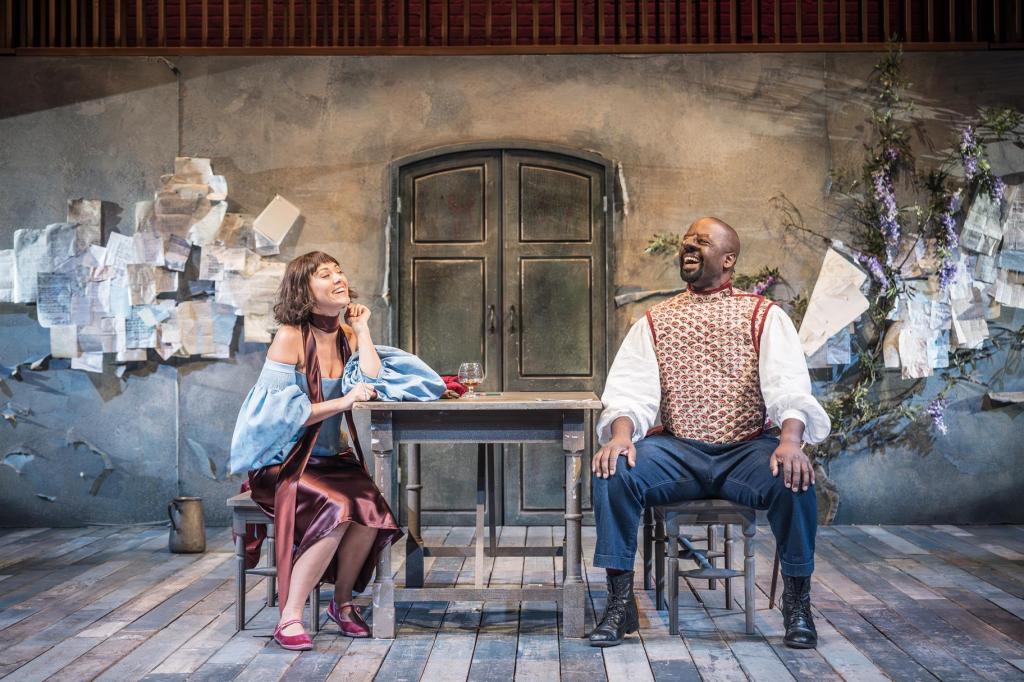
Simon Evans’ production of Cyrano is a very convincing and enjoyable account of a play which stands up well to re-examination. Evans has also adapted the play, with Debris Stevenson, giving the language a contemporary flavour without undermining the period setting, in a fantasy 17th century France. The play is held aloft by an exceptionally strong case who bring a notable level of star wattage to the stage. Adrian Lester, as Cyrano, exudes leading man skill and control, to the extent that at times he reminds us of Derek Jacobi, who triumphed in the role at the RSC for Terry Hands in the early 1980s, and at others of Simon Russell Beale. Cyrano is a part that requires a dashing, confident, yet vulnerable performance, and Lester provides this with apparent ease. He is brash in the tavern scenes, charming with Roxanne, conflicted with love rival Christian and, in the play’s final scene, when he drops the letter he is reading, supposedly the last missive of the dead Christian, and recites it to Roxanne from memory, devastating. Up until this point the play has been hugely entertaining, but it is this culminating encounter which makes it something special. The play’s emotional weight all builds to this moment of revelation, as Roxanne realises he has loved her all along, and Cyrano realises the same. There is not a dry eye in the house.

Lester’s triumphant performance helps create the conditions for the whole cast to shine brightly. Susannah Fielding, as Roxanne, is exemplary – riding a wave of breezy, charming detachment until her emotions catch up with her. Her outrage at discovering she has been deceived by Cyrano all along unleashes a fascinating cascade of conflicting impulses. Levi Brown is excellent as a casuallly insulting Christian de Neuvillette, cocky and doomed. Scott Handy’s Comte de Guiche is very funny, appearing to belong to a parallel aristocratic world where nothing quite makes sense to him. And Greer Dale-Foulkes makes Abigail, Roxanne’s companion, a very amusing comic adjunct to the action.

Performed on Grace Smart’s sets of torn posters, worn plaster and red velvet curtains, the play fills the Swan stage as though written for it. Evan’s has conjured a hit, somewhat old-fashioned in a good way because it revives a classic for a new generation without significantly remaking the play. It’s a significant achievement, and makes for a very satisfying evening watching very good actors show us their skills.

The Seagull

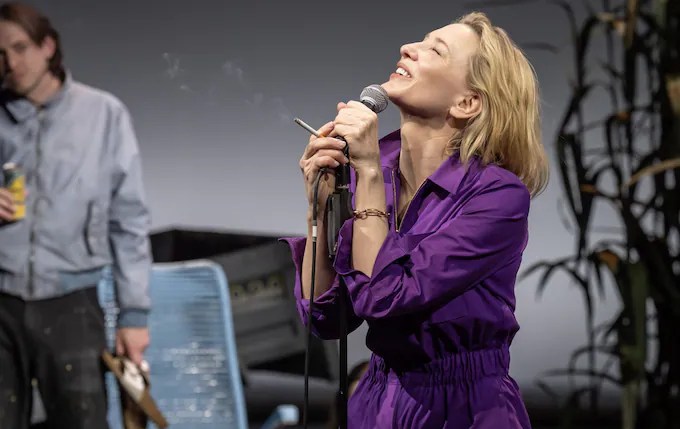
Cate Blanchett as Irina Arkadina (c) Marc Brenner

The Seagull by Anton Chekhov – Barbican Theatre, London

The quadbike which Simon Medvedenko (Zachary Hart) rides onto the stage at the start of Thomas Ostermeier’s production of The Seagull makes a statement straight away about the type of evening this will be. Ostermeier, true to form, strips away the play’s morose, stuffy pre-Revolutionary setting and makes it about the here and now. He has a point: this is something directors are reluctant to do with Chekhov, who still inspires the kind of reverence we long ago got past with Shakespeare. It makes for an entertaining but wildly inconsistent evening.

Hart, having got off his bike, pulls out an electric guitar and sings some Billy Bragg. The microphones that stay on stage throughout are used to address the audience directly, on the basis presumably that everyone is giving some kind of performance. Ostermeier’s approach is to underline everything, which is superficially entertaining. but has the tendency to pull the play to pieces. Central to this is Cate Blanchett, who delivers a fully committed performance as Irina Arkadina but gives the impression of being in a different play, encouraged by alienating devices such as the catwalk attached to the front of the stage on which she drapes herself dramatically, separating herself from the intense drama building behind her.

The rest of the cast ranges from brilliant to ineffectual. In the former category, Paul Bazeley’s Dorn is destroys people without meaning to, and Priyanga Burford brings his occasional lover Polina to intense life with limited stage time. Tanya Reynolds is excellent as a willowy, emo Masha, too wise for her years. And Tom Burke as Trigorin has an intensity of disappointment with life and himself that is truly scary. On the other hand, Kodi Smit-McPhee never fires or convinces as Konstantin, and the climactic scene with Emma Corrin’s Nina, a part to which she does not well-suited, does not deliver chemistry or intensity. On the night I attended, Jason Watkins was unfortunately indisposed and not playing Sorin.

The adaptation, by Duncan Macmillan, sets out to bring the play, leaping and shouting, into the 2020s, showing us it has as much to say now as it did in Chekhov’s era. However, this is never a subtle process, albeit full of energy, and when we hear actors raging about how little theatre doesn’t matter to ordinary people, it’s hard not hear a background hum of self-congratulation at just how self-ware everyone is. And Chekhov speaks to people on a human level, communicating political and existential issues in the frustrations we can all identify with. Macmillan and Ostermeier seem intent on making The Seagull something it isn’t.

There are powerful scenes including, surprisingly, the use of ‘Golden Brown’ by The Stranglers to punch home the sadness of a happiness that has entirely gone. Magda Willi’s clever set is simply a dense patch of maize stalks, from which characters emerge, sometimes addjusting their clothing, and into which they vanish again. But the show as a whole seems somewhat misguided, both in terms of concept and cast.

More Life

Photo (c) Helen Murray.

More Life by Lauren Mooney and James Yeatman – Royal Court Theatre, London

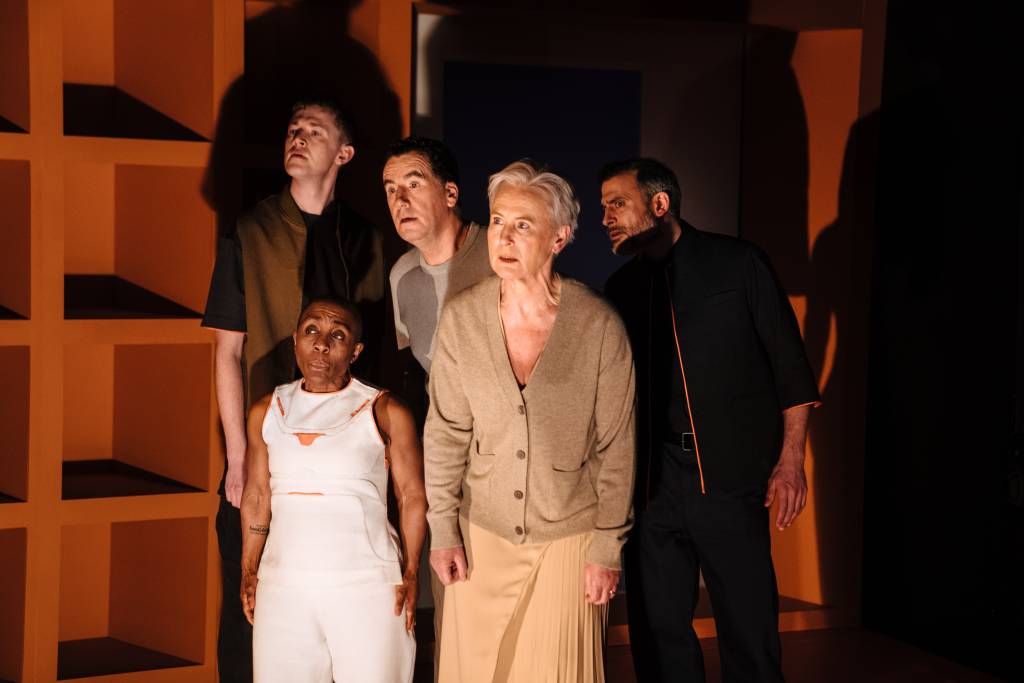
With the tech-enabled delusions of the super rich now the central driving force in global politics, there could not be a more opportune moment to examine the reality behind fantasy bundled as product. Lauren Mooney and James Yeatman, who together are Kandinsky, have devised a chilling and remarkable play for our times. ‘More Life’ imagines what it would actually be like to live forever, and the unequivocal conclusion is… absolutely terrible. Corporate scientist Victor (Marc Elliott) is working to impact the consciousness of dead people, digitally stored half a century earlier, into living bodies – bringing the dead back to life.  After many failed experiments, with people ‘turned off’ when they fail to react positively to the discovery, firstly, that they have died, and then that they have been brought back to life, he succeeds with Bridget, whose new body is played by Alison Halstead. She also appears in her original form as a ghost, played by a Danusia Samal, observing her inexplicable resurrection

‘More Life’ focuses on the emotional impact on Bridget, and her husband (Tim McMullan) and his second wife (Helen Schlesinger), of meeting someone who died 50 years ago. Mooney and Yeatman’s writing teases apart the sheer horror of living in a world where you no longer have a place, and of having your life ripped from its moorings. This is not an advert for AI. A quality cast delivers focused, persuasive performances: McMullan’s blank features crumbling under pressure, Schlesinger’s amenability stretched and torn, and Halstead’s understated performance carrying an emotional heft that builds and builds. Elliott is quixotically driven, while Lewis Mackinnon’s fellow scientist is a counterweight with a conscience.

‘More Life’ is partly an updating of ‘Frankenstein’ – it is bookended with the 1802 electrification of a corpse that inspired Mary Shelley – and partly an echo of Caryl Churchill’s hyper-prescient play ‘A Number’, but very distinctly its own self. Kandinsky’s style is low-key and highly inventive, honed over the course of several productions at the New Diorama Theatre, under now-Royal Court director David Byrne. They present complete, enthralling theatre. The orange cubicles of Shankho Chaudhuri’s set conjure a distant future without cliché; lighting from Ryan Joseph Stafford, sound and music from Zac Gvirtman, and sound from Dan Balfour delineate constantly shifting time periods with complete clarity. James Yeatman’s direction takes an apparently setting and uses the cast in multiple ways, as chorus, narrators, physical presence, and participants in a way that appears seamless, and is very difficult to achieve.

There is an entirely unexpected, devastating scene in which the whole cast sings David Byrne’s ‘Glass, Concrete and Stone’ – a sly tribute to the man who brought Kandinsky to the Royal Court perhaps, and a song of social disconnection. The lyric “Everything’s possible when you’re an animal” takes new on new poignancy in the context of the directions we are choosing to take as a species, or that are being chosen for us. ‘More Life’ is an intelligent and troubling critique, with a fabulous cast – a production enthrals from start to finish. It exemplifies the role of drama as a social mirror which shows us the things we would prefer to ignore.

Nachtland

Angus Wright, John Heffernan and Dorothea Myer-Bennett. Photo by Ellie Kurtz.

Nachtland by Marius von Mayenberg – Young Vic, London

Translated by Maja Zade, Marius von Mayenberg’s play is a brutal satire on the hypocrisy and racism of the contemporary German middle-classes. Brother and sister Philipp (John Heffernan) and Nicola (Dorothea Myer-Bennett), who have a difficult relationship, come together to clear their recently deceased father’s house. In the attic, they find a painting, wrapped in brown paper which, on examination, appears to by Adolf Hitler. This provides a more than sufficient catalyst to strip away the pair’s principles and dignity, as they attempt to cash in.

Nachtland (an invented German word meaning something like ‘night-land’) is a broad, bitter comedy drawn with cartoonish strokes. Most of the cast have a lot of fun with their absurd characters. Myer-Bennett is extremely aggressive, particularly towards her brother, self-righteous and openly racist. Heffernan is patronising, passively aggressive, and racist in a more insidious way. The two performances complement each other very well, culminating in a jaw-dropping brother-sister masturbation scene, as their excitement about the money they can make from the painting boils over. They play off against their partners, Gunnar Cauthery as Fabian and Judith, played by Jenna Augen. The latter is Jewish, and the only remotely normal character in the play, who whips the rug from under everyone without blinking. The events take place in an aging house, set designed by Anna Fleische, where the past has clearly been shoved in the attic and left unexamined for too long.

The absurdity of Nachtland, managed beautifully by director Patrick Marber, is its strength. Jane Horrocks is restrained, and funnier because of it, as Hitler art expert Annamaria. Angus Wright puts in the most eye-catching performance as wealthy Hitler collector, Kahl. First appearing in a cut scene, dancing to techo in a jockstrap, he re-emerges in furs and coloured chinos to appraise the painting for sale. Wright rings every drop of potential out of Kahl’s quivering ecstasy at the sight of a ‘Hitler’, but also delivers the collector’s dismissal of morality and art with fine disdain, launching into a list of those we prefer to forget were anti-semitic.

It is a little hard to judge Nachtland from outside Germany. Its satire, which feels unrestrained and to some extent shocking, is clearly aimed at Germans themselves. Whether this is familiar territory, or an essential reality check is not obvious to us in the UK. The play is too obvious at times in its humour, and struggles to get off the ground until Wright’s entrance. Von Mayenburg also gives the Devil, in a long tradition, the best lines. But it an entertaining and disconcerting evening in equal parts, with some very memorable moments. And the overall suggestion, of deep-lying, unapologetic prejudice among those who should know better for all sorts of reasons, is highly disturbing and an urgent matter for the stage to address.