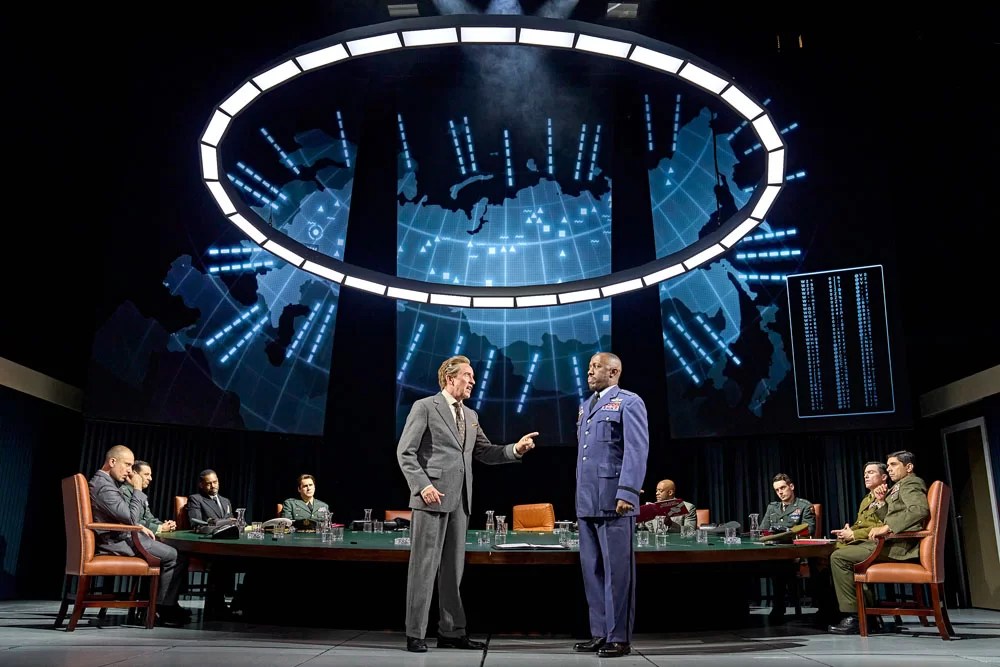
Steve Coogan and Giles Terera. Photo by Manuel Harlan.
Dr. Strangelove by Armando Ianucci and Sean Foley – Noël Coward Theatre, London
Sean Foley and Armando Ianucci have adapted Stanley Kubrick’s 1963 satire, Dr. Strangelove, for the stage, powered by the willingness of Steve Coogan to go one better than Peter Sellers, and play four parts (Sellers bailed on Major TJ Kong, who was played instead by Slim Pickens). The concept of staging the film is attention-grabbing, and the issues it satirising more current than they’ve been for decades. However, it is not ultimately clear why this story needs to be on the stage. The adaptation, , and Sean Foley’s direction, are very faithful to the film apart than the odd update such as a acknowledgment that the cast is almost entirely male, which does not change the fact it is still almost entirely male. Part of the problem is that it is less a story than a series of set-piece scenes, which work well on film and less well on stage. The film is oddly set-bound, which may have made it seem suited for theatre, but somehow the show never quite takes off.
Coogan is accomplished and highly professional in all four roles: frightfully posh English officer Captain Mandrake; US President Muffley, trying to be reasonable in the face of insanity; Major TJ Kong, perhaps his best role, the gung-ho, bomb-riding B52 pilot with a strange attitude to women; and Dr. Strangelove, wheelchair-bound not-very-ex-Nazi scientist. The play is, inevitably, mostly focussed on him – and the substitution of lookalikes with their backs to the audience while Coogan changes into another costume quickly become distracting. There is also the sense that Coogan never really lets it all out. His performances seem controlled and script-bound, and the moment when he unleashes the madness never arrives.
There is limited space for other cast members to shine, and indeed there appear to be several senior military figures who spend much of the show sitting around the War Room table, never speaking. However, John Hopkins has a lot of fun cast, slightly surprisingly, as the mad General Ripper, who launches a nuclear assault on Russia without permission. His performance has an unpredictable edge to it that is lacking elsewhere, and his conspiracy-theory fuelled spiral seems alarming current. Giles Terrera has fun as General Turgidson, cheerleader for ‘pretaliation’ against the Soviets, but he can’t animate the War Room scenes on his own.
Hildegard Bechtler’s set recreates the look of the film very well, but inevitable involves filling the stage with large immovable objects, notably the giant oval War Room table, and the cockpit of a B52. This does not aid the production’s fluidity. Nor does the fact that the large back-projection is invisible to the substantial section of the audience in the balcony, and has to be replicated on very small tv screens. In fact, the Noël Coward Theatre seems the wrong place for this show, which is too constrained on its tight proscenium stage. It would have worked much better in the Olivier.
The characters, conversations and events of Dr. Strangelove are terrifying close to real life. Much of the film is a documentary in disguise, dramatising the insane thinking of senior US military figures such as Curtis Le May and Thomas Powers, who actively encouraged a nuclear conflict in which they were quite willing, as General Turgison says, for 20 million American to die, as long as even more Russians were killed. The revived nuclear threat following the invasion of Ukraine makes this satire both timely, and as important now as it was then. It is just a shame that the stage version delivers more of a tribute show than a rebirth.
 Tom Bolton