Krapp’s Last Tape

Krapp’s Last Tape by Samuel Beckett – Barbican Theatre, London

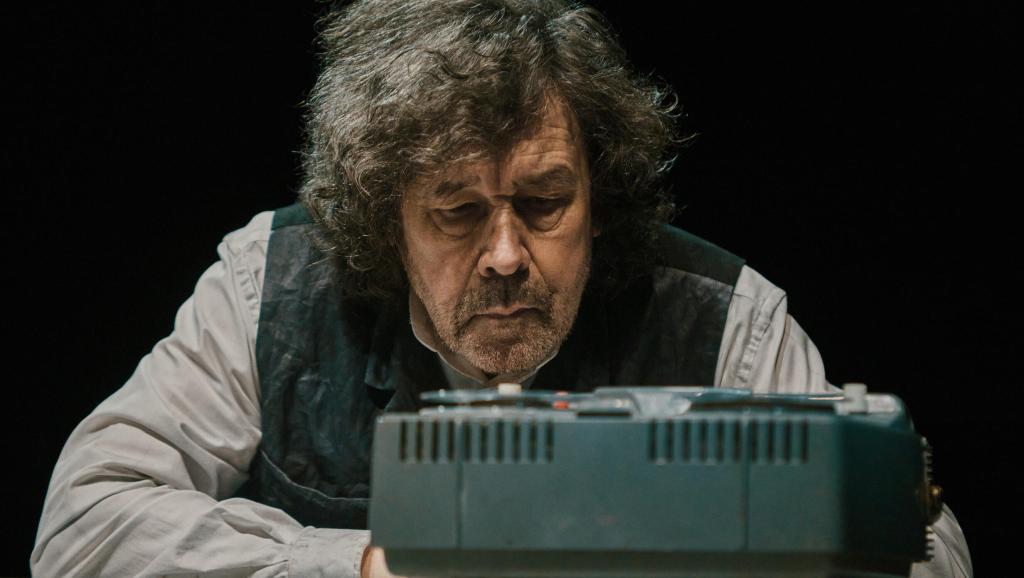
With the pre-announcement of not one, but two future productions of Krapp’s Last Tape scheduled for the mid-2030s (when Sam West and Richard Dormer reach 69, the age of Beckett’s main character), it’s reasonable to ask what makes actors want to play this role so much. To some extent, it could be that recording the lines for younger Krapp at 39 represents a solid investment in future work. But there is also a clear sense that this is one of the big roles, a defining part, and one that suits unconventional actors better than classic leads. Stephen Rea is very much the kind of performer suited to Krapp. Actually 78, although he very much does not look it, Rea bring a hangdog comedy and a deep sadness to a role others have approached with more rage and less stillness. He also met Beckett himself, who attended rehearsals for the Royal Court’s 1976 production of ‘Endgame’ with Rea in the cast.

Vicky Featherstone’s production is designed by Jamie Vartan, who places Krapp’s desk in a square of light beyond which lies only darkness. A path of light leads from the desk to a door, beyond which lies smoke, the drink which Krapp retires periodically to consume, with a comic sloshing sound, and who knows what else. The set also aids the silent comedy at the heart of Beckett’s play, in the form of a ludicrously long desk drawer which Krapp pulls out further and further to reach his hidden bananas. Rea plays the sad clown very well, dialling down the slipping on banana skins but emphasising the shambling walk, which looks both exaggerated and weirdly familiar. The inevitable comedy of decay is inseparable from the sadness, loneliness and failure that haunts Krapp, in the form of his naive 39-year old self, still seeking and possibly expecting happiness. His writing, unlike that of Beckett, faded away despite his epiphany in a storm, which he can not longer bear to hear about.

Stephen Rea recorded the Krapp tapes in his 60s, but they sound like the work of a younger man. The weighted precision of his delivery makes very word matter a great deal, to Krapp and to Beckett as writers and to us as an audience. His performance is heartbreaking without ever needing to fully express the emotions we know he is feeling. This play, so slight, remains a work of remarkable power that can bind the entire audience of a large theatre into the unravelling existence of one man.
A Knock on the Roof

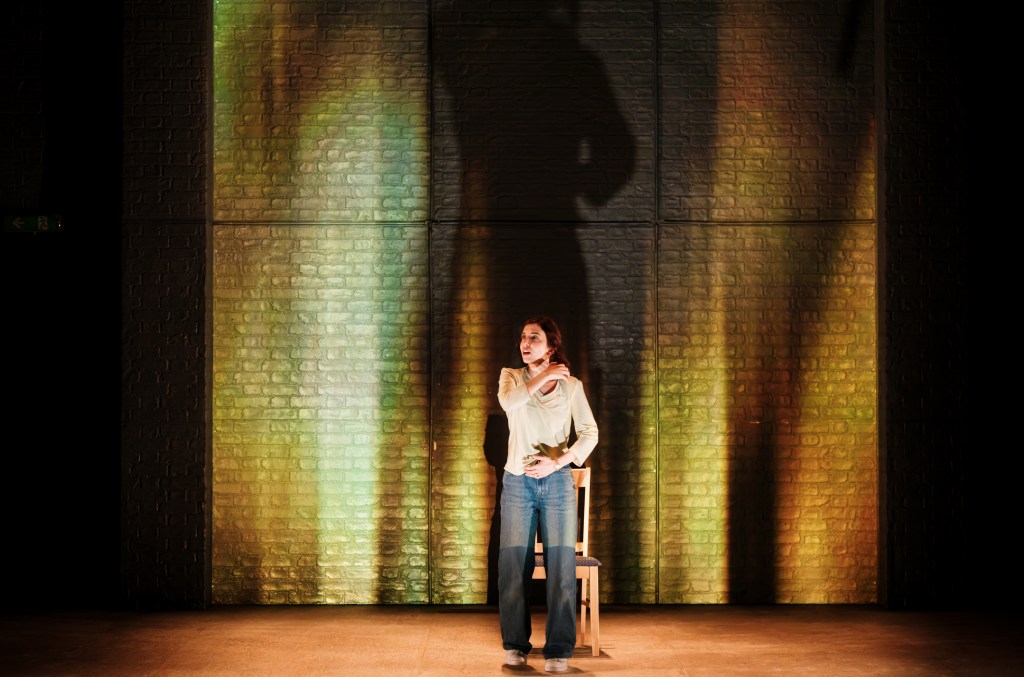
Khawla Ibraheem. Photo (c) Alex Brenner.

A Knock on the Roof by Khawla Ibraheem – Royal Court Theatre, London

Published at Plays International

The significance of Khawla Ibraheem’s one-woman play about life in Gaza has only intensified since its runs at the 2024 Edinburgh Fringe and off-Broadway. A Knock on the Roof is one of the starkest, most politically urgent pieces the Royal Court has staged for some time. The war in Gaza has put UK theatre in the spotlight, and not to its advantage. The cancellation by the Royal Exchange in Manchester of Stef O’Driscoll’s A Midsummer Night’s Dream over what have been described as ‘pro-Palestinian’ messages revealed a cultural fault line. It has fed into disputes involving leading industry figures and the Culture Secretary about theatre’s freedom to make political statements, especially on the Israel-Hamas conflict. The brutal events in Gaza have been notable by their absence from our stages, even as they dominate political discourse. In the midst of this, Khawla Ibraheem delivers a masterclass in political theatre. She communicates, with honesty, commitment, humour and self-awareness, the truth of life under siege in a war zone, where politics is not a choice but an all-consuming, everyday reality.

A Knock on the Roof, is both written and performed by Ibraheem. It is named after the tactic, adopted by the Israeli Defense Forces, of dropping a ‘small’ bomb on residential buildings as a five-minute warning to residents that a rocket is coming. Ibraheem plays Maryam, who has a young son, Noor, an aging mother and a husband studying abroad. Her daily existence includes keeping Noor out of the polluted sea, dealing with her mother’s nagging, and negotiating with an absent partner. It also involves escape drills. Maryam becomes obsessed with how far she can run in five minutes, and who or what she can carry, if the knock comes. She practices in the middle of the night, carrying a weighted bag to represent her son, hoping to get fitter, trying to create a scenario in which her family survives.

The constant, never-ending fear that attends Gazan life is both mesmerising and terrible. The concept of being on the alert 24 hours a day for a signal that death is imminent is a deeply distressing scenario, and also farcical. What would you really bring if you had just one bag? Would you choose clothes, or things that really matter to you? How far do you imagine you can run in 5 minutes? Which way would you go? And what if you miss the ‘knock’? The combination of the ordinary and extraordinary is excruciating, but Ibraheem also makes it funny. Her performance, committed, nuanced and physical, is a real success. She appears relaxed, hugging friends before the play starts, engaging in audience interaction, but she is laser-focused. Her writing is multi-layered, acknowledging absurdity as well as terror. We are entirely convinced as she describes what on the surface seems unrelatable, describing an extreme situation entirely in terms of human experience.

The play is also about more than the war, or the many previous wars – even Noor has already lived through two. Ibraheem writes about the frustration of being a woman in Gaza, with a child and husband neither of whom she really wanted, her studies and future curtailed. Her mother reinforces the social expectations that weigh her down, insisting she showers in a dress so she is not pulled naked from the rubble if the building is bombed. The focus is entirely on her performance. The stage is bare apart from a single chair, and settings are shown through light-touch back projections on the bare brick of the back wall – set designs by Frank J Oliva, and projection design by Hana S Kim. Director Oliver Butler developed the piece with Ibraheem, and together they conjure a place we find hard to comprehend from nothing with enormous skill. Ibraheem uses her body to communicate the sheer physical demands of survival in a war zone.

A Knock on the Roof is a significant show for a number of reasons. Staging such a stripped-back piece in the Royal Court’s main auditorium is a big and bold statement. Khawla Ibraheem is not only a significant talent, but a performer we need to hear from right now. And she blows away the fog of political argument and disinformation by showing what it is like to live in Gaza – something that, despite many months of press coverage, we still do not really know. The message she communicates is undeniable, that what happens to people is the only thing that matters. Away from slogans, this is surely the most meaningful lesson we can learn from disastrous conflict. If theatre cannot communicate this, it has no role; but by staging this show Artistic Director, David Byrne, makes it clear that he understands where the Royal Court’s power lies.

Ghosts

Ghosts by Henrik Ibsen – Sam Wanamaker Playhouse, London

Joe Hill-Gibbins’ production of Ghosts is the first Ibsen to be staged in the candelit glow of the Sam Wanamaker Theatre, and it looks remarkable. Set and costumes, designed by Rosanna Vise, are from a decadent mid-20th century society. The back wall consists of mirrors and the floor a cocoon of blood red, deep pile carpet. It is alluring and disturbing like the costumes – the upper class characters in velvet dresses and satin waistcoats, enfolding iron gloves. From the upper levels, the production takes place beneath a bank of six chandeliers which, while offering more of a glimpsed view than a theatre audience would expect, show the action in soft focus. The whole production looks like Visconti’s 1963 film, ‘The Leopard’, in its low light designed to reveal only costly surfaces. Osvald, infected with syphilis, compares his softening brain to “cherry-coloured velvet”, and the setting depicts suffocating interiors from which there is no escape.

It remains hard to imagine how Ibsen’s play, still direct and shocking, would have seemed to its original audience. Hill-Gibbins deploys the high end cast at his disposal with relish, and they make the most of Ibsen’s brutal exposé of hypocrisy. Paul Hilton’s Parson Manders is a canting fool, a man whose only show of strength lies in his moral convictions, which are thoroughly mistaken. It is hard to imagine why Hattie Morahan’s Helene Alving loved him, but the fact she did makes the poverty of her existence plain. She gives a riveting performance, quivering with a lifetime’s suppressed rage, then collapsing with absolute despair. Stuart Thompson as her son, Osvald, conveys the character’s conflicting emotions and failure to escape his social constraints very well indeed. Sarah Slimani’s Regene is blunt and unsentimental, the only character with any hope of achieving any freedom. And Greg Hicks is brilliant as the wheedling, deceitful Engstram, who has Manders in the palm of his hand. He creeps around the stage with his bad leg, like Richard III without the social position. Yet we feel a residual sympathy for a man whose class has limited his opportunities to opening a brothel and getting others to fund his drinking.

Hill-Gibbins, consistently one of the most interesting British directors of the classics, pulls off a sophisticated, layered account. He has also adapted the play, and the version is crisp and startling. This production shows the quality of productions that the Globe Theatre, frustratingly inconsistent in the past, can and should be staging. It also reconfirms the reputation of Ghosts as one of the touchstone plays that made modern theatre.