Who’s Afraid of Virginia Woolf? by Edward Albee – Soho Place, London
Sixty-four years after its premiere, Who’s Afraid of Virginia Woolf? is firmly a play from a different time, but its regular revivals throughout the 21st century suggest Edward Albee produced a work that continues to speak to and intrigue us. The play is many things. Most obviously, it offers a perfect pair of lead roles for warring couple Martha and George, combining humour, verbal dexterity, unashamedly bad behaviour, pathos, tragedy and a Shakespearian amount of time on stage. They are some of the biggest parts the stage has to offer. Not only that, Albee gives us Nick and Honey, the younger couple, walking into something they definitely do not understand. These are complex, demanding and brilliant supporting roles.
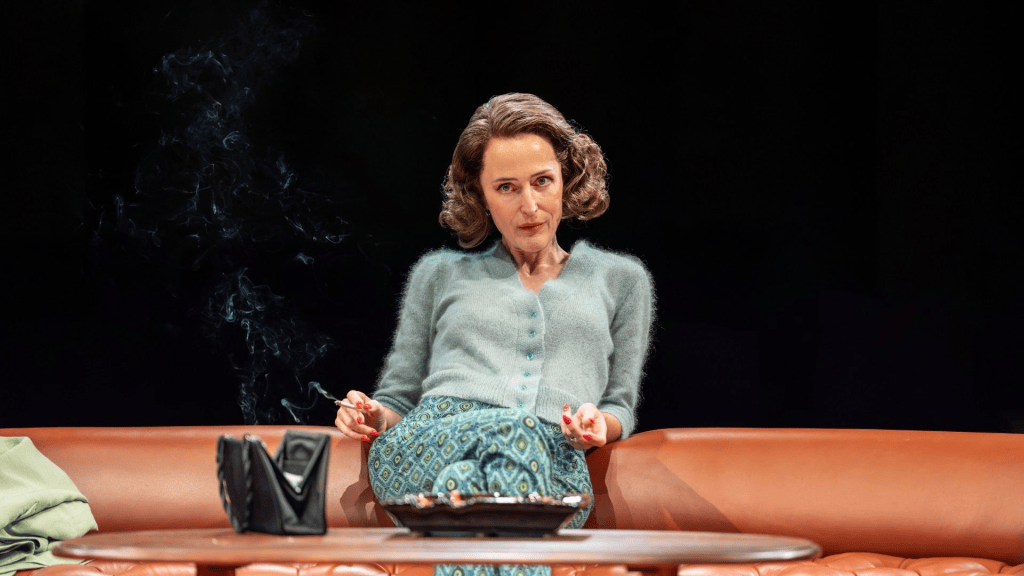
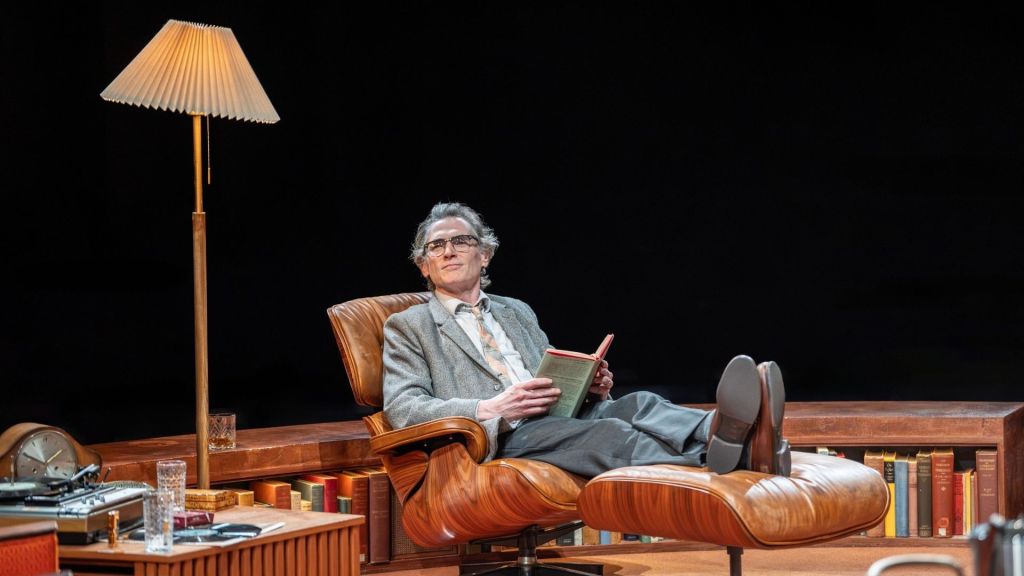
Marianne Elliott’s star-studded production at Soho Place supplies performers more than capable of relishing these parts. Gillian Anderson seizes the centre of the round stage as though she belongs there and performs – as an actor, as Martha, treating her own living room like a bull ring, and as a woman – standing right back up to anyone who dares test her, and using anyone she can. Billy Crudup, as George, is more than a match. He looks every inch the crumpled, aging academic, an underdog in most situations, and certainly when his wife’s in the room. But he is every inch as theatrical and devious as she is, and he knows – most of the time – how to use his perceived status to his advantage. Both performers are magnificent and horrifying, as they tear strips off each through the drunken early hours, and they are heart-breaking when the vulnerabilities they fight so hard to conceal finally start to wear through. The final scene, when the truth about their son is revealed, is difficult to watch.
Lined up for their pleasure are Josh Dylan’s Nick and Phoebe Horn’s Honey. Both performers have a great deal of fun – Dylan as a jock who is too easy to rub up the wrong way, and Horn as a young woman out of her depth. Then, as the barbs start to dig deeper and the older couple, George in particular, delivers carefully crafted cruelty, they fall apart in dramatic fashion. It remains highly entertaining and horrifying to watch people pulling one another apart through words alone. The play never leaves Martha and George’s sitting room, which contains a constantly shifting combination of the characters in twos, threes and fours. It’s a writing tour de force.
But the play remains more than the high-wire act. It’s harder now to understand the impact in 1962 of a female protagonist who makes no concessions to men, to expectations of female behaviour, to status, or to politeness. Martha is fearsome, and before here there had been few, if any, stage women who said and did exactly what they pleased. She is powered by her powerlessness, as the daughter of a influential man (her daddy is the college principal) with no influence or status of her own, dependent on her husband to get ahead or be recognised.
The play’s brutal irony that, although she can rail against her surroundings she cannot escape them, but her real sadness is her failure to have a child – which is both what’s expected of her, and what she wants. Honey is approaching a similar situation, her great secret being a false pregnancy, meaning that Nick is questioning her value. The play makes the situation of women in the post-war era horribly clear, but it has meaning now too for an era when politics no longer seem translated through personal relationships are they were a generation ago. Looking back to the way it was still seems important, both in terms of the underlying equality issues but also the directness with the characters speak to one another – which lands differently in the impersonal, online era. Can four people just talking ever have quite this impact again?
Elliott’s highly assured production plays on a remarkable set by Miriam Buether which revolves – but so imperceptibly slowly that it takes about 20 minutes before yo suddenly realise that all the furniture is in a different place. It’s an eerie effect, and a very clever way to match the pace of the play, where vocal excitement flares but the underlying dramatic pace is heating gradually over hours to a real boil at the very end. An ingenious, classy setting for a production which delivers a near-flawless account of a play that still hits home hard.

