The Line of Beauty

Photo by Johan Persson.

The Line of Beauty by Alan Hollinghurst adapted by Jack Holden – Almeida Theatre, London

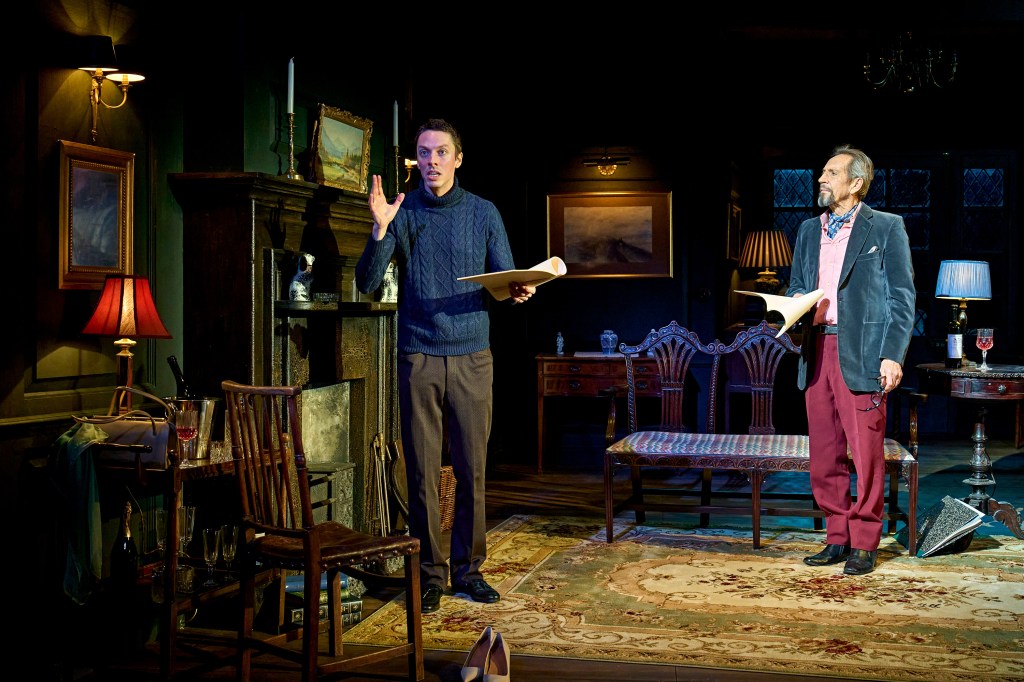
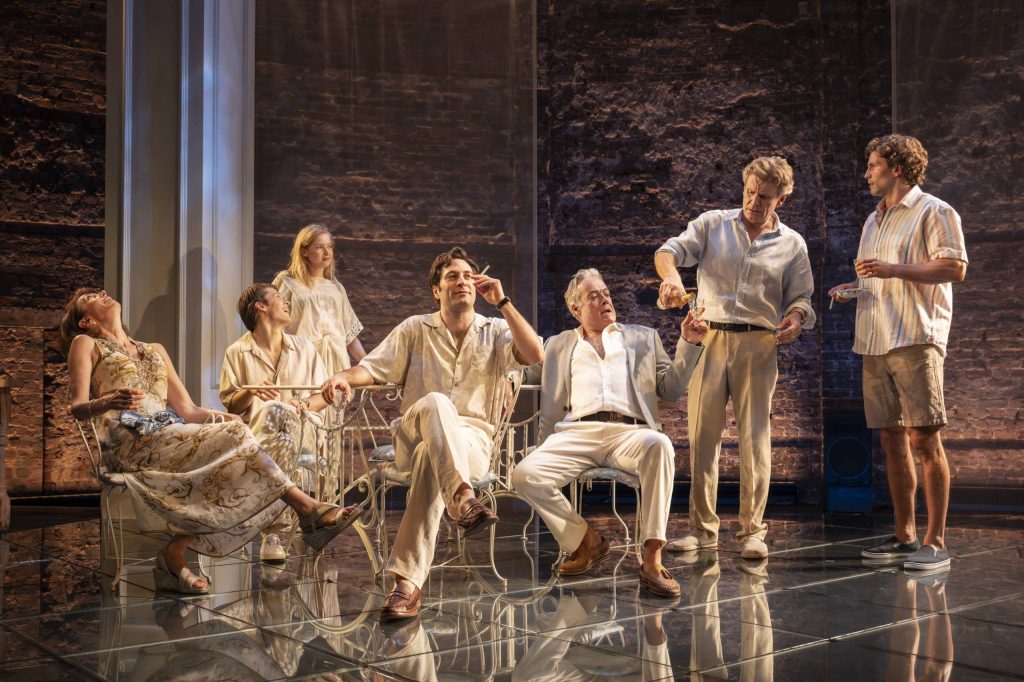
Alan Hollinghurst’s much-loved novel, The Line of Beauty, won the Booker Prize in 2004. Looking back to the rise of Conservative politics in 1980s Britain, and the parallel AIDS crisis, it explored gay life and consciousness through the eyes of ingenue Nick Guest, who learns a lot in a short space of time. Now, adapted by Jack Holden and directed by Michael Grandage, it reappears two decades later on the Almeida stage.

Adapting novels as plays can be a thankless task, especially when they’re well known, but Holden does a good job in not allowing the book to kill the drama. Covering the period between the Conservative victories at the 1983 and 1987 elections, the play dramatises the collision of personal and political from the perspective of Nick, played engagingly by Jasper Talbot and his experiences in love, and while lodging with the family of a Conservative MP. Performances are universally strong, and Grandage’s production is very tightly delivered. Alistair Nwachukwu gives a standout performance as Nick’s first lover Leo, charming, clever and vulnerable. Arty Froushan, as cocaine-snorting playboy Wani, Charles Edwards as smooth, fatherly MP Gerald Fedden, Robert Portal’s menacing Badger, and Ellie Bamber as bipolar Cat Fedden are all excellent performances. Hannah Morrish channels the demeanour of Fergie in a way that is both hilarious and disturbing. Doreene Blackstock, as Leo’s mother, and Claudia Harrison as Gerald’s wife are also very strong, but their roles are rather limited – a problem with both book and play. The staging is sumptuous – sets and costumes by Christopher Oram – who has clearly delighted in recreating and subtley parodying the high society 1980s with its odd combination of frumpiness and glamour.

Some of the more literary aspects of the book get a bit lost in the dramatisation, such as the thematic significance of Henry James and of the ogee, a shape which swings both ways. What is more significant is how much of a period piece the play feels. Hollinghurst was writing about a period 20 years earlier, a time now approaching half a century from the present day. The key issues of the time – homophobia, social conservatism, privilege and the devastation wrought by AIDS should not be forgotten, but are not undiscussed. The play offers a highly professional and entirely entertaining evening, but it is unclear exactly why this novel needs to be staged at this particular moment.
Einkvan

Photo ©Tristram Kenton

Einkvan by Jon Fosse – Coronet Theatre, London

Published at Plays International

Kjersti Horn’s production of Jon Fosse’s Einkvan, visiting The Coronet Theatre on tour, is a startlingly experimental piece of theatre. Horn is artistic director of the Det Norske Teatret in Oslo, and she is working with perhaps her country’s foremost writer in Fosse, winner of the 2023 Nobel Prize for Literature. He is unusual in being known equally for his novels and his plays, and the production provides a rare opportunity to see his work on the London stage. It does not disappoint, being both simultaneously dark and compassionate, with a staging that unpicks fundamental assumptions about the stage.

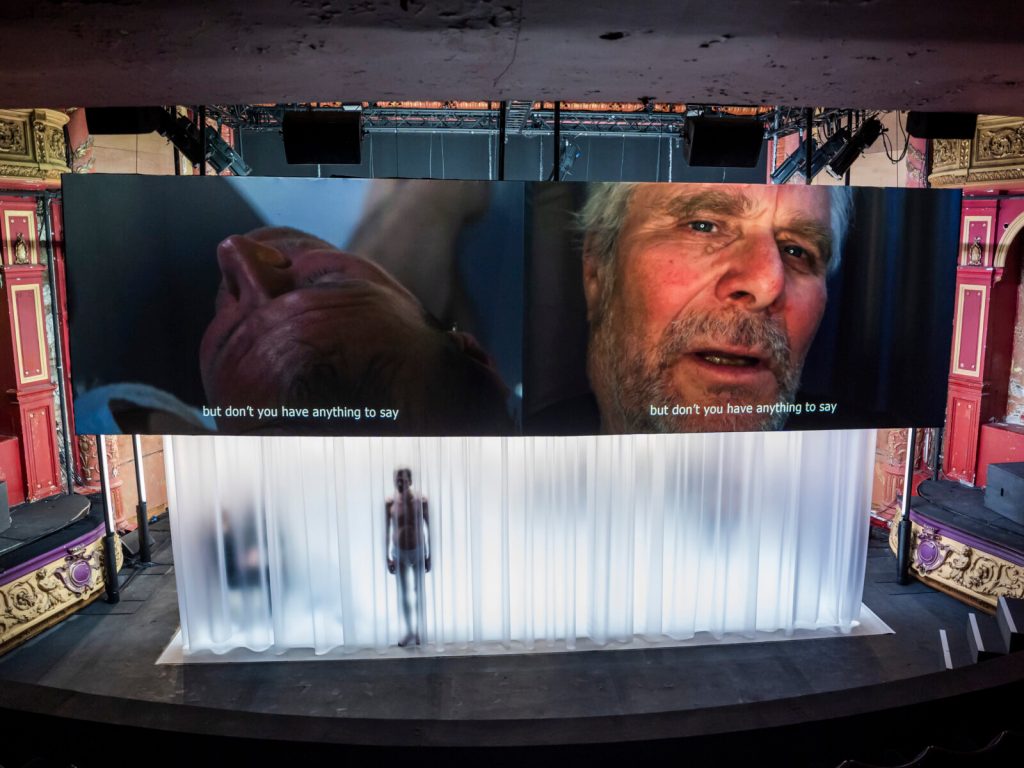
Both set and costumes are designed by Sven Haraldsson, but their main role is to obscure the action. The performers are concealed for the entire hour-long show behind an opaque plastic curtain which surrounds the stage. Only their faint dark outlines are visible as they perform the play. Instead, we see them through two large video screens hanging above the stage. The action is filmed with handheld cameras, with a single face shown in close-up on each screen. The video work, by Mads Sjøgård Pettersen, frames the audience’s perception of the entire show. The unseen camera operators are crucial performers, driving the mood with tighter, more disturbing close-ups as the tension slowly builds. Pettersen and Borgar Skjelstad, who together film the action, rightly take a bow at the end.

Einkvan is Norwegian for ‘uniqueness’. The play is performed in subtitle Norwegian by a cast of six, playing a mother, a father, a son and their apparent doppelgangers – characters who look similar although not identical but appear to live parallel lives. Only two characters ever appear at a time, one on each screen. The play consists of a series of first-hand accounts of meetings. Both the mothers and the fathers encounter the sons unexpectedly in the street, and are baffled when they refuse to reply to their enquiries about why it’s been so long since they met, or their invitations to supper.

These encounters use ritualised repetition, but are also naturalistic. Fosse strips language back to its hidden core, using no superfluous words. This directness, which seems very Norwegian to a UK audience, is also strangely moving. The failure of people to connect – parents with children, but also friends with one another and people with themselves – seems a highly apt social metaphor for the 21st century. It may be even more than that. At times it feels as though Fosse has traced the source of all our social ills, and is shining a spotlight on it.

The performers – Laila Goody and Marianne Krogh as the two mothers, Jon Bleiklie Devik and Per Schaanning as the fathers, Vetle Bergan and Preben Hodneland as the sons – are very effective at delivering performances in close-up, a technique which is undoubtedly much harder than they make it look. The performances to a camera on stage is reminiscent of Andrew Scott’s breakthrough stage appearance twenty years ago, filming himself on the Royal Court stage in ‘A Girl in a Car with a Man’, but this takes the challenge to a whole new level. Characters are constantly interacting with one another across cameras, and at one point even staging a fight in a bath. All the actors are compelling throughout. In fact, the whole play holds the audience rapt, a remarkable achievement for a show in which the actors only appear in the flesh at the curtain call. When they do, the dissonance is sharp as we emerge from what feels like a dream, suffused with sadness and loss, tenderness and a powerful endorsement of the need for humans to support and love one another.

Double Feature

Joanna Vanderham & Ian McNeice. Photo by Manuel Harlan.

Rowan Polonski and Jonathan Hyde. Photo by Manuel Harlan.

Double Feature by John Logan – Hampstead Theatre, London

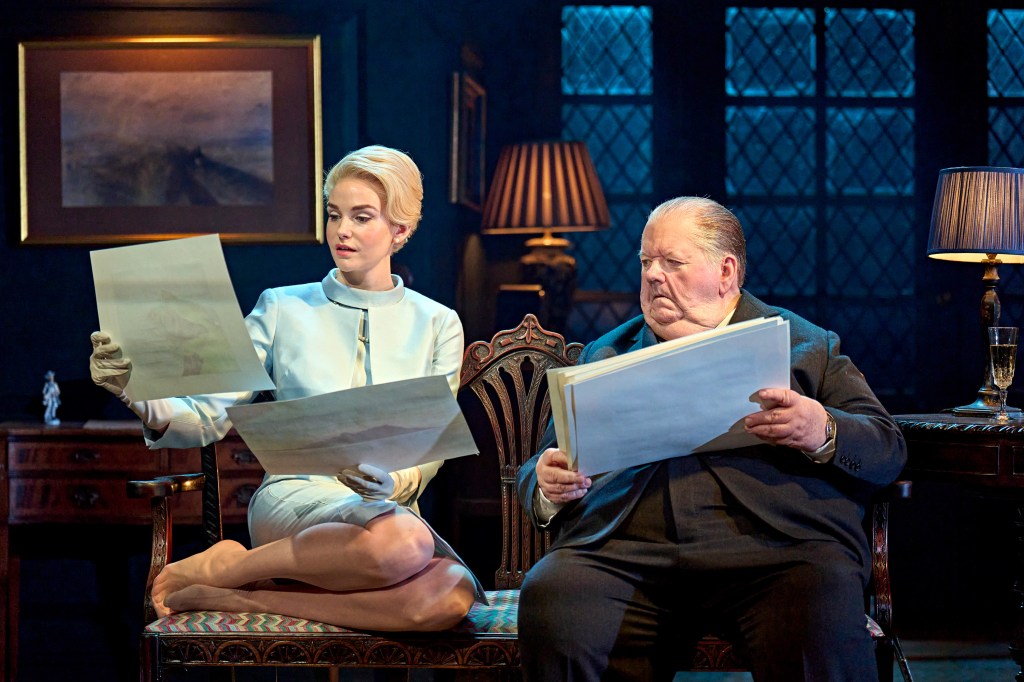
John Logan’s new play reanimates two moments of cinema history, taking us behind the scenes to the discussions that ended careers, in very different ways. The play opens with a man in a hat and cloak sweeping, Gothically, into a comfortable cottage. It is Vincent Price (Jonathan Hyde), and he is meeting Michael Reeves (Rowon Polonski), young, brilliant and doomed film director during the shooting of Witchfinder General. Soon, we realise that this time period, 1968, is woven with another, around four years earlier. Onto the same set step Alfred Hitchcock (Ian McNeice) and Tippi Hedren (Joanna Vanderham). Now we are in Hitchcock’s cottage on the Universal lot, during the filming of ‘Marnie’. The relationships between the two pairs are very different. Hitchcock is a sexual predator, offering stardom in exchange for giving him what he wants. And he always gets what he wants. Hedren is his creation, a model he made into a film star, and she fully understands the power Hitchcock has over he. Meanwhile, Reeves has no power and can only beg Price not to walk out on his film and, it turns out, persuade him he is for real. Price looks impressive, but his performance style is hopelessly out of date and the work has dried up.

Logan has written a very enjoyable play that raises multiple questions about reputations and the way we imagine people, as well as the creative process. He also pulls off some technically demanding effects, writing scenes that overlap between the two timelines, sharing moments of dialogue. Jonathan Kent, directing, delivers a production of undeniable quality, and Anthony Ward’s hyper-realist set is richly imagined, even allowing space for Jonathan Hyde to demonstrate Price’s cooking skills by whipping up some pasta in real time.

Ultimately the success or otherwise of ‘Double Feature’ depends on the play’s overriding vision and logic, and on the performances. On the former, it does not quite deliver. It is clear that Logan is very interested in the two relationships he portrays, and in the film history around them. Hitchcock’s poisonous relationship with Hedren has only been fully revealed in the last few years, and is certainly worthy of exploration. Meanwhile, Reeves short career (he died of a drug overdose at the age of 25), and his unlikely encounter with Price, is a fascinating topic. Despite his undoubted writing skills, it is never entirely clear why Logan has chosen to interweave these two subjects, other than as contrasting examples of creative connection. Really, they seem like two short plays that could just as easily have remained separate.

However, where ‘Double Feature’ really delivers is in its cast. Admittedly, Rowon Polonski, while an excellent awkward young man in a hurry, perhaps lacks enough of the underlying darkness that is surely part of Reeves persona. However, the scene in which he persuades Price to stop hamming up his performance is a brilliant moment, as we suddenly hear the voice that makes ‘Witchfinder General’ so chilling. As Price, Jonathan Hyde is a real pleasure to watch, both flamboyant and entirely real, explaining touchingly how he wears make-up to maintain the illusion as he ages.

Joanna Vanderham is entirely convincing, both playing the role of a Hitchcock blonde, and unravelling her fears and anxieties, before finally tells Hitch what she thinks of him. And Ian McNeice is both delightful and thoroughly nasty as Hitchcock himself, obsessing over everything from oysters to luncheon meat, and gradually making his sinister side more and more apparent. By the end it is clear that Hedren’s film career is over, and she will not play another lead – and that’s the way she wants it. Meanwhile, Price will go out on a career high, having finally found a film he really wants to make. There is plenty on offer here to entertain and to inform.