Ghosts by Henrik Ibsen adapted by Gary Owen – Lyric Theatre, Hammersmith
Published at Plays International.
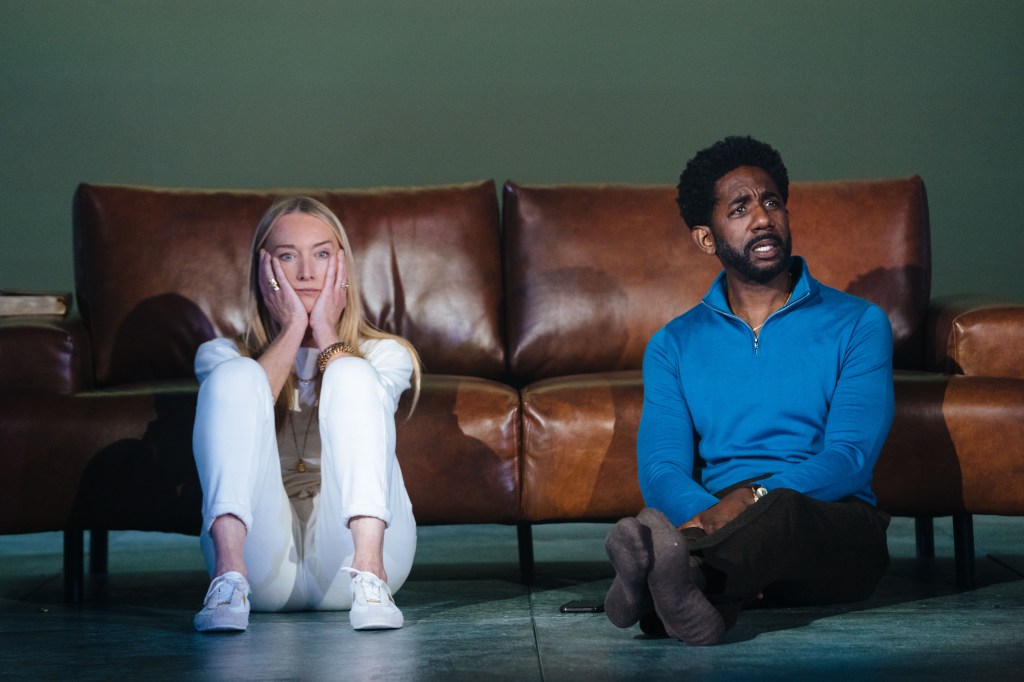
The back of The Captain’s heavy, balding head is literally papered onto the walls of Merle Hensel’s set for the Lyric’s new version of Henrik Ibsen’s Ghosts, in a repeating patten. He may be dead, but his menacing presence looms large in the lives of everyone he has left behind. Meanwhile, the rear wall is a curtain of mist, dimly reflecting the characters who wander, lost, through a mental fog. The marble and leather opulence of the expensive interior does nothing to disguise the unresolved anguish which is pulling everyone apart from the inside. The Captain was a larger-than-life figure, a bully, a philanderer and arapist. Gary Owen’s pin-sharp updating of Ibsen’s classic preserves the generational impact of dark, unacknowledged secrets, while making them completely of the moment.
The Lyric’s boss, Rachel O’Riordan, has a fruitful artistic relationship with Owen including their hit Iphigenia in Splott. Their new collaboration feels like an event. The show’s emotional impact smoulders from the very first scene, as Rashan Stone’s lawyer, Andersen, visits the Captain’s widow, Helena (Victoria Smurfitt), to discuss arrangements for a new children’s home to be funded by his legacy. The professional atmosphere rapidly dissolves in the face of their unresolved relationship as old lovers. Callum Scott Howells, a force of nature as Helena’s deeply troubled son Oz, arrives on the scene to confront the older generation with the consequences of their silence. His burgeoning relationship with the Captain’s unacknowledged daughter Reggie (Patricia Allison) is both sweet and real, and deeply troubling as they discover they are half-siblings. Meanwhile, her non-biological father, Jacob (Deka Walmsley), is from a different social world, from where he can see exactly how poisonous a situation she is in.
Owen’s rewrite is masterful, pulling the play from its 19th century setting and refocusing on the human relationships that make it powerful and current. The lurking threat of syphilis, which no longer makes sense, is removed making space to dive into the realities of a coercive relationship, the corrosive power relationships created by wealth, and the terrible dilemma of discovering you are closely related to your lover. Ghosts is brilliantly cast. Victoria Smurfit, making a rare and welcome stage appearance, is perfect as a woman struggling with her inability to speak out against her abuser. She switches between full insight and reversion to the language of the oppressor. Her relationship with her son, Oz, is at the centre of the play. Callum Scott Howells is Gen Z to the core in bleached hair and Adidas tracksuit bottoms, his emotions always on the surface. He hides nothing, but being open to his feelings of rejection does not make them easier to bear. The generational gap with his mother, who hid everything to protect him, comes to a head in a scene reminiscent of Gertrude and Hamlet, where he questions her about whether she was raped. It draws gasps from the audience, as do several scenes during the evening.
Rashan Stone’s Anderson is a much more sympathetic character than his original, the hypocritical Pastor Manders. He gives a deeply human performance as a man trying hard to do the right thing, and finding there are no good choices. Patricia Allison’s Reggie is spiky, and fully aware of how much she has to lose while Deka Walmsley, as her father, is also more sympathetic than Ibsens’ original, using what little power he has to protect his daughter. Jacob, a painter-decorator with a broad East Anglian accent, emphasises the social gulf between the wealthy, living in coastal luxury, and those who work for them, who have very few options.
Ghosts is a significant achievement, a fresh look at a classic which shows us just how powerful Ibsen’s writing can be. Gary Owen turns our attention to themes easily obscured by the differences between eras. His version includes a powerful, entirely real evocation of Anderson’s lifelong, unrequited love for Helena. It draws on the power of public image, with the children’s home destroyed by the threat of toxic press coverage, rather than burning down, as in the original. He explores, in excruciating detail, how parents come to emotionally damage their children. And he gives a sophisticated, convicing analysis of the insidious ways a coercive relationship isolates and destroys a woman. Ghosts is a gripping, beautifully acted show, driven by a creative vision that brings this 150-year-old play pulsatingly to life.
 Tom Bolton