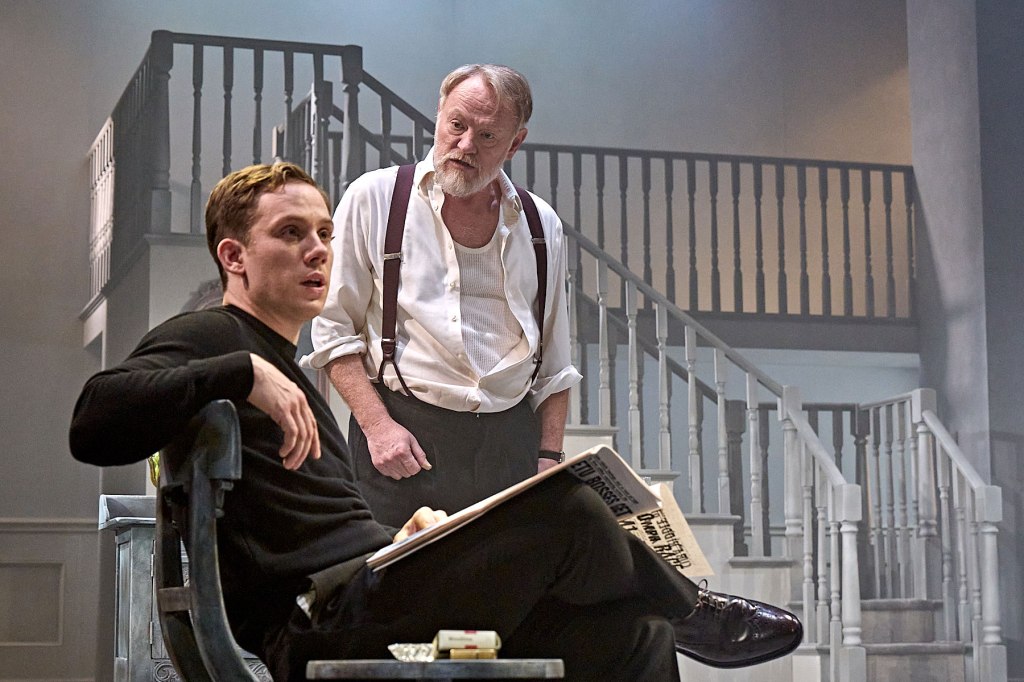
Joe Cole and Jared Harris in The Homecoming © Manuel Harlan
The Homecoming by Harold Pinter – Young Vic, London
It feels like a new era for Harold Pinter’s work. Jamie’s Lloyd’s 2019 Pinter West End season came before the pandemic and, since then, his plays no longer seem to pop up everywhere as they did throughout his life and for a decade after his death. A lot has happened since 2019, and audiences are now much less willing to take 1960s sexual politics for granted. The Young Vic’s revival of The Homecoming, directed by Matthew Dunster, is therefore something of a test of how Pinter’s work comes across in the 2020s. While critical reactions have been mixed, I think the play is darker, funnier and more socially incisive than at any point since it first burst onto the stage.
The Homecoming is set in a 1960s a household occupied by two generations of working class men with underworld connections, and the outsized absence of the deceased woman of the house, Jessie. When brother Teddy makes a surprise return from academic exile in the States with his wife Ruth, the men have a new focus for their hostile energies. What happens next remains properly shocking, as Ruth appears to agree to their seedy proposition that she should abandon her husband and children to make herself available to them all, while bringing in money as a sex worker. The charge is that Pinter has written the only woman in the play as a passive reflection of male sexual fantasies.
Dunster’s production makes two things clear – that Pinter’s writing is just as precise and brilliant as ever, and that the play may not be what we imagine. Moi Tran’s heavily carpeted set filled with assorted post-war furnishing, ashtrays and soda siphons, places the action in a very precise time, but Sally Ferguson’s lighting, which spotlights characters and objects, repeatedly lifts us away at key transition points. The men in the play are individuals but also types. Jared Harris as patriarch Max is brilliantly angry and volatile, flailing at the family around him, a classic tyrant. Joe Cole is born to play Lenny, a sinister pimp whose charm thinly conceals his capacity for violence. Joey (David Angland) is an aspiring boxer, all muscle and not much else. Nicholas Tennant’s Uncle Sam is in some ways the star of the show, and his twitchy performance as a bullied chauffeur clinging onto the shreds of his dignity is inspired. He stands as a critical presence outside the trio of toxic males. Meanwhile, the house represents society as much as it does a particular place, and its inhabitants the system of male control exercised through threats and manipulations – financial, emotional and physical.
Pinter, whose dialogue is a lot funnier than people think, balances the conversation throughout on the brink of farce. Characters speak in a heightened, exagerrated form of normality which is close enough to real life to be familiar, but far enough away to be hilarious. The characters of Teddy (a passively aggressive Robert Emms) and Ruth fit into this parody. As Ruth, Lisa Diveney seems beamed in from a quirky mid-60s social comedy, quickly seeing the power she has over everyone in the house as a replacement for the missing Jessie. The scenes in which the men press their sexual attentions on her are thoroughly disturbing, and it is hard to imagine how the original audiences would have reacted to the play’s full-throttle transgressiveness. Incidentally, the implication that she will happily abandon her children is, surely, a reference to Hedda Gabler, with Nora’s willingness to leave her family literary cause célèbre for a previous generation. However, in a play that twists reality so gleefully it seems a mistake to take anything too literally. Pinter gives us the strong impression that Ruth is playing the men, who think they have her under their thumbs. They imagine themselves cunning and in control, but they are completely at her mercy. The play is an unashamedly nasty tale, and a very effective metaphor for a society where men are cocky, self-confident and fatally vulnerable. Dunster’s production is horrifying and compelling in equal measure.
 Tom Bolton