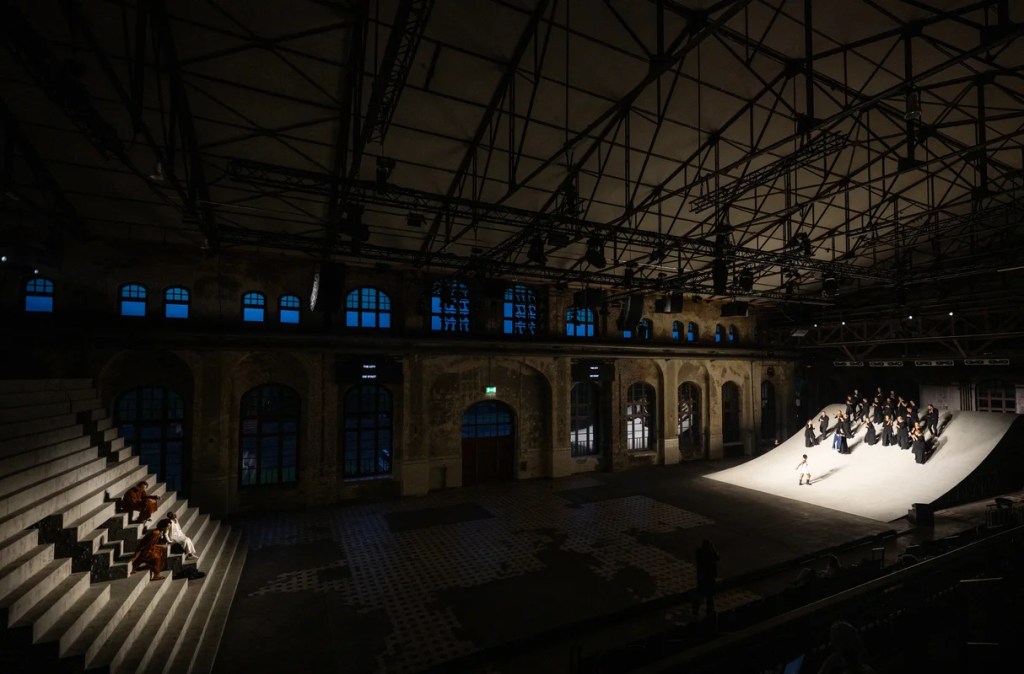
Photo by Kurt Van Der Elst.
The huge Maschinehalle, once the engine house for the Zweckel coalmine in the heart of Ruhr, looks as much like a mansion as a place of work, with balconies, staircase and a space inside like a ballroom. Standing alone, surrounded by forest, it makes a bewitching venue for Lisaboa Houbrechts’ production of Siddhartha, adapted from the novel by Herman Hesse about the journey towards enlightenment made by a young prince in the time of the Buddha.
Siddhartha by Herman Hesse, Lisaboa Houbrechts, Caroline Shaw, Latvian Radio Choir – Maschinenhalle Zweckel, Gladbeck
Published at Plays International
The scale of the production matches the space, which is especially wide, and ideally suited to the grand, symbolic gestures which structure the production. Houbrechts not only directs, but has also written what is described as ‘the libretto’. The production has a cast of 27, most of whom are members of the Latvian Radio Choir, providing a chorus which is varied, and at times stunningly, performed. They move through the production as a group of fully committed extras, directed and managed in great detail, contributing throughout. They combine singing with movement, resulting in a series of very memorable moments. The cast process, slowly and deliberately, in copper robes, carrying flaming brands, and performing a piece using only intonations of breath. It is as though an ancient ritual has sprung to life in front of us. Dressed in black and white they form a village, and later a town, while performing a varied, impressive soundtrack which includes the entirety of Caroline Shaw’s ‘Partita for Eight Voices’. At one point the choir also sings the first lines of ABBA’s ‘Lay All Your Love On Me’. That they not only pull this off, but make it a moment of extreme poignancy, is testament to the production’s confidence. The show has a musical leader, Christian Balvig, and Casper Clausen working on soundscapes, while Kaspars Putnins conducts the choir on stage as part of the ensemble. The scale and impact of a choir, filling the space both physically and musically, is a result of many people’s work.
Credit must go to Oumar Dicko, whose costumes are a key part of the setting, and to set designer Sammy Van den Heuvel. He bookends the remarkably wide stage with a set of white steps on one side and a long white slope on the other, each a good 20 feet high. The steps represent the hard way, and the slope the easy way, but the latter of course is not as easy as it seems. Houbrechts has adapted Hesse’s novel by changing the gender of the Siddhartha, who becomes non-binary, played by a woman – Belgian singer-songwriter Meskerem Mees. Her lead role is demanding, as she has to not only sing but at times express her struggle through pure physical movement, and she does occasionally feel a little lost in the space. The show works best when it fills the room with people, but is anchored by some key performances, including from Sufi singer Zila Khan as a harrumphing, chuckling Buddha, and Claron McFadden as Siddghartha’s mother.
The production achieves some remarkable moments. One is the boat – in the form of a floating wheel – which drifts across the stage as it becomes a river, apparently of its own accord, in a piece of bold stagecraft. Another is the use of the Machinehall’s big windows, open to the trees beyond, as the backdrop to the entire show. The sun sets as the evening progresses, and the natural light fades, bringing us closer together in the room. When the central doors are flung open to the outside, once at the start as Siddhartha begins her journey, and again near the end as the Buddha appears, the effect is simple but startling.
Siddhartha has been five years in the making, and is a fine example of a clarity of vision, purpose and ambition which characterises the best theatre in Germany and the Low Countries. It plays at Antwerp’s Tonelhuis over the winter, before touring, and is very much worth a trip across the Channel.

