The Mistake

The Mistake by Michael Mears – Arcola Theatre, London

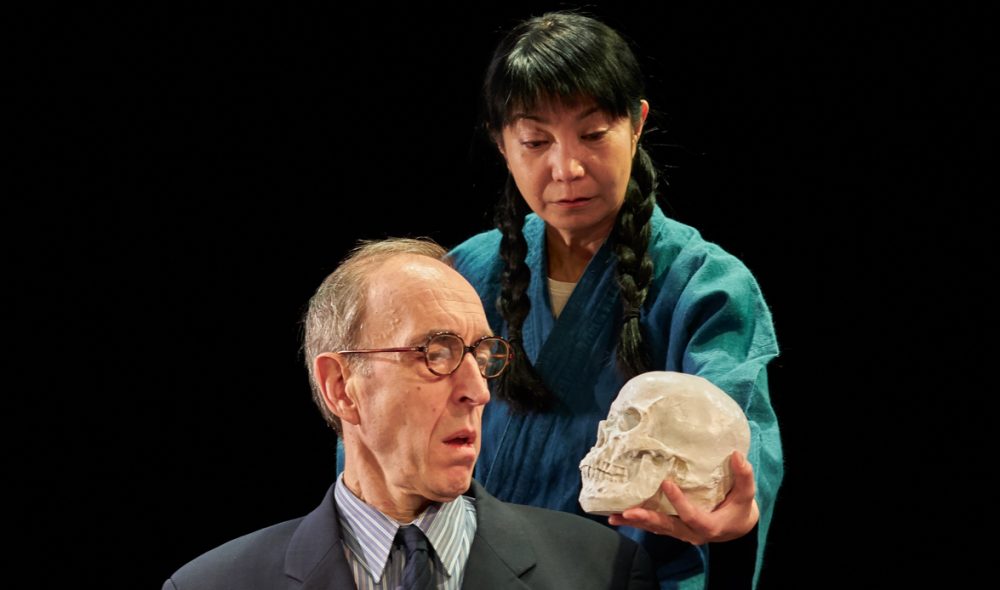
The Mistake, which returns to the Arcola for a short run during a global tour, is a two-person show about something that happened 80 years ago, but still reverberates through our culture: the atomic bombing of Hiroshima. Michael Mears is both writer and performer, switching between multiple roles alongside Riko Nakazono. The play combines close examination of the bombing and its terrible aftermath with inventive staging that brings a topic that risk become a lecture to life with ingenuity and moments of powerful emotion.

Mears focuses key figures in the development and deployment of the first atomic bomb, who are often forgotten: atomic scientist Leo Szilard, who made the breakthrough that led to the successful testing of the first atomic reactor; and Paul Tibbets, the pilot who dropped the Hiroshima bomb, flying the Enola Gay – a plane named after his mother. Szilard was immediately aware of what he might have unleashed, and campaigned valiantly, an in vain, to prevent the bomb being dropped on a populated city. Tibbets, whose later interviews with Studs Terkel form part of the play’s source material, was unapologetic to the end about his role and said he’d do it again in a heartbeat. Mears plays both these constrasting characters and a host of others, including Robert Oppenheimer and Albert Einstein, with great conviction.

His white, male authority figures are set against a parallel storyline about the horrific impact of the bombing itself, told through the eyes of a young Hiroshima woman played by Nakazono. Using minimal props, the pair make a big impact, staging the moment-by-moment approach of the B-29 as a normal day unfolds in the city below. The impact of the bomb is graphically evoked with nothing but a model plan and a set of metal steps, while Nakazono’s account of the terrible injuries and the mass deaths it caused is heartbreaking. Rosamunde Hutt’s direction gives the show life and energy, and Mears’ writing gives it strong purpose. It is very well-informed and researched, full of fascinating or alarming pieces of information, such as the fact that the possibility of a critical nuclear reaction came to Szilard, living in London, as he waited to cross the road on Southampton Row; or the little-know fact that the USA made preparations to bomb a third Japanese city. The Mistake – which, needless to say, refers to Szilard’s discovery of the chain reaction – is a campaigning play, seeking to prevent us forgetting what a terrible thing we once did, so we do all we can to prevent it from ever happening again.

Scenes from a Repatriation

Photo: Alex Brenner

Published at Plays International

Scenes from a Repatriation by Joel Tan – Royal Court Upstairs, London

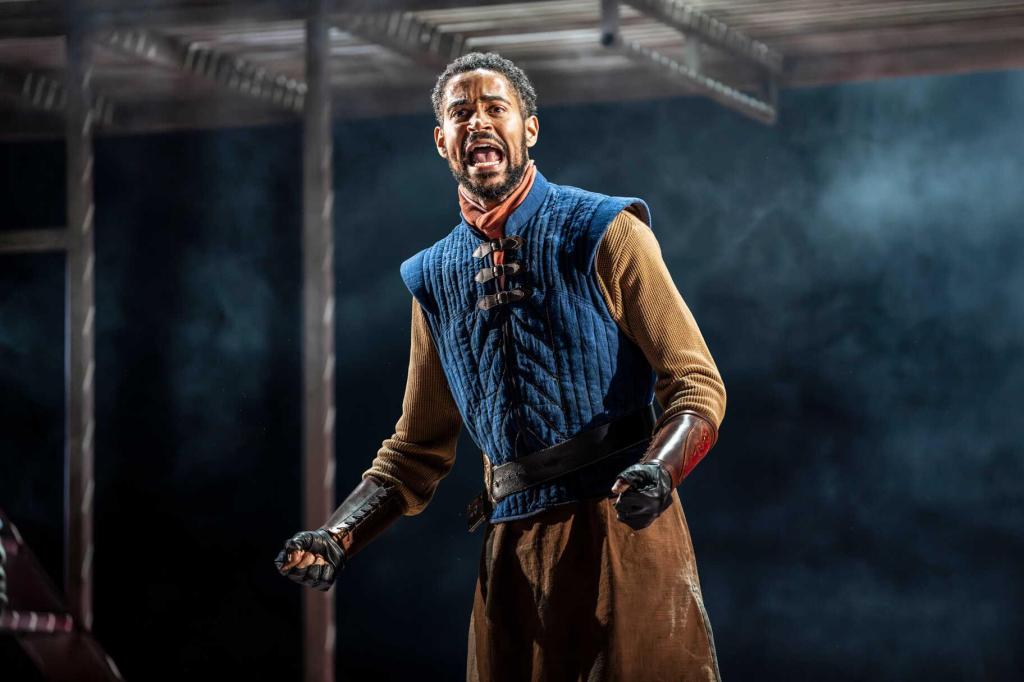
Joel Tan’s new play is an ambitious overview of a post-colonial world, examined through the fraught question of museum repatriations. A statue of the Boddhisattva Guanyin, on display in the British Museum overlooing the gift shop, becomes the focus of attention in the UK and in China, from where it was stolen during the destruction and looting of the Summer Palace in Beijing in 1860, by British and French troops. The violence of this act echoes in the opening moments of the play. The production, directed by emma + pj, has powerful sound design by Patch Middleton, who conjures the screams and earth-shaking roars as soldiers burn the palace in a fire which killed more than 300 servants.

Scenes from a Repatriation switches characters and sometimes eras with each scene. They are announced on a screen formatted like object labels in a museum. The play is in two parts. The first half, set in the present day, tells the story of pressure on British Museum curators to return Guanyin to China, while exploring the experience of people of Chinese origin living in the UK. The second half takes place in China after the return, and features more loosely connected scenes, probing politics, money, social relations in China itself. Tan pushes the limits of the format, staging an epic with a cast of only six, in the Royal Court’s small Upstairs space. It is not entirely successful, but when it works it works well.

The cast, constantly switching roles, do a very good job of telling a narrative that always remains entirely clear. The cast are predominantly performers of Chinese origin, and some scenes are performed in subtitled Cantonese and Mandarin, rare on the London stage. Kaja Chan switches with great fluidity between roles from English curator to Mandarin-speaking secret police interrogator. Sky Yang shows similar range, moving among roles that include a protesting Chinese student and the Scottish soldier who first looted the statue.

The play gives us much to admire, and is also frustrating at times. It would have benefited from an edit. There are a couple of scenes that do not work well, in particular an encounter at a party between a wealthy Chinese businessman, an ingratiating employee and his hired female companion, in which the characters appear either stupid or viciously misogynistic. The production’s tone is also confusing at times, shifting between broad parody – a comic posh curator, a doddery professor, a protest group called Islington Witches for Change – and the intense realism of an interrogation in a Hong Kong prison cell, which diffuse the play’s focus and impact.

However, many scenes do really hit home. A student, boycotting the British Museum, explains to his tutor how Guan Yin is a surrogate mother figure for young Chinese people far from him. A flashback takes us into the mind of a soldier looking down on himself as he loots the Summer Palace. The tokenism of a Chinese-themed British Museum Late is neatly skewered. And the interrogation scene, in which a cartoonist is questioned about the political intentions of his work, is powerful – the interrogator perched high up behind a screen and a civilised veneer that fails to hide that the outcome is never in doubt.

Scenes From a Repatriation brings wider issues to the stage that are both current and neglected. The conduct of the British and colonial armies in China in successive opium wars during the second half of the 19th century, intentionally forgotten in the West, is well-remembered in China and influences international politics now as much as it ever did. The return of looted objects is an issue becoming impossible to ignore. But the play is also about human dislocation: Chinese people looked down upon in the UK, Chinese students propping up the higher education system, oppression of Uiyghurs, crackdowns in Hong Kong. Empires then and empires now use people as their currency.

The production is urgent and exciting – video from Tyler Forward and lighting by Alex Fernandes are integral to the fast-paced story-telling. Joel Tan’s play is entertaining and urgent, with so many stories to tell that they cannot be contained. Perhaps if more work by writers and performers from Chinese backgrounds was staged, there would be less need to cover everything in one go. However, Tan has created real political theatre, dramatising debates that are difficult, unresolved and unavoidable, and reflecting our society in an unexpected light. The Royal Court is fulfilling its mission by staging plays like these.

Tachwedd (November/The Slaughter)

Cari Munn, Glyn Pritchard, Saran Morgan in Tachwedd. Photo by WoodForge Studios.

Tachwedd (November/The Slaughter) by Jon Berry – Theatre 503, London

Published at Plays International.

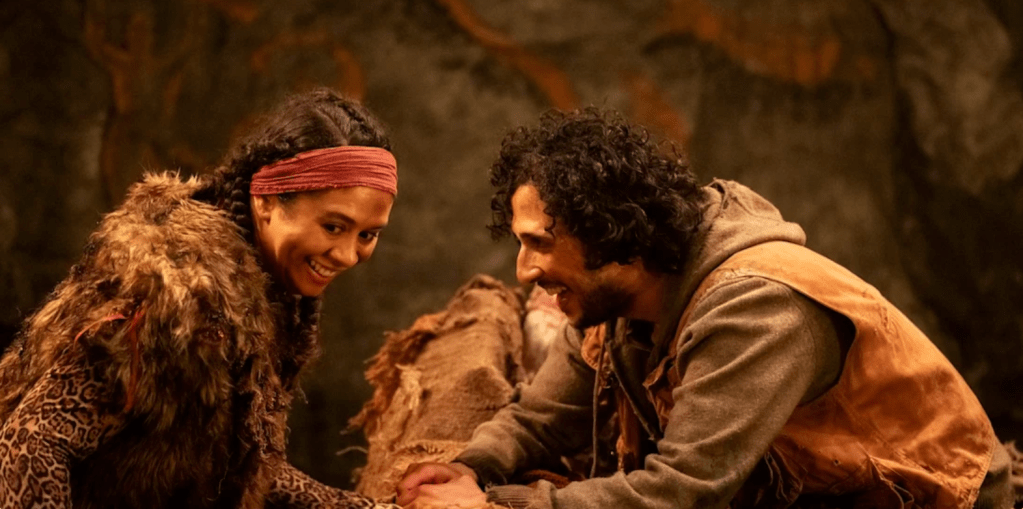
The title of Jon Berry’s new play is the Welsh word for November which, as well as the month, suggests a time of year when the mood darkens. In a rural context, it is also when the animals are fat enough to slaughtered. The foreboding title is a fair representation of the drama, which is ambitious, era-spanning and disturbing. Set in a single location – a farm house somewhere near Trawsfynydd in Snowdonia – it takes place in five time periods, from pre-history to the present. The stories in each are connected by the influence, generally malign, of their shared place. The show opens with the cast of four scooping up handfuls of the earth and eating them, sending the unambiguous message that the place is within them, whether they want it or not.

The play concentrates on four stories: a young man trying to escape his farming inheritance in 1758; a grim tale of power and sexual abuse in 1902; worklessness and a failing marriage in 1975; and a writer winning fame by exploiting family tragedy in 2024. The all-Welsh cast of four give appealing performances, and switch very effectively between their various roles, which are neatly indicated by small changes in costume. Saran Morgan plays a series of young women, always fighting back against expectations. The young men played by Bedwyr Bowen are trapped by society, place and expectation, in capable of getting out. Carri Munn’s characters range from self-deluding and dangerous, to furious at the restrictions of place and society . Glyn Pritchard’s older men are similarly varied, by turns predatory, self-destructive, and possessing all the power and authority. The set, by Rebecca Wood, is a crescent of tall slats which can channel blinding light towards the audience, or focus beams like a stone circle, connecting events beyond their time.

Jon Berry’s ambition is impressive, and Tachwedd is reminiscent of Alistair McDowall’s similarly time-hopping play, The Glow. The impressionistic prehistoric scenes, involving a wild boar hunt, add an exciting element of the mysterious and undefined to the social history that powers the main scenes. It is difficult to weave themes together across such large timespans, and the play’s thesis is not entirely clear. Berry’s describes the play as being like “a distintegration tape” running in a loop until it becomes “saturated” and falls apart. Events layer up in a single location across time, creating shadows that cannot be erased. However, the drama would benefit from stronger shared threads to justify the telling of these particular stories, than just the soil that connects them.

Nevertheless, Tachwedd gives us a defiantly unpretty social history of North Wales. It is a serious play that, despite its tragic events, has strong characters and humour too. Berry has fun, for example, unpicking the hypocrisies of literary agents. Well-managed by director Jac Ifan Moore, the play is an entertaining, and often powerful evening which thoroughly defies expectations. It is also a testament to Theatre 503’s crucial work developing new writing for the stage, and giving London exposure to creative artists from Wales.

Nachtland

Angus Wright, John Heffernan and Dorothea Myer-Bennett. Photo by Ellie Kurtz.

Nachtland by Marius von Mayenberg – Young Vic, London

Translated by Maja Zade, Marius von Mayenberg’s play is a brutal satire on the hypocrisy and racism of the contemporary German middle-classes. Brother and sister Philipp (John Heffernan) and Nicola (Dorothea Myer-Bennett), who have a difficult relationship, come together to clear their recently deceased father’s house. In the attic, they find a painting, wrapped in brown paper which, on examination, appears to by Adolf Hitler. This provides a more than sufficient catalyst to strip away the pair’s principles and dignity, as they attempt to cash in.

Nachtland (an invented German word meaning something like ‘night-land’) is a broad, bitter comedy drawn with cartoonish strokes. Most of the cast have a lot of fun with their absurd characters. Myer-Bennett is extremely aggressive, particularly towards her brother, self-righteous and openly racist. Heffernan is patronising, passively aggressive, and racist in a more insidious way. The two performances complement each other very well, culminating in a jaw-dropping brother-sister masturbation scene, as their excitement about the money they can make from the painting boils over. They play off against their partners, Gunnar Cauthery as Fabian and Judith, played by Jenna Augen. The latter is Jewish, and the only remotely normal character in the play, who whips the rug from under everyone without blinking. The events take place in an aging house, set designed by Anna Fleische, where the past has clearly been shoved in the attic and left unexamined for too long.

The absurdity of Nachtland, managed beautifully by director Patrick Marber, is its strength. Jane Horrocks is restrained, and funnier because of it, as Hitler art expert Annamaria. Angus Wright puts in the most eye-catching performance as wealthy Hitler collector, Kahl. First appearing in a cut scene, dancing to techo in a jockstrap, he re-emerges in furs and coloured chinos to appraise the painting for sale. Wright rings every drop of potential out of Kahl’s quivering ecstasy at the sight of a ‘Hitler’, but also delivers the collector’s dismissal of morality and art with fine disdain, launching into a list of those we prefer to forget were anti-semitic.

It is a little hard to judge Nachtland from outside Germany. Its satire, which feels unrestrained and to some extent shocking, is clearly aimed at Germans themselves. Whether this is familiar territory, or an essential reality check is not obvious to us in the UK. The play is too obvious at times in its humour, and struggles to get off the ground until Wright’s entrance. Von Mayenburg also gives the Devil, in a long tradition, the best lines. But it an entertaining and disconcerting evening in equal parts, with some very memorable moments. And the overall suggestion, of deep-lying, unapologetic prejudice among those who should know better for all sorts of reasons, is highly disturbing and an urgent matter for the stage to address.