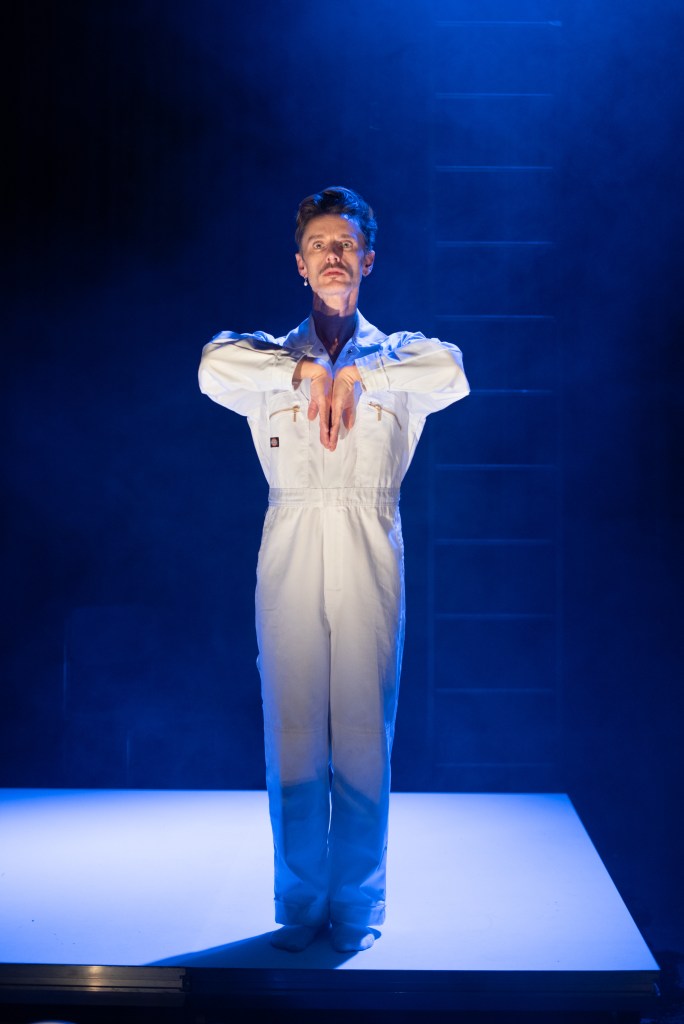
Showmanism

Photo by Sarah Ainslie

Showmanism by Dickie Beau – Hampstead Theatre, London

Published at Plays International.

Dickie Beau, wearing a white jumpsuit, stands on the edge of the stage and speaks the first line of ‘Hamlet’: “Who’s there?”. By the end of his 90-minute, one-man show he has returned to the same downstage spot, but now he has cast aside physical presence and embraced pure being. In between lies a rigorous, personal and brilliant exploration of theatrical history and the meaning of performance: to seek an audience, to speak so they can hear, to perform. Remarkably, this is achieved using other people’s voices. Dickie Beau is a lip-syncer and, unless you caught his previous show at Hampstead Theatre, Re-Member Me, or Showmanism itself on its first outing in Bath, you will not have seen anything like this.

Lip-syncing could seem gimmicky or superficial, but in Beau’s hands it is a tool that cuts right to the heart of being. An interviewee describes the invention of sound recording as a break-through for puppetry, as it allowed the performers to concentrate on the spectacle. Beau channels the physicality of the people he impersonates, so the audience recognises distinct individuals, even without hearing their voices. He performs to interviews he has recorded with a fascinating range of actors, trainers and thinkers. At the starry end of the spectrum, his discussions with Ian McKellen are very funny, including an account of Sir Ian’s worst night on stage, and various asides to noisy builders interrupting the recording. But generally Beau chooses to channel the words of people who are less famous but have remarkable insight to offer, including Greek actress Mimi Denissi, impressionist Steve Nallon, critic Rupert Christiansen, voice coach Patsy Rodenburg, and psychedelic teacher Ram Dass.

Beau performs on a set by Justin Nardella which consists of a white platform and a backdrop of hanging objects, from televisions to an astronaut’s helmet. Marty Langthorne’s lighting is instrumental in conjuring a range of spaces, including a box of light in which Beau becomes trapped, mime-style, by invisible walls. With minimal but carefully chosen props, including a Yorick skull, a ladder, a bath and a beautiful pop-up album filled with masks and auditoriums, he switches from person to person and idea to idea, weaving a thesis on theatre. It is completely riveting, even as interviewees delve deep into abstract concepts.

Showmanism, with a nod in its title to the idea actors as priests conducting the audience in a ritual, offers a succession of thought-provoking insights. The advent of speech, a mere 35,000 years ago, is discussed as humanity;s most successful technological innovation. Greek theatres are ‘stone ears’, calibrated so the audience can hear every word. An actor addressing a skull is the single image that represents theatre. People inhabit their bodies like space suits, hidden inside. But there is emotional connection too. Stripped to his underpants (admired by Ian McKellen), Beau is asked why he performs, and whether it is to escape. “What is the point?” he asks, lip syncing to a recording of his own voice. Fiona Shaw helps to answer, with her heart-stopping account of performing at Epidavros, feeling in the utter silence that she could be back in 400 BC. Theatre can transport performers and audience, and transform them too.

The show is directed by Jan-Willem van der Bosch, who should take a great deal of credit for his partnership with Beau. Together they make Showmanism both intellectually ambitious and a theatrical delight. Material that looks dry on paper is brought vividly to life, the audience plunged into the heart of arguments that seem to cut to heart of our reasons for being. Beau is gently funny too, including a recurring gag about Edmund Kean’s fabled sword, which he eventually uses to butter some toast. And he is physical, creating a performance style that reinvents mime as something new and significant. He seems to channel voices in way which, as an interviewee suggests, would have once had him burned as a witch. It is a rich and satisfying evening from a performer who does not fit the accepted categories, and is all the better for it.

Player Kings

Player Kings by William Shakespeare, adapated by Robert Icke – New Wimbledon Theatre, London

Warming up for the West End, Sir Ian McKellen’s appearance as Falstaff in Robert Icke’s compressed Henry IVs created real excitement on a Wimbledon Friday night. Some actors seem fated to play the fat knight, Michael Gambon or Desmond Barritt for example, while for others, notably Antony Sher, the role comes as a surprise to both actor and audience. McKellen is in the latter category. As they await his first entrance, everyone is silently wondering whether such a lean, vulpine actor can really carry off a fat suit. Of course he can. McKellen is the UK’s greatest living actor, and his decision to take on a demanding role at a stage in his life and career when he can do what he pleases, is a gift to us all.

McKellen’s decision to work with Robert Icke is a canny one. Icke is in demand as a reimaginer of the classic, and he has taken the radical, but entirely logical, decision to combine Henry IV Parts 1 and 2 into a single play. Althought it’s the kind of thing John Barton used to get up to at the RSC, this type of heavey editing has fallen out of fashion. But anyone who has seen the two plays in full will have experienced a slump in Part 2, when repetition seems to set in. Icke’s edits strip the plays back, to largely good effect, keeping all the best bits but cutting back on scenes such as Northumberland’s follow-up rebellion, and Pistol’s lengthy rants. The downside is a four-hour running time, but the production is very well-paced and the evening speeds by, a real achievement with the first half alone 2 hours long.

Hildegard Bechtler’s set is simple – two curtains that pull across the width of the stage – but good for switching between echoing court and cosy tavern. Other than the text changes, Icke’s production is clear and direct, giving text and performers room to breathe. The exception is an amusing staging of Falstaff’s confrontation with the Lord Chief Justice (Joseph Mydell) following the Battle of Shrewsbury. Falstaff, in a wheelchair and looking like Captain Tom, is accosted at a drinks reception in his honour, from which he methodically steals all the booze. McKellen is backed by a strong cast, including the dignified Mydell. Richard Coyle’s King Henry is a troubled man who is clearly ill from the start, and knows how little he has achieved. Toheeb Jimoh is a posh boy Hal, who seems motivated by cynical self-entertainment. The play is driven by his parade of schemes to humiliate Falstaff, but we see a glimpse of his real self in his alarming intense reaction to trying on his father’s crown.

Samuel Edward-Cook makes Hotspur a shaven-headed force of nature, and then channels a similar energy as Pistol, a clever piece of double casting. Justice Shallow is delightfully played by Robin Soans, while James Garnon is both a trouble-making Worcester and Shallow’s cousin Silence, who turns out to have a remarkable drunken singing voice. Clare Perkins makes Mistress Quickly London, and very real. Annette McLaughlin’s Warwick has hints of Theresa May, Mark Monero’s Peto is a real chancer, with no choice but to live on his wits, and Geoffrey Freshwater was born to play Bardolph.

The cast is strong, and the evening is not all about Falstaff, but he provides the plays with a deep, complex centre. McKellen, in flat cap, cravat and leather jacket, is dressed for a different era, which offers a key to his interpretation. His Falstaff is a seasoned villain, used to being top of the heap – but he has become lazy and, above all, old. Falstaff is losing his powers, and as the play progresses starts to realise that he is past it, and his time is coming. Each of Hal’s humiliations, which he shrugs off to amuse his followers, cuts deeper. He keeps being found out, and his life of sitting in the pub being deferred to is coming to and end. McKellen makes it clear that Falstaff is an aristocrat slumming it, like Hal, but far past the point of return. He is vicious and doesn’t hesitate to exploit weakness, but he is also loveable and, his physical weakness – trying and failing to rise from his tavern seat, as Mistress Quickly rushes to support him – is a heart-stopping moment, as is the final rejection scene, when he choses continued self-delusion over facing the truth. Icke incorporates his death scene from Henry V, just as Orson Welles did in ‘Chimes at Midnight’, which works well.

McKellen’s performance is a triumph – both physically menacing and vulnerable, charming and nasty – a multi-layered interpretation certainly as good as anyone who has played the role in recent memory. Icke’s production doesn’t reinvent the play with the brilliance of his Hamlet, but provides much more than a vehicle for McKellen, spawning a world that allows his performance to flourish. It’s an evening to cherish.