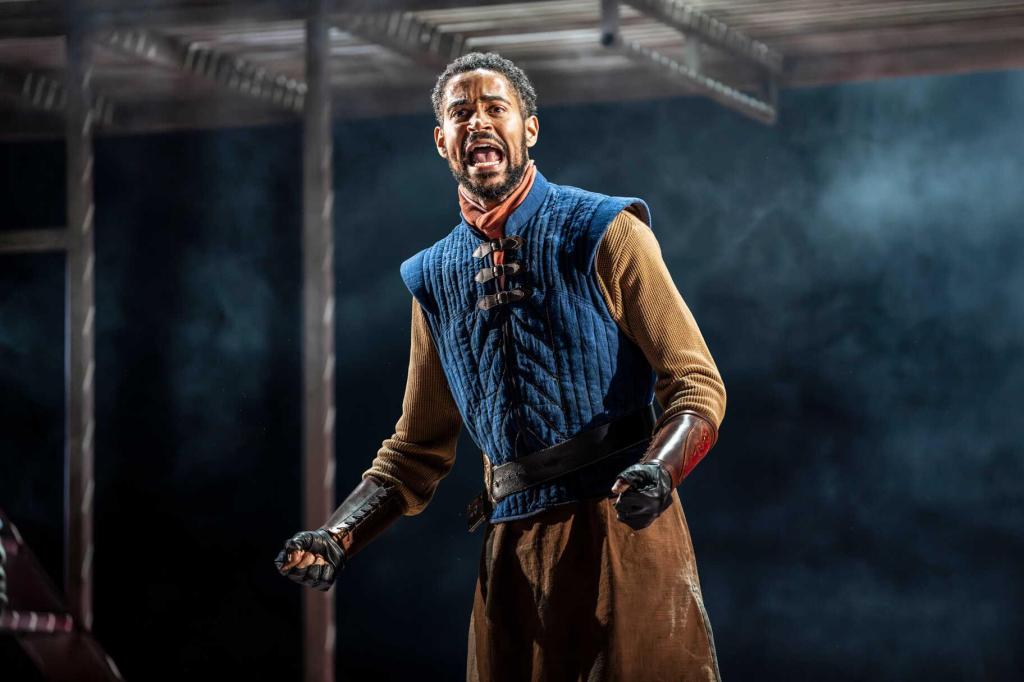
Alfred Enoch – photo by Johan Persson
Henry V by William Shakespeare – Royal Shakespeare Theatre, Stratford-upon-Avon
Following their highly successful 2024 collaboration on Pericles, Joint Artistic Director Tamara Harvey and Alfred Enoch reunite for a Henry V that uses the same language of movement, from Annie-Lunnette Deakin-Foster and fight director Kate Waters. Lucy Osbourne’s costumes are medieval in inspiration, with a couture edge. Michael Elcock’s Dauphin wears silver trainers, but the foot soldiers on both sides are in dull colours, and one side is indistinguishable from the other. The mass of men suffer and die, regardless of allegiance. The glorification of war is constantly exposed in front of a wooden scaffolding set, also by Osbourne, against which attackers and defenders alike are slaughtered.
The war, which is the singular plot of what is an unusually simple play for Shakespeare, in terms of structure, cannot be escaped. Harvey brings in Henry IV’s deathbed speech to Hal, from Henry IV Part 2, at the start of the play in which the father advises the son “Be it thy course to busy giddy minds with foreign quarrels, that action, hence borne out, may waste the memory of the former days.” Alfred Enoch’s Henry V takes him at his word, and displays a messianic focus in pursuing what is revealed to be a tenuous claim to the French throne in the play’s opening exchange. There’s something of Tony Blair in Enoch’s smooth, polite and slightly innocent manner. He gives the impression that he is an entirely reasonable man, and his war is reasonable too, but the glint in his eye grows and, by the time he delivers the St. Crispin’s Day speech, he has morphed into a cult leader. Enoch is excellent, both likeable and unnerving in one of Shakespeare’s strangest roles.
The triumphalism traditionally read into the play seems very hollow in Harvey’s interpretation. Little of what Henry says that can be taken at face value and, when he alone, he gives a bitter, self-pitying pre-battle soliloquy in which he castigates his subjects for their lack of gratitude, bemoaning his position as “subject to the breath of every fool whose sense no more can feel but his own wringing.” At the end, the Chorus reveals the futility of achieved Henry did, explaining how his son will go on to lose it all.
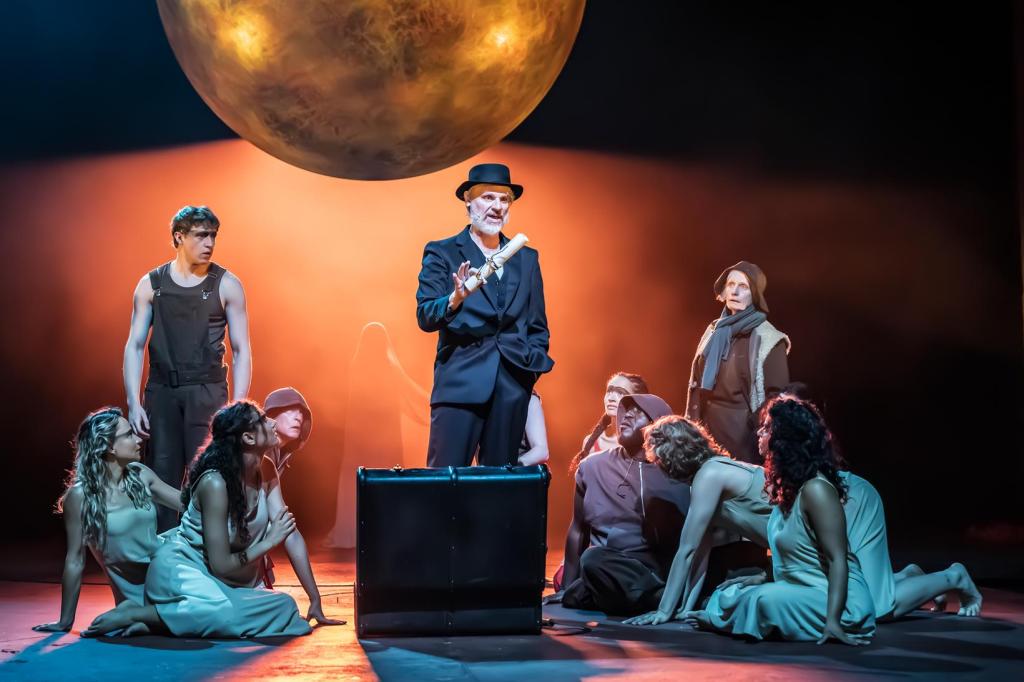
Harvey’s production uses a coherent, well-cast ensemble, continuing a welcome trend under the new RSC leadership of powerful group dynamics on stage. There a no weak links, and the performers clearly fully understand the production’s direction, and are committed to it. Jamie Ballard plays the Archbishop of Canterbury, King of France and the soldier Williams in a tour de force of flexibility. Catrin Aaron is excellent and completely different as Mistress Quickly and the Queen of France. Micah Balfour’s Exeter is a lynchpin. Gender switched parts worked seamlessly, includoing Sophie McIntosh as the Duchess of Gloucester and Sarah Slimani as Mountjoy. Natalie Kimmerling’s Katherine is a strong presence, fully understanding the politics that sweep her into marriage. Emmanuel Olusanya as Bardolph, Ewan Wardrop as Nym and Tanvi Virmani as ‘The Girl’ (the Boy in the original) make a genuinely funny and seedy grouping with Paul Hunter’s Pistol. The latter is a joy to watch, setting an extremely high baseline for physical comedy, drawing other performers in his wake.
This Henry V is less obviously a response to current events than is sometimes the case in times of international crisis, but it provides a powerful, coherent warning against leaders who never doubt themselves, a lesson with wide application. Harvey continues to direct very high quality Shakespeare, and to build a broad company and a clear, fluid, modern performance style (with excellent verse speaking) which we can look forward to enjoying, all being well, for many years to come.

 Tom Bolton