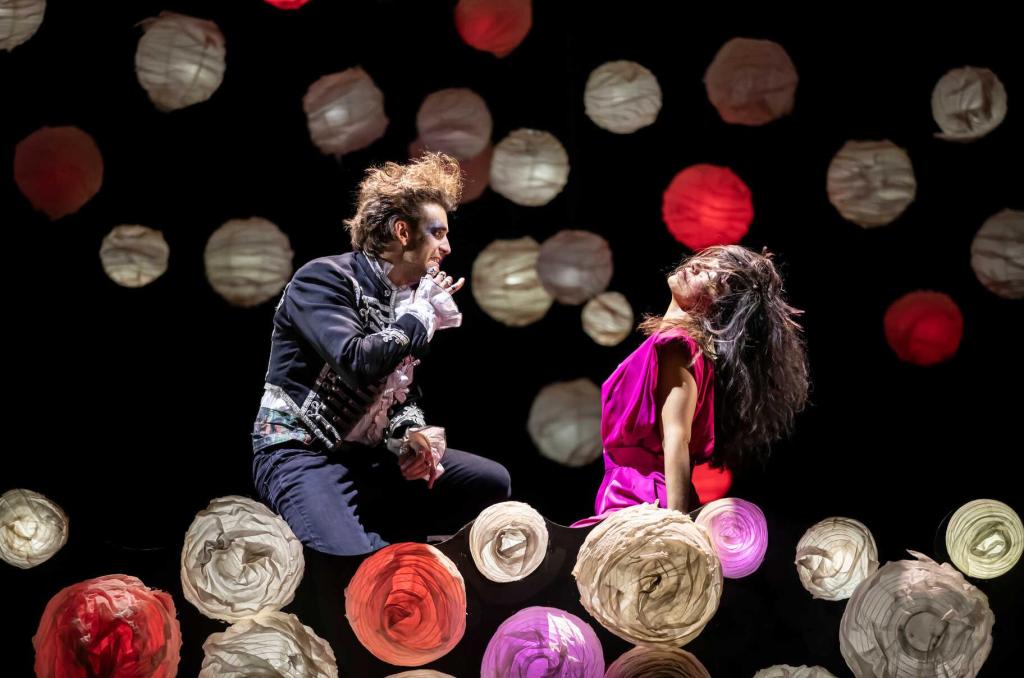
Andrew Richardson and Sirine Saba. Photo by Pamela Raith.
A Midsummer Night’s Dream by William Shakespeare – Barbican Theatre, London
Eleanor Rhode’s production for the RSC brings a wave of enjoyment to the Barbican on its transfer to the Barbican. A Midsummer Night’s Dream has darker aspects – at least those that appears so to 21st century audiences – but this is the not the production to reveal those. Instead, we are presented with a high calibre, high spectacle Dream which fits consciously into an RSC lineage. The show’s design by Lucy Osborne takes a gleefully 1980s approach to costumes, and a fanastical approach to the fairy scenes in the woods. The costumes are particularly well-observed, with echoes of John Caird’s punkish 1989 RSC production, and of the recent tv adaptation of Jilly Cooper’s ‘Rivals’. Demetrius (Nicholas Armfield) is in full Barbour, while Lysander (Ryan Hutton) is a working class upstart in red braces, tight slacks and brogues. Meanwhile, Helena (Boadicea Ricketts) roams the woods in a pierrot top. The detail is very enjoyable, and wandering lovers even have a 1980s sleeping bag and an Eveready torch.
The transition from the mortal to the fairy realm is managed in a delightful fashion, as Snug (Laurie Jamieson) enters a changing cubicle in her tailor’s shop and vanishes, replaces by Puck (Katherine Pearce) who picks up a ringing desk phone to find a fairy on the other end. All the fairies, in a unusual move, are voices represented by flitting, Tinkerbell-style lights, caught and held by the actors. This works remarkably well, and fits into a world of light, with the woods becoming a forest of dangling paper lanterns. Oberon (Andrew Richardson) also inhabits a dramatic forest of ladders, which rise from under the stage. The 1994 Adrian Noble production, with its dangling light bulbs and umbrellas designed by Anthony Ward, feels like an inspiration.
Although the show delivers spectacle in spades, it is subservient to the performances – an impressive achievement from Rhode. Matthew Baynton is effortlessly funny as Bottom, all long, prancing legs and physical presence. He is a more sympathetic Bottom than is often the case, less of a bombastic bully and more of a hero to his fellow mechanicals. His final death scene as Pyramus, in which he knifes himself in the heart, before proceeding to dramatically disembowel himself, and ending the job by stabbing a knife into his head, is a tour de force. The Mechanicals are strong, but Helen Monks’ excitable, Midlands Rita Quince is particularly good. The lovers are a strong foursome, with Dawn Sievewright’s Hermia delivering frantic physicality, contrasting nicely with the elegant, angry Ricketts. Ryan Hutton’s Lysander stands out with a notably leggy, wild interpretation – going further over the top than seems reasonable, with excellent results.
Sirine Saba’s performance as Titania / Hippolyta has shades of Clare Higgins’ 1989 performance. She is fired with energy, but of a different kind to Andrew Richardson’s Oberon / Theseus, who is dressed in full dandy highwayman gear and is willowy and volatile. The only interpretation that perhaps falls short is Katherine Pearce’s Puck. Usually the coolest character in the play, which sets up their failure, this Puck is out of their depth – out of breath from rushing around serving her master, mugging to the audience for laughs. It seems a missed opportunity. However, the production is a undoubted success: a thoroughly entertaining evening, deploying the RSC’s impressive resources – including the skills of illusionist, John Bulleid – to bring the play’s strange, impossible world to life and to suspend our collective disbelief through traditional theatricality and spectacle.
 Tom Bolton