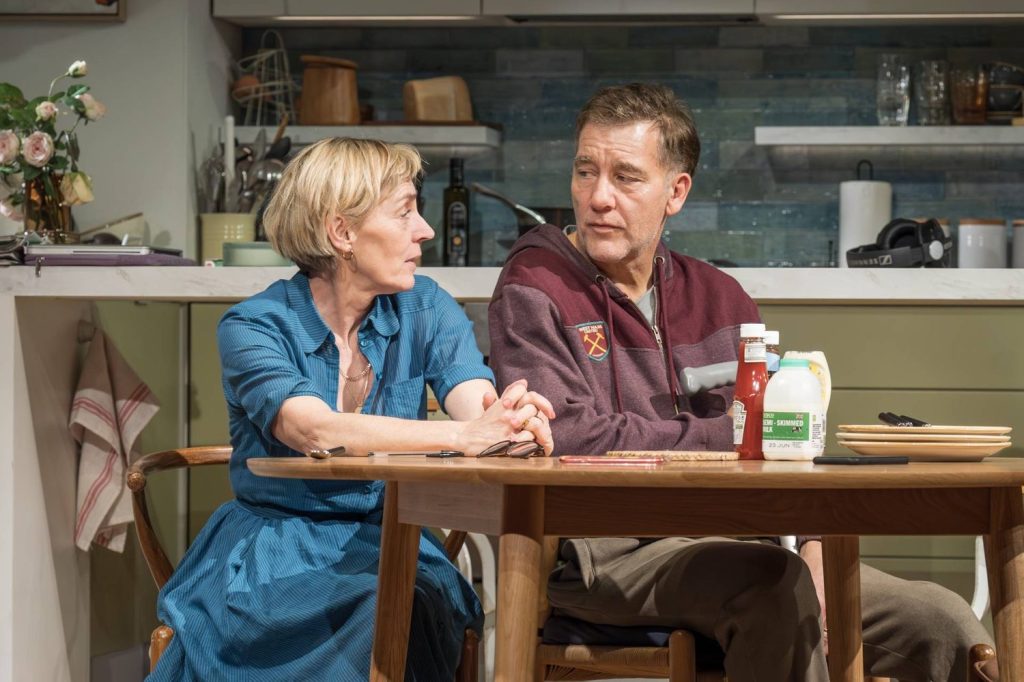
End is the final instalment of David Eldridge’s trilogy about a couple at different life stages, which began with Beginning in 2017, then Middle in 2022. It brings Saskia Reeves and Clive Owen together, recalling their 1991 incest film drama Close My Eyes. Gary McCann’s set is full of details which make it clear that Alfie and Julie are a 90’s couple – CDs, DVDs, a hi-fi. Alfie is a DJ who, in the opening lines of the play, is diagnoses with terminal cancer. Owen and Reeves create a fully convincing married relationship, still close despite a history that, as the play unfolds, is revealed to be less than smooth. Eldridge’s writing takes a straightforwardly narrative approach, documenting the pair as they wrestle with the decision about whether to continue with chemotherapy. Their daughter, who is coming round that night but never arrives, is the focus of their dilemma – whether to buy more time at the cost of a reduced quality of life.
Rachel O’Riordan’s direction gives dynamism to what is essentially a long conversation between the pair. Clive Owen conveys the sense of a man used to people, including his partner, deferring to him – even in the context of his funeral playlist. Saskia Reeves, a writer, comes into her own as her power in the relationship is gradually revealed, and her ability to interpret what is happening to her through fiction, becomes apparent. The play is not revelatory – there is little in here that is not familiar – but the experience of Generation X characters facing death is, in itself, new. Eldridge also uses very specific London geography well – the annoyance of having to change between Forest Gate and Wanstead Park to reach the cemetery for example – to convey the sense of real relationship, happening in real time.
Cyrano de Bergerac by Edmond de Rostand – Swan Theatre, Stratford-upon-Avon
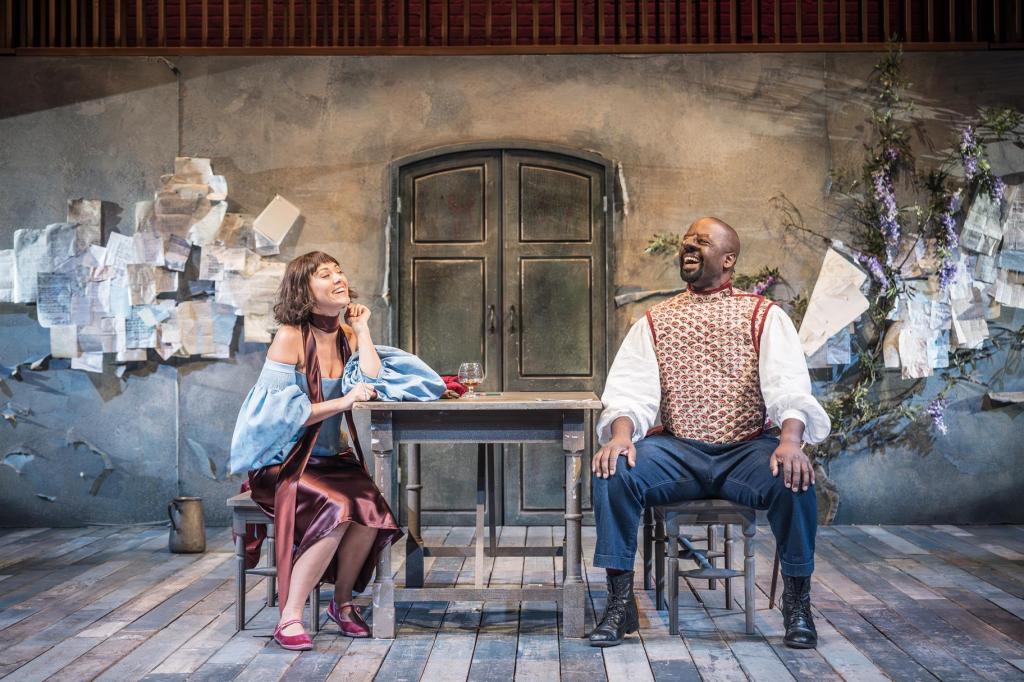
Simon Evans’ production of Cyrano is a very convincing and enjoyable account of a play which stands up well to re-examination. Evans has also adapted the play, with Debris Stevenson, giving the language a contemporary flavour without undermining the period setting, in a fantasy 17th century France. The play is held aloft by an exceptionally strong case who bring a notable level of star wattage to the stage. Adrian Lester, as Cyrano, exudes leading man skill and control, to the extent that at times he reminds us of Derek Jacobi, who triumphed in the role at the RSC for Terry Hands in the early 1980s, and at others of Simon Russell Beale. Cyrano is a part that requires a dashing, confident, yet vulnerable performance, and Lester provides this with apparent ease. He is brash in the tavern scenes, charming with Roxanne, conflicted with love rival Christian and, in the play’s final scene, when he drops the letter he is reading, supposedly the last missive of the dead Christian, and recites it to Roxanne from memory, devastating. Up until this point the play has been hugely entertaining, but it is this culminating encounter which makes it something special. The play’s emotional weight all builds to this moment of revelation, as Roxanne realises he has loved her all along, and Cyrano realises the same. There is not a dry eye in the house.
Lester’s triumphant performance helps create the conditions for the whole cast to shine brightly. Susannah Fielding, as Roxanne, is exemplary – riding a wave of breezy, charming detachment until her emotions catch up with her. Her outrage at discovering she has been deceived by Cyrano all along unleashes a fascinating cascade of conflicting impulses. Levi Brown is excellent as a casuallly insulting Christian de Neuvillette, cocky and doomed. Scott Handy’s Comte de Guiche is very funny, appearing to belong to a parallel aristocratic world where nothing quite makes sense to him. And Greer Dale-Foulkes makes Abigail, Roxanne’s companion, a very amusing comic adjunct to the action.
Performed on Grace Smart’s sets of torn posters, worn plaster and red velvet curtains, the play fills the Swan stage as though written for it. Evan’s has conjured a hit, somewhat old-fashioned – in a good way because it successfully revives a classic for a new generation without significantly remaking the play. It’s a significant achievement, and makes for a very satisfying evening watching very good actors show us their skills.
Steve Coogan and Giles Terera. Photo by Manuel Harlan.
Dr. Strangelove by Armando Ianucci and Sean Foley – Noël Coward Theatre, London
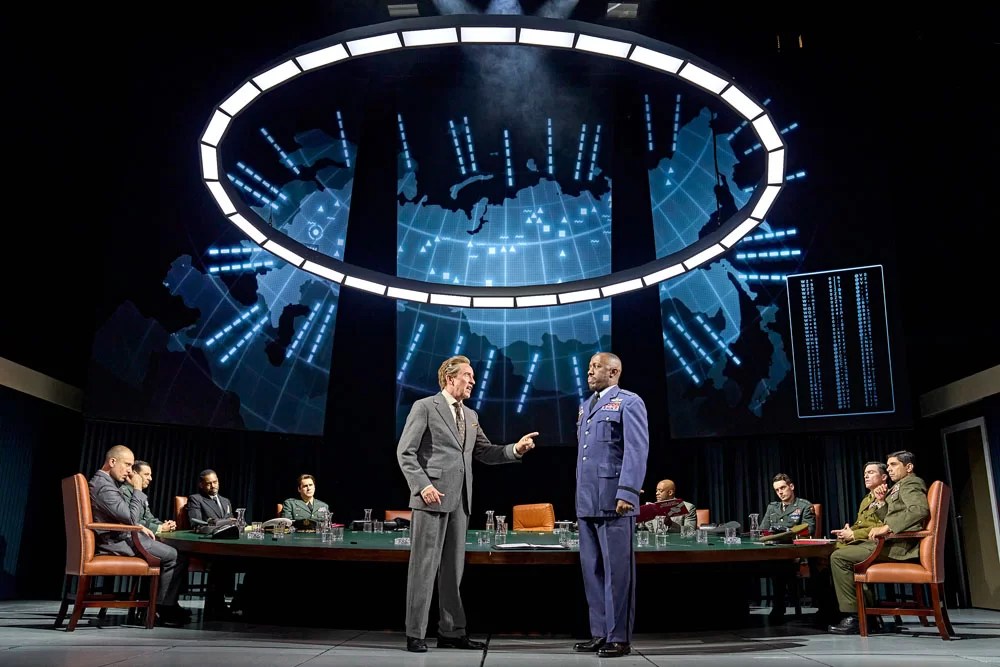
Sean Foley and Armando Ianucci have adapted Stanley Kubrick’s 1963 satire, Dr. Strangelove, for the stage, powered by the willingness of Steve Coogan to go one better than Peter Sellers, and play four parts (Sellers bailed on Major TJ Kong, who was played instead by Slim Pickens). The concept of staging the film is attention-grabbing, and the issues it satirising more current than they’ve been for decades. However, it is not ultimately clear why this story needs to be on the stage. The adaptation, , and Sean Foley’s direction, are very faithful to the film apart than the odd update such as a acknowledgment that the cast is almost entirely male, which does not change the fact it is still almost entirely male. Part of the problem is that it is less a story than a series of set-piece scenes, which work well on film and less well on stage. The film is oddly set-bound, which may have made it seem suited for theatre, but somehow the show never quite takes off.
Coogan is accomplished and highly professional in all four roles: frightfully posh English officer Captain Mandrake; US President Muffley, trying to be reasonable in the face of insanity; Major TJ Kong, perhaps his best role, the gung-ho, bomb-riding B52 pilot with a strange attitude to women; and Dr. Strangelove, wheelchair-bound not-very-ex-Nazi scientist. The play is, inevitably, mostly focussed on him – and the substitution of lookalikes with their backs to the audience while Coogan changes into another costume quickly become distracting. There is also the sense that Coogan never really lets it all out. His performances seem controlled and script-bound, and the moment when he unleashes the madness never arrives.
There is limited space for other cast members to shine, and indeed there appear to be several senior military figures who spend much of the show sitting around the War Room table, never speaking. However, John Hopkins has a lot of fun cast, slightly surprisingly, as the mad General Ripper, who launches a nuclear assault on Russia without permission. His performance has an unpredictable edge to it that is lacking elsewhere, and his conspiracy-theory fuelled spiral seems alarming current. Giles Terrera has fun as General Turgidson, cheerleader for ‘pretaliation’ against the Soviets, but he can’t animate the War Room scenes on his own.
Hildegard Bechtler’s set recreates the look of the film very well, but inevitable involves filling the stage with large immovable objects, notably the giant oval War Room table, and the cockpit of a B52. This does not aid the production’s fluidity. Nor does the fact that the large back-projection is invisible to the substantial section of the audience in the balcony, and has to be replicated on very small tv screens. In fact, the Noël Coward Theatre seems the wrong place for this show, which is too constrained on its tight proscenium stage. It would have worked much better in the Olivier.
The characters, conversations and events of Dr. Strangelove are terrifying close to real life. Much of the film is a documentary in disguise, dramatising the insane thinking of senior US military figures such as Curtis Le May and Thomas Powers, who actively encouraged a nuclear conflict in which they were quite willing, as General Turgison says, for 20 million American to die, as long as even more Russians were killed. The revived nuclear threat following the invasion of Ukraine makes this satire both timely, and as important now as it was then. It is just a shame that the stage version delivers more of a tribute show than a rebirth.
Joanna Vanderham & Ian McNeice. Photo by Manuel Harlan.
Rowan Polonski and Jonathan Hyde. Photo by Manuel Harlan.
Double Feature by John Logan – Hampstead Theatre, London
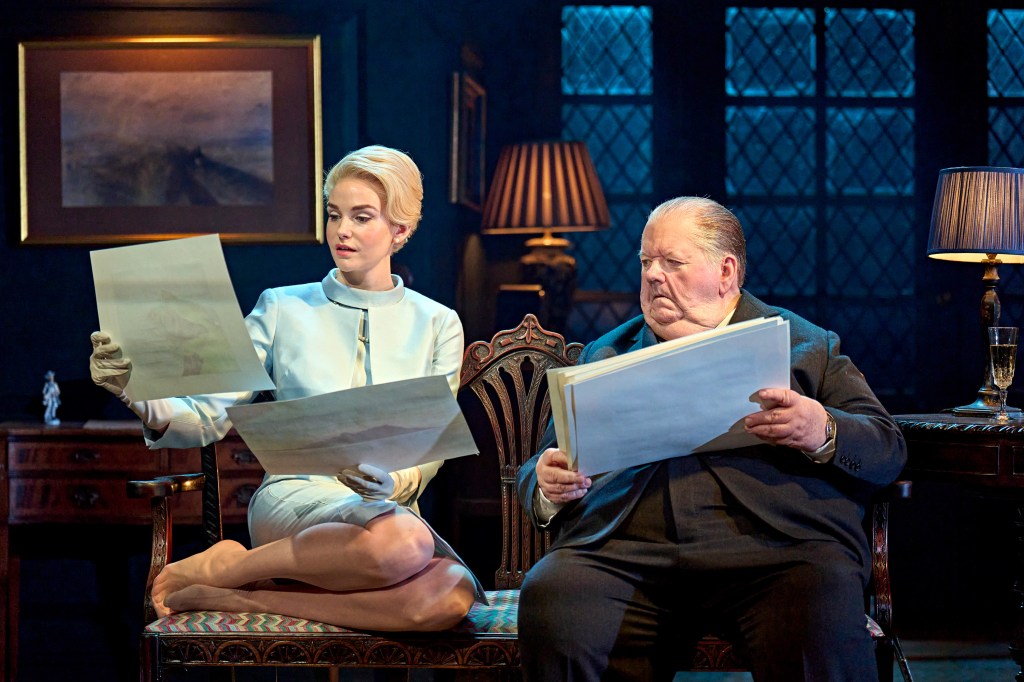
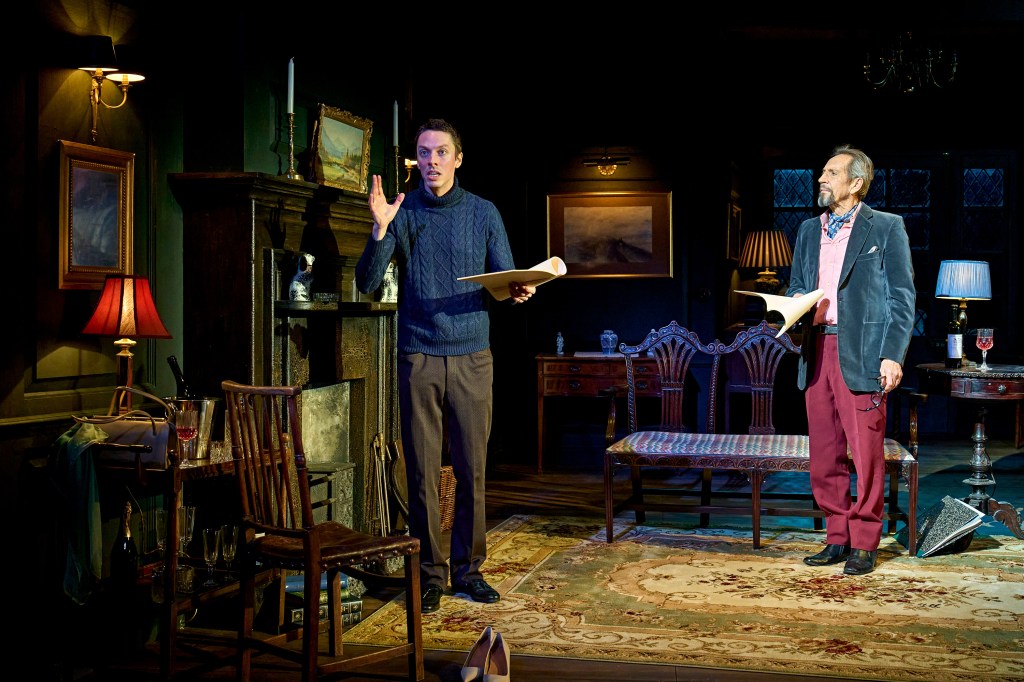
John Logan’s new play reanimates two moments of cinema history, taking us behind the scenes to the discussions that ended careers, in very different ways. The play opens with a man in a hat and cloak sweeping, Gothically, into a comfortable cottage. It is Vincent Price (Jonathan Hyde), and he is meeting Michael Reeves (Rowon Polonski), young, brilliant and doomed film director during the shooting of Witchfinder General. Soon, we realise that this time period, 1968, is woven with another, around four years earlier. Onto the same set step Alfred Hitchcock (Ian McNeice) and Tippi Hedren (Joanna Vanderham). Now we are in Hitchcock’s cottage on the Universal lot, during the filming of ‘Marnie’. The relationships between the two pairs are very different. Hitchcock is a sexual predator, offering stardom in exchange for giving him what he wants. And he always gets what he wants. Hedren is his creation, a model he made into a film star, and she fully understands the power Hitchcock has over he. Meanwhile, Reeves has no power and can only beg Price not to walk out on his film and, it turns out, persuade him he is for real. Price looks impressive, but his performance style is hopelessly out of date and the work has dried up.
Logan has written a very enjoyable play that raises multiple questions about reputations and the way we imagine people, as well as the creative process. He also pulls off some technically demanding effects, writing scenes that overlap between the two timelines, sharing moments of dialogue. Jonathan Kent, directing, delivers a production of undeniable quality, and Anthony Ward’s hyper-realist set is richly imagined, even allowing space for Jonathan Hyde to demonstrate Price’s cooking skills by whipping up some pasta in real time.
Ultimately the success or otherwise of ‘Double Feature’ depends on the play’s overriding vision and logic, and on the performances. On the former, it does not quite deliver. It is clear that Logan is very interested in the two relationships he portrays, and in the film history around them. Hitchcock’s poisonous relationship with Hedren has only been fully revealed in the last few years, and is certainly worthy of exploration. Meanwhile, Reeves short career (he died of a drug overdose at the age of 25), and his unlikely encounter with Price, is a fascinating topic. Despite his undoubted writing skills, it is never entirely clear why Logan has chosen to interweave these two subjects, other than as contrasting examples of creative connection. Really, they seem like two short plays that could just as easily have remained separate.
However, where ‘Double Feature’ really delivers is in its cast. Admittedly, Rowon Polonski, while an excellent awkward young man in a hurry, perhaps lacks enough of the underlying darkness that is surely part of Reeves persona. However, the scene in which he persuades Price to stop hamming up his performance is a brilliant moment, as we suddenly hear the voice that makes ‘Witchfinder General’ so chilling. As Price, Jonathan Hyde is a real pleasure to watch, both flamboyant and entirely real, explaining touchingly how he wears make-up to maintain the illusion as he ages.
Joanna Vanderham is entirely convincing, both playing the role of a Hitchcock blonde, and unravelling her fears and anxieties, before finally tells Hitch what she thinks of him. And Ian McNeice is both delightful and thoroughly nasty as Hitchcock himself, obsessing over everything from oysters to luncheon meat, and gradually making his sinister side more and more apparent. By the end it is clear that Hedren’s film career is over, and she will not play another lead – and that’s the way she wants it. Meanwhile, Price will go out on a career high, having finally found a film he really wants to make. There is plenty on offer here to entertain and to inform.
 Tom Bolton