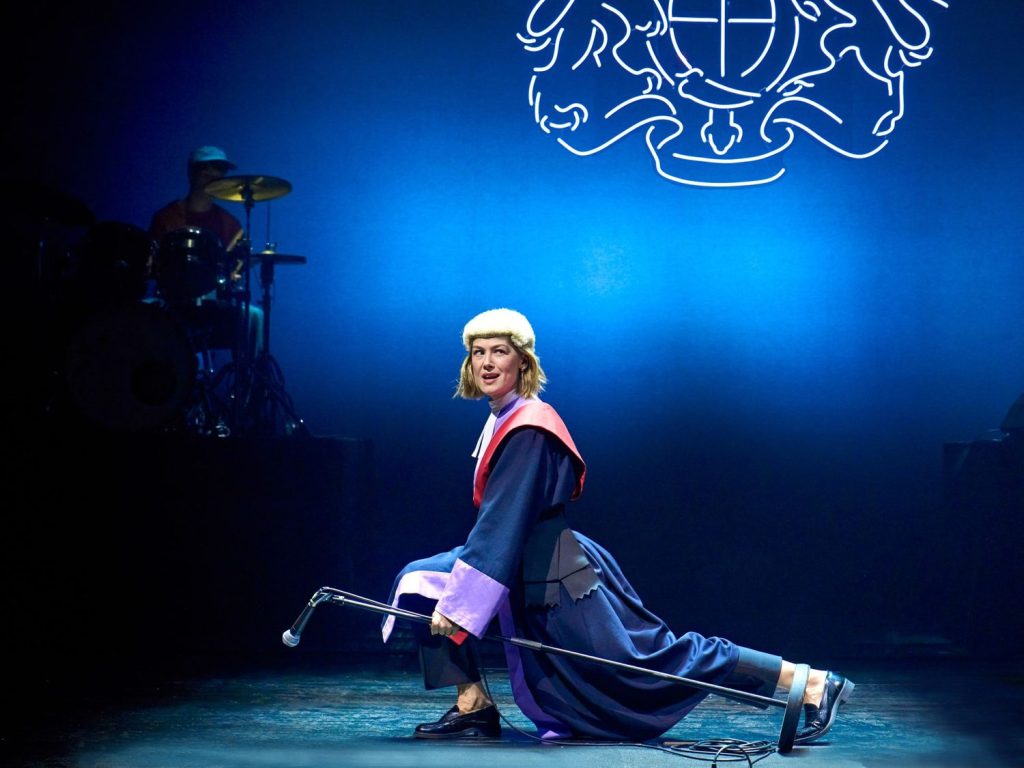
Inter Alia

Rosamund Pike. Photo by Manuel Harlan.

Inter Alia by Suzie Miller – National Theatre: Lyttleton, London

Judge Jessica Parks (Rosamund Pike) juggles a high profile career as one of a small number of female justices with the usual pressures of family life – trying keep an eye on her son Harry (Jasper Talbot) while assuaging the ego of her barrister husband Michael (Jamie Glover), and living an upper middle class dinner party lifestyle with their friends. She is both a pioneering, feminist judge who stands up to the patriarchy and tries to do things differently, particularly in her treatment of rape victims, and a mother whose role is to shoulder the family’s emotional burdens. Suzie Miller’s new play is a follow up to her hit Prime Facie with Jodie Comer, and is set in the same high pressure legal world in which she once worked – but Inter Alia also has the plot line of a Greek drama. It asks how far a mother would go to protect her son.

Justin Martin’s production builds the tension through a physicality, to which Rosamund Pike is beautifully suited. She deploys the pin-point timing of a farce as she pulls coats, wigs and ironing boards from cupboards in her kitchen, powering through her life without a moment to spare, entertainingly depicted through Lucy Hind’s movement direction. She also struts her stuff on the bench, addressing the prosecution with a microphone stand and backing band consisting of her husband and son. The set, by Miriam Buether, hides the domestic behind the courtroom and, behind that a dark wood filled with towering trees into which her son disappears, both as a child and as an 18-year old – not a subtle metaphor, but a satisfying scenic effect.

The writing is direct, and sometimes too obvious. The nature of the dilemma Jessica faces cannot be revealed without spoilers, but it is clear what will happen from early on. Her principles are tested in way that is cruel and believable. However, it draws the audience into the terrible moral conundrum while effectively addressing issues of online toxicity, the manosphere and the unequal justice system. There are moments of particular power, not least when Michael, perfectly pitched by Glover, collapses in tears at his inability to communicate with his son.

The show’s focus on the terrible power of blood ties is cleverly enhanced by the physical absence of almost any actors beyond the family trio. Jessica’s best friend and her dinner party guests are present on stage, but only in our imaginations. It’s an ingenious technique and, when new actors do appear they are children who drive the disturbing plot developments. Inter Alia is a high quality production of an effective if limited play. It will undoubtedly be a big success because of Pike’s triumphant performance, owning holding our attention, and the show together from start to finish.

The Importance of Being Earnest

Photo by Marc Brenner

The Importance of Being Earnest by Oscar Wilde – National Theatre: Lyttleton, London

In Max Webster’s new production intentions clear are from the opening moments. The play begins with a dance sequence. Ncuti Gatwa, playing Algernon, drapes himself over a grand piano wearing a shocking pink ballgown, split to reveal boxer shorts underneath. It sends an unambiguous message that this will not be The Importance of Being Earnest we have become familiar with, but a high camp, high glitter entertainment… and much more beside. Webster opens the play up to a much-need re-examination. One of the best known and loved – and overquoted – plays in the repertoire is reclaimed as the brutal social critique it has been all along.

For the National Theatre to stage Oscar Wilde’s best known play is a balancing act. It’s a sure audience pleaser, which is why every amateur group in the country has done it at some point, but there needs to be a reason to give it a major new production. Webster delivers this triumphantly, and his show is a revelation. The play has an excellent, highly entertainingly and disruptive cast. Gatwa is suave, shameless and very funny, with a commanding stage presence and a knack for comedy. He is matched with Hugh Skinner’s apparently more vulnerable Jack Worthing, constantly struggling to match his mental self image. The ingenue Cecily Cardew is played by Eliza Scanlen who channels Miranda Richardson to fine effect. And the excellent Ronkẹ Adékọluẹ́jọ́ is very funny as Gwendolen, teetering throughout between comic social propriety and crotch-grabbing sexual meltdown. Richard Cant and Amanda Lawrence, as Canon Chasuble and Miss Prism, deliver supporting performances of an exceptionally high calibre, while Julian Bleach has fun as two butlers: the scary Merriman and his derelict country counterpart, Lane.

However, every production of ‘…Earnest’ pivots on its Lady Bracknell. The part has become an old-fashioned star turn, somewhat divorced from the play itself. It is mystifying that Wilde has become so cosy, as though his annihilation by the society who had fêted him happened to someone else. ‘…Earnest’ is packed with bitter social recrimination fed to the audience in sugared pills. Sharon D Clarke’s Lady Bracknell undoes all that. Casting actors of colour in the key roles challenges some assumptions, and Clarke’s forbidding, stereotypical Caribbean matriarch works perfectly for the part. Wearing dramatic costumes combining western and Afro-Caribbean styles, by Rae Smith, she puts up a fierce resistance to her daughter’s wishes, but we gradually realise that this a façade relates directly to her origins. The key moments in the play are when she reveals that she had no money before she married Lord Bracknell; and when she discovers that Jack is very wealthy, and becomes suddenly supportive of his marriage to Gwendolen. She knows what it means to have nothing, and what it takes to stay afloat when you don’t belong. She can compete with any of the great Lady Bracknells, but her performance reinvents the part.

The entire play is explicitly about dissembling and façades. Nobody says what they mean, while revealing what they really think. We see clearly from Webster’s production that no-one can afford to be who they actually are. Wilde certainly couldn’t. But he devised a way to say things in a way that allowed his plays to become accepted and mainstream, all the while presenting an unequivocal condemnation of the British social order. Gatwa’s Algernon is certainly not a straightforwardly heterosexual character, but neither is anyone else. Algernon and Jack seem as interested in each other as their fiancees, and so do Celia and Gwendolen. Webster stages a spectacular pile-on in which they all seem on the brink of engaging in a foursome. On Rae Smith’s slightly psychedelic sets, reality is heightened and pushed to the brink of absurdity, which is where the truth lies. The show is as funny and entertaining as any production of the play, but it shows us what’s been lying in plain sight. Wilde deserves to be fully understood, and his work given the freedom of interpretation it could never receive at the time, and that has eluded it since. The evening ends with a masque dance, with all the characters in feathers and frills. It is a moment of joy, releasing us from the terrifying constraints of a world that forces everyone to pretend in order to survive.