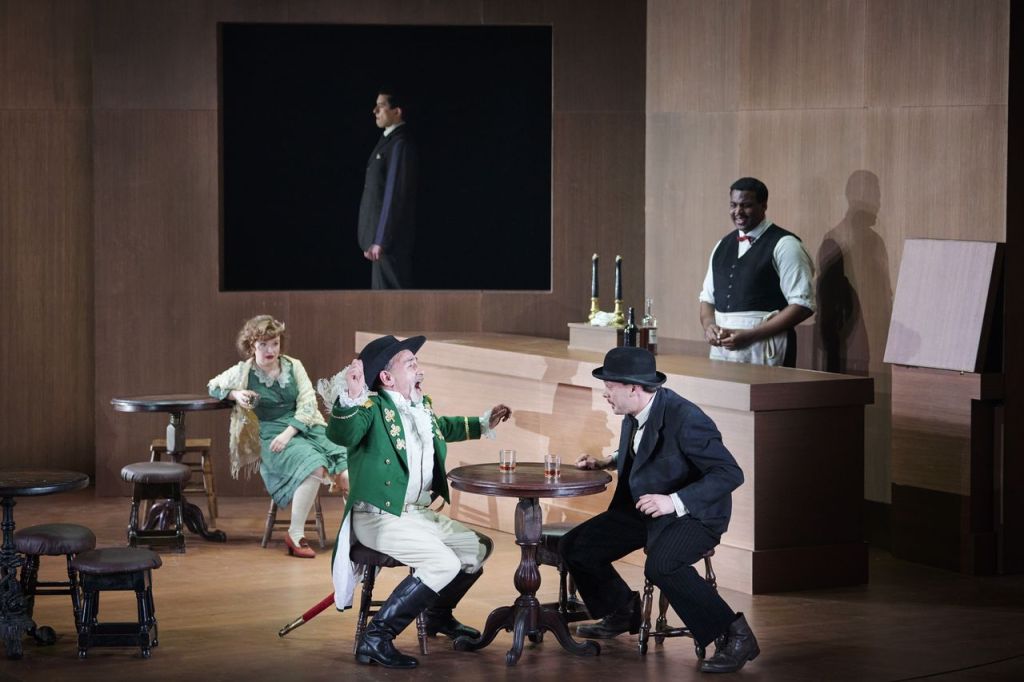
Photo by Roz Kavanagh
The Plough and the Stars by Sean O’Casey – Abbey Theatre, Dublin
Published at Plays International
Sean O’Casey’s 1926 play is a super-local drama, describing events that took place on the Abbey Theatre’s doorstep during the 1916 Easter Rising in Dublin. Set in a nearby tenement block around the corner from the General Post Office, as it is besieged by the British Army, it is a masterpiece with Shakespearian character and scale but, as a modern work, a more immediate impact. Tom Creed’s centenary production for the Abbey revisits a play which, at its première, upset sections of the audience so much they rioted. Theatrical riots can seem strange and archaic: it is hard to understand why the Abbey’s patrons got so hot under the collar at the Abbey première of A Playboy of the Western World twenty years earlier. However, it is entirely different with The Plough and the Stars. Creed’s riveting production reveals it to be provocative and iconoclastic one hundred years on, and relevant to an extent that should alarm us as a society.
In Dublin, where streets and stations are named after Easter Uprising leaders and 1916 is commemorated all over town, questioning the credentials of the Irish Citizen Army and the Irish Volunteers is close to heresy. Sean O’Casey tears the rebels to pieces, along with the British. He pulls idealisers to the ground, and elevates ordinary, fundamentally flawed people who do not live the lives politicians imagine for them. Snatches of Patrick Pearse’s speeches ahead of the uprising drift through the pub window during the play, his calls for a blood sacrifice to cleanse the soil sounding fascistic and unhinged. As we fail to learn the endlessly repeated lesson that violence brutalises and destroys, the play still has the capacity to upset the accepted view of history.
O’Casey’s towering achievement is to craft a play built around such a large, complex, yet wholly convincing cast of characters. His tenement inhabitants reveal a society with an ease comparable to the Henry IV plays. There are many fine roles, but it is particularly notable how well he wrote the female characters, who are all complex, unidealised and alive – an achievement beyond most male playwrights of the time. The Abbey’s cast are fully immersed in the play’s world, and seem to emerge from the setting rather than imposing their performances on it. Kate Glimore’s tragic Nora Clitheroe puts everything she has into saving Eimhin Fitzgerald Doherty’s doomed Jack, knows exactly what she has to lose, and fails. Her descent into madness is horrifying. Mary Murray’s Bessie Burgess is confrontational and aggressive, but also unexpectedly kind, with a tale as confounding as anyone. Kate Stanley Brennan is very funny as Mrs. Grogan, her lyricism and larking a terrible counterpoint to her hollow-eyed, dying daughter Mollser (Evie May O’Brien). O’Casey’s incorporation of humour into the dark events is a masterclass in dramatic writing. Caitríona Ennis’s Rosie is desperate, but achieves a moment of remarkable dignity when she, accused of being a prostitute, her silence speaks volumes.
The men in the play do not understand what is coming, and what the consequences of war will be. Michael Glenn Murphy’s Peter Flynn is a comic braggart, perhaps the most ludicrous character in the play, from a Shakespearian lineage of old men who fancy themselves as soldiers. Thommas Kane Byrne’s Marxist Young Covey is smackably smug and very entertaining, but also the only man who lets his front fall apart at the end. Fluther is one of the great comic everyman roles, a man who survives despite his own best efforts, and Dan Monaghan delivers both entertainment and depth. Ash Rizi, Fintan Kinsella and Conor Wolfe O’Hara as the British soldiers who arrive on the scene to make things, inevitably, much worse are frightened and dangerous.
Jamie Vartan’s sets are somewhat confrontational, consisting of unpainted, plywood flats and minimal decor, but they prove very effective. At times the characters feel like ghosts, inhabiting a place that is fading out around them, casting long shadows on the bare walls. The revolve is elegantly used to switch scenes, and seems to echo the transience of time and the lives it contains. The production is superbly powerful – in the commitment of the performers, the vivacity of the characters who live on, a century down the line, and the uncompromising message of the play – that war is madness. Creed’s production reaffirms O’Casey’s status as a great writer who still has much to teach, and whose work remains gripping from start to finish.

