Bog Witch

Photo by Lucy Powell

Bog Witch by Bryony Kimmings – Soho Theatre, Walthamstow

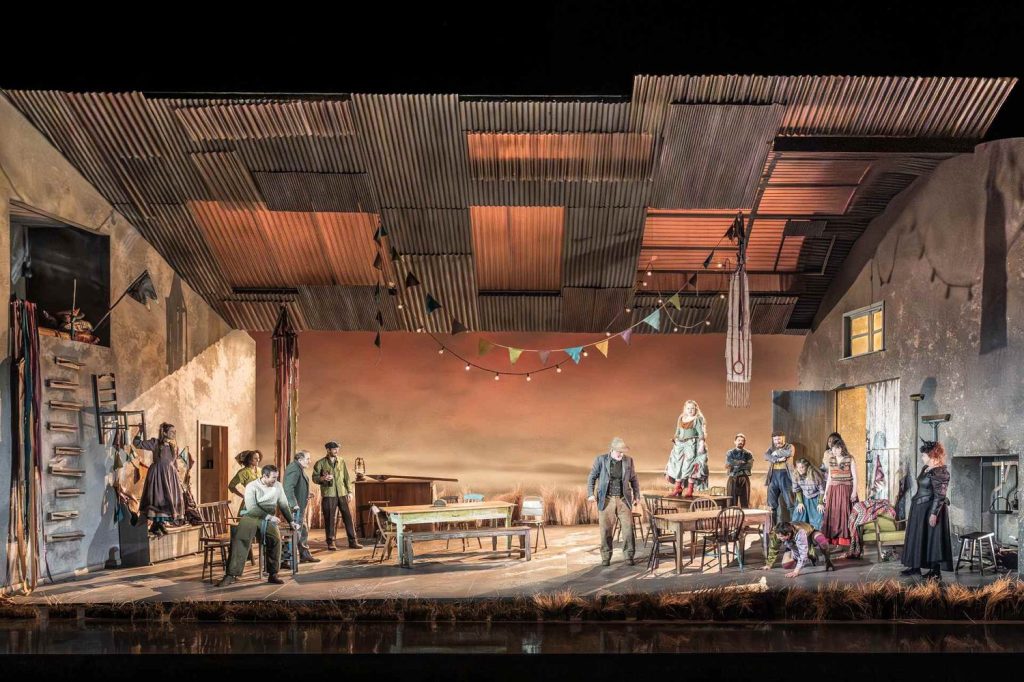
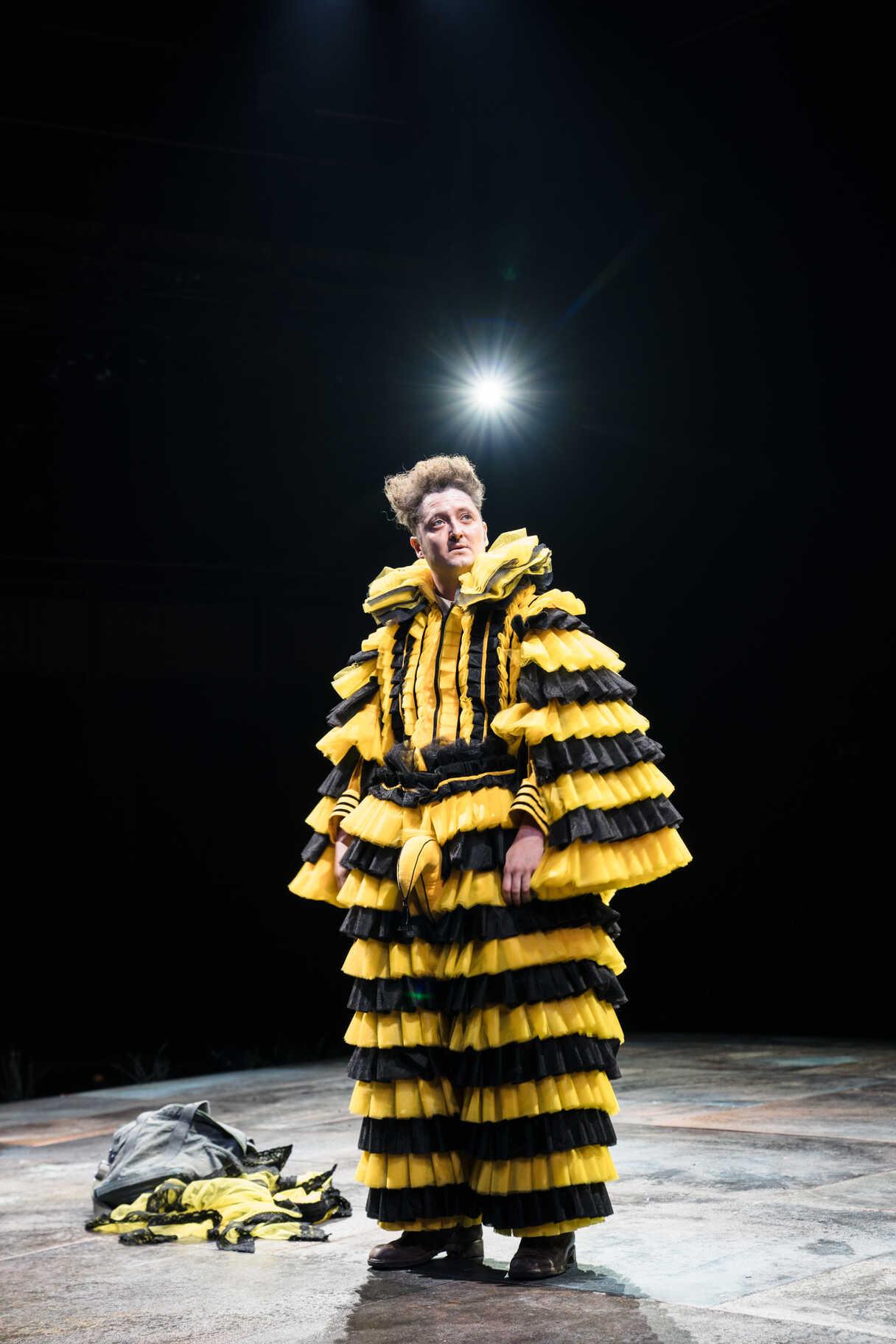
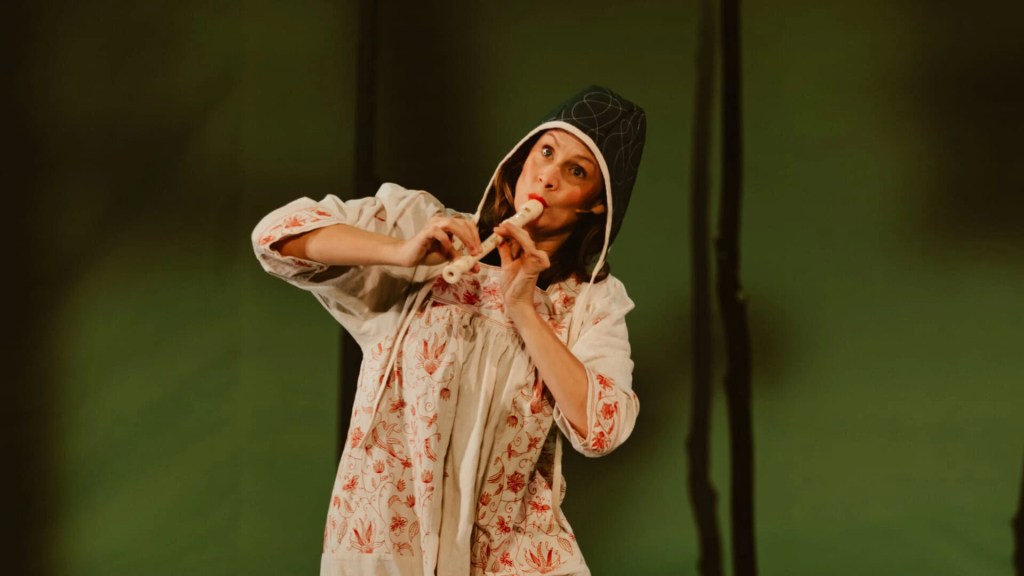
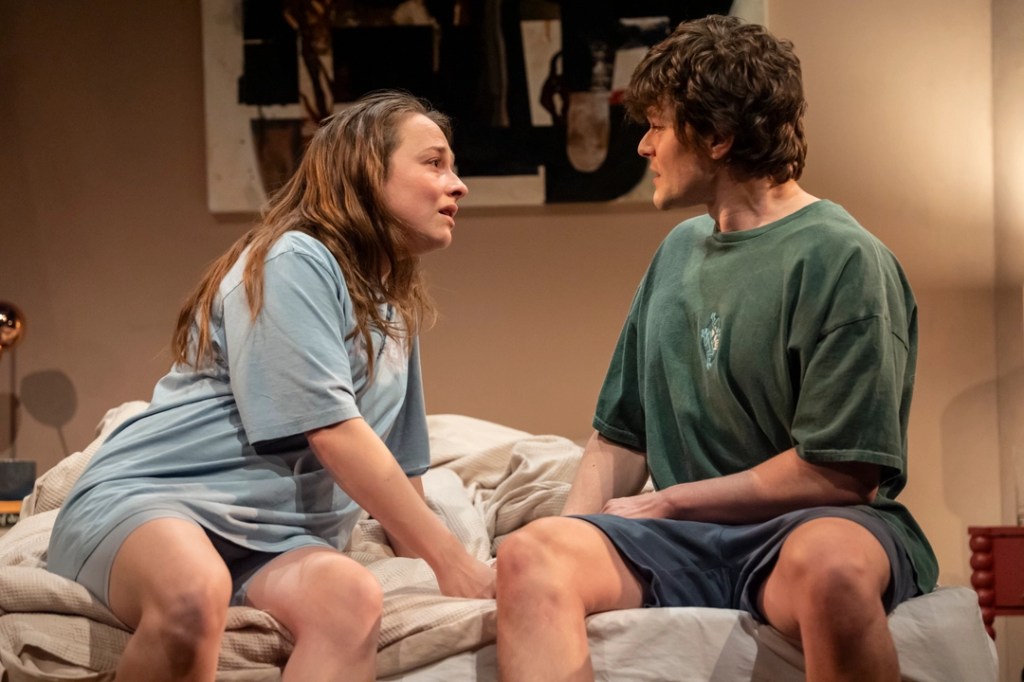
Bryony Kimmings’s last show was in 2018, in a different era. Her disturbingly personal and raw shows made her a 2010s fringe star. Her unpredictable, apparently chaotic style proved highly influential on the style of alternative theatre performers. Now she’s back with her first show since having a son, separating from her partner (Tim Grayman, well known to audiences from their joint show, Fake it ‘til you Make it), and moving to the countryside with a man called Will. Bog Witch unpicks this experience. To some extent it is classic Kimmings. She is disconcertingly direct, about herself and the way she feels, tells rude jokes, and wears ludicrous costumes. She is a very engaging performer, always undercutting herself with double takes at her own explanations. The audience loves her, and there is a very welcoming atmosphere in the vast, gleaming, newly refurbished Walthamstow branch of the Soho Theatre.

However, Bog Witch does not deliver the energy levels of previous Kimmings work. The size of the venue does not help. Beautiful although it is, the new venue is much larger than any comparable fringe venue and there is a sense that this show would have worked better in a more intimate space, more suited to Kimmings confessional style. Working (for the first time?) with a co-director, Francesca Murray-Fuentes, Kimmings works hard to occupy the cavernous stage, using everything from a long white backcloth to an epic witch costume, rustic paraphernalia and an amusing ‘burning at the stake’ tableau. However, the work to achieve this detracts from the show, with Kimmings often engaged in moving props around.

There is also a lack of the wildness and abandon apparently promised by the title. Bog Witch is a controlled show, which threatens to flatline at a couple of points in the second half (not that there is an interval, despite the near 2-hour running time). The themes she is addressing are very grown-up – depression, miscarriage, social compromise, climate responsibility. She (her performance persona, that is) seems changed by her experiences of getting older and having to compromise more, with some of her edges rubbed away. We have to buy into her changed self to stay involved in the show. The story of redemption she has to tell lacks excitement at times, and the audience-participation finale is somewhat flat. Although watching Kimmings on stage is always a good use of time, this is not the most driven or electrifying of her shows.

The Land of the Living

Juliet Stevenson, Tom Wlaschiha and Artie Wilkinson Hunt. Photo: Manuel Harlan

The Land of the Living by David Lan – National Theatre: Dorfman, London

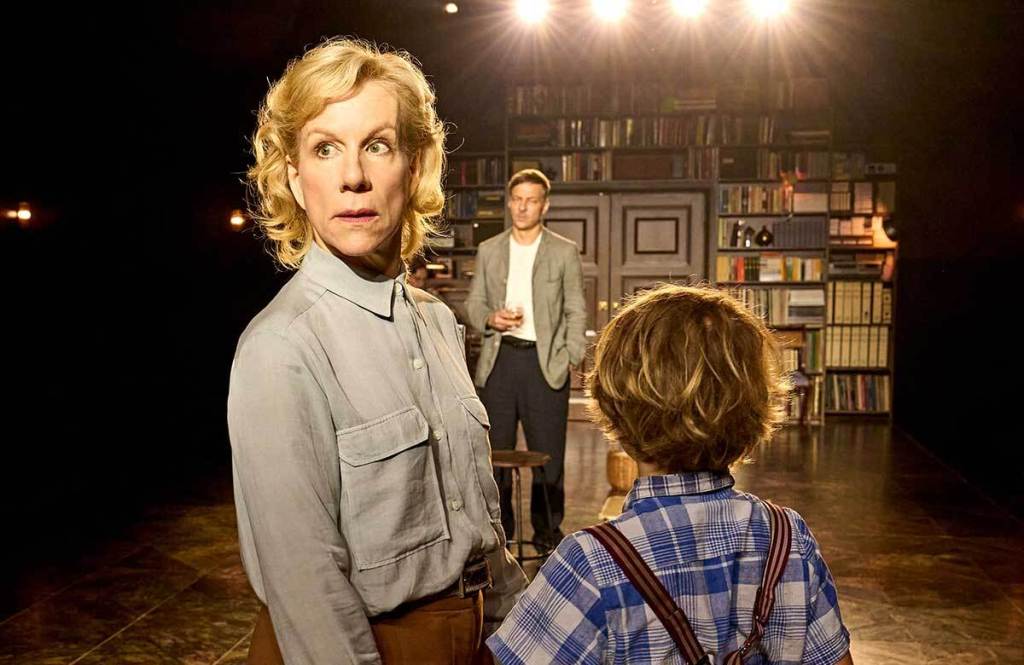
Stephen Daldry’s production of David Lan’s new play, about the moral dilemmas in the aftermath of World War II and their lifelong consequences, piles the pressure on relentlessly. Juliet Stevenson plays Ruth, now in her 70s, living in London. Someone she hasn’t seen for 50 years arrives – Thomas (Tom Wlaschiha) – and we watch the story of what happened to him unfold over the next two and a half hours. Ruth was a young woman working for the UN in Bavaria, the American sector, after the German surrender. She and her small team of women look for children stolen by the Nazis from Eastern Europe and checked for Aryan characteristics. Those who passed the tests were given to German families with new names. Those who did not were murdered. Once the children are identified, the hard part begins. Thomas is with parents who hide his real identity, but are distraught when he is removed. Ruth becomes attached to him, saving him from the fate of many children – removed en masse by the Russians or by the Americans to be rehomed. But she doesn’t send him back to Poland either, where he might have rediscovered his original family. He has flown to London from New York to reveal the consequences.

Daldry crosses the play’s two time periods over one another – literally, with Ruth and Thomas occupying either end of a long traverse stage holding Miriam Buether’s London apartment set .while the events of 1945 play out across the middle. The pacing is effective, with the flashback action erupting into the civilised lives they have both built. Stevenson is remarkable, her calm demeanour drawing the audience’s attention to the emotions shifting tectonically below the surface. Wlaschiha is blank faced, traumatised, and expressing himself through music – although it’s a shame he stands aside from the action for much of the play, providing a catalyst rather than participating. The character Thomas is a pianist, and Wlaschiha has remarkable skills too, performing live on the apartment piano as a number of other characters also do, including Stevenson. It is an ensemble performance, with strong performances from Kate Duchêne as Ruth’s mother, Marek Oravec and Cosima Shaw as Thomas’s adopted parents and Caroline Lonq as Elise in a cast that includes several European stage actors appearing at the National Theatre for the first time.

Lan has uncovered a little documented set of events from a time that is much pored over, and has constructed a rigorous, emotionally hard-hitting story. It is an excellent vehicle for the talents of its very high end cast and production team.

Cascando

Photo by Greta Zabultye

Cascando by Samuel Beckett – Jermyn Street Theatre, London

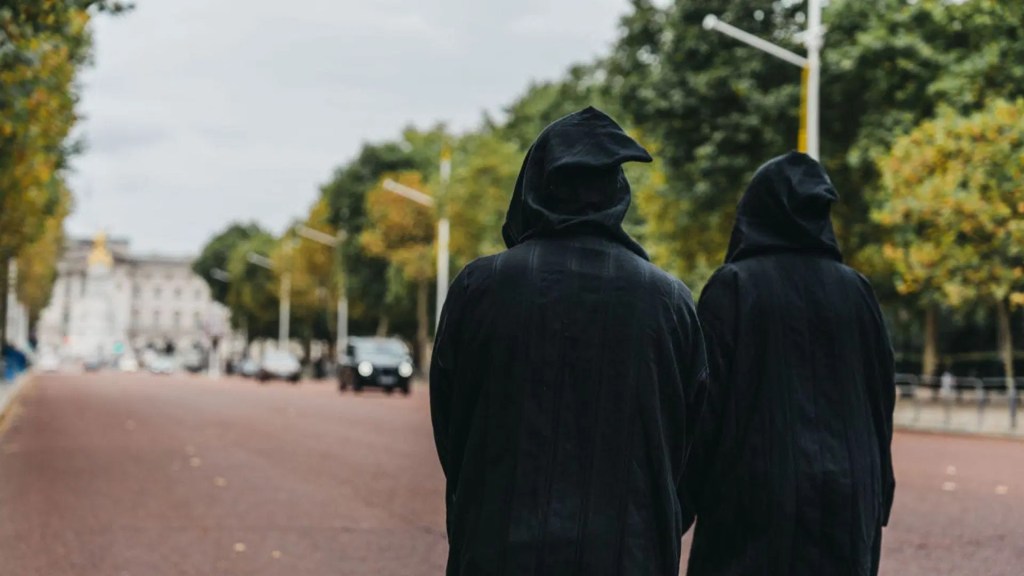
Irish company Pan Pan’s production of Beckett’s radio play, Cascando, is a promenade piece. The audience gathers at the theatre to put on hooded black cloaks and an mp3 player with headphones. With the tech hidden under their hoods, they walk at a measured pace through the streets of, in this case, St. James’s for half an hour while the piece plays in their ears. It is both an intense experience, immersive in the true sense, and a public performance.

Audience members are directed to walk in single file, heads down, focusing on the feet of the person in front ‘as if you were slightly depressed’. The result is a quietly disruptive experience, as a procession of, apparently, monks files slowly through the central London rush hour, amusing and bemusing passers-by, stopping both them and the traffic. The experience of becoming the performance is both very simple, and exhilarating. It is a fundamental twist in the audience contract which turns everything on its head. And that’s without the play itself. Cascando was written for radio and first broadcast in 1963. There are two male voices – Opener (Daniel Reardon) and Voice (Andrew Bennett) – whose rich tones fill our heads. They tell a disjointed story in language stripped to the essentials. Opener sets the scene for Voice, who is apparently trying to finish a story about a man called Woburn, on a journey, ‘same old coat’. The journey seems to be a pilgrimage of sorts, and the Opener a God-like presence. There are also intervals of music by Jimmy Eadie.

The overall production, which premiered in 2016 and has since been performed in venues around the world, is directed by Gavin Quinn. It is quietly astonishing, bringing Beckett disconcertingly alive in a new, modern ritual. As Woburn drifts out to sea clinging to a boat, we know that there is only one way the story will end for all of us, but we measure our steps anyway, one foot in front of another, along the pavements.

Clive

Paul Keating as Thomas. Photo by Ikin Yum.

Clive by Michael Wynne – Arcola Theatre, London

Published at Plays International

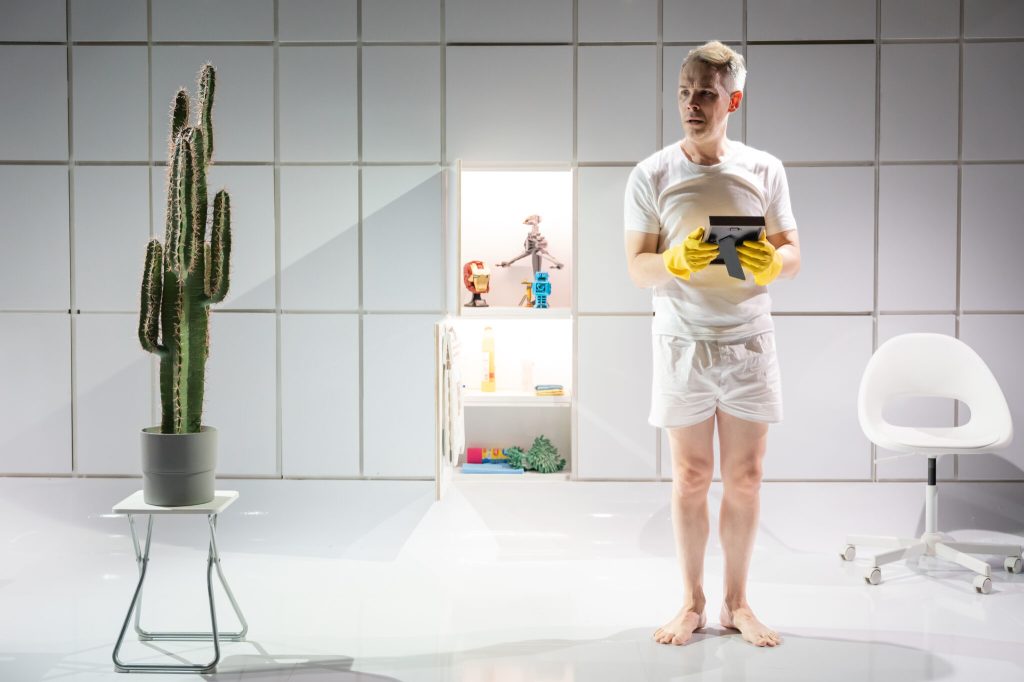
At first he seems a little fussy but in control of his life, an impression that disintegrates over the course of an hour as his obsession with cleanliness grows, his isolation increases, and rejection mounts as it becomes clear that real connection is beyond him. Even the cactus has the capacity to hurt him.  

The show, imaginatively directed by Lucy Bailey, makes great use of the Arcola’s studio theatre. Mike Britton’s wall of cupboards brings bursts of colour into the space as doors are opened, and Chris Davey’s lighting transforms the flat into “Mexico”, “Iceland”, or whatever Thomas asks Alexa.  

Keating – who worked so successfully with Bailey at the Arcola in 2016 when he starred in Mike Poulton’s play Kenny Morgan, telling the story of Terence Rattigan’s real-life inspiration for The Deep Blue Sea – is excellent. He holds the audience’s attention effortlessly and draws them into his increasingly dysfunctional world. He moves from gleeful dancing, polishing the floor with mops attached to his feet, to a full-blown crisis over the course of a well-balanced performance. His victimization as a gay man drives the psychological difficulties that begin to engulf him, retreating from a world that does not seem to want him.  

However, the script by Wynne – who won an Olivier Award for Best New Comedy for his 2009 play The Priory – falls somewhat short. The tone is uneven, with the titular cactus bringing a more whacky than gothic tone to the story, which seems at odds with the abusive and self-destructive behaviour surrounding Thomas. There is also too much telling, as Thomas explains what he is doing and why, narrating his own actions while telling us little we do not already know. Thomas also seems naïve about people in a way that does not fully convince us he is a fully realized character.  

The play was inspired by Philip Ridley’s Covid-era dramatic monologue The Poltergeist, but Clive lacks the weirdness and unremitting menace that make Ridley’s work so compelling. Clive is a well-performed and produced show, but the writing is too predictable for it to be more than the sum of its parts. 

The Estate

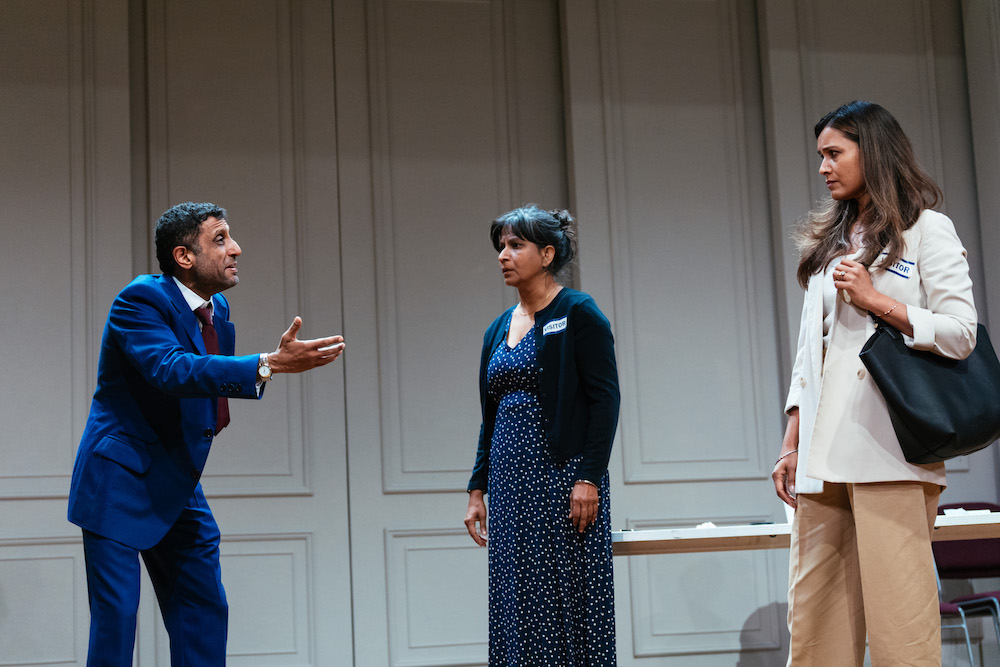
Adeel Akhtar, Thusitha Jayasundera and Shelley Conn. Copyright: Helen Murray

The Estate by Shann Sahota

Shann Sahota’s new play is a family drama, tying Southall to Westminster. Adeel Akhtar’s Angad Singh is a government minister, seizing the unexpected opportunity to stand for the party leadership. It quickly gets personal, and his relationship with his two sisters, Gyan (Thusitha Jayasundera) and Malicka (Shelley Conn), and with his late father, become political collateral. Sahota’s writing is very sharp, and she explores themes somewhat outside general discourse – the equivocal position of south Asians within the British establishment, misogyny in Sikh families, and what families have to hide when society expects them to justify their existence by being better than everyone else.

The performances are excellent too. Adeel Akhtar brings his vulnerability and the underlying menace he can produced, which is all the more disturbing for being so expected. He is thoroughly compelling, although it is a little hard to believe that someone quite as self-abasing has made it up the political ladder. His sisters are equally well-played. Thusitha Jayasundera superb, as always, as the motherly older sister ground down by Angad’s refusal to share his inheritance equally with his sisters, against their domineering father’s wishes. Shelley Conn is impressively combustible as the furious, younger sibling. The spiky atmosphere of a minister’s office is amusingly embodied by advisers Petra (Helena Wilson) and Isaac (Fode Simbo). The power of establishment is represented by the towering, besuited figure of Ralph (Humphrey Ker).

Daniel Raggett’s production is thoroughly enjoyable. He stages the play as a drawing room drama on a set that could double for a Noël Coward, complete with sliding wooden panels by Chloe Lamford. The Dorfman is set out, unusually, in a proscenium configuration, playing on the expectations of traditional theatre by using a familiar form to tell stories about ‘brown’ people, as Angad puts it. The Estate is a straight show – a family drama that plays out in a linear fashion, which brings limitations too, but within her own parameters Sahota has done an excellent job.

Inter Alia

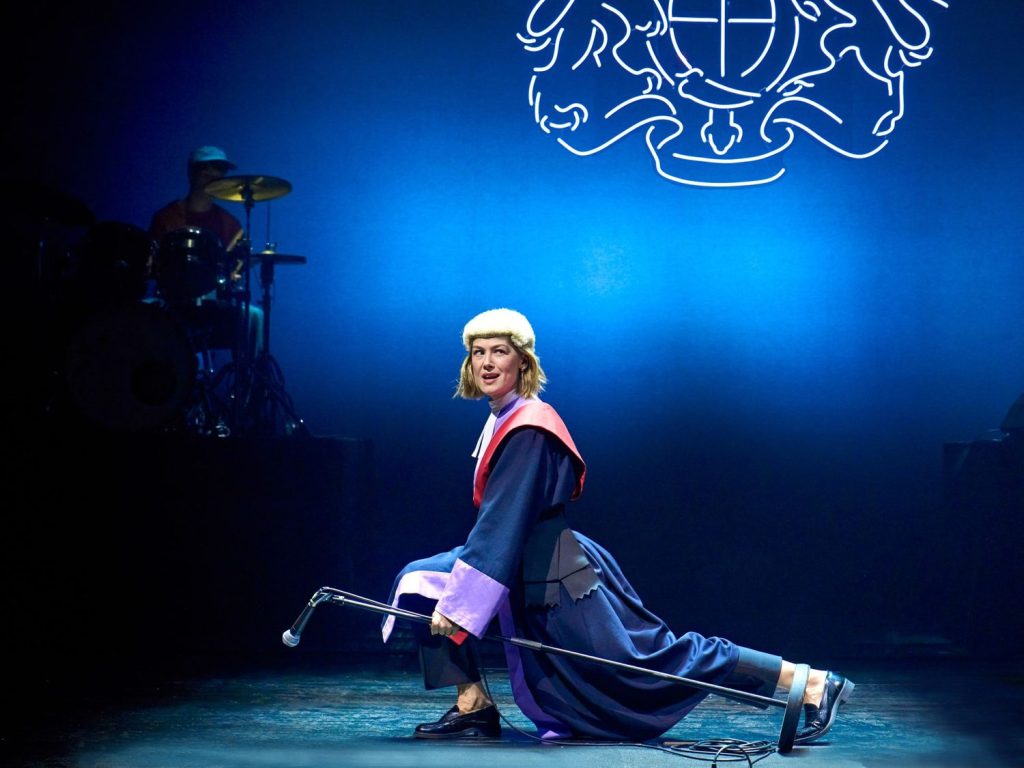
Rosamund Pike. Photo by Manuel Harlan.

Inter Alia by Suzie Miller – National Theatre: Lyttleton, London

Judge Jessica Parks (Rosamund Pike) juggles a high profile career as one of a small number of female justices with the usual pressures of family life – trying keep an eye on her son Harry (Jasper Talbot) while assuaging the ego of her barrister husband Michael (Jamie Glover), and living an upper middle class dinner party lifestyle with their friends. She is both a pioneering, feminist judge who stands up to the patriarchy and tries to do things differently, particularly in her treatment of rape victims, and a mother whose role is to shoulder the family’s emotional burdens. Suzie Miller’s new play is a follow up to her hit Prime Facie with Jodie Comer, and is set in the same high pressure legal world in which she once worked – but Inter Alia also has the plot line of a Greek drama. It asks how far a mother would go to protect her son.

Justin Martin’s production builds the tension through a physicality, to which Rosamund Pike is beautifully suited. She deploys the pin-point timing of a farce as she pulls coats, wigs and ironing boards from cupboards in her kitchen, powering through her life without a moment to spare, entertainingly depicted through Lucy Hind’s movement direction. She also struts her stuff on the bench, addressing the prosecution with a microphone stand and backing band consisting of her husband and son. The set, by Miriam Buether, hides the domestic behind the courtroom and, behind that a dark wood filled with towering trees into which her son disappears, both as a child and as an 18-year old – not a subtle metaphor, but a satisfying scenic effect.

The writing is direct, and sometimes too obvious. The nature of the dilemma Jessica faces cannot be revealed without spoilers, but it is clear what will happen from early on. Her principles are tested in way that is cruel and believable. However, it draws the audience into the terrible moral conundrum while effectively addressing issues of online toxicity, the manosphere and the unequal justice system. There are moments of particular power, not least when Michael, perfectly pitched by Glover, collapses in tears at his inability to communicate with his son.

The show’s focus on the terrible power of blood ties is cleverly enhanced by the physical absence of almost any actors beyond the family trio. Jessica’s best friend and her dinner party guests are present on stage, but only in our imaginations. It’s an ingenious technique and, when new actors do appear they are children who drive the disturbing plot developments. Inter Alia is a high quality production of an effective if limited play. It will undoubtedly be a big success because of Pike’s triumphant performance, owning holding our attention, and the show together from start to finish.

Einkvan

Photo ©Tristram Kenton

Einkvan by Jon Fosse – Coronet Theatre, London

Published at Plays International

Kjersti Horn’s production of Jon Fosse’s Einkvan, visiting The Coronet Theatre on tour, is a startlingly experimental piece of theatre. Horn is artistic director of the Det Norske Teatret in Oslo, and she is working with perhaps her country’s foremost writer in Fosse, winner of the 2023 Nobel Prize for Literature. He is unusual in being known equally for his novels and his plays, and the production provides a rare opportunity to see his work on the London stage. It does not disappoint, being both simultaneously dark and compassionate, with a staging that unpicks fundamental assumptions about the stage.

Both set and costumes are designed by Sven Haraldsson, but their main role is to obscure the action. The performers are concealed for the entire hour-long show behind an opaque plastic curtain which surrounds the stage. Only their faint dark outlines are visible as they perform the play. Instead, we see them through two large video screens hanging above the stage. The action is filmed with handheld cameras, with a single face shown in close-up on each screen. The video work, by Mads Sjøgård Pettersen, frames the audience’s perception of the entire show. The unseen camera operators are crucial performers, driving the mood with tighter, more disturbing close-ups as the tension slowly builds. Pettersen and Borgar Skjelstad, who together film the action, rightly take a bow at the end.

Einkvan is Norwegian for ‘uniqueness’. The play is performed in subtitle Norwegian by a cast of six, playing a mother, a father, a son and their apparent doppelgangers – characters who look similar although not identical but appear to live parallel lives. Only two characters ever appear at a time, one on each screen. The play consists of a series of first-hand accounts of meetings. Both the mothers and the fathers encounter the sons unexpectedly in the street, and are baffled when they refuse to reply to their enquiries about why it’s been so long since they met, or their invitations to supper.

These encounters use ritualised repetition, but are also naturalistic. Fosse strips language back to its hidden core, using no superfluous words. This directness, which seems very Norwegian to a UK audience, is also strangely moving. The failure of people to connect – parents with children, but also friends with one another and people with themselves – seems a highly apt social metaphor for the 21st century. It may be even more than that. At times it feels as though Fosse has traced the source of all our social ills, and is shining a spotlight on it.

The performers – Laila Goody and Marianne Krogh as the two mothers, Jon Bleiklie Devik and Per Schaanning as the fathers, Vetle Bergan and Preben Hodneland as the sons – are very effective at delivering performances in close-up, a technique which is undoubtedly much harder than they make it look. The performances to a camera on stage is reminiscent of Andrew Scott’s breakthrough stage appearance twenty years ago, filming himself on the Royal Court stage in ‘A Girl in a Car with a Man’, but this takes the challenge to a whole new level. Characters are constantly interacting with one another across cameras, and at one point even staging a fight in a bath. All the actors are compelling throughout. In fact, the whole play holds the audience rapt, a remarkable achievement for a show in which the actors only appear in the flesh at the curtain call. When they do, the dissonance is sharp as we emerge from what feels like a dream, suffused with sadness and loss, tenderness and a powerful endorsement of the need for humans to support and love one another.

Krapp’s Last Tape

Krapp’s Last Tape by Samuel Beckett – Barbican Theatre, London

With the pre-announcement of not one, but two future productions of Krapp’s Last Tape scheduled for the mid-2030s (when Sam West and Richard Dormer reach 69, the age of Beckett’s main character), it’s reasonable to ask what makes actors want to play this role so much. To some extent, it could be that recording the lines for younger Krapp at 39 represents a solid investment in future work. But there is also a clear sense that this is one of the big roles, a defining part, and one that suits unconventional actors better than classic leads. Stephen Rea is very much the kind of performer suited to Krapp. Actually 78, although he very much does not look it, Rea bring a hangdog comedy and a deep sadness to a role others have approached with more rage and less stillness. He also met Beckett himself, who attended rehearsals for the Royal Court’s 1976 production of ‘Endgame’ with Rea in the cast.

Vicky Featherstone’s production is designed by Jamie Vartan, who places Krapp’s desk in a square of light beyond which lies only darkness. A path of light leads from the desk to a door, beyond which lies smoke, the drink which Krapp retires periodically to consume, with a comic sloshing sound, and who knows what else. The set also aids the silent comedy at the heart of Beckett’s play, in the form of a ludicrously long desk drawer which Krapp pulls out further and further to reach his hidden bananas. Rea plays the sad clown very well, dialling down the slipping on banana skins but emphasising the shambling walk, which looks both exaggerated and weirdly familiar. The inevitable comedy of decay is inseparable from the sadness, loneliness and failure that haunts Krapp, in the form of his naive 39-year old self, still seeking and possibly expecting happiness. His writing, unlike that of Beckett, faded away despite his epiphany in a storm, which he can not longer bear to hear about.

Stephen Rea recorded the Krapp tapes in his 60s, but they sound like the work of a younger man. The weighted precision of his delivery makes very word matter a great deal, to Krapp and to Beckett as writers and to us as an audience. His performance is heartbreaking without ever needing to fully express the emotions we know he is feeling. This play, so slight, remains a work of remarkable power that can bind the entire audience of a large theatre into the unravelling existence of one man.

What If They Ate the Baby?

What If They Ate the Baby? by Xhloe and Natasha – Soho Theatre, London

Published at Plays International

New York performance duo Natasha Roland and Xhloe Rice are fringe stars, winners of Edinburgh Fringe First Awards for each of their three shows: What If the Rodeo Burned Down, A Letter to Lyndon B Johnson or God, and What If They Ate the Baby. Their success has brought them to bigger audiences at the Soho Theatre, where they are currently performing the latter two shows. Their distinctive performance style combines funny, experimental writing with surreal physical techniques, and is both highly entertaining and brilliantly strange. They pick at the tropes of American, as seen in film and music, until they become something both familiar and disturbing.

Natasha and Xhloe play suburban American housewives in 1950s dresses inhabiting an unsettling neon interior. A house call to return a casserole dish is all conventional social niceties, in which everything is unsaid. The script becomes a cycle of repetition, carrying shifting meanings as the never-ending visits plays out again and again. Physical gestures are stylised to the point of absurdity, and underlying social and sexual tensions spill to the surface. The two characters want one another, and intercut scenes show them indulging their fantasies. It is also clear that what they are doing is unacceptable in the society of the time, and there are also disturbing suggestions that normal is in fact very strange. There are bodies literally under the patio, and hints at dark deeds reveal a queer rebellion that is constantly bubbling to the surface.

What If They Ate the Baby plays with different sources which have set our expectations of the, brittle post-war suburban USA. The atmosphere is David Lynch crossed with Whatever Happened to Baby Jane?, as deep tensions play out between the pair as both insist everything is ok with their husbands, the neighbours and their homemaking lives. The show is very funny, and very tightly scripted and performed. The insistent repetition of actions, the meanings of which shift every time, is reminiscent of Forced Entertainment, while the combination of silliness and rigour is worthy of Sh!t Theatre. Natasha and Xhloe use music to great effect, from 1950s popular song ‘Music! Music! Music!’ to hip hop, such as ‘Punk Tactics’ by Joey Valence & Brae. Angelo Sagnelli’s work as Lighting Designer and Technical Manager is essential to creating a world with a handful of props. Finely coordinated interplay makes the show a mini-masterpiece of physical theatre. The pair are original, imaginative and highly entertaining performers, and the show is a sophisticated treat which fully justifies their growing reputation.