Dear Octopus

Photo by Marc Brenner.

Dear Octopus by Dodie Smith – National Theatre: Lyttleton, London

While ‘I Capture the Castle’ remains much-loved, Dodie Smith’s stage work is rarely revived. Emily Burns’ production at the Lyttleton demonstrates why, but also shows the value in revisiting a play that is very old-fashioned, but is also dominated by excellent parts for women. The play, set during a weekend reunion of the Randolph family for the golden wedding of Dora (Lindsay Duncan) and Charles (Malcolm Sinclair), is on many levels very uneventful. People resolve sometimes fraught relationships, with the shadow of the First World War, and the death of eldest son Peter, in the background, and the subsequent, unexplained death of Nora, one of twins. The play was written in 1938, but only the cccasional radio broadcasts hints at the war to come. It is all about personal relationships, and about social ones too – although, Smith was not really concerned with the power balance in an upper-middle class household enabled by servants.

Frankie Bradshaw’s set flies in huge chunks of wall and staircase to create hall, dining room and nursery in a house that is substantial in every respect. There are also real fire burning in grates, a very impressive effect. Also substantial is Lindsay Duncan’s performance as the matriarch, a proper tour-de-force. Early in the play, she is domineering, constantly ordering everyone off to do jobs for her, but her charm and sincerity is never in doubt either, lending full credibility to her reconciliation scenes with her daughter Cynthia, a troubled Bethan Cullinane. The cast is the show’s strongest suite, with a host of excellent performances. Malcolm Sinclair is tender, and very convincingly devoted to his wife, as Charles. However, here are no weak cast members. The ensemble relationship is what makes the show. The family relationships require a diagram to unpick, but Bessie Carter as ‘companion’ Fenny, Kate Fahy as reprobate elder aunty, Belle, Billy Howle as brother Nicholas and Amy Morgan as sister Margery are all highly watchable.

As this is Dodie Smith, there is also a clutch of clever and amusing children – three of them, played by a rotating cast of young actors. These are very demanding parts, requiring performers who can really mix it with the adults and, along with the size of the cast, presumably one of the reasons this play is rarely seen. Smith’s ability to charm, and to conjure up the kind of family which, despite their troubles, you want to be part of, is unrivalled. Her social milieu is a lost world, which dominated the inter-war stage and now often seems unrecognisable. However, ‘Dear Octopus’, despite being sometimes preachy on the subject, shows family dynamics in a way that still speaks to us. And Smith writes about women with a skill that is entirely natural, yet highly unusual. This is very much the kind of play that the National Theatre exists to re-examine – technically demanding, unfashionable, but with qualities missed before that we can now value .
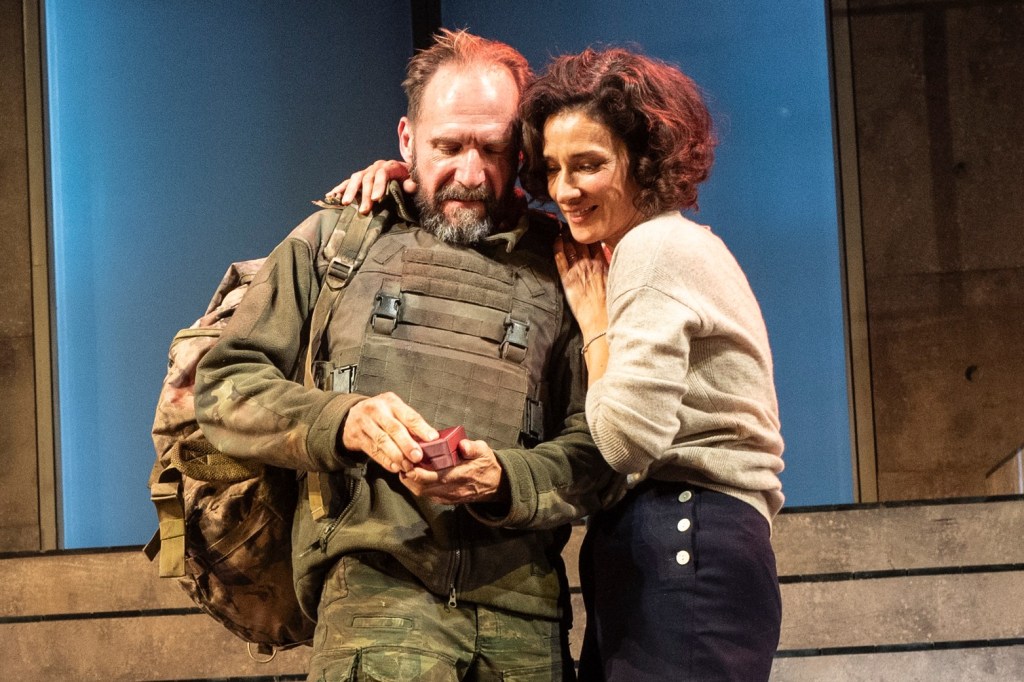
Macbeth

Ralph Fiennes and Indira Varma. Photo by Matt Humphrey.

Macbeth by William Shakespeare – Dock X, London

Simon Godwin’s production of Macbeth, starring Ralph Fiennes, touring non-traditional venues, is reminiscent of the Almeida’s double-header of Richard II and Coriolanus, staged in the pre-conversion Gainsborough Studios, with Fiennes playing both leads. That was in 2000, and Fiennes is still bringing in the crowds, burnishing his reputation as one of the great actors of his generation. This record includes, but does not depend upon, his Shakespearian work, with Mark Antony in both Antony & Cleopatra and Julius Caesar, Richard III, and Coriolanus (in the 2011 film) all performances of the highest calibre. His Macbeth is another major achievement, a portrayal that offers a persuasive account of a man veering rapidly into evil.

The show’s London venue is the Surrey Quays warehouse, Dock X, which provides a very successful auditorium with a large capacity, but excellent sight lines all the way to the back row. There is a gesture at immersiveness, with the audience entering through a miniature war zone with burned out car, but the production is surprisingly traditional in the right ways. Frankie Bradshaw’s concrete stepped set is simple but entirely effective, adapting with minimal fuss while creating the impression of Scotland as a militarised landscape. Soldiers wear battle fatigues so, when different costumes appear, they make a big visual impression: Lady Macbeth in a vivid green gown, Macbeth in a purple robe. The witches hover between ordinary and scary, three young women in dungarees and puffa jackets who might be hanging around on any street corner – a strong approach that normalises the extreme.

Fiennes himself is evidently an efficient soldier partly because he is single-minded to the point of lacking social skills. He is awkward and abrupt in the opening scenes, while Indira Varma plays Lady Macbeth as an influencer, who knows how to present people in their best light. It makes sense that these two are together, and that Lady Macbeth is in control. She can shape and direct her husband to make the most of his opportunities. But the production makes the tipping point clear, when her plans start to spin out of control. As soon as she tells her husband he is ‘lily-livered’, having declared that Duncan’s murder would make him a man, their pact is broken. After this betrayal, Macbeth is unleashed to live his worst life.

Godwin’s production is based around notably clear verse speaking, that makes the text sound fresh in a way that only the best productions can pull off. Fiennes leads the way in this, making all the great moments, especially the ‘brief candle’ speech, revelations. He is mesmerising, the best and most believable Macbeth I’ve had the good fortune to see, and Indira Varma is a match for his performance, making Lady Macbeth a great deal more comprehensible than is often the case, a woman who will give all in exchange for the rewards she confidently anticipates, only to disastrously miscalculated the cost.

The production also gives the wider cast weight and presence. Making the unusual, but understandable, decision to cut the Porter scene pays off through enhanced narrative drive. Another of Godwin’s achievements is to make the Macduff/Malcolm scene in England, often dismissed as an aberration, actually work. Malcolm (Ewan Black) is genuinely wrestling with self-doubt about his fitness to rule, not playing games, but it is swept away by the terrible revelation that Macduff’s (Ben Turner) family has been murdered. This moment is centre of the play’s second half, balanced against the murder of Duncan in the first, and showing how it can be played makes it complete.

A strong cast also features Steffan Rhodri as a poetically Welsh Macduff, Rebecca Scroggs as a justifiably furious Lady Macduff, and Jake Neads and Michael Hodgson as the two murderers. The ungainly presence of the latter, is used cleverly as the witches (Lucy Mangan, Daniella Fiamanya and Lola Shalam) channel their visions of the future through Hodgson’s twitching body. Christopher Shutt’s sound design creates an eerie backdrop to the action, with hints of The Exorcist that make this production not so much bewitched, as possessed. The combination of characters destroyed by their own personalities, excitingly portrayed by Fiennes and Varma, and a war-ravaged setting in which people are not what they seem, makes this a production to savour.