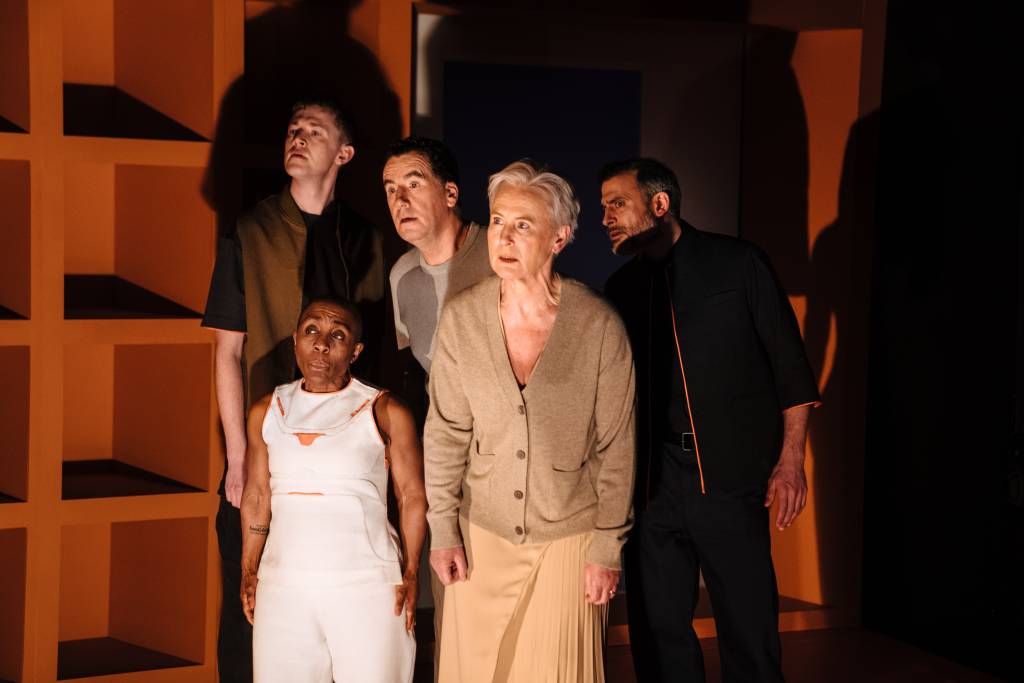
More Life

Photo (c) Helen Murray.

More Life by Lauren Mooney and James Yeatman – Royal Court Theatre, London

With the tech-enabled delusions of the super rich now the central driving force in global politics, there could not be a more opportune moment to examine the reality behind fantasy bundled as product. Lauren Mooney and James Yeatman, who together are Kandinsky, have devised a chilling and remarkable play for our times. ‘More Life’ imagines what it would actually be like to live forever, and the unequivocal conclusion is… absolutely terrible. Corporate scientist Victor (Marc Elliott) is working to impact the consciousness of dead people, digitally stored half a century earlier, into living bodies – bringing the dead back to life.  After many failed experiments, with people ‘turned off’ when they fail to react positively to the discovery, firstly, that they have died, and then that they have been brought back to life, he succeeds with Bridget, whose new body is played by Alison Halstead. She also appears in her original form as a ghost, played by a Danusia Samal, observing her inexplicable resurrection

‘More Life’ focuses on the emotional impact on Bridget, and her husband (Tim McMullan) and his second wife (Helen Schlesinger), of meeting someone who died 50 years ago. Mooney and Yeatman’s writing teases apart the sheer horror of living in a world where you no longer have a place, and of having your life ripped from its moorings. This is not an advert for AI. A quality cast delivers focused, persuasive performances: McMullan’s blank features crumbling under pressure, Schlesinger’s amenability stretched and torn, and Halstead’s understated performance carrying an emotional heft that builds and builds. Elliott is quixotically driven, while Lewis Mackinnon’s fellow scientist is a counterweight with a conscience.

‘More Life’ is partly an updating of ‘Frankenstein’ – it is bookended with the 1802 electrification of a corpse that inspired Mary Shelley – and partly an echo of Caryl Churchill’s hyper-prescient play ‘A Number’, but very distinctly its own self. Kandinsky’s style is low-key and highly inventive, honed over the course of several productions at the New Diorama Theatre, under now-Royal Court director David Byrne. They present complete, enthralling theatre. The orange cubicles of Shankho Chaudhuri’s set conjure a distant future without cliché; lighting from Ryan Joseph Stafford, sound and music from Zac Gvirtman, and sound from Dan Balfour delineate constantly shifting time periods with complete clarity. James Yeatman’s direction takes an apparently setting and uses the cast in multiple ways, as chorus, narrators, physical presence, and participants in a way that appears seamless, and is very difficult to achieve.

There is an entirely unexpected, devastating scene in which the whole cast sings David Byrne’s ‘Glass, Concrete and Stone’ – a sly tribute to the man who brought Kandinsky to the Royal Court perhaps, and a song of social disconnection. The lyric “Everything’s possible when you’re an animal” takes new on new poignancy in the context of the directions we are choosing to take as a species, or that are being chosen for us. ‘More Life’ is an intelligent and troubling critique, with a fabulous cast – a production enthrals from start to finish. It exemplifies the role of drama as a social mirror which shows us the things we would prefer to ignore.
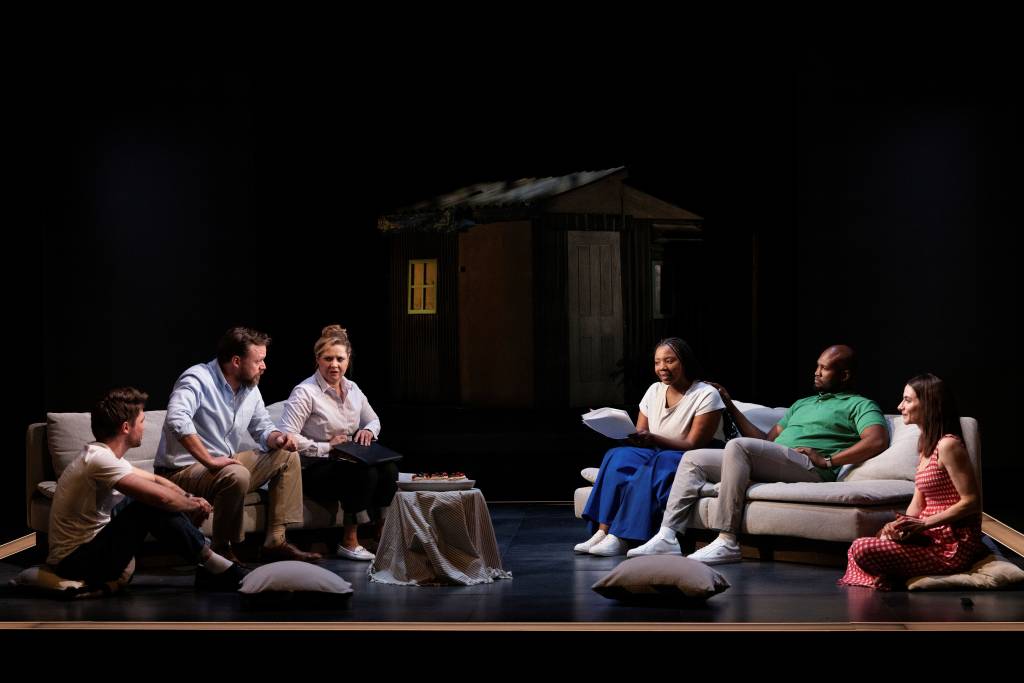
A Good House

Photo by Camilla Greenwell

A Good House by Amy Jephta – Royal Court Theatre, London

Published at Plays International

The set for A Good House starts empty, a bare stage surrounded by a strip of light which looks like an arena designed for combat. The set, by Ultz, transforms into a series of interiors over the course of the evening, as the living rooms of three different homes. Each scene is changed by the cast as they build their own interiors, carefully constructed to build or hide racial and social identity. These houses, it turns out, are battlegrounds.

Amy Jeptha’s tense, funny satire is set on a new-build estate called Stillwater, somewhere in South Africa. In an echo of Harold Pinter’s ‘A Slight Ache’, a mute but menacing presence is enough to explode the conventions holding a fragile social consensus together. With Pinter it was a matchseller in the street outside; in ‘A Good House’ it is a shack, erected overnight on waste ground by unseen hands. It is visible from the sitting room belonging to young couple Chris (Scott Sparrow) and Jess (Robyn Rainsford), and seems to them to jeopardise their entire way of life. Attempts to form a ‘neighbourhood watch’ to deal with the perceived threat strips the covers off everyone’s assumptions about race, threat and social status – and about their most intimate relationships.

Jeptha’s writing is highly skilled and very funny, even as it lays middle-class South African society open. The young couple and the shack become a catalyst for an excruciatingly polite war of words between white couple Andrew (Kair Luke Brummer) and Lynette (Olivia Darnley) and black couple Bonolo (Mimî M Khayisa) and Sihle (Sifiso Mazibuko). The cast give highly entertainingly, finely calibrated performances. Brummer is hilariously tense as he tries to avoid saying the wrong thing, while sounding like a racist every time he opens his mouth. Darnley is equally amusing as a social manipulator not nearly as clever as she imagines. Jeptha mercilessly caricatures white hypocrisy, but also insecurity: Rainsford’s Jess quivers with the effort of maintaining her place on the social ladder, and Sparrow, as her partner Chris, descends into meltdown over his perceived social inferiority. 

However, the focus of the play in on Bonolo and Sihle. A financially successful black couple, they find themselves forced to choose between defending middle-class privilege, or the rights of the unseen shack dwellers. This opens up rifts in their relationship. Bonolo openly questions Andrew and Lynette’s motives, while besuited executive Sihle tries to keep the peace, and not make trouble: yet it is Sihle who grew up in poverty while, as he puts it, the activist Bonolo was always ‘bouji as fuck’. Khayisa and Mazibuko give excellent performances as a couple who love one another, but whose personal lives cannot be separated from the political choices engulfing them. There are a couple of remarkable cut-away scenes, as the tensely polite living room chat pauses and the pair give way to their real feelings about their neighbours, rolling around on the carpet helpless with laughter.

‘A Good House’ is a quality drama, directed with vision and control by Nancy Medina. Jeptha’s writing is honed and precise, exposing the tensions of a society where everything that matters goes unsaid. Her drama involves an intruder disrupting a supposedly cosy social setting, a classic theatrical scenario, but the play feels right up to the minute. The cosiness is superficial, and the self-interest entirely transparent, with characters such as Andrew principally concerned about ‘optics’. Everything and everybody feels closer to the edge than ever before, but ‘A Good House’ is also riotously funny. It is a fine production on every level.

The Legends of Them

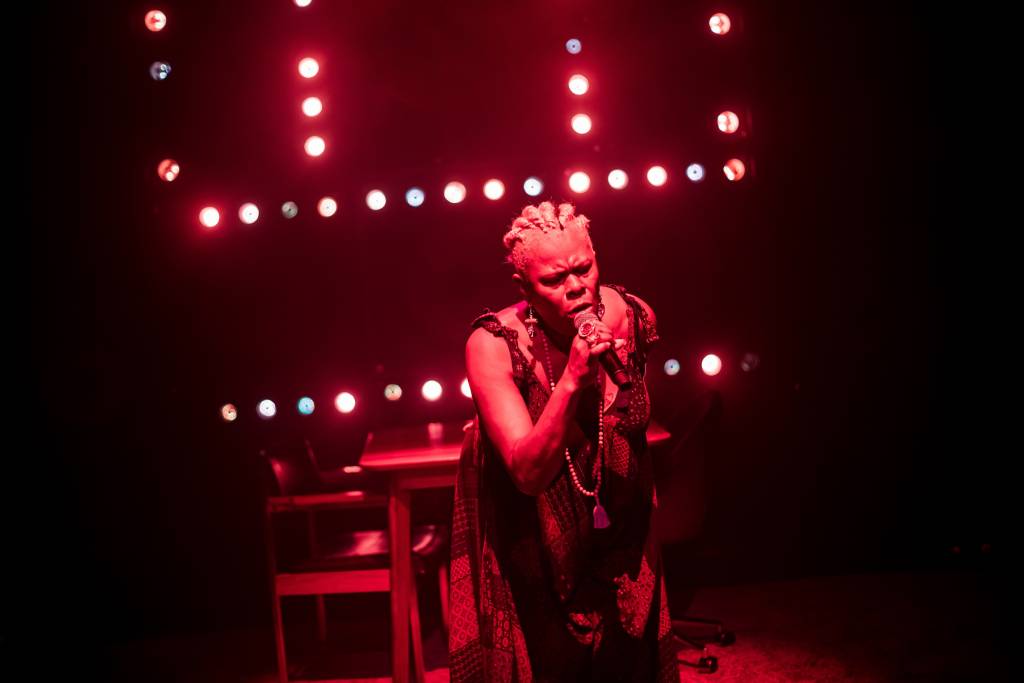
Sutara Gayle. Photo by Harry Elletson

The Legends of Them by Sutara Gayle AKA Lorna Gee – Royal Court Theatre, London

Published at Plays International

Sutara Gayle has had quite the life. Her one woman show expresses remarkable experiences through powerful, focused theatre. Gayle, born in Brixton, is a musician, singer, DJ and British reggae pioneer. She has lived in New York, opened for Shabba Ranks, spent time in Holloway Prison, and changed her name during a spiritual retreat in India. Her brother Mooji is a Hindu guru. Her sister Cherry’s shooting by police triggered the 1985 Brixton Riots. The Legends of Them combines music, film (projections by Tyler Forward and Daniel Batters) and a swirling array of characters, all played by Gayle, into a journey of awakening and discovery.

Gayle is also an actor, with a long career on stage and in film and television. This is the one aspect of her life she does not mention, and there is no need because it is obvious. Legends of Them is a performance tour de force. Gayle plays a long list of people she meets across eras and places – from Linton Kwesi Johnson to school friends, taxi drivers, dominoes players and policemen – who pass across the stage and through her life in sometimes dream-like fragments. She conveys each scene with minimum fuss and the maximum skill, using a vocal intonation, a tilt of the head, or a flick of the wrist. Gayle makes it look easy, but her performance is a masterclass in storytelling, from which other, far less subtle one-person shows could learn at lot.

The Legends of Them conjures up lost eras and events, knotting them loosely together as the bigger picture emerges, piece by piece. Although Gayle is the connecting presence, the show is explicitly about four legends in her life: her mother Euphemia, sister Cherry, brother Mooji, and the 17th century Jamaican freedom fighter, Nanny of the Maroons. Euphemia, who came to Brixton from Jamaica, brought up eight children, and pounded out living from her sewing machine. Cherry, who died in 2011, found herself thrust into the national news in disastrous circumstances, which she handled with great dignity. Her older brother Mooji is her guiding light, imparting Buddhist wisdom that helps Gayle see beyond tragedy and turmoil in her life. And Nanny is part of a suppressed history of resistance to empire, fighting the 17th century British occupation of Jamaica, and giving identity to those fighting the same battles today.

She threads together their stories expertly, never over-explaining but giving the audience enough to understand what is happening and why it matters. It is a high-wire act completed with supreme confidence, co-created with director Jo McInnes and dramaturg Nina Lyndon. Then there is the music. Gayle is a highly versatile writer and singer, and she sings at key moments. The set is dominated by a vast speaker stack covered in disco lights, which flash a backdrop to the action. Gayle strides on stage and immediately shows us what she’s capable of with her trademark reggae MC delivery, immediately raising excitement levels to eleven. Having established her formidable skills, she uses her full range, singing charming numbers influenced by pop and gospel, written with composer and musical director Christella Litras. She expresses herself directly and truthfully through music, which is clearly an essential part of her existence, and drives the show.

Gayle, with her collaborators, conjures an evening which is subtle, carefully woven, and at times exhilarating theatre, but it is more than that. The Legends of Them is a big success for the still-relatively-new Brixton House theatre, where it was first performed before moving the Royal Court – taking a show which is Brixton through and through into Belgravia. But it is more than a theatre production. Sutara Gayle’s life tracks the Black experience in Britain, through the terrible personal impact of racism and sexism, to personal fulfilment and self-knowledge. She is a local heroine, but her voice reaches far beyond SW9. She speaks from long, tough experience, and The Legends of Them sends a message which is proud, loud and clear.