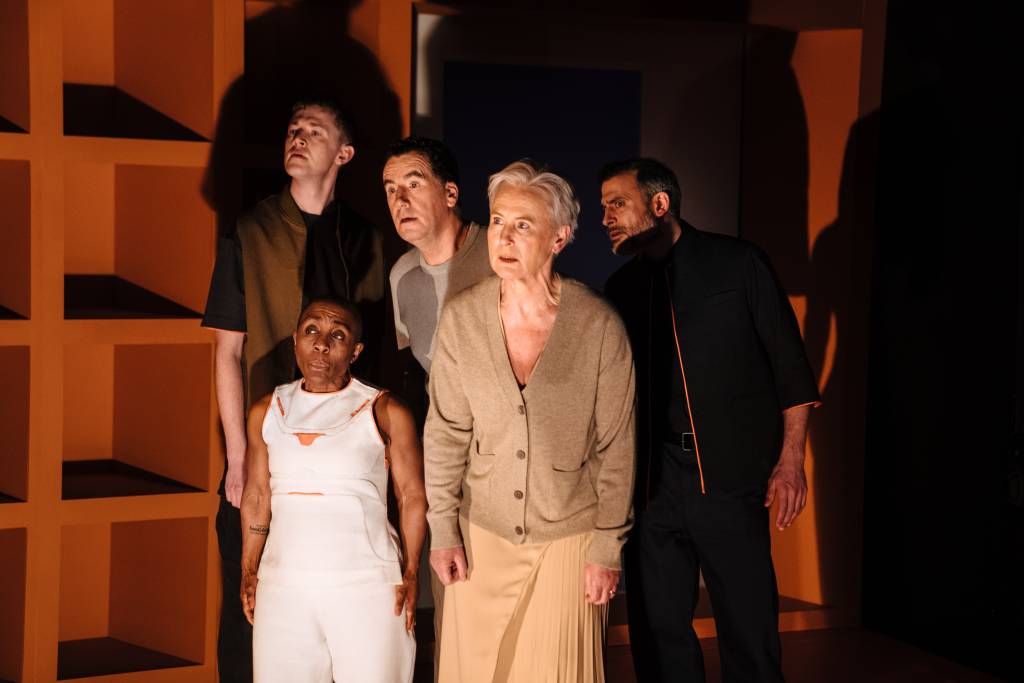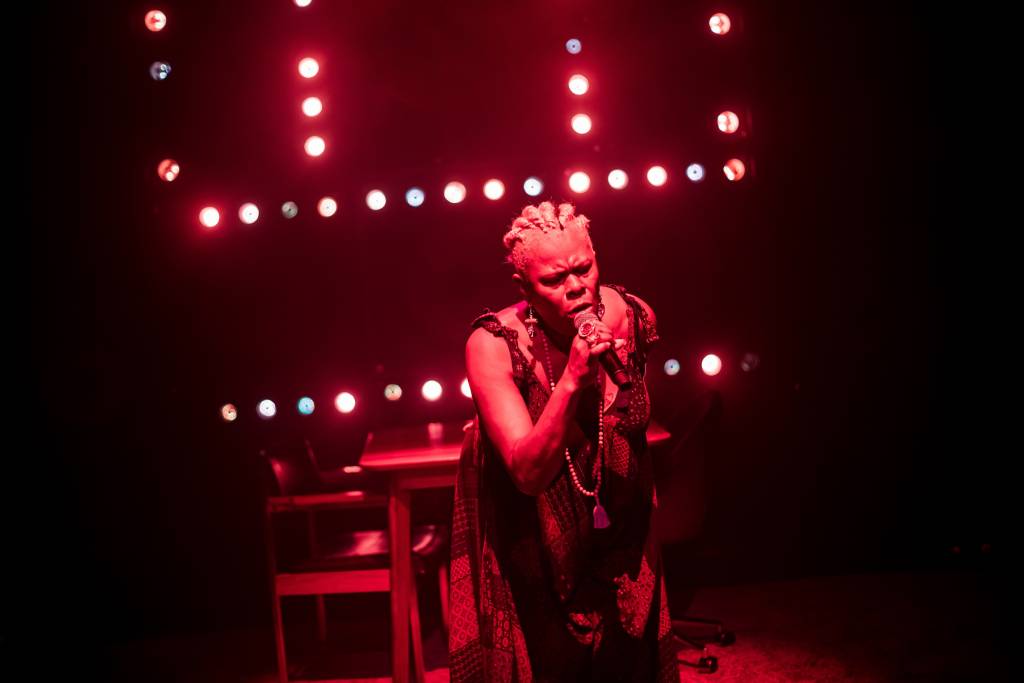
Photo by Rüdiger Glatz.
Man is Man by Manfred Karge – Royal Court Theatre, London
Tilda Swinton’s return to the Royal Court would be a serious theatrical event, even if she weren’t appearing in the play she performed on her last stage appearance, also at the Royal Court in 1988. Since then, she has become a film star of remarkable character and artistic credibility, building on her early fringe work and her artistic relationship with Derek Jarman to craft an entirely individual career. There is no doubting her star quality on screen, but what is it like to return to live theatre after a 38 year absence? It’s hard to think of another actor who has taken on a challenge quite like this.
Manfred Karge’s play is an adaptation of Bertolt Brecht’s Mann ist Mann, and is a one woman show – but the woman in question spend most of the night impersonating a man. Swinton plays Ella Gericke, whose husband Max is a crane operator in a 1930s German city. When he dies of cancer, a burial mistake means she can assume his identity and live as a man, experiencing the wild turmoil of the 20th century in Germany. In a string vest and Y-fronts, face crusted in white, Swinton roams her apartment telling us her story. The play has undergone several updates since its première, not least when the Berlin Wall a year later. Now, it continues to the present day (although this takes Ella out of any realistic timeline), to the point where the megaphones are out again and the menacing rise of AfD threatens to bring events full circle.
Directed by Stephen Unwin, who helmed the 1988 production too, this is a real reunion and, it has to be said, something of a throwback. It feel as though we are watching alternative theatre from a different era, which is indeed the case. It is easy to see the influence Man Is Man must have had first time around, but repeating the show does not have the same effect. The moral ambiguity of Ella, who goes with the flow and does what she needs to survive, including becoming an SA prison guard during the war, is unsettling and politically challenging both then and now. The gender fluidity and the deeply unglamorous costumes and setting (by the original designer Bunny Christie) were foundational for much subsequent fringe work. The use of an onstage microphone to deliver speeches, and flinging a pot of red paint over the back wall of the set, are examples techniques that were clearly ahead of their time – and that we have now seen many times. Although the motivation of a revival, to highlight disturbing political developments in Germany, is very laudable but the production is more of an archival exercise, fascinating to students of theatre but much less urgent than it should be.
The other issue is, unfortunately, Tilda Swinton herself. She is fully committed and invested in a lengthy solo performance, but she does have weight and stage presence to fill the auditorium. Vocally, she is underpowered and, unusually, would have benefited from being mic-ed up for the back row. Her performance also lacks variation, undermining the intense drama of the events she’s describing. She uses a South London-esque whine throughout, which is quite a transformation but does not seems to leave her room to pitch or vary her performance. As a result, it lacks pacing, and has neither peaks or troughs. The audience is always waiting for the moment that will grab them and draw them into the play, but if never quite happens. the result is an evening that fails to match up to its considerable promise.