Photo Marco Anelli
Balkan Erotic Epic by Marina Abramović – Kraftzentrale, Landschaftspark Duisburg-Nord
Published at Plays International.
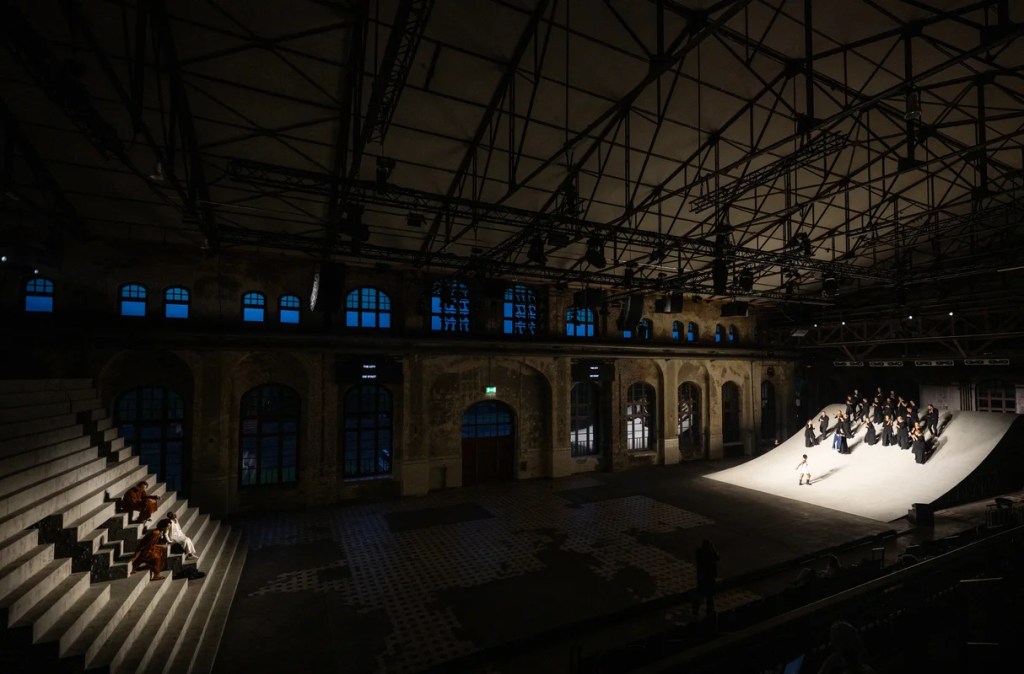
The venues for the Ruhrtrienniale (which is, confusingly, an annual festival) are like no others. The region’s heavy industrial past has left a legacy of vast halls, chimneys, blast furnaces, gantries and bunkers which, at Landschaftspark Duisburg-Nord in particular, are imaginatively repurposed to stunning effect. Thus, Marina Abramović’s Balkan Erotic Epic is staged in the 170m-long brick Kraftzentrale building, a former power plant for the surrounding iron works. The work fills the vast space with ease. Directed by Abramović, with a cast of 70 performers and a large production team, it completely ignores supposed boundaries between performance art, installation, film, music, dance and theatre, creating a full immersive parallel reality over the space of four hours.
This is the German première for a production co-commissioned by the Ruhrtrienniale festival with a number of other institutions, including Factory International, Manchester and Park Avenue Armory, New York, and has been playing around the world since 2025. The audience gathers in front of a 30m-high black curtain as a woman enters leading a funeral procession, followed by a Balkan band. She is Abramović’s mother Danica, played by Maria Stamenković Herranz, and this is the funeral procession for Yugoslav dictator Josep Broz Tito, whose death in 1980 signalled the beginning of the end for his country. The procession leads us into a space with thirteen separate stages, on which performances take place simultaneously. The audience can move between stages and experience the evening in any way they choose, including leaving temporarily for a drink. The performances combine endurance and skill with impressive, moving, funny and confrontational elements often combining in one setting.
The central funeral thread moves between two of the stages, including a carefully recreated 1970s Yugoslav café, where women dressed identically in black sit virtually motionless for a good two hours, occasionally lifting a hand to smoke, before finally rising to stand in turn on Tito’s coffin while the national anthem plays. The final woman stamps furiously on the lid. All this is overseen by Danica Abramović, whose stony face gradually softens as the evening progresses. Marina’s mother, a senior party official, was notoriously dictatorial and this show is undoubtedly her daughter’s attempt to come to terms with her upbringing. She brings the rituals of her home region to bear, focusing on the power of women as expressed through Balkan traditions to influence the weather and the land, and to bring fruitfulness to crops and couples.
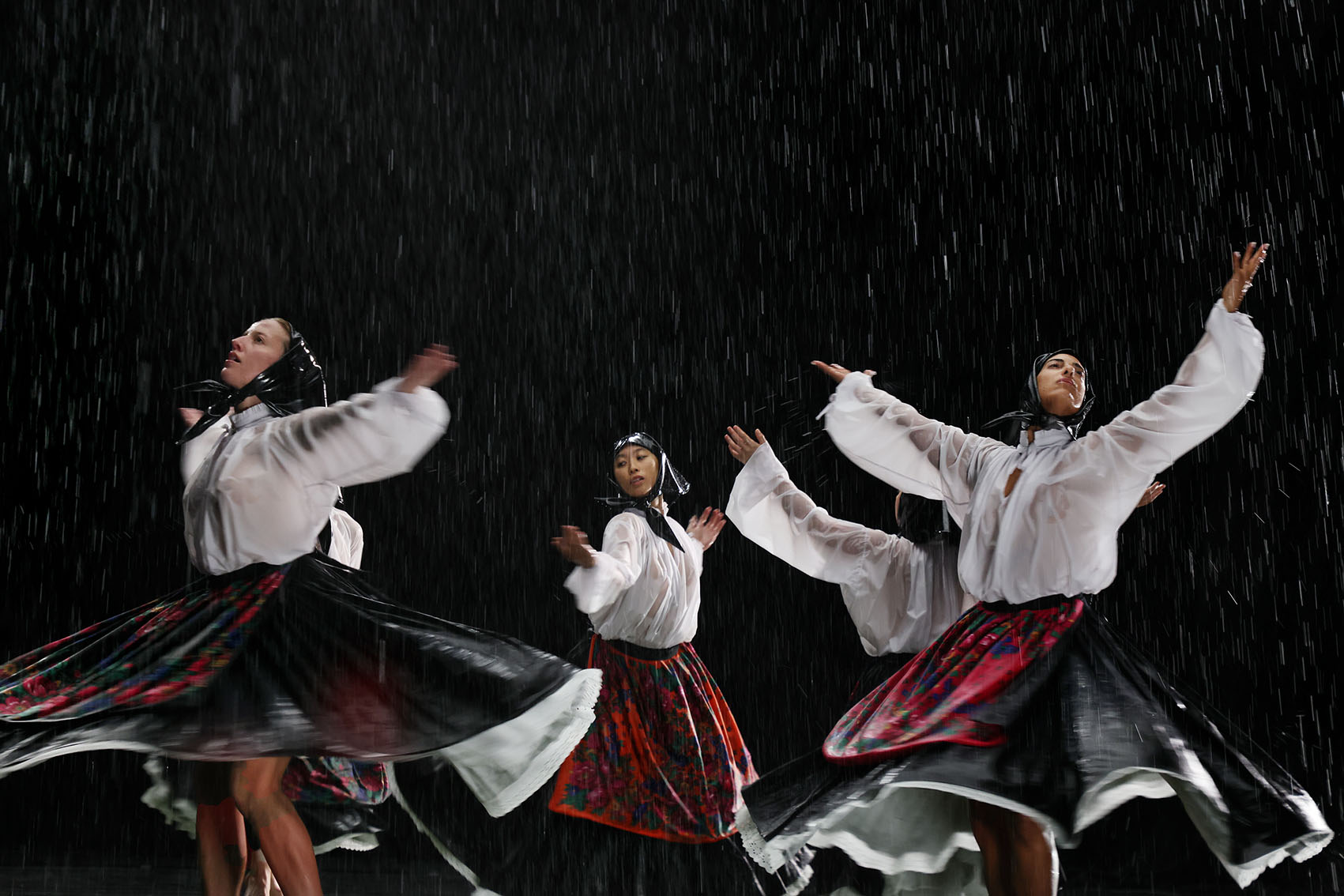
On stages scattered around the huge space, these rituals are performed. The many scenarios include a graveyard in which naked men and women copulate with skeletons, moving in extreme slow motion, to awaken the earth; a violent knife dance, in which women assume the male role in a household lacking men; a dance in which five women in traditional costume bare their vulvas to the sky to banish the rain; three naked men humping the earth to bring fertility; and a lecture from a ‘scientist’ played by Elke Lutyen, who informed us about various Balkan sexual rituals, surrounded by giant phalluses.
The most moving and arresting peformance is, perhaps, the black wedding – a ceremony in which a young man is joined with a woman after death. His ‘widow’ dresses his naked corpse, the weight and difficulty of moving a body evident in every tender gesture. Meanwhile, a troupe dressed in black perform intense, mutually supportive dances. A man carries two women, one on each shoulder, clasped around him. The quality of the choreography, by Blenard Azizaj, is outstanding.
The show also has a Durational Performance Director, Billy Zhao, whose work is crucial to the evening. There is an element of endurance for the audience, as they watch repeated, ritualistic actions, but the entertainment value makes the show pass remarkably quickly. However, the commitment of the performers, who are too numerous to name, is astonishing. A woman, for instance, dressed in red and looking like Marina herself, poses on a high platform beside a coffin, moving roughly every 40 minutes, in a performance of pure discipline. The vulva-baring women dance non-stop throughout the full four hours, a feat of remarkable endurance. Marina Abramović describes Balkan Erotic Epic as her most ambitious work, and it is certainly her most complex and collaborative. It is hard to imagine anyone attempting anything comparable, and the result is an experience which those lucky enough to attend will not forget. Her originality and vision are indisputable, and so is her ability as an artist, and now as a director, to bring performances and audiences with her, teaching us to speak her language.