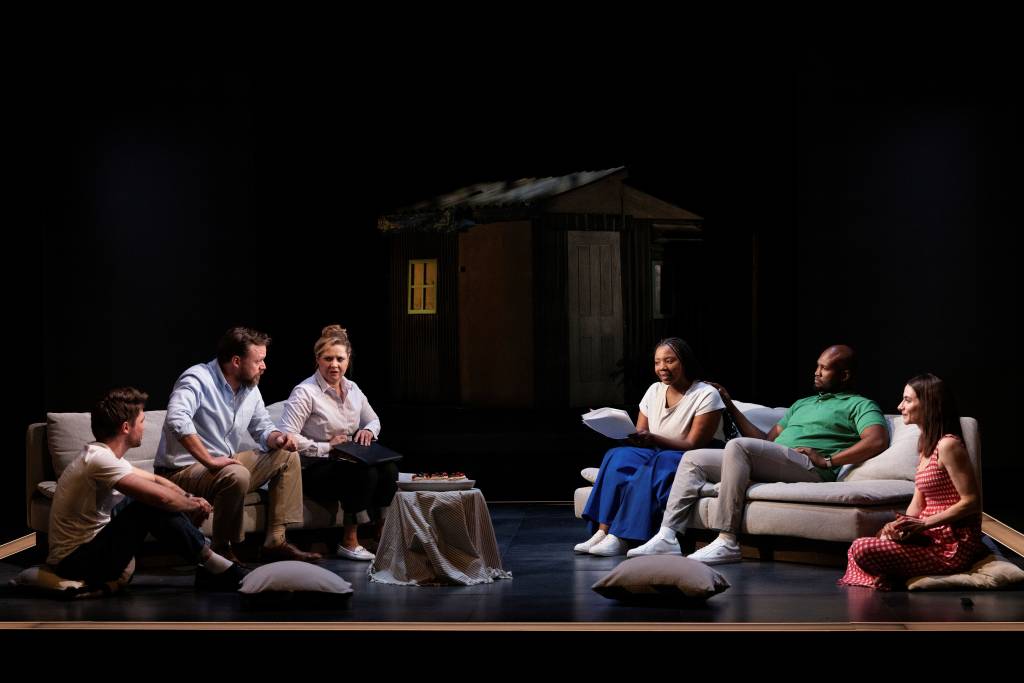
Photo by Camilla Greenwell
A Good House by Amy Jephta – Royal Court Theatre, London
Published at Plays International
The set for A Good House starts empty, a bare stage surrounded by a strip of light which looks like an arena designed for combat. The set, by Ultz, transforms into a series of interiors over the course of the evening, as the living rooms of three different homes. Each scene is changed by the cast as they build their own interiors, carefully constructed to build or hide racial and social identity. These houses, it turns out, are battlegrounds.
Amy Jeptha’s tense, funny satire is set on a new-build estate called Stillwater, somewhere in South Africa. In an echo of Harold Pinter’s ‘A Slight Ache’, a mute but menacing presence is enough to explode the conventions holding a fragile social consensus together. With Pinter it was a matchseller in the street outside; in ‘A Good House’ it is a shack, erected overnight on waste ground by unseen hands. It is visible from the sitting room belonging to young couple Chris (Scott Sparrow) and Jess (Robyn Rainsford), and seems to them to jeopardise their entire way of life. Attempts to form a ‘neighbourhood watch’ to deal with the perceived threat strips the covers off everyone’s assumptions about race, threat and social status – and about their most intimate relationships.
Jeptha’s writing is highly skilled and very funny, even as it lays middle-class South African society open. The young couple and the shack become a catalyst for an excruciatingly polite war of words between white couple Andrew (Kair Luke Brummer) and Lynette (Olivia Darnley) and black couple Bonolo (Mimî M Khayisa) and Sihle (Sifiso Mazibuko). The cast give highly entertainingly, finely calibrated performances. Brummer is hilariously tense as he tries to avoid saying the wrong thing, while sounding like a racist every time he opens his mouth. Darnley is equally amusing as a social manipulator not nearly as clever as she imagines. Jeptha mercilessly caricatures white hypocrisy, but also insecurity: Rainsford’s Jess quivers with the effort of maintaining her place on the social ladder, and Sparrow, as her partner Chris, descends into meltdown over his perceived social inferiority.
However, the focus of the play in on Bonolo and Sihle. A financially successful black couple, they find themselves forced to choose between defending middle-class privilege, or the rights of the unseen shack dwellers. This opens up rifts in their relationship. Bonolo openly questions Andrew and Lynette’s motives, while besuited executive Sihle tries to keep the peace, and not make trouble: yet it is Sihle who grew up in poverty while, as he puts it, the activist Bonolo was always ‘bouji as fuck’. Khayisa and Mazibuko give excellent performances as a couple who love one another, but whose personal lives cannot be separated from the political choices engulfing them. There are a couple of remarkable cut-away scenes, as the tensely polite living room chat pauses and the pair give way to their real feelings about their neighbours, rolling around on the carpet helpless with laughter.
‘A Good House’ is a quality drama, directed with vision and control by Nancy Medina. Jeptha’s writing is honed and precise, exposing the tensions of a society where everything that matters goes unsaid. Her drama involves an intruder disrupting a supposedly cosy social setting, a classic theatrical scenario, but the play feels right up to the minute. The cosiness is superficial, and the self-interest entirely transparent, with characters such as Andrew principally concerned about ‘optics’. Everything and everybody feels closer to the edge than ever before, but ‘A Good House’ is also riotously funny. It is a fine production on every level.
 Tom Bolton